Dana borrowed her father’s pressure washer for three springs in a row before she finally bought her own. The borrowed machine was a bargain-brand unit that started on the fifth pull, shook like a paint mixer, and left a wand-shaped trench in the lawn every time the hose kinked. When it finally quit mid-driveway, she started reading about the brands that keep showing up in repair shops for the right reasons rather than the wrong ones. That is how she landed on an Ariens pressure washer, a machine built by a company that has been making outdoor power equipment since the 1930s. Two seasons later, her summary was simple: it starts, it cleans, and it does not make her dread the job.
That experience is not unusual. Ariens is one of those names people recognize from snow blowers and zero-turn mowers, and when they discover the brand also builds pressure washers, the first question is always the same. Is it actually good, or is it just a familiar label on an ordinary machine? The honest answer is that an Ariens pressure washer sits in a specific lane. It is not the cheapest option on the shelf, and it is not trying to be. It is built for people who want a gas machine with a real engine, a durable frame, and safety features that keep it running season after season. This guide walks through the lineup, the numbers that matter, the engines and pumps behind the paint, and the mistakes that turn a good purchase into a frustrating one.
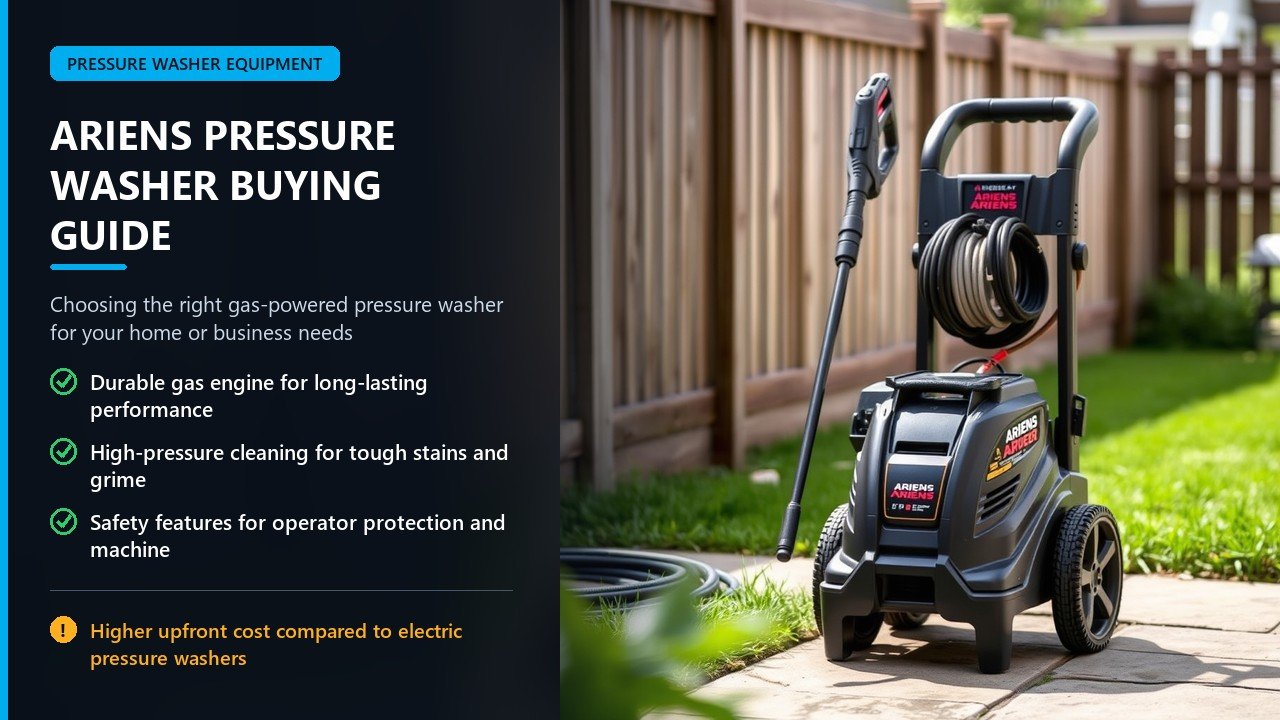
What an Ariens Pressure Washer Really Is
Ariens Company is an American manufacturer based in Brillion, Wisconsin, and it has been building outdoor power equipment since 1933. The company is best known for snow blowers, but it also owns Gravely, a commercial turf and grounds-care brand, and it sells a range of pressure washers under its own name. The official Ariens website lists these machines in consumer and prosumer tiers, and you can usually find them at independent power equipment dealers rather than the big box stores.
That dealer channel matters more than it sounds. When you buy an Ariens pressure washer from a dealer, you typically get a machine that was assembled, tested, and is supported by a shop that services gas engines every day. For a homeowner who does not want to learn small-engine repair, that support is worth as much as a few hundred points of PSI.
Where the brand sits. Ariens is not competing with the $99 electric washers in the entry aisle, and it is not chasing $2,000 hot-water commercial skids. It occupies the middle and upper-middle: reliable gas machines from roughly 2,700 PSI up into the 4,000-plus PSI range, using engines it builds or sources from trusted names and pumps from established manufacturers. That is a sensible place to be, because it is exactly the range most homeowners and small contractors actually need.
What you are paying for. Four things show up again and again in reviews and owner reports: a strong engine, a rugged frame with real wheels, safety features that protect the machine, and a three-year warranty that many buyers can extend with registration. Those are not marketing bullet points; they are the parts that decide whether the machine is still working in year six.
Gas Versus Electric in the Ariens Lineup
Most people shopping for an Ariens pressure washer are looking at gas models, because that is where the brand’s reputation and volume live. Still, Ariens has offered electric units too, and the two categories serve genuinely different owners. Understanding the split is the first real decision you make.
Gas machines are the core. Gas pressure washers deliver more PSI and, just as importantly, more GPM, which is the flow that actually carries dirt off a surface. They run anywhere without an outlet, which makes them ideal for long driveways, fences, and rural property where the nearest plug is far away. The trade-offs are the ones every gas engine brings: fuel to store, oil to change, a pull cord or starter to manage, and a little seasonal maintenance.
Electric machines are the convenience lane. An electric pressure washer starts with a switch, runs quieter, needs almost no maintenance, and is lighter. Its limits are power and reach, because the cord ties you to an outlet and the motor produces modest flow. For a city lot with a short driveway and a couple of cars, electric is often the smarter buy. For a large property and heavy spring cleanup, gas wins every time. If you are weighing this choice in general and not just within Ariens, our comparison of gas, electric, and hot-water 4000 PSI machines lays out the full picture.
| Aspect | Gas Ariens Machines | Electric Ariens Machines |
|---|---|---|
| Typical pressure | 2,700 to 4,400 PSI | About 1,700 to 3,400 PSI |
| Typical flow | 2.3 to 4.2 GPM | 1.2 to 2.0 GPM |
| Best for | Big driveways, siding, commercial work | Cars, patios, small lots, quick jobs |
| Maintenance | Oil, fuel, spark plug, pump care | Almost none beyond winter storage |
| Mobility | Unlimited, no cord | Limited by cord length |
| Noise | Loud, needs hearing protection | Much quieter |
Reading the Numbers: PSI, GPM, and What They Mean
Every pressure washer spec sheet leads with two numbers, and buyers routinely misread both. PSI is pounds per square inch, the force of the water. GPM is gallons per minute, the volume of water moving. Cleaning power is really a product of the two, which is why a lower-PSI machine with strong flow can out-clean a high-PSI machine with a trickle. Our deep dive into what GPM means and why it matters as much as PSI explains the math without the jargon.
Pressure is for penetration. PSI determines how hard the water hits and how well it gets into textured concrete, grout lines, and grainy wood. Higher PSI strips paint, blasts oil stains, and removes caked mud. It also does damage faster when you aim it at the wrong surface, which is why the highest numbers are not automatically the best choice.
Flow is for speed. GPM determines how quickly you cover ground. Two machines at the same PSI will clean at very different speeds if one moves twice the water. For large flatwork, flow matters so much that professionals chase it deliberately. If you want to understand why more flow often feels like more power, our look at why a 5.5 GPM machine cleans faster than higher PSI is worth ten minutes.
The sweet spots. For routine home cleaning, roughly 2,500 to 3,200 PSI at 2.3 to 2.5 GPM handles decks, siding, fences, and vehicles. For paint prep, oil-stain removal, and heavy concrete, step up to about 3,400 PSI and beyond with more flow. Anything above roughly 4,000 PSI is commercial territory, and it demands both experience and a properly sized surface cleaner to be useful rather than dangerous.
Engines and Pumps: What Is Under the Hood
A pressure washer is really two machines bolted together: an engine that spins a shaft and a pump that turns that spin into pressurized water. Get both right and the machine runs for years. Get either wrong and you fight it constantly.
The engine. Ariens gas models commonly use Ariens-branded engines in the consumer range, often displacing around 200 to 212 cc, and step up to larger engines on the biggest units. Some earlier and companion models have used engines from Kohler and Subaru, names that small-engine shops trust. A bigger engine is not automatically better; an engine should match the pump’s demands so it runs at a confident, steady rpm rather than straining.
The pump. This is where the real difference in longevity lives. Consumer machines generally use an axial cam pump, a compact and affordable design that works well for intermittent home use. Prosumer and commercial machines use a triplex plunger pump, sometimes described by the pump brand, which lasts far longer under continuous duty and can often be rebuilt instead of replaced. If you plan to run the machine for hours on end or use it in a business, a triplex pump is the upgrade that pays for itself. Our guide to AR pumps and why they matter covers what a premium pump actually changes.
| Pump Type | Typical Use | Lifespan | Rebuildable | Cost |
|---|---|---|---|---|
| Axial cam | Homeowner, occasional use | Shorter, often 100 to 500 hours | Usually not | Lower |
| Triplex plunger | Prosumer and commercial, daily use | Long, often 1,000+ hours | Yes | Higher |
Why the pump deserves your attention. Engines are easy to replace and easy to service, but a pump that runs dry, freezes, or gets starved of water fails fast and can cost more than it is worth to fix. That is why pump care, not engine care, is the maintenance habit that separates owners who get a decade out of a machine from owners who get three seasons.
Safety Features That Actually Protect the Machine
Ariens models are known for a handful of features that sound dull on a spec sheet but save real money. Understanding them helps you see why the price is what it is.
Automatic low-oil shutdown. This sensor cuts the engine if the oil level drops too low, which prevents the single most common cause of catastrophic small-engine failure. Run a gas engine out of oil and it can seize within minutes. This feature is cheap insurance.
Thermal relief valve. If you leave the machine running with the trigger released, the pump heats trapped water until it can be damaged. A thermal relief valve releases that built-up hot water automatically, protecting the seals. It is exactly the kind of detail that tells you the machine was engineered by people who service washers, not just sell them.
A real frame and real wheels. Ariens machines use a powered-coated steel frame and large flat-free wheels, often around 11 inches. Flat-free means no tires to inflate and no slow leak that flattens the machine in the shed over winter. Big wheels roll over gravel, grass, and thresholds instead of catching and tipping.
Non-marking hose and quick-connect nozzles. The included hose is usually a non-marking type, which matters if you wash a light-colored driveway, and the nozzles are quick-connect so you can swap spray patterns in seconds without a wrench.
Matching an Ariens Model to Your Actual Job
The right machine is the one that matches your hardest regular job, not the largest one you can imagine. Match too low and you spend weekends frustrated. Match too high and you overpay, burn fuel you do not need, and increase the risk of surface damage.
Light homeowner tasks. Cars, patio furniture, grills, and a short walkway are comfortable territory for a machine around 2,500 to 2,800 PSI with decent flow. Do not oversize here; a gentler machine with the right nozzle is safer on paint and clear coat.
General home exterior. Siding, fences, decks, and a standard driveway call for roughly 3,000 to 3,400 PSI at 2.5 GPM. This is the workhorse range and where most Ariens buyers land. It cleans quickly, reaches two-story walls with the right wand, and still feels controllable.
Heavy and commercial work. Paint prep, deep concrete cleaning, fleet washing, and long daily sessions justify 4,000 PSI and up with 3.5 to 4.2 GPM. At this level you want a triplex pump, a bigger engine, and attachments sized for the flow. Commercial users should read our advice on matching a pressure washer to a business before spending the money.
Flatwork always wants a surface cleaner. Whatever machine you buy, if you clean driveways and patios, a rotating surface cleaner will do the work faster and with fewer streaks than any wand. A dedicated tool like a professional surface cleaner pays for itself on the first big slab. Pairing it with a machine that has enough flow is the single biggest upgrade to real-world speed.
The Maintenance That Keeps an Ariens Running for Years
Gas pressure washers reward basic care more than almost any tool in the garage. The good news is that the routine is short, and none of it requires special skill.
Change the engine oil on schedule. The first oil change usually comes early, after a few hours of break-in use, then follows a seasonal or hourly schedule in the manual. Fresh oil is the cheapest way to protect an engine you want to keep. Follow the manual’s viscosity recommendation instead of guessing.
Check and change the pump oil. Many pumps have their own oil reservoir, and neglected pump oil is a leading cause of premature failure. The right fluid is not engine oil in every case, so use the manufacturer’s recommendation. Our guide to the best pump and engine oils explains the differences so you do not pour the wrong bottle into the wrong fill hole.
Never run it dry. Always connect the water supply and let it flow before you pull the trigger, and never let the machine run without water. A pump starved of water destroys itself quickly, and that is a self-inflicted wound no brand protects against.
Winterize before the first freeze. Trapped water freezes, expands, and cracks pumps and wands. Blow the water out, add the correct antifreeze protection, or store the machine indoors. Our article on pump savers and freeze damage walks through the exact steps so a freezing night does not cost you the machine.
Protect the fuel system. Gas left to sit for months turns to varnish and clogs carburetors. Run the engine dry or add a fuel stabilizer for the off-season, and you will avoid the classic spring no-start.
Mistakes Buyers Make With an Ariens Pressure Washer
Most of the disappointment around any pressure washer comes from a short list of predictable errors. Avoiding these will matter more than which exact model you pick.
Buying only by PSI. Chasing the biggest number ignores flow, which is what cleans fast. A balanced machine at 3,000 PSI and strong GPM beats a peaky 4,000 PSI machine with weak flow for most home jobs.
Oversizing for gentle surfaces. A machine built for concrete will devastate a wooden deck or a car’s paint if used carelessly. Match the machine and nozzle to the surface, and use the widest tip that still cleans. Our tips for safer, faster pressure washer use cover the technique that keeps you out of trouble.
Ignoring the pump’s water supply. A pump needs a steady, unrestricted feed. A kinked garden hose or a weak well pressure tank starves the pump and causes cavitation, which sounds like marbles rattling and destroys seals over time. Use a short, large-diameter supply hose and keep it straight.
Storing it wrong. Left outside in freezing weather or stored with fuel and water inside, a good machine becomes a spring repair project. A covered, dry, above-freezing spot extends its life enormously.
Forgetting the accessories. A pressure washer is a platform. A hose reel keeps the high-pressure line tidy and ends kinking, a telescoping extension wand reaches second-story siding without a ladder, and a turbo nozzle restores bite for stubborn concrete. Budget a little for these up front and the machine feels twice as capable.
How Ariens Compares to Other Brands
It helps to place Ariens among the names buyers usually consider side by side. Ariens focuses on gas-powered, heavy-duty outdoor equipment, which shapes how it competes.
Against Simpson. Simpson builds robust gas machines, often with Honda or other trusted engines, aimed at professionals and demanding homeowners. The two overlap in the prosumer range; outside it, they serve slightly different owner profiles.
Against Ryobi. Ryobi dominates the affordable, battery-friendly consumer market with huge retail presence. It emphasizes versatility and price, while Ariens emphasizes power and longevity in a narrower range. A weekend tinkerer may prefer Ryobi’s ecosystem; a serious property owner may prefer Ariens’ build.
Against the budget electric names. Brands selling lightweight electric washers undercut everyone on price, but they cannot match a gas Ariens on flow. If your job list is small, that is fine. If you clean a big property, the gap shows up every weekend.
The practical conclusion is that Ariens makes the most sense for the buyer who wants a dependable gas machine, values dealer support and safety engineering, and plans to keep the tool for many seasons rather than the next two. If that is you, the brand fits. If you want the cheapest way to rinse a patio twice a year, it is more machine than the job requires.
Common Questions About Ariens Pressure Washers
Is an Ariens pressure washer worth the money? For a homeowner who does regular exterior cleaning and wants a gas machine that lasts, yes. The value shows up in the engine, the pump, the safety features, and the warranty rather than in a flashy spec sheet.
What engine does an Ariens pressure washer use? Most current gas models use Ariens-branded engines, and some models have used Kohler or Subaru engines. The size scales with the machine, from around 200 cc on homeowner units to larger displacements on commercial models.
Is an axial or triplex pump better? Triplex plunger pumps are the more durable, professional option and can often be rebuilt. Axial cam pumps are lighter and cheaper and are fine for occasional home use, but they wear out sooner under heavy duty.
How much PSI do I need for a concrete driveway? Most sources, including retailer buying guides, suggest roughly 2,500 to 3,500 PSI for concrete and asphalt, ideally paired with a surface cleaner for even results. Extra PSI helps, but even coverage and good flow matter just as much.
Can I use an Ariens pressure washer for washing my car? Yes, but step down in nozzle size and keep the pressure moderate. Use a wide-angle tip, keep a safe distance, and never aim a tight stream at paint, trim, or tires. A foam cannon and a gentle tip make car washing far safer.
How do I winterize an Ariens pressure washer? Flush the water out, run the machine briefly to clear residual water, add the recommended antifreeze protection for the pump, and store it somewhere it will not freeze. Doing this once saves a spring full of repairs.
Final Thoughts on Choosing an Ariens Pressure Washer
An Ariens pressure washer is a considered purchase rather than an impulse buy, and that is the point. The brand asks you to pay more up front for a gas engine that starts, a pump that lasts, a frame that survives the weather, and a set of safety features that quietly prevent the failures that kill cheaper machines. For the owner who cleans a real property several times a year and wants the tool to still be working five seasons from now, that trade makes sense.
Start by naming your hardest regular job, then choose the machine that covers it with a little margin instead of a lot. Read the working PSI and GPM, not just the maximums. Decide whether an axial pump’s lighter duty or a triplex pump’s endurance fits how often you clean. Add the accessories that turn the platform into a system, and set up a short maintenance routine you will actually follow. Do those things, and the Ariens will do what Dana’s borrowed bargain never could: show up ready, every single time, and make the work feel smaller than it is.