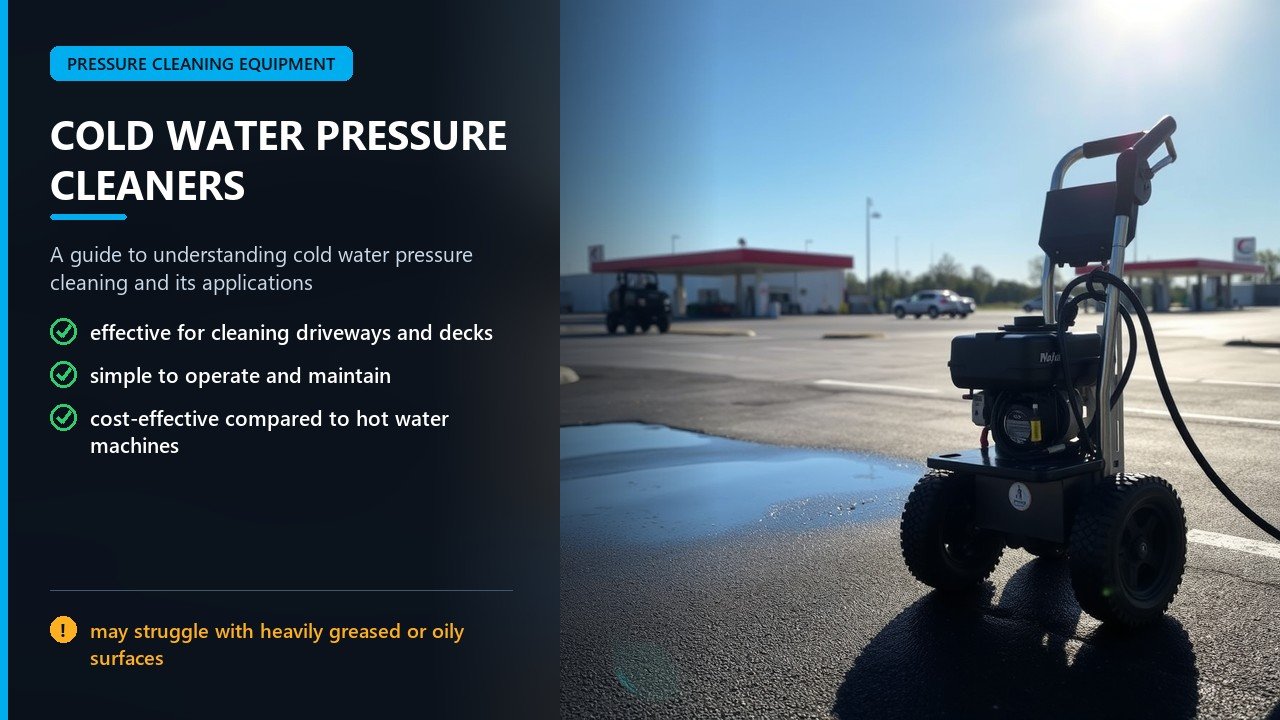
Tom watched a pair of franchise pressure washers work a gas station forecourt for an hour, then noticed something he had not expected. Neither machine had a heater, no burner on the skid, no hot water at all. Both were running a cold wash at high pressure, one on the concrete apron, one scrubbing the dumpster area with a little detergent mixed in, and the grease on the asphalt was dissolving under the mechanical pounding, not under heat. That afternoon he asked the operator what it took to get into the business. “Start with a cold water pressure cleaner,” the guy said, pointing at the machine. “Heat’s for when dirt is oily enough to need melting. For 90 percent of the jobs out here, pressure and chemistry do it, and cold machines are cheaper, simpler, and start every morning.”
Cold water pressure cleaners are the quiet majority of the pressure washing world. They power the driveway jobs, the deck washes, the fleet washes, and the farm equipment rinses that make up most of what homeowners and cleaners actually do. They are cheaper than hot-water machines, lighter, simpler to service, and entirely capable on any stain that pressure plus working the surface will break apart. Where they genuinely fall short is the small share of jobs that are dominated by grease, oil, and wax baked in by heat, the territory that belongs to a hot-water machine. This guide explains how cold water cleaning really works, what it handles and what it does not, the components that matter on a cold machine, and the honest build-versus-buy decision at the heart of it.
How a Cold Water Machine Cleans
A hot-water cleaner melts grease with heat; a cold water machine has to break it apart with force and chemistry instead. The mechanism is worth understanding because it sets the list of real expectations.
Pressure blasts the bond. The stream from a properly sized nozzle hits the dirt with enough force to shatter its grip on the surface and lift it into the water stream, which carries it away. Repeated passes erode even stubborn grime, which is why cleaning with a cold machine is so often a matter of technique, angle, and persistence more than brute force.
Water flushes the residue. Volume moves the freed dirt sideways. The gallons per minute matter as much as the pressure, because a stream that breaks the bond but lacks volume just redeposits the sludge a few inches away. Big cold machines sell on flow and pressure together, the same pairing that makes any power washer useful.
Chemistry stands in for heat. A detergent, degreaser, or surface cleaner pre-soak dissolves what mechanical pounding alone cannot dislodge. Cold-cleaning pros run chemistry for the stubborn stages, then strip with pressure and rinse with the plain stream. The detergent softens the grease so the cold hammer finishes it. Our guide to choosing a soap dispenser covers the chemistry side of the loop.
Where it quietly wins. Moss, mildew, algae, dirt films, pollen, and general grime all release readily under pressure without any heat. For the majority of residential reality, driveways, patios, siding, fences, and equipment that lives outdoors, a cold machine cleans with room to spare, which is exactly why the franchise operator Tom watched needed no burner.
What Cold Water Cannot Melt
Honesty about the boundary keeps a buyer from overpaying for heat they do not need, and from under-buying when the job list really does need it.
Heavy baked grease and oil. Engine grease that has cooked on for months, restaurant grease traps, industrial floors beneath fryer hoods, and asphalt oil stains that have set into the surface all respond far better to heat. Hot water melts the fat’s bond at the molecular level, which pressure alone grinds at. On these, a cold machine doubles the passes, trips the detergent, and still hands back a faint ghost. Our comparison of hot versus cold water and how much heat you actually need draws the line in the field.
Slow-setting wax and road tar. Both soften with heat. A cold stream can scatter the tar bead but often smears it wider rather than lifting it, and the fix lands in the hot lane, or in a chemical bath it would rather not wait for.
Deep ground-in industrial soil. The kind packed into loading dock concrete and farm equipment cabs. Cold machines chase it into the texture and can miss what heat-rich steam blasts out in a pass. Turf and barn cleaning, pressure-wise, run hot in practice for that reason.
Not a hard rule, just a longer day. Cold machines can attack all of the above; it just costs more time and chemical. The decision is economics: is the extra detergent and the double pass cheaper than a hot machine’s price tag? For most homeowners, yes. For a commercial grease customer, usually no. Our article on who should buy a cold water pressure washer turns that equation into a checklist.
Cold Versus Hot: The Full Trade
The two machine classes are not “better and worse”; they are different answers to the same job list, and the real differences run through the whole ownership experience.
Price. Cold machines cost less at every tier, because a burner, a heating coil, a fuel system, and the plumbing to run them add thousands. Cold water pressure cleaners start a fraction of the price of their hot sisters and are the standard entry point for a reason.
Weight and size. Cold machines are lighter and more compact, easier to haul to a fence line, onto a trailer, or into tight equipment bays. A hot machine carries a whole second subsystem.
Maintenance and starting. Cold machines have fewer parts to fail and start instantly: open the water, start the engine, pull the trigger. Hot machines need the burner lit, a fuel path checked, and the coil tended, and they reward a warmer storage care routine.
The cleaning ceiling. Where the tables turn is the stubborn grease, oil, and tar mentioned above. Hot water lifts these decisively, and in those jobs the price premium pays off across years of shorter days and cleaner results. The debate over hot versus cold where pros answer “both” is exactly that split.
| Factor | Cold Water | Hot Water |
|---|---|---|
| Price | Lower | Higher |
| Weight | Lighter | Heavier |
| Warm-up | None | Burner wait |
| Grease and oil | Chases, with chemistry | Melts quickly |
| Maintenance | Simpler | Burner care added |
| Everyday cleaning | Excellent | Excellent |
The Components That Decide a Cold Machine
Strip the marketing away and a cold water pressure cleaner is a small number of real parts, and the quality of those parts sets the machine’s life.
The pump is the organ inside. An axial pump is cheap and fine for consumer duty; a triplex or a belt-drive pump is built to run harder and last, and it is where the money goes on machines trusted daily. The pump’s oil, seals, and unloader are its whole personality. Our look at triplex pump machines and what they cost explains the upgrade path clearly.
The engine or motor. Gas engines, mostly 4-stroke small engines, provide the mobile power, and quality engines like Honda and Briggs units hold value and start reliably. Electric motors are quieter and simpler for fixed locations, with the constraint of needing a pressurizable water supply and a wall outlet.
Nozzle and unloader. The nozzle sizes the stream’s force and flow together, and the unloader recirculates when the trigger closes so the pump is not dead-headed. Cheap unloaders surge and thump; a smooth unloader makes the machine pleasant to run all day.
Wheels, frame, and hose. The rolling parts decide whether the machine travels or stays parked. A wheeled cart with a good hose reel and a hose reel takes the sore-wrist labor out of long runs, and the frame stiffness decides how the machine handles a tow or a trailer bounce. These are the parts people budget past and then miss every single day.
How the Water Supply Shapes Every Job
A cold water cleaner is fed from the supply, and the supply’s limits are the machine’s limits, no exceptions, whatever the sticker says.
Match flow to the machine. A machine that wants 4 GPM needs an available four gallons a minute from the tap, the tank, or the well. A slower feed starves the pump, drops the pressure, and on some machines leads to pump damage. Measure the site’s flow before you buy, not after the first weak pass.
Hose size at the supply. The water path from the spigot to the machine matters as much as the machine’s output hose. A 5/8-inch supply hose carrying 4 GPM beats a 1/2-inch one that chokes it. Our guide to the water source and connection flow guide walks through the whole feed line.
Tanks and buffer. Site with no spigot runs a tank, and the tank needs enough volume and pickup design to keep the pump fed at full flow. A small buffer tank with a float-fed pickup is the standard mobile workaround, and our pressure washing tank setup builds it in steps.
Cold water and the weather. Cold machines are fine on dew-damp mornings, but they cannot thaw frozen lines. In near-freezing weather the entire feed has to be kept above freezing, and the machine itself should be winterized and protected from a freeze after the season.
Buying the Right Cold Water Machine
With cold units spanning everything from a 1,600 PSI electric cleaner to a 4,000 PSI gas workhorse, the purchase comes down to three honest questions.
What is on your actual job list? Cars and light patios take an electric or small gas unit, concrete and flat cleanings favor a bigger gas machine, and mobile commercial work wants a cart or trailer unit rated in hours. The job list writes the spec sheet; the sticker price fills it in.
What is your water? Confirm the supply flow, pressure, and the practical distance to the machine. Buy the machine the water can feed, or budget the tank at the same time, because the pair decide the daily result together.
What will you do with the stream? If your work is mostly flatware, a surface cleaner on a moderately powered machine beats a bigger bare machine without one, because spreading pressure across spinning tips changes speed more than the PSI reads. Match the machine to the tips you intend to run, not the top number alone.
If the list is heavy on grease, oil, and baked tar, read the hot water argument before you buy cold and be sure you are choosing the longer day knowingly. Our buyers’ guide on how to buy a pressure washer that fits the real work sequences the decision with the water in view.
Caring for a Cold Water Machine
Cold machines are simple, and their upkeep is simple too, which is exactly why they keep working for the people who maintain them.
Water first, always. Open the supply fully before the engine starts, and never run the pump without water. The pump is intolerant of air and silent on the subject; it simply fails. This one habit prevents the majority of cold machine breakdowns.
Fluids on schedule. Engine oil at the mark and on the hours schedule; pump oil at its own level; fresh, clean fuel. A cold machine that is oiled and winterized will easily outlive the one that is washed and forgotten. Our guides on engine oil for pressure washers keep the fluid side simple.
Winterize the whole loop. Drain the pump and lines, run the machine dry briefly after the hose is disconnected, and store the pump protected against a freeze. Cold water machines are just as killable by ice as hot ones, and an annual drain takes five minutes. The storage check and preventive care routine is the yearly insurance policy.
Keep the chemistry sane. A cold machine happily pushes detergent, but harsh chemicals left in the pump and lines do their own damage. Flush the system after chemical days, and store machine and jugs apart. The EPA’s runoff guidance reminds every washer to keep wash water and detergents away from storm drains and lawns, and a rinse-down loop handles that discipline on site.
Cold Water by the Job
The theory is clean, and the field is where it shows up, so here is the cold machine’s scorecard across the jobs people actually run.
Driveways, patios, sidewalks. The flagship use. Concrete, brick, and pavers shrug off a cold blast that is kept moving with a surface cleaner head, and moss and mildew fall off in strips. Long cleanings, zero heat, no complaints. This is the job that alone justifies the machine for most owners.
Wood decks and fencing. Cold water with a wide tip lifts grayed film off composite and softens wood fibers cleanly without scorching them the way an impatient hot pass can. The machine has to be kept at the right distance, but a careful cold wash is gentler on wood than hot steam in careless hands.
Cars, trucks, and boats. Powder coat, clear coat, gel coat, tires, wheels, and cabs all respond to cold pressure with the right detergent and a deliberate order. Cold water is standard for vehicle washing; heat is rarely part of the car wash equation, and a cold machine is exactly what detail bays and home washes use.
Farm and construction equipment. A cold bucket doing a from-the-top rinse on a tractor, a backhoe, or implements is a full day of the grime that settles on equipment. Good, plain, cold cleaning with chemistry is the norm here, because the machine earns its keep as the mobile pressure source at the worksite.
Fleet and light commercial. Trucks, vans, and delivery trailers built up a day’s film without baking it on. Cold machines flush them clean in a pass each evening, and the whole exercise stays cheap enough to run nightly. Building exteriors and storefronts join the same list, and none of it needs a burner.
The one-word warning: verify, don’t assume. A stain that keeps reappearing after a cold wash is usually a stain that needs stepping back and re-reading: hot water for baked grease, a different chemical for tannin, a surface cleaner for flatware that the bare stream cannot cover. Treat the cold machine as the sharp default and the diagnosis as the follow-up. Our guide to cold water washing tips that get visible results catalogues the fix-it list for those stubborn repeats.
Cold Water by the Power Source
Cold machines split into two broad power camps, and the choice swings most people’s daily handling and cost.
Electric cold cleaners. Plug-in machines are the quieter, lighter, garage-friendly lane: no fuel smell, no engine maintenance, instant start, and cord management in exchange. They run at modest PSI and flow, which covers cars, bikes, patio furniture, and light exterior grime, and they are the natural first machine. Their limit is a wall outlet and the modest output that goes with it.
Gas cold cleaners. Fuel-driven machines bring the real power and the true mobility: run the hose past every corner, feed the machine from a tank anywhere, and switch careers from homeowner to cleaner. They cost more, weigh more, need engine care, and reward the investment exactly on the bigger, longer jobs. The gas lane is where the trailer rig lives, and our mobile rig building guide is its natural extension.
Wheels or no wheels. A rollable cart decides whether the machine follows the damp work or whether the damp work comes to it. For the medium jobs, wheels win; for the stationary bench, a bolted unit is fine. Choose the machine’s feet based on your feet’s daily route.
The honest version of the power-source question is a budget and a job list question. Electric is the starter, gas is the professional, and many owners stack both: a quiet electric for the weeknight car wash and a gas unit for the weekend heavy session. Nothing about cold water changes that equation; the machine just keeps it simple on either side.
Common Cold Water Machine Mistakes
Buying a hot machine for a cold job. Paying for a burner you will never light is the most expensive mistake on this list. Confirm the job list before the buyer’s remorse.
Running the pump dry. Even seconds without water damage the seals. Supply first, always.
Chasing grease with cold pressure alone. A cold machine that just grinds at the same pad all day is losing to chemistry it should be using. Pre-soak, then rinse.
Undersizing the supply hose. The machine starves the moment the feed can’t keep up. Match the whole line, not just the output side.
Ignoring the pump and the unloader. The pressure gauge lies when the unloader surges and the pump complains. Service both before they become a claim.
Skipping winterizing. A machine that dies in the garage each spring is a machine that was never drained. Five minutes a year fixes it.
Frequently Asked Questions
Is a cold water pressure cleaner good enough? For the vast majority of home and light commercial cleaning, yes. Moss, grime, decks, patios, sidewalks, equipment, and vehicle rinses all yield to pressure and chemistry. Only baked grease and tar genuinely need heat.
What is the difference between cold and hot water cleaning? Cold works mechanically, blasting and flushing with pressure and detergent; hot adds heat that melts grease and oil bonds, cleaning those faster, at the cost of a heavier and pricier machine.
Can I make a cold machine clean grease? Yes, with more passes and the right degreaser, and it is the common fix in practice. Deep industrial grease still belongs to hot water, but a skilled cold wash handles most residential incidents.
Do cold water cleaners use more time? On grease-heavy jobs, yes. On ordinary grime, no. The time penalty is entirely concentrated on the jobs heat would have melted.
Are cold water machines cheaper to maintain? Yes. No burner, no coil, no fuel system, and fewer seals to age, so yearly cost and shops time both stay low.
When should I buy hot water instead? When grease, oil, and tar dominate the work, or when customers pay by the job for speed that chemistry cannot match. Otherwise, the cold machine is the honest value.
Final Thoughts on Cold Water Pressure Cleaners
Cold water pressure cleaners are the workhorses tucked in the corners of garages, driveways, trailers, and depot bays, and they earn that corner by being simple, cheap, and quietly unstoppable on the work that fills a normal week. They prove every day that cleaning is mostly force and chemistry, not heat, and that the machine which starts instantly and costs a fraction of the hot flagship is the one most jobs actually need.
Know the boundary, because that is the whole skill. Cold machines chew through moss, mildew, grime, and the ordinary filth of life; they get slower where grease has baked itself into place, and on those lanes the hot machine earns its heavier price. Match the machine to your real work list, feed it properly from the supply, keep the pump watered and winterized, and run detergent where heat would otherwise be needed. Do that, and the cold water pressure cleaner becomes the dependable tool that starts every morning with no ceremony and no complaints, turning pressure and simple water into clean, the same way it does on the driveways and forecourts that keep whole neighborhoods presentable.