Search for a “CRX210 pressure washer” and you will find machines from several different brands — Simpson, DeWalt, Craftsman, Bad Boy, and others. That is the clue to what CRX210 really is: not a pressure washer model, but a gasoline engine that many washers share. Understanding the CRX210 means understanding the power plant behind a whole family of popular gas pressure washers.
This guide explains what the CRX210 engine is, the machines it powers, what you can expect from them, and how to look after one.
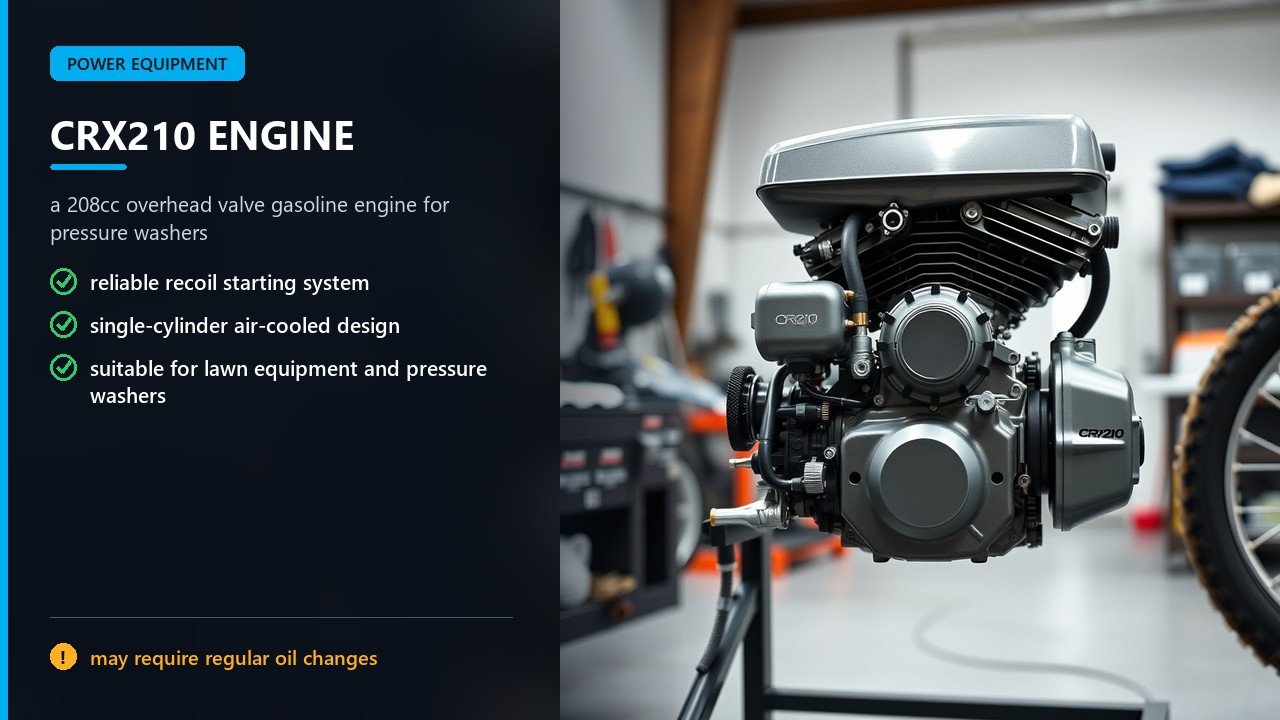
What CRX210 Actually Is
CRX210 is a small four-stroke gasoline engine with a displacement of about 208 cc. It is an overhead valve (OHV) design, which is the modern, efficient layout for small engines, and it produces roughly 4.3 kilowatts. It uses recoil starting, runs on regular gasoline, and is a single-cylinder air-cooled engine of the kind found on lawn equipment and pressure washers.
The engine is made and supplied to pressure washer brands that build complete machines around it. That is why the same CRX210 badge appears on washers sold under several labels: the engine is the common component, while the frame, pump, hose, gun, and nozzles differ from brand to brand. When a listing says “CRX210 engine,” it is describing the power source, not the whole machine.
This is common practice in the pressure washer industry, where engines and pumps are often sourced from specialists and assembled by a range of brands. The CRX engine family, produced in multiple sizes, is one of the well-known small-engine options in the consumer and light-commercial gas market.
What the CRX210 Powers
Pressure washers built around the CRX210 typically deliver around 3,000 to 3,600 PSI at roughly 2.4 to 2.5 GPM. That is the mid-to-upper home and light commercial range — enough for driveways, patios, decks, siding, and vehicles, but not the heavy industrial work that needs a much larger engine and an industrial pump.
The pump paired with the engine is often an axial cam pump on the more affordable machines, or a triplex plunger pump on the better ones. Axial pumps are lighter and cheaper; triplex pumps last longer and hold pressure better under continuous use. Many CRX210 washers use an axial pump with a thermal relief valve, while the higher-end models step up to a triplex pump.
The table below outlines typical CRX210-powered machines.
| Example line | Typical specs |
|---|---|
| Simpson Megashot / Clean Machine | 3,000 – 3,400 PSI, 2.5 GPM, axial cam pump |
| DeWalt DXPW series | 3,400 PSI, 2.5 GPM, axial cam pump |
| Simpson SuperPro roll cage | 3,600 PSI, 2.5 GPM, AAA triplex pump |
| Bad Boy BBPW3525 | 3,500 PSI, axial pump, welded steel frame |
The pattern is consistent: a 208 cc engine driving a mid-range gas washer at around 3,000 to 3,600 PSI. The variation between models comes mainly from the pump and the frame, not the engine.
Features of the CRX210 Engine
The CRX210 is a small OHV four-stroke engine, and its features suit pressure washer duty. OHV design gives it reasonable efficiency and easier starting than older engine types. A recoil starter means no battery to maintain, and the engine is built to run for extended periods driving a pump under load. Fuel capacity on typical machines is around 0.8 to 1 gallon, enough for a good session of cleaning.
One feature worth noting is low-oil shutdown. This safety system stops the engine if the oil level drops too low, protecting it from running dry and seizing. It is a common and valuable feature on CRX210 washers, and while it is a backup rather than a substitute for checking oil, it prevents a costly mistake.
The engine is air-cooled, so it relies on airflow over its cooling fins to stay at temperature. Keeping those fins and the surrounding shroud clear of dirt and debris is important, especially for a machine that works outdoors in dusty conditions. A clogged cooling system is a common cause of overheating and shortened engine life.
What It Powers Well
A CRX210 pressure washer suits the homeowner and light-commercial user who needs real gas-powered cleaning power without the size and cost of a larger machine. It handles concrete driveways and patios, wooden and composite decks, siding, fences, vehicles, and outdoor furniture. It is the workhorse of the suburban driveway, not a toy and not an industrial tool.
Because it produces useful pressure and flow, it pairs well with a surface cleaner for flat surfaces, a turbo nozzle for tough spots, and a range of spray tips for different jobs. Its mid-range output is versatile: enough to strip stubborn grime, but manageable enough for a homeowner to control and store.
Where it reaches its limit is in heavy, continuous, or industrial work — large-scale commercial flatwork, hot water cleaning, or jobs needing very high flow. For those, a larger engine and an industrial triplex pump are required. Matching the engine’s class to the job is the key to satisfaction.
Maintenance and Reliability
A CRX210 engine needs the same routine as any small gas engine. Check the oil before each use and change it on schedule, using the grade the manual specifies — commonly a 10W-30 or 10W-40 engine oil. Replace the spark plug periodically, keep the air filter clean, and use fresh fuel. For long storage, either use a fuel stabiliser or drain the fuel system to prevent gumming.
Protect the pump as carefully as the engine. Never run the machine without water, keep the inlet filter clean, avoid long periods with the gun closed while the pump runs, and change the pump oil if the pump is oil-filled. On axial-pump machines, the thermal relief valve protects the pump during dead-heading, but it is a last resort, not a routine.
For a machine used seasonally, winterising is essential. Drain the pump, hose, and gun, and store the washer dry and covered. Engines and pumps that are properly maintained regularly outlast neglected ones by years, and the routine is short.
Buying a CRX210 Washer
Because many brands use the CRX210, the engine is not the deciding factor between them — the pump, frame, and included accessories are. When comparing CRX210 machines, look past the engine and at the parts that vary: is the pump an axial cam or a triplex? What is the hose length and quality? Does it include a full nozzle set, a surface cleaner, or a turbo nozzle? These differences matter more than the shared engine.
A machine with a triplex pump and a strong frame is worth more than one with the same engine and a basic axial pump, because the pump usually determines how long the machine lasts. Check the warranty as well — a longer warranty on the engine or pump signals confidence in the components. The engine itself is proven across many units, so the rest of the machine is where the value lies.
For buyers considering a used CRX210 washer, the engine is a good sign — it is a known quantity with widely available parts. Inspect the pump carefully, since that is the common failure point, and check for leaks, weak pressure, or a pump that has been run dry. A sound engine with a tired pump is a repair project; a sound engine with a good pump is a bargain.
Parts and Service
One advantage of a widely used engine is parts availability. CRX210 engines appear across many brands, so consumables like spark plugs, air filters, and oil filters are easy to find, and replacement engines are available if one ever fails. That is a real benefit for a machine you intend to keep for years.
The pressure washer parts around the engine are also generally available, though they vary by brand: pumps, unloaders, inlet and outlet fittings, guns, wands, and nozzles. If you own a CRX210 washer, identify the brand and model so you can source the correct parts, because the engine label alone does not tell you the pump or frame specifications.
Keep a few spares on hand — spark plug, air filter, engine oil, and pump oil, plus O-rings and a nozzle or two. These small items cover most routine needs and let you service the machine without waiting for deliveries. Simple, regular care is what keeps a CRX210 washer running season after season.
Is a CRX210 Washer Right for You
A CRX210 pressure washer is a good fit for homeowners and light-commercial users who want dependable gas cleaning power in the 3,000 to 3,600 PSI range. It is capable enough for driveways, decks, siding, and vehicles, simple enough to maintain at home, and supported by widely available parts.
It is not the right tool for heavy industrial work, continuous commercial cleaning, or high-flow or hot water applications, where a larger engine and industrial pump are needed. As always, match the machine to the job rather than to the label on the engine.
The CRX210 is best understood as a reliable mid-range engine that powers a wide family of capable gas washers. Choose the machine around it for its pump, frame, and accessories, maintain both engine and pump with care, and it will serve well for years of serious home cleaning.
Frequently Asked Questions
What is a CRX210 pressure washer? It is a gas pressure washer powered by the CRX210 engine — a 208 cc OHV engine used by brands such as Simpson, DeWalt, Craftsman, and Bad Boy. CRX210 is the engine, not a washer model.
What size engine is the CRX210? It is a 208 cc single-cylinder OHV four-stroke gasoline engine, rated around 4.3 kW and fitted with a recoil starter.
What PSI do CRX210 washers produce? Typically around 3,000 to 3,600 PSI at about 2.4 to 2.5 GPM, depending on the pump and model.
Which brands use the CRX210? Several, including Simpson (Megashot, Clean Machine, SuperPro), DeWalt, Craftsman, Bad Boy, and others. The engine is shared; the rest of the machine differs by brand.
Does the CRX210 have low-oil shutdown? Many machines with this engine include low-oil shutdown, which stops the engine if the oil drops too low. It is a protective backup, not a substitute for checking oil.
What pump comes with a CRX210 washer? It varies. Affordable models use an axial cam pump with thermal relief, while higher-end models use a triplex plunger pump.
How do I maintain a CRX210 engine? Check and change the oil on schedule, replace the spark plug, keep the air filter clean, use fresh fuel, and keep the cooling fins clear.
Are CRX210 parts easy to find? Yes. Because the engine is widely used, consumables and replacement engines are readily available. Identify your machine’s brand and model for washer-specific parts.
Final Thoughts
CRX210 is not a pressure washer but the engine behind many of them — a 208 cc OHV gas engine that powers mid-range machines from several brands at around 3,000 to 3,600 PSI. That shared engine is reliable and well supported, which is why it appears across so many models.
When choosing a CRX210 washer, look past the engine and judge the machine by its pump, frame, and accessories, since those decide how long it lasts and how well it performs. Maintain the engine and pump with simple, regular care, and it will handle serious home cleaning for years. For related reading, see our guides on a gas engine pressure washer and a 3800 psi pressure washer.