Diesel Powered Pressure Washer: Hot Water, Engine Power, and Where Each Belongs
A diesel powered pressure washer is one of two machines, and the phrase covers both because diesel shows up in two different jobs. In the most common meaning, diesel is the fuel, burned to heat water in a hot-water machine — the burner that turns a cold-water washer into a grease-and-grime destroyer. In the other meaning, diesel is the engine, driving the pump on a machine built to work where there is no power outlet at all. Both are real, both are found in the same industrial catalogs, and choosing between them starts with knowing which job is actually yours.
This guide separates the two, then walks the details that decide a purchase: how a diesel-fired burner makes hot water, how the drive choices compare, what heat actually does to cleaning, the specs worth checking, the maintenance that keeps a diesel machine alive, the fuel economics, and the jobs each style fits. By the end, the phrase “diesel powered” will point to a specific machine rather than a vague category.
Quick Note: Diesel burner or diesel engine? A diesel-fired hot-water machine heats water with an oil burner and can still run on an electric motor. A diesel-driven machine uses a diesel engine to spin the pump and needs no power outlet. The two are often confused, and they solve opposite problems.
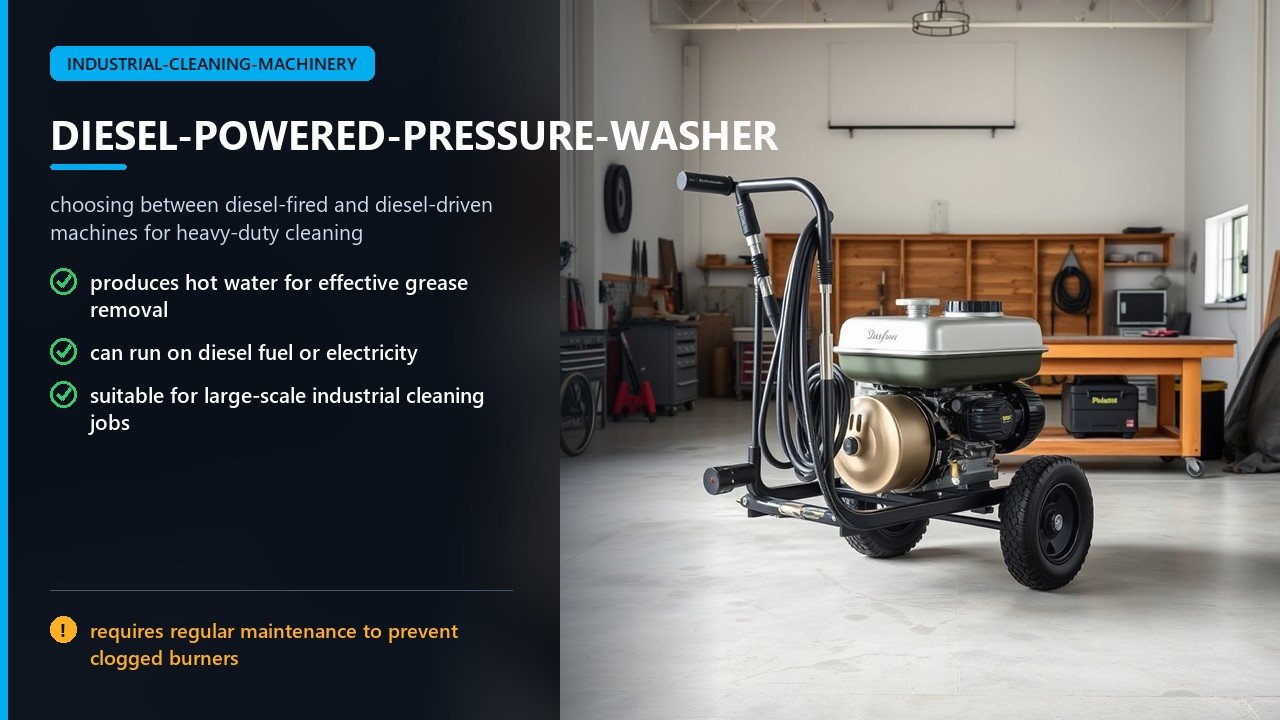
What “Diesel Powered” Really Means
The confusion is worth clearing first because it changes everything downstream. A diesel-fired washer keeps a pump driven by an electric motor or a gasoline engine, and adds a diesel burner (the same oil-fired heating coil found on home furnaces) to raise the water temperature. It still needs a power source and a water supply, but it produces hot water, and hot water is the reason most people search for a “diesel pressure washer” in the first place. The Karcher HDS 6/10-4 C is a clean example: a 240V electric motor and pump paired with a diesel burner and a 15-liter fuel tank.
A diesel-driven washer replaces the electric motor entirely with a diesel engine. No cord, no generator, no outlet — just fuel in the tank and go. These machines exist for construction sites, municipal work, and remote locations where power simply is not available; the Karcher HDS 8/20 De pairs a Yanmar diesel engine with a crankshaft pump and a 30-liter tank so it can run all day off the grid. Many diesel-driven units are also hot-water machines with a burner, which is why the line between the two meanings blurs so easily — a single machine can be both diesel-engined and diesel-fired.
The practical upshot: before you shop, name the missing ingredient. If your cleaning is cold-water-adequate and your problem is having no outlet, you want diesel drive. If you have power but the grease does not come off, you want a diesel burner. And if both problems are real — no outlet and heavy grease — you want the machine that does both, which is where the top of the category lives and where the price follows.
How a Diesel Burner Makes Hot Water
The heating side is straightforward engineering: pump pushes water through a coiled tube inside a combustion chamber, a diesel burner fires into that chamber, and the water picks up heat as it travels the coil. It is the same principle as a tankless oil furnace, and the output is dramatic — commercial machines reach 200 degrees Fahrenheit and beyond. Karcher rates its hot-water line to as much as 210 degrees at pressures up to 4,000 PSI, and the first thing that temperature does is melt grease that cold water only smears around.
Three controls keep the burner honest. A flow switch lights the burner only when water is moving, so the coil never fires dry; an exhaust-gas thermostat shuts the motor down if the exhaust climbs past roughly 300 degrees Celsius, protecting both machine and operator; and a water-softening system (or a care bottle) fights the scale that hard water leaves inside the coil. That last one matters most over time: a scaled coil loses efficiency, then overheats, then fails, and avoiding it is mostly a matter of treating the water. The hot-versus-cold logic the burner exists to serve is laid out in our cold or hot machine guide.
Drive Choices: Diesel Engine, Electric Motor, or Gas Engine
| Drive | Runs Off-Grid | Best For |
|---|---|---|
| Diesel engine | Yes | Remote sites, construction, municipal, long duty |
| Electric motor | No | Fixed bays, indoor use, low maintenance |
| Gasoline engine | Yes | Portable outdoor work, lower upfront cost |
The engine choice is where diesel earns its premium. A diesel engine delivers more torque per liter, sips fuel compared to a comparable gas engine, runs cooler, and is built for thousands of hours of service — the reason a Yanmar or Kubota diesel can outlast two or three gasoline engines doing the same work. The trade is higher purchase price, more weight, more noise, and diesel fuel handling (which includes watching for cold-weather gelling). For a machine that works every day on construction or municipal duty, the diesel engine’s durability and fuel economy usually win the long math. For a garage or wash bay with a power outlet, the electric motor is quieter and simpler. The power-source comparison continues in our 240V electric guide.
Diesel Engine vs Gasoline Engine: The Real Differences
On paper the two engines look similar — a few hundred cubic centimeters, electric start, a fuel tank — but they age very differently. A gasoline engine makes its power high in the rpm range, needs ignition tuning, and is designed around a lighter, cheaper duty cycle. A diesel engine makes torque low and steadily, has no spark plugs or distributor to maintain, and is built with compression ratios and component weights meant for continuous industrial work. The result is a diesel that idles cheaper, pulls harder through a pump at low rpm, and keeps running while its gasoline twin is on its second or third replacement.
The costs push the other way. Diesel engines are heavier, louder, and more expensive to buy and to service when something major does fail. Diesel fuel is widely available but demands more care — filtration, water separation, and seasonal blending. And a diesel engine’s cold-start manners are worse, which is why block heaters and winter fuel matter. The honest summary: gasoline wins the light, occasional, budget job; diesel wins the daily, heavy, off-grid job where uptime and longevity are worth the premium. The same split applies to the burner fuel, where a machine can run on diesel or light heating oil depending on the design.
What Hot Water Actually Does to Cleaning
Heat is not a luxury feature; it changes the chemistry of the job. Hot water dissolves grease and oil that cold pressure merely pushes around, and it lets you clean with lower pressure and less detergent, which is gentler on the surface and cheaper to run. The industry sums hot-water cleaning up as three elements working together — heat, agitation, and detergent — and heat is the multiplier that makes the other two work harder. A hot-water machine can lift years of caked grease from a fleet engine bay or a restaurant floor mat that a cold unit would fight all afternoon.
There is a hygiene argument too. Commercial hot-water manufacturers note that hot water can reduce bacteria far better than cold, because the temperature that melts grease also kills the organisms living in it. That is why food-processing plants, kitchens, and medical facilities lean toward hot water (and often toward electric-fired heat, since burner exhaust is not welcome indoors). And on the practical side, hot water dries faster, so a floor or engine comes back into service sooner. The full case for spending on heat is in our cold or hot guide and the 4 GPM benchmark guide.
There is also a workflow effect that buyers underestimate: because hot water cleans with less pressure, it is gentler on the surface being cleaned. A hot-water machine can lift grease off machinery, painted fleet panels, and food equipment at pressure that a cold machine would need to double to match — and lower pressure means less risk of etching paint, driving water past seals, or scoring a finished surface. The machine that costs more up front often pays back in the parts it does not blast into replacement, alongside the labor it saves.
The Specs Worth Checking on a Diesel Machine
The nameplate numbers that decide fit are temperature, flow, pressure, and fuel capacity. Maximum temperature tells you whether the machine can hit the 200-degree range or stops short; flow (GPM) is the real cleaning-speed number; pressure needs to match the work; and the fuel tank’s size sets how long the burner and engine can run before a refill. A diesel-driven skid like the HDS 8/20 De carries a 30-liter tank for extended duty, while a compact diesel-fired unit may hold 15 liters and refill more often.
Two less obvious specs deserve equal weight. The pump type — a triplex ceramic-plunger pump is the commercial standard, rebuildable and heat-tolerant, versus a disposable axial cam — decides how long the machine lives. And the safety package — flow switch, exhaust thermostat, thermal relief valve, and water-shortage protection — decides whether a moment of inattention becomes a small shutdown or a ruined coil. On a machine built for continuous industrial use, those two specs separate a professional tool from an engine on a frame.
Maintaining the Diesel Burner
The burner is the part of a hot-water machine that most needs attention, and most of that attention is about scale and combustion. Hard water leaves minerals inside the heating coil; the machine’s water-softening system slows that process, but periodic descaling is still the difference between a coil that lasts years and one that fails in months. A scaled coil runs hotter and hotter for the same output until the protection trips or the coil splits, so treating the water is cheap insurance on the most expensive replaceable part of the machine.
The combustion side has its own small list: keep the fuel filter clean, keep the burner nozzle and electrodes in spec, and make sure the fuel itself is clean and water-free. A diesel burner that runs rough, smokes, or fails to light is usually complaining about filter, nozzle, or air adjustment rather than anything serious — and catching it as a maintenance item keeps it from becoming a shutdown mid-job. Store the machine with stabilized, full fuel when it will sit, and drain the water from the system if freezing is possible.
Two habits extend the burner’s life more than any repair. First, never let the coil run without water flow — the flow switch is there to prevent it, but the operator should still understand that a dry firing is what ruins a coil, so supply problems are stop-work events. Second, reduce fuel consumption where the job allows by running in an economy temperature range instead of always at maximum; the manufacturer’s own eco mode shows the pattern, cutting diesel use by roughly a fifth without hurting the clean. The burner’s job is to make hot water, not to burn fuel for its own sake.
Maintaining the Diesel Engine
A diesel engine is a simple, long-lived machine if it gets its basics: engine oil changes on schedule, a clean air filter, fresh fuel filters, and a healthy battery for the electric start. Unlike a gasoline engine, there is no ignition system to tune, which is part of why diesel lasts — but the fuel system hates contamination, so clean diesel and clean filters are the engine’s whole religion. Check the oil and coolant (if liquid-cooled) before long runs, and let the engine warm and cool properly rather than starting under full load.
The one diesel-specific trap is cold. Diesel fuel gels as temperatures fall, and gelled fuel means a machine that will not start on the coldest morning of the year. The fix is seasonal: use a winter-blend fuel or a fuel conditioner where the climate demands it, and treat stored fuel so it does not grow the water and microbes that diesel is prone to. A diesel machine that is fed clean, seasonal fuel and serviced on schedule will clock an enormous service life, which is exactly why the category costs more up front.
Cost and Fuel Economics
Diesel machines cost more to buy than their gasoline or all-electric cousins, and the diesel-engine version sits at the top of the price ladder. That premium buys durability and duty cycle, not a cheaper sticker, and it also buys fuel economy: a diesel engine burns noticeably less fuel per hour than a comparable gasoline engine, and a hot-water burner running in an economy mode (Karcher’s eco!efficiency mode cuts diesel consumption by about 20 percent) lowers running cost further. Over a long service life on real commercial work, the fuel and longevity savings close much of the gap.
The honest math still depends on use. A machine that runs daily on construction or fleet work justifies the diesel premium through uptime and longevity; a machine that runs a few weekends a season rarely does. Add the fuel logistics — diesel storage, winter treatment, and the realities of handling a second fuel type — and the category clearly rewards the operator who has regular, heavy, off-grid work to do. For everyone else, the electric hot-water machines deliver the same heat with less fuel handling. The business economics of choosing the right machine are in our pressure washer for business guide.
Who a Diesel Machine Is For
The diesel-driven washer is for work that happens away from power: construction sites, road and utility crews, municipal and rental fleets, and any outdoor job where running a generator or a cord is impractical. It is the machine that starts cold, runs all day off its own tank, and cleans with heat when the job demands grease removal far from any building. The diesel-fired electric washer is for fixed locations that need hot water but have power — commercial kitchens, food plants, and wash bays where a burner’s exhaust can be vented and the machine stays put.
What both have in common is a workload that justifies heat and industrial build. If the cleaning is grease-heavy — engines, machinery, kitchen floors, food equipment — hot water earns its cost in labor time and detergent savings. If the work is light, occasional, and cold-water-friendly, neither diesel machine is the right spend. The category is a tool for a job, not a default upgrade, and matching it to the actual workload is the decision that keeps the purchase honest.
Portable, Skid, or Trailer
Diesel machines come in three physical formats, and the format often decides how much work the machine can actually reach. Portable units — a wheeled cart with the engine, burner, and tanks onboard — suit one-operator jobs that move between sites, and they trade tank size and stability for mobility. Skid units bolt to a truck bed or trailer deck and are the industrial default for fleets, since they draw from larger tanks and can be plumbed for a fixed water supply. Trailer-mounted systems bundle the machine, water tank, and sometimes a recovery system into a self-contained mobile wash rig — the full solution for a business that cleans on the road every day.
Choosing among them is a logistics question, not a specs question. If the machine mostly stays and the water comes to it, skid or stationary makes sense. If the machine and the water both travel, a trailer with an onboard portable water tank turns any parking lot into a wash bay. And if the operator is the only thing that moves day to day, the portable cart is the lightest commitment. Size the tank to the job — a diesel engine and burner both draw fuel, and running dry mid-job is a self-inflicted delay.
Fuel Handling and Storage
Diesel rewards a little discipline. Store it clean and water-free, because water is the enemy of both the burner and the engine’s injection system, and a drum or tank that collects condensation all winter will deliver problems all summer. Use a filter or water-separator on the supply side, keep the machine’s fuel filter serviced, and treat stored fuel with a stabilizer and biocide, since diesel is prone to growing microbes that foul tanks and lines. The same fuel often serves the burner and the engine, so one clean supply keeps both happy.
Cold weather is the other chapter. As temperatures drop, diesel forms wax crystals that thicken the fuel until the machine will not start; a winter-blend fuel or a cold-flow additive keeps it pour-able, and a block heater helps an engine turn over on a frozen morning. The rule of thumb is simple — buy seasonal fuel, never let the tank sit half-full for months, and replace the filters on time. A diesel machine that gets that care will start when the job needs it, which on a construction or municipal site is the only thing that matters. The broader maintenance habits that apply to every machine are in our pressure washer tips guide.
Buying Tips and Common Mistakes
- Confusing burner and engine. Confirm whether you are buying diesel-fired heat, a diesel drive, or both — they need different infrastructure and solve different problems.
- Ignoring the power requirement. A diesel-fired electric unit still needs the right circuit; a diesel-driven unit needs none but must handle its own fuel.
- Neglecting water treatment. The number-one killer of hot-water machines is coil scale; a softener or care bottle is not optional.
- Running untreated diesel in winter. Gelled fuel strands the machine; use a winter blend or conditioner in cold climates.
- Buying an axial-cam pump on an industrial frame. Insist on a triplex ceramic-plunger pump for a machine meant to work daily.
- Skipping the safety package. Flow switch, exhaust thermostat, and thermal relief are what turn an accident into a shutdown.
Frequently Asked Questions
Is a diesel pressure washer better than gas? Diesel engines last longer, use less fuel, and produce more torque, which makes them better for heavy, frequent, off-grid work. Gasoline is cheaper and lighter for occasional use. If the machine also needs hot water, “diesel” usually refers to the burner, which is a separate choice from the drive.
Does a diesel pressure washer need electricity? A diesel-driven machine does not — it runs entirely off its own engine and fuel. A diesel-fired (burner) machine with an electric motor still needs a power supply for the motor and a fuel supply for the burner.
How hot does a diesel pressure washer get? Commercial hot-water machines reach roughly 200 to 210 degrees Fahrenheit, with some units rated higher. The exact maximum depends on the burner and coil, and the temperature is what breaks down grease.
Why is my diesel heater smoking or not lighting? The usual causes are a dirty fuel filter, a worn burner nozzle, or an off air adjustment. Those are routine maintenance items, not necessarily a failed burner.
Can I use off-road or red diesel? Use the fuel the manufacturer specifies. Many machines run on diesel or light heating oil, and off-road (dyed) diesel may be legal for non-road use but is regulated — check local rules before using it.
Are diesel pressure washers hard to maintain? They have more maintenance than an electric machine — engine oil, fuel filters, burner nozzle, coil descaling — but each item is simple, and the diesel engine’s durability offsets the extra chores.
What fuel does a diesel pressure washer use? The engine runs on diesel (or, on some units, a light heating oil). The burner on a hot-water machine typically runs on the same diesel or light oil, so one fuel often serves both — check the manual, since a few designs separate them.
Can a diesel pressure washer run indoors? An engine-driven unit cannot — exhaust is a carbon-monoxide hazard and belongs outdoors or well ventilated. A diesel-fired unit running on an electric motor can be used indoors only where the burner exhaust is properly vented; that is exactly why many indoor operations choose electric-fired heat instead.
Final Thoughts
A diesel powered pressure washer is really two industrial tools sharing one fuel name: the diesel-fired hot-water machine that uses heat to cut grease and germs, and the diesel-driven machine that runs anywhere without a cord. Deciding which you need is the whole game, and it comes down to whether your missing ingredient is heat or power.
When the answer is heat, look for a machine with real temperature, a triplex pump, and a treatment system for the coil — and feed it clean, seasonal fuel. When the answer is independence, look for a diesel engine, a long-range tank, and a safety package that protects the pump on job sites that never sit still. Get the choice right and the diesel machine earns its premium in uptime, and gets the dirtiest machines clean in a single hot pass.