If one number defines the professional pressure washing class, it is not 4,000 PSI alone — it is 4,000 PSI combined with 4 GPM. A pressure washer 4000 psi 4 gpm delivers what the industry calls serious cleaning power, and the pairing of high pressure with high flow is what lets a machine strip paint, restore concrete, wash fleets, and keep up with commercial schedules. Understanding why that combination matters, and what it demands from your water supply, is the key to buying and running one well.
Derek learned this when he outgrew his first machine. His washer handled residential driveways acceptably, but on commercial jobs he was painfully slow. The problem was not pressure — it was flow. When he moved to a 4,000 PSI, 4.0 GPM commercial-grade unit with a triplex pump, his productivity roughly doubled. The extra gallon per minute meant twice the water carrying cleaning energy onto the surface, and jobs that had taken a full day dropped to half of one.
This guide explains the 4000 PSI, 4 GPM benchmark: what the numbers mean, why flow matters as much as pressure, the machines that deliver it, the water supply they require, what they can clean, how they are configured, and how to choose and maintain one. If you are considering a machine at this level, this is the buyer’s guide that answers the real questions.
Quick Note: A 4,000 PSI, 4.0 GPM pressure washer produces roughly 16,000 cleaning units (PSI × GPM) — the professional benchmark for heavy-duty concrete, paint stripping, and fleet work. It is a commercial-grade machine with a triplex pump, and it demands a water supply of at least 4.8 GPM to run correctly.
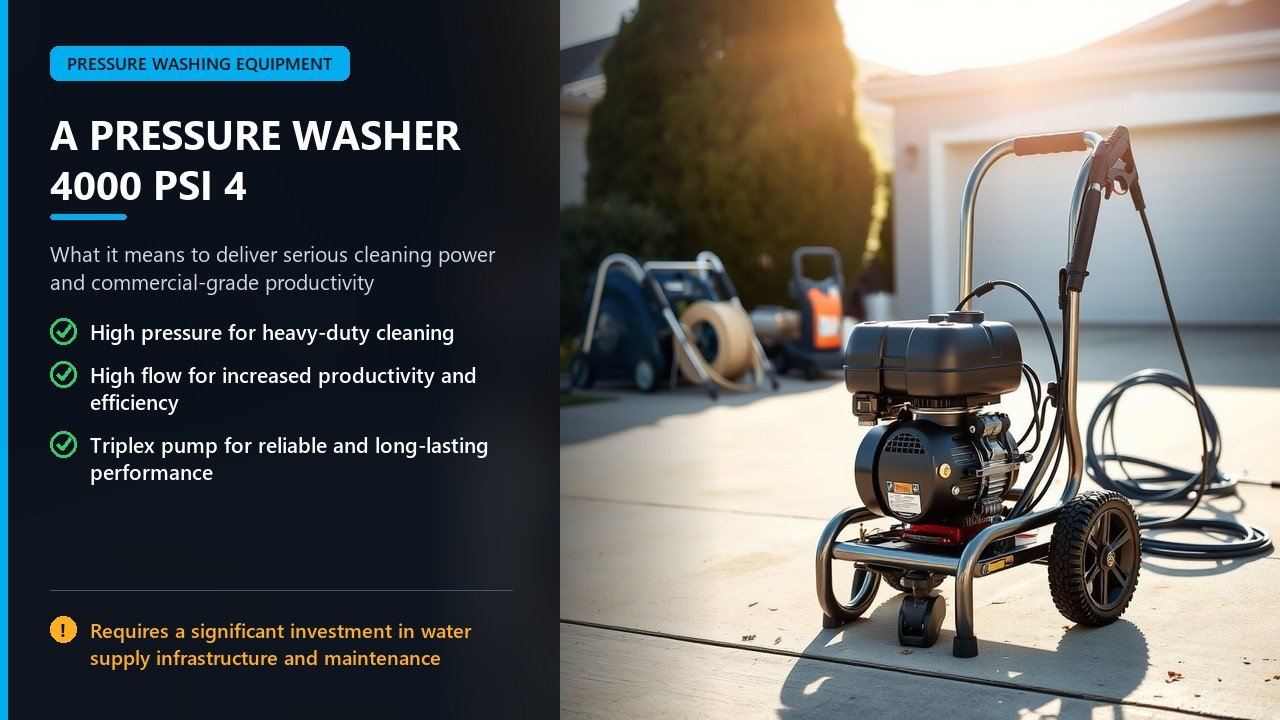
What 4000 PSI and 4 GPM Actually Mean
PSI, or pounds per square inch, is the force with which water hits the surface. GPM, gallons per minute, is how much water is delivered. Cleaning power is the product of the two, and that is why a 4,000 PSI, 4.0 GPM machine is so capable: it applies strong force with a generous volume, removing material and carrying it away at the same time.
Multiply them and you get a figure often called cleaning units. A 4,000 PSI, 4.0 GPM machine scores 16,000. A typical homeowner electric unit at 2,000 PSI and 1.2 GPM scores 2,400. That is nearly a sevenfold difference, and it explains why professionals gravitate to this class. As the Northern Tool trailer-mounted 4,000 PSI manual describes its own unit, it produces a high-pressure spray of up to 5 gallons per minute at 4,000 PSI — the flow is central to the machine’s productivity, not an afterthought.
| Machine | PSI × GPM | Cleaning Units |
|---|---|---|
| Homeowner electric | 2,000 × 1.2 | 2,400 |
| Mid-range gas | 3,000 × 2.5 | 7,500 |
| 4,000 PSI gas, 3.5 GPM | 4,000 × 3.5 | 14,000 |
| 4,000 PSI gas, 4.0 GPM | 4,000 × 4.0 | 16,000 |
The jump from 3.5 to 4.0 GPM may look small on paper, but on a large surface it is a meaningful difference in time. That is why the 4 GPM version is the professional standard and the 3.5 GPM version is often positioned one notch below it. If you want to see how the flow equation scales further, our articles on the 5 gallon per minute pressure washer and the 6 GPM sweet spot carry the logic to the next tiers.
The Water Supply Equation
A machine that flows 4 GPM needs water coming in at least that fast, and in practice a little faster. If the supply cannot keep up, the pump starves, cavitates, loses pressure, and wears prematurely. This is the most common mistake new owners of a 4 GPM machine make, and it is entirely preventable.
Manufacturers are direct about the requirement. The Northern Tool manual states that the water supply must have a flow rate of at least 4.8 gallons per minute — 20% higher than the machine’s flow rate — and that the water must be clean and particle-free. That 20% margin accounts for losses through hoses, fittings, and elevation. Feeding a 4 GPM machine from a weak spigot, a long undersized garden hose, or a shared tap will produce exactly the symptoms novice operators misdiagnose as a pump problem: surging pressure, erratic spray, and heat buildup.
- Check your tap’s flow. Not all spigots deliver 4.8 GPM. A quick bucket-and-stopwatch test tells you what you actually have.
- Use a short, large-diameter feed hose. A 5/8-inch or larger garden hose kept as short as practical minimizes supply losses.
- Consider a buffer tank. Many commercial rigs draw from a tank that is refilled by a tap or pump, guaranteeing adequate flow even when the source is marginal.
- Never run dry. Loss of supply damages the pump quickly. Watch the stream and stop if it falters.
Note: A 4.0 GPM machine needs a supply of at least 4.8 GPM. If your water source cannot keep up, the pump will cavitate and lose pressure, and the damage is not covered by warranty. Use a proper feed hose, or draw from a buffer tank, to guarantee flow.
Cold Water or Hot Water at 4000 PSI and 4 GPM
The 4,000 PSI, 4 GPM platform comes in both cold-water and hot-water configurations, and the right choice depends on the grime you face.
Cold-water machines at this rating handle concrete, paint stripping, mud, and most exterior dirt with ease. A representative cold-water unit is the Karcher 4,000 PSI, 4 GPM gas pressure washer, which pairs a 389cc Honda engine with a triplex plunger pump, a 50-foot hose, detergent injection, and a variable-pressure lance.
Hot-water machines add a burner that heats the water, and heat is what dissolves oil, grease, and chemical contamination that cold water merely spreads around. The BE Power HW4013HG is a strong example: 4,000 PSI at 4.2 GPM, powered by a Honda GX390 with a General EZ4040G triplex pump, delivering heated cleaning up to 200°F with an external unloader for cooling and a thermal relief valve to protect the pump during bypass. The Simpson Big Brute 4000 PSI, 4.0 GPM hot-water machine follows the same pattern with a Honda GX390, low-oil shutdown, dual fuel tanks, and a burner on/off switch with thermostat control. For the toughest commercial work, American Pressure Systems offers a 4,000 PSI, 4 GPM diesel-fired hot-water unit with a 170,000 BTU burner, choice of General, AR, or CAT triplex pumps, and full commercial accessories.
| Configuration | Best For | Extra Components |
|---|---|---|
| Cold water 4,000 / 4.0 | Concrete, paint, mud, general exterior | Simpler, lower cost |
| Hot water 4,000 / 4.0 | Grease, oil, food, industrial grime | Burner, coil, diesel tank |
Pumps and Engines Behind the 4 GPM Benchmark
Sustaining 4,000 PSI and 4 GPM requires components built for continuous commercial duty. The pump is the heart of it, and at this level it is almost always a triplex plunger pump from a respected brand — General, CAT, AR, Udor, or Comet. Triplex pumps use three ceramic plungers driven by a crankshaft, and they hold pressure efficiently over long hours.
The General EZ4040G on the BE unit, and the CAT 66DX on the Northern Tool trailer unit, are examples of pumps engineered specifically for this class. Features that matter include forged brass manifolds, ceramic plungers, removable valve caps for easy service, an external unloader that runs cooler, and a thermal relief valve that protects the pump during extended bypass. Engines are typically premium units — Honda GX390 being the commercial standard — with low-oil shutdown and, on many models, electric start with recoil backup.
Our guide to a Honda industrial pressure washer explains why the GX series is the benchmark engine, and our discussion of the 4,000 PSI pressure washer covers the broader class in depth.
What a 4,000 PSI, 4 GPM Machine Can Clean
This is a commercial-grade platform, and its workload reflects that.
- Concrete and flatwork at scale. Parking lots, sidewalks, plazas, and driveways, cleaned quickly with a surface cleaner.
- Paint, coating, and graffiti removal. Stripping failing paint and coatings from hard surfaces.
- Fleet and heavy equipment. Trucks, trailers, buses, farm, and construction machinery.
- Commercial and industrial buildings. Siding, brick, dumpster pads, loading docks, and storefronts.
- Grease and oil (hot water). Restaurant hoods, engine bays, food processing, and machine shops.
- Municipal and property management. Turnover cleaning, transit, and public spaces.
The high flow makes large surfaces practical. On flatwork, a surface cleaner is almost mandatory for speed and consistency, and the 4 GPM flow lets it clean in wide, even passes. For concentrated stubborn spots, a turbo nozzle delivers rotating force. Our guides to surface cleaner attachments and the turbo nozzle explain how each fits a machine of this output, and the nozzle guide covers tip selection.
Everything a Machine at This Level Includes
A true 4,000 PSI, 4 GPM machine is usually sold as a complete working package rather than a bare pump and engine. Typical inclusions reflect the commercial intent.
- A triplex pump with an external unloader and thermal relief valve.
- A commercial-grade engine with low-oil shutdown, sometimes electric start.
- A 3/8-inch high-pressure hose, often 50 feet on portables and up to 150 feet on trailer units.
- An insulated trigger gun with a safety lock, and a lance.
- A set of color-coded quick-connect nozzles, plus a soap or chemical nozzle.
- A detergent injector or soap adjustment for downstream chemical application.
- A sturdy frame — welded steel tube, pneumatic or flat-free tires, and often a roll cage, lift point, or trailer-mount brackets.
Checking that a machine includes these items matters, because buying them separately adds cost and hassle. Our guide to the pressure washer trigger gun and the guns and wands guide help you evaluate what is included and what should be upgraded.
Maintaining a 4,000 PSI, 4 GPM Machine
Heavy-duty machines reward maintenance with long life. The routine centers on the engine, the pump, and the fuel system.
- Change the pump oil. Typically after the first 40–50 hours, then every 3 months or 500 hours. Clean oil protects the plungers and bearings that sustain high pressure.
- Change the engine oil at the intervals in the engine manual, and check it before each use.
- Protect the unloader and bypass. Avoid prolonged bypass running, which builds heat; rely on the thermal relief valve as a backup, not a habit.
- Winterize. Freezing water cracks pumps and coils. Use a pump saver before storage and flush in spring — our pump saver guide covers the routine. Hot-water units also need their coils drained.
- Inspect hoses, O-rings, and fittings regularly and replace worn seals.
- Store fuel properly with stabilizer, and service the air filter and spark plug.
If a pump does eventually fail, it can often be rebuilt. Our guide to whether to rebuild, replace, or buy new helps you decide. For a machine in this class, keeping the triplex pump healthy is the single most valuable maintenance habit you can form.
How to Choose the Right Machine
- Decide cold or hot water. Cold water covers concrete and exterior dirt; hot water is essential for grease, oil, and industrial grime.
- Confirm the flow serves your work. The 4.0 GPM flow is the reason to choose this class over a 3.5 GPM machine — make sure your jobs actually benefit from it.
- Insist on a triplex pump. General, CAT, AR, or equivalent. Avoid axial pumps for this level of duty.
- Pick a premium engine. Honda GX390 and comparable engines offer reliable starts and low-oil shutdown.
- Verify your water supply. Confirm you can deliver at least 4.8 GPM to the machine, ideally via a buffer tank.
- Check the included accessories. A 3/8-inch hose, pro gun, and full nozzle set should be in the box.
- Look at the frame and mobility. Welded steel, good tires, and a roll cage or lift point matter on real jobsites.
Common Mistakes to Avoid
- Starving the pump. Inadequate supply is the fastest way to damage a 4 GPM machine. Confirm 4.8 GPM and keep the feed hose short and wide.
- Choosing cold water for grease. Cold water cannot match hot water on oil and grease. Pick the configuration that fits your grime.
- Accepting an axial pump. At this level, a triplex pump is the durability standard.
- Running long in bypass. This builds heat and stresses the pump and seals.
- Neglecting pump oil. Skipping its changes is a leading cause of early pump failure.
- Forgetting winterization. One freeze can crack a pump or coil worth more than the rest of the machine.
- Mismatching nozzles. A nozzle orifice sized wrong for 4 GPM and 4,000 PSI either robs performance or overstresses the system.
- Pulling the hose to move the machine. Move the machine, not the hose; it damages both.
Frequently Asked Questions
What does 4,000 PSI and 4 GPM mean? PSI is the force of the water and GPM is the volume delivered per minute. Together they define cleaning power. At 4,000 PSI and 4.0 GPM, a machine produces roughly 16,000 cleaning units — a professional-grade benchmark.
Is 4 GPM better than 3.5 GPM? For large surfaces, yes. The extra flow covers more area per minute and carries debris away faster, which significantly shortens big jobs. On flatwork this difference is easy to feel.
What water supply does a 4 GPM pressure washer need? At least 4.8 GPM — about 20% more than the machine’s flow — with clean water. If your tap cannot supply that, use a buffer tank to guarantee flow and avoid pump damage.
Do I need hot water at 4,000 PSI and 4 GPM? Only if you clean grease, oil, or chemical contamination. Cold water handles concrete, paint, and general dirt. Hot water, with a burner, dissolves oil and grease far better, but costs more and adds maintenance.
What pump do 4,000 PSI, 4 GPM machines use? Almost always a triplex plunger pump from General, CAT, AR, Udor, or Comet. These pumps are built to hold high pressure and flow over long hours. Avoid axial-cam pumps for this level of duty.
Can one 4,000 PSI, 4 GPM machine clean a whole commercial property? Yes. With a surface cleaner for flatwork, a turbo nozzle for spots, and a full nozzle set, this class of machine handles concrete, buildings, fleets, and heavy equipment — provided the water supply keeps up.
Productivity: Why Extra Flow Saves Real Time
Contractors rarely choose 4 GPM for the pressure alone; they choose it for time. On a flat surface, the amount of area a machine can clean in an hour scales closely with its flow rate, because flow determines how much water carries the loosened material away. A 4.0 GPM machine covers a wide swath faster than a 3.5 GPM model and dramatically faster than a residential unit, and on a large parking lot or building exterior that difference compounds over a day.
Think of it in terms of passes. A surface cleaner on a 4 GPM machine can move across concrete at a steady walking pace while still laying down enough water to flush the surface. On lower-flow machines the operator must slow down or overlap passes to achieve the same result, and both cost time. Multiply that saving across thousands of square feet and the flow advantage becomes a business advantage: more jobs per day, more bids won, and less fatigue for the operator.
There is also a quality benefit. Adequate flow helps a surface cleaner produce an even, stripe-free finish rather than the swirl marks and missed spots that come from starving the tool of water. Pressure does the loosening; flow does the rinsing. A machine balanced at 4,000 PSI and 4 GPM honors both halves of that equation, which is exactly why the combination became the professional standard rather than a one-sided push for maximum pressure.
Quick Note: On large flatwork, flow rate drives productivity more than pressure does. A 4.0 GPM machine lets a surface cleaner travel at full walking pace while still rinsing the surface, while lower-flow units force slower passes and overlap. The extra gallon per minute pays for itself in jobs completed per day.
Surface Cleaners and Multiple-Gun Potential
A machine with 4 GPM of flow opens options that lower-flow units cannot match. The most important is the surface cleaner, a rotating attachment that cleans flat concrete in wide, even passes at speed. Surface cleaners are sized by flow, and a 4 GPM machine can run a mid-to-large cleaner with authority, producing consistent results on driveways, sidewalks, and commercial flatwork. Our guide to the surface cleaner attachment explains how to match the tool to the machine.
The second option is two-gun operation. With enough flow, some commercial operators split the output to run two wands at once — one pressure washer, two workers cleaning in parallel. This is where high GPM truly separates a commercial machine from a homeowner unit. At 4 GPM, splitting the flow is feasible with the right equipment, though it requires care to keep pressure and volume balanced and to maintain supply. For a residential operator this capability is unnecessary; for a small crew it can double output from a single engine.
Remember that splitting the flow divides the pressure as well, so each gun receives less force. The technique suits large, lightly soiled surfaces where coverage matters more than concentrated power. Handled thoughtfully, it turns a 4 GPM machine into a two-person tool without buying a second unit.
Detergents, Chemicals, and Downstream Injection
At the commercial level, cleaning is as much about chemistry as about pressure. A 4,000 PSI, 4 GPM machine typically includes a detergent injector, and many hot-water units add an adjustable injector for variable chemical concentration. The two common approaches are downstream injection and upstream injection, and each has a place.
Downstream injection draws detergent into the low-pressure side of the system, so the chemical is applied at low pressure through a soap nozzle and then rinsed at full pressure. It is gentle on seals and pumps because the chemical never passes through the high-pressure pump. Upstream injection runs the chemical through the pump itself, which delivers a stronger effect but requires chemicals approved for that use and more careful maintenance. The Northern Tool manual is explicit on this point: any cleaning chemicals used must be specifically approved for use in pressure washers, and the operator should use soap adjustment to regulate cleaning power.
- Match the chemical to the job. Degreasers for oil and grease, specialty cleaners for concrete, and appropriate brighteners for wood.
- Never mix incompatible chemicals, and never use anything containing bleach or acid without verifying compatibility with your pump, coil, and the surfaces involved.
- Always rinse thoroughly after applying detergent, and follow the manufacturer’s dwell-time guidance.
- Flush the injector after use with clean water so residue does not clog it.
For hot-water machines, the combination of heat and detergent is where the platform shows its greatest strength. Heat dissolves greasy soil while chemistry lifts it and pressure rinses it away — a three-part attack that cold water simply cannot reproduce. This is the reason food-processing plants, fleet yards, and industrial facilities specify hot-water equipment at this rating rather than cold.
Setup, Transport, and Storage
A machine of this caliber is heavier and more involved than a homeowner unit, and handling it correctly protects both the equipment and the operator.
- Position it close to the work. Set up with the feed supply and the work area both within comfortable hose reach, so you are not dragging the unit by the hose.
- Secure the feed hose. Confirm it cannot be pulled loose, and keep it clear of the hot burner and exhaust on hot-water models.
- Respect the weight. A commercial cart or trailer unit is heavy; use ramps when loading, and use the lift point or trailer brackets where provided.
- Protect the hose from traffic and heat. Route it where vehicles and pedestrians will not run over it, and away from hot surfaces and sharp edges.
- Cool down before shutdown. Run clean water through briefly, and on hot-water units let the burner and coil cool according to the manual.
- Store dry and protected. Drain the pump and coil, protect against freezing, and store the machine out of the elements between jobs.
Winter is the season that claims the most pumps, coils, and hoses. Water left inside expands as it freezes and cracks castings and seals. Use a pump saver or an approved antifreeze method before storage, and flush the system in spring before putting the machine back to work. Our pump saver guide covers the routine in detail, and it is the simplest protection you can give a machine this expensive.
Is 4,000 PSI and 4 GPM Too Much for a Homeowner?
Often, yes. This is a commercial-grade platform with a commercial-grade price, and it needs a water supply most homes cannot easily provide. A homeowner cleaning a driveway, a deck, and some siding a few times a year is better served by a smaller gas machine or a capable electric unit, and will spend far less on both purchase and maintenance.
The 4,000 PSI, 4 GPM machine earns its place when the work is genuinely heavy and recurring: professional pressure washing, fleet and equipment cleaning, commercial property maintenance, or industrial grease removal. If those describe your workload, the flow and durability justify the investment. If they do not, a smaller machine at 3,000 PSI and 2.5 GPM will clean a typical home thoroughly while being easier to run, feed, and store. Match the machine to the job, not to the biggest number on the box.
Final Thoughts
The pressure washer 4000 psi 4 gpm is the professional benchmark because it pairs serious force with serious flow. That combination produces roughly 16,000 cleaning units, enough to strip paint, restore large areas of concrete, wash fleets, and keep commercial schedules on track. It is a commercial-grade platform built around a triplex pump and a premium engine, and it is configured with the hose, gun, and nozzles to work hard from day one.
Choose it for the right reasons — real heavy-duty work, cold or hot water as your grime requires — and respect its one strict rule: feed it at least 4.8 GPM. Keep the pump oil and engine oil changed, avoid prolonged bypass, and winterize faithfully. Do that, and a 4,000 PSI, 4 GPM machine will pay for itself in faster jobs, cleaner surfaces, and dependable service season after season.
For occasional light cleaning, this class is more machine than you need. For the professional, the fleet operator, and the owner of serious commercial surfaces, 4,000 PSI and 4 GPM is where power, flow, and productivity come together — and where the work finally keeps up with the ambition.