Every pressure washer kit sells the same promise: five colored tips, five different jobs, total control. Then a homeowner named Vince spent an entire Saturday working with the red 0-degree tip, etched a white scar straight through his concrete, and learned a lesson that a two-dollar piece of steel could have prevented. The tip he should have reached for first, for almost every one of his surfaces, was the green pressure washer tip.
Green is the middle child of the pressure washing world. It is the 25-degree spray, the all-rounder that cleans siding, cars, decks, patios, and patio furniture without the scarring that narrower tips leave behind. It is the one you reach for when you do not know what to use, the one that works on the widest range of materials, and the one most likely to sit quietly in the spare tip holder while the red and yellow tips do the damage.
This guide explains exactly what a green tip does, why 25 degrees matters, how to size the orifice to your machine, when to step up to yellow or down to white, the mistakes that ruin surfaces, and how to keep your green tip performing like new. By the end, you will know precisely when green is the right choice and when it is not.
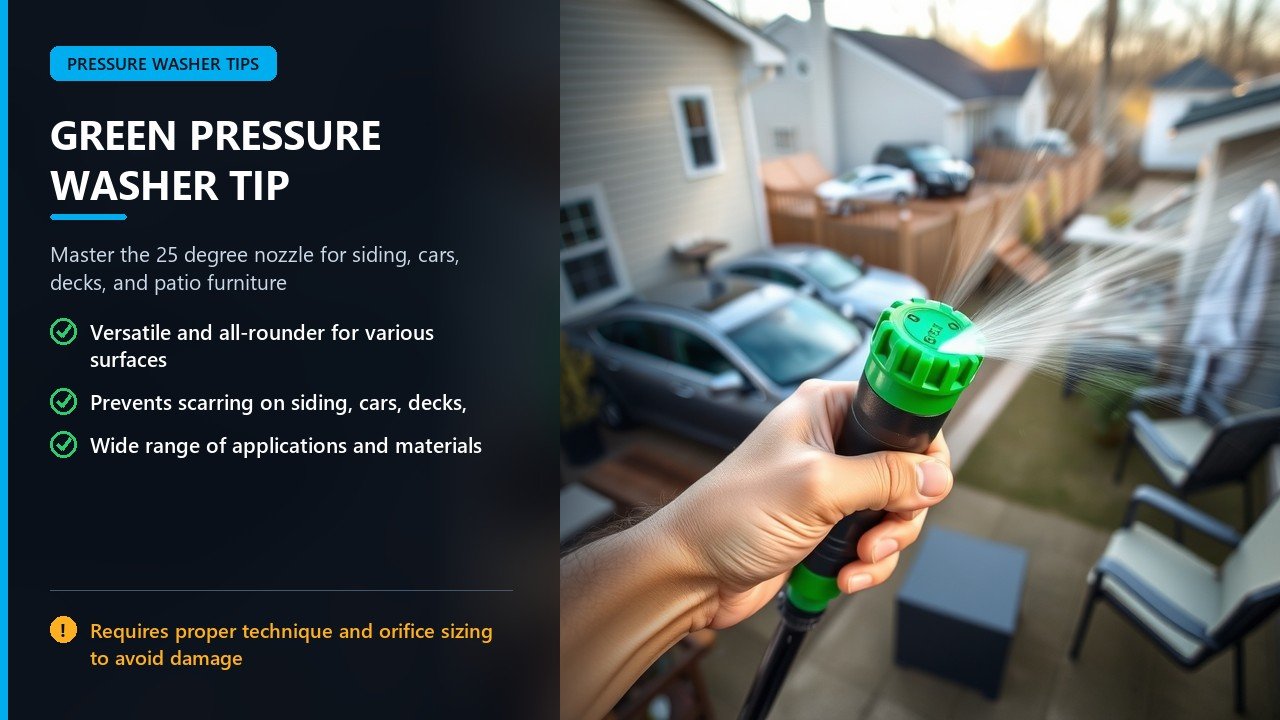
What a Green Pressure Washer Tip Is
A green pressure washer tip is a color-coded spray nozzle with a 25-degree fan pattern. The color is a standardized industry shorthand: red means 0 degrees, yellow 15, green 25, white 40, and black is the low-pressure soap tip. Learn the color code once and you can walk up to any pressure washer and know what each tip will do.
The angle describes how wide the spray opens. A 0-degree tip concentrates the entire stream into a needle point with maximum cutting force and almost no coverage. A 40-degree tip spreads the water into a wide, gentle fan with lower impact and greater coverage. Green sits between them in the versatile middle, balancing enough focus to blast grime with enough width to cover an area in a reasonable time.
Most green tips are stamped stainless steel with a molded collar and a 1/4-inch quick connect plug, which is the near-universal wand standard. They are rated by maximum PSI and by orifice size, both of which must match your machine.
Why Green Is the Versatile Middle Ground
The reason professionals default to green more than any other color is impact control. Every pressure washer nozzle trades coverage for concentration. Green’s 25 degrees clean competently without crossing the line into the aggressive territory that strips paint, furs wood, and etches concrete.
Where red and yellow focus, green covers. Where white and black are too gentle to remove embedded grime, green still cleans. That balance makes it the safest effective choice for the widest range of surfaces, and it is why so many manufacturer guides describe the 25-degree tip as the general-purpose nozzle.
The Full Color Code at a Glance
Green only makes sense in context. Here is how the standard colors compare.
| Color | Angle | Typical Use | Risk Level |
|---|---|---|---|
| Red | 0 degrees | Cutting, stubborn stains, stripping | Very high; can etch and gouge |
| Yellow | 15 degrees | Heavy grime, concrete, tough mildew | High; can strip paint and damage wood |
| Green | 25 degrees | General cleaning: siding, decks, cars, patios | Moderate; the everyday all-rounder |
| White | 40 degrees | Rinsing, delicate and painted surfaces | Low; gentle wide fan |
| Black / brass | About 65 degrees | Soap application, gentle rinse | Lowest; minimal impact |
Many nozzle kits also include a pink or blue “second story” tip, and turbo or rotary nozzles that spin a 0-degree jet across a wider area. Those are specialties layered on top of the base color set. For a complete explanation of every option, including turret and adjustable tips, see our pressure washer nozzle types guide.
What Jobs the Green Tip Handles Best
Green earns its reputation on a specific list of tasks. Reach for it on these surfaces first:
- House siding. Vinyl, aluminum, and fiber cement all tolerate a 25-degree fan from a reasonable distance. Keep the tip moving and work top to bottom.
- Decks and fences. Wood is sensitive, but green from a foot or more away removes gray film and dirt without the gouging a narrow tip causes.
- Cars, trucks, boats, and RVs. A 25-degree tip safely knocks off road film and bugs, provided you keep distance. It is a better starting point than a 15-degree tip on paint.
- Patios, walkways, and driveways. For light-to-moderate grime, green cleans concrete without the aggressive etching red can cause.
- Outdoor furniture and grills. Wide enough to rinse, focused enough to lift grime from plastic and metal.
- Prep work before painting. A green pass preps surfaces for coating by removing dust, chalk, and light contamination without tearing them up.
When green stalls on a job, the usual answer is technique, not a bigger tip. Slow the pass, reduce the distance slightly, or let detergent do the work. Only when a surface genuinely resists a reasonable green pass should you consider yellow.
Sizing the Orifice to Your Machine
Color tells you the angle; the number tells you the size. Every nozzle has an orifice, expressed either as a number (2.0, 3.0, 4.0, and so on) or as a diameter in millimeters. That number controls how much water passes at your machine’s pressure. Wrong size means either weak cleaning or an overloaded pump.
The core rule is simple: match the orifice to your machine’s rated GPM and PSI, then never exceed the pump’s rated pressure. Two machines with similar PSI but very different flow need different orifice sizes.
| Orifice Size (approx.) | Typical Machine Flow | Notes |
|---|---|---|
| 2.0 – 2.5 | Light electric, around 1.2 – 2.0 GPM | Common on small corded units; easy to over-restrict a big machine |
| 3.0 – 3.5 | Residential gas, around 2.3 – 3.0 GPM | The home gas-washer sweet spot |
| 4.0 – 4.5 | Larger gas machines, around 3.5 – 4.0 GPM | Pairs well with surface cleaners and bigger engines |
| 5.0 – 6.5 | High-flow commercial, 5 – 8 GPM | Used with multi-gun and surface cleaner setups |
| 7.0 – 8.0+ | Industrial, 8 GPM and above | Specialty high-flow nozzles and rotary bodies |
If you are unsure, use your machine’s published GPM and PSI to find the recommended nozzle in its manual or a standard nozzle chart. An oversized orifice simply lowers cleaning pressure a little; an undersized orifice raises back-pressure and stresses the pump, which is far more expensive than a set of tips. Our nozzle size selection guide walks through the math.
Green Versus Yellow: When to Step Up
The most common upgrade question is simple: green or yellow? The honest answer is that yellow is a specialist, not an upgrade.
Stay with green when: the surface is finished, painted, soft, or valuable; when you are near trim, weatherstripping, or glass; and when you simply want predictable, safe cleaning on a mix of materials.
Move to yellow when: you face bare concrete with stubborn stains, heavy mildew on masonry, or thick caked mud; and when the surface can take aggressive force without damage. Yellow’s 15-degree fan doubles the concentrated impact of green, which speeds up hard-surface work and speeds up the damage equally if misapplied.
A good habit is to start with green, escalate to yellow only for the spots that resist, and treat red as a last-resort tool for metal and uncoated concrete only. Red is the tip that turns a cleaning project into a repair project, which is exactly how Vince’s driveway ended up with a permanent scar.
Technique: Getting the Most From a Green Tip
A green tip cleans beautifully when you respect a few fundamentals.
Start far, move closer. Begin at three or four feet and close in gradually. Distance is your safest control, and it costs nothing to test from farther back first.
Keep the tip moving. Holding a 25-degree fan in one spot overheats the surface and strips it. Overlap your passes and keep a steady rhythm.
Work top to bottom. Gravity is your ally. Clean high areas first so dirty water runs onto sections you have not yet finished, then rinse downward.
Match the angle to the surface. Hit flat work at a slight angle to push debris rather than drive it in. For siding, angle slightly downward to keep water out of seams.
Use detergent for organic growth. Mildew and mold come back because the spores survive the spray. Detergent with dwell time kills growth rather than merely cleaning it. Pair pressure with a proper detergent pre-treatment instead of chasing stains with force.
Rinse before it dries. On sunny days, work in smaller sections because detergent residue dries quickly and leaves streaks that require a redo.
Surfaces Where Green Is the Wrong Choice
No single tip is universal, and green has its limits. Avoid it, or use extreme care, in these situations:
- Soft wood at close range. Fresh or soft lumber furs even under mild pressure. Use white and keep well back.
- Painted surfaces with loose edges. Any pressure can lift failing paint. Clean gently and repaint rather than peeling it clean.
- Glass and window seals. Direct pressure can force water past seals and break thermal panes. Our window cleaning guide explains the safe approach.
- Asphalt shingles. Roofs should generally be treated with chemical and low pressure, not a cleaning fan.
- Vehicles with loose trim or damaged clear coat. Stay back and use white if the finish is already compromised.
Green is safe for the widest range of surfaces, not every surface. The distinction matters, because the same tip that cleans a driveway cleanly will still damage a soft cedar fence if you antagonize it.
Common Mistakes With the Green Tip
- Starting too close. The single biggest cause of surface damage is holding any tip close on the first pass.
- Confusing pressure with cleaning. Dirt often needs dwell time and flow, not more PSI.
- Using the wrong orifice. An undersized green tip strains the pump and can overheat the water.
- Ignoring nozzle wear. A worn fan sprays unevenly and leaves streaks that look like bad technique.
- Skipping the pre-soak. Detergent softens grime so the green tip can remove it in fewer passes with less risk.
- Keeping only one tip. Buy a spare set; tips are cheap and losing one mid-job halts everything.
- Mixing tip connections. A 1/4-inch tip will not fit a 3/8-inch socket, and forcing adapters invites leaks.
Caring for Your Green Tip and the Rest of the Set
Tips are simple tools, but they degrade. A little care keeps them accurate:
- Flush the nozzle with clear water after every use, especially after detergent.
- Remove and store tips in a holder so the orifice does not collect grit.
- Never poke a wire through the orifice to clear a clog; use a soft bristle or low-pressure air.
- Replace any tip whose fan pattern looks lopsided or streaked.
- Keep the quick connect o-rings in good shape; a leaking connection robs pressure that the tip cannot recover.
- Rinse and dry the holder so it does not corrode and sever the tips into place.
A Cleaning Day, Surface by Surface
Understanding the physics of a fan angle is one thing; seeing how it plays out over a real afternoon is another. Here is how a green tip behaves across the surfaces a typical homeowner faces, and where the limits appear.
The vinyl-sided house. Green is the natural first choice. Working from the top of each wall downward at a slight angle, the 25-degree fan peels away pollen, spider webs, and dirt quickly. The key is distance: three feet back at first, closing in only on stubborn areas. Up close, even green can push water behind siding seams and into wall cavities, so restraint is the whole game. For the second story, a telescoping lance paired with green keeps the operator off a ladder.
The concrete driveway. Here green handles daily grime and light staining well, but heavy oil spots will resist. The smart approach is to pre-treat the oil with a degreaser, let it dwell, then finish with a few green passes. A surface cleaner attachment, which spins its own spray bars, beats a single green tip on wide flatwork because it eliminates the overlap stripes that handheld work creates.
The wood deck. This is where amateurs get into trouble. Soft wood furs under too much pressure, and a green tip held close will raise the grain instantly. The fix is distance and angle: stand well back, spray along the grain rather than across it, and accept that a deck needs detergent and light pressure rather than force. Brightener and sealer do more for a deck’s appearance than water ever will.
The car in the driveway. Green is a reasonable first tip for a dirty car, but only at a distance and only after a foam pre-soak has loosened the grit. The moment you move close, you risk driving water into seams and forcing debris across the clear coat. Most detailers step down to white for the final rinse and never let a 25-degree fan linger on one panel.
The patio furniture and grill. Plastic and powder-coated metal tolerate green from a sensible distance. This is the ideal use case: small, durable items that need grime lifted quickly without a specialized approach.
The pattern holds across every surface. Green cleans well when you respect distance, keep moving, and let detergent and dwell time handle what should not be forced.
Green Tip Versus Turbo and Rotary Nozzles
Turbo or rotary nozzles look like an upgrade to a fixed tip, and sometimes they are. Understanding the difference prevents buying the wrong tool and using it on the wrong surface.
A turbo nozzle contains a zero-degree jet that spins rapidly inside a wider housing. The result is the cutting force of a 0-degree stream applied across a larger footprint, which makes short work of stubborn concrete and masonry. The tradeoff is intensity. A turbo nozzle impacts a surface harder than a 25-degree fan, so it can etch soft concrete, scar wood, and damage anything that cannot take concentrated force.
A green fixed tip spreads that force across the full 25-degree fan with no rotation and predictable coverage. It cannot match a turbo nozzle on raw speed for heavy concrete work, but it is far safer on mixed surfaces and requires less finesse to use correctly.
The practical division of labor is straightforward. For heavy flatwork, a surface cleaner or a turbo nozzle speeds up the job. For siding, decks, vehicles, and anything finished, green is the better default. Many professionals carry both and switch based on the surface rather than the project.
How Angle, Distance, and Impact Connect
Understanding the relationship between spray angle, distance, and cleaning impact helps you use green intelligently instead of memorizing rules.
Angle sets concentration. A narrow angle packs the same water flow into a smaller footprint, raising impact. A wide angle spreads it out, lowering impact while raising coverage. Green’s 25 degrees is the middle ground, and the reason it works on so many surfaces.
Distance changes everything. Doubling your distance from the surface spreads the fan over a much larger area, cutting impact dramatically. This is why moving back is the safest way to reduce damage risk without changing tips, and why creeping closer is the fastest way to cause it.
Flow carries the rinse. Pressure loosens grime; volume washes it away. A machine with more GPM rinses more effectively, which is why high-flow machines clean faster even at moderate pressure. This is also why a green tip on a low-flow machine can leave residue that a high-flow machine removes instantly.
Temperature helps chemistry and grease. Hot water dissolves oils and boosts detergent performance. Where grease is involved, heat often does more than pressure ever could.
Put those four variables together and the logic of green becomes clear: it delivers the most reliable cleaning force across the widest range of surfaces, as long as distance and motion are managed. Master that and you rarely need any other color.
Quick Answers About the Green Tip
What is a green pressure washer tip used for?
It delivers a 25-degree spray for general cleaning of siding, decks, vehicles, patios, and outdoor furniture. It is the balanced all-rounder of the standard tip set.
What degree is green?
25 degrees. Red is 0, yellow 15, green 25, white 40, and black is the low-pressure soap tip.
Is green safe for car paint?
From a reasonable distance it is, but keep the tip off the surface and switch to white for delicate areas. The greater risk is distance and technique, not the color itself.
Can I clean concrete with a green tip?
For light-to-moderate grime, yes, and it is safer than a red or yellow tip. For heavy staining, a yellow tip or a surface cleaner may be required.
Green or yellow for a driveway?
Start green. Escalate to yellow only on bare, unsealed concrete with stubborn stains, and never mix the two up on painted or finished surfaces.
Why does my green tip leave streaks?
Uneven passes, a worn nozzle, or a mismatched orifice are the usual causes. Overlap your strokes, replace worn tips, and match the size to your machine.
How much should a green tip cost?
Individually, a stainless 25-degree tip usually costs a few dollars, and a five-pack runs into the low teens. That price makes keeping a spare set almost trivial, which is exactly why leaving one at the bottom of a bucket is a false economy.
How do I know when a green tip is worn out?
Look at the fan shape against a dark surface. A healthy tip produces a clean, symmetrical triangle with crisp edges. A worn tip spreads unevenly, sprays a ragged pattern, and cleans noticeably slower at the same settings. When the fan stops being sharp, replace the tip.
Does the green tip work with a foam cannon?
No. Foam cannons use their own internal nozzle and metering system, not a quick connect tip. Use the black soap nozzle or the cannon’s built-in head for detergent, and the green tip for pressure cleaning and rinsing.
Final Thought
The green pressure washer tip is the most useful two dollars in your entire kit. It cleans the widest range of surfaces with the least risk, and its 25-degree fan balances coverage and force better than any other color in the box.
Respect the fundamentals: start far, keep moving, work top to bottom, and let detergent soften what pressure should not force. Match the orifice to your machine, replace tips when the fan degrades, and step up to yellow only when a surface can genuinely take it. Do that and green will quietly handle most of your cleaning for years. For the full picture of every color, angle, and specialty tip, start with our power washing nozzle color guide, and pair your green tip with the right rotary tip when speed matters.