Pressure is the headline number on most pressure washers, but it is not the whole story. Flow rate — measured in gallons per minute (GPM) — often determines how fast a machine actually cleans. A high-volume pressure washer prioritizes that flow, moving more water per minute to rinse faster, cover more area, and handle jobs that pressure alone cannot touch.
This guide explains what a high-volume pressure washer is, why flow matters as much as pressure, how the two work together, where high-volume machines shine, how to match one to your water supply, and how to choose and maintain it.
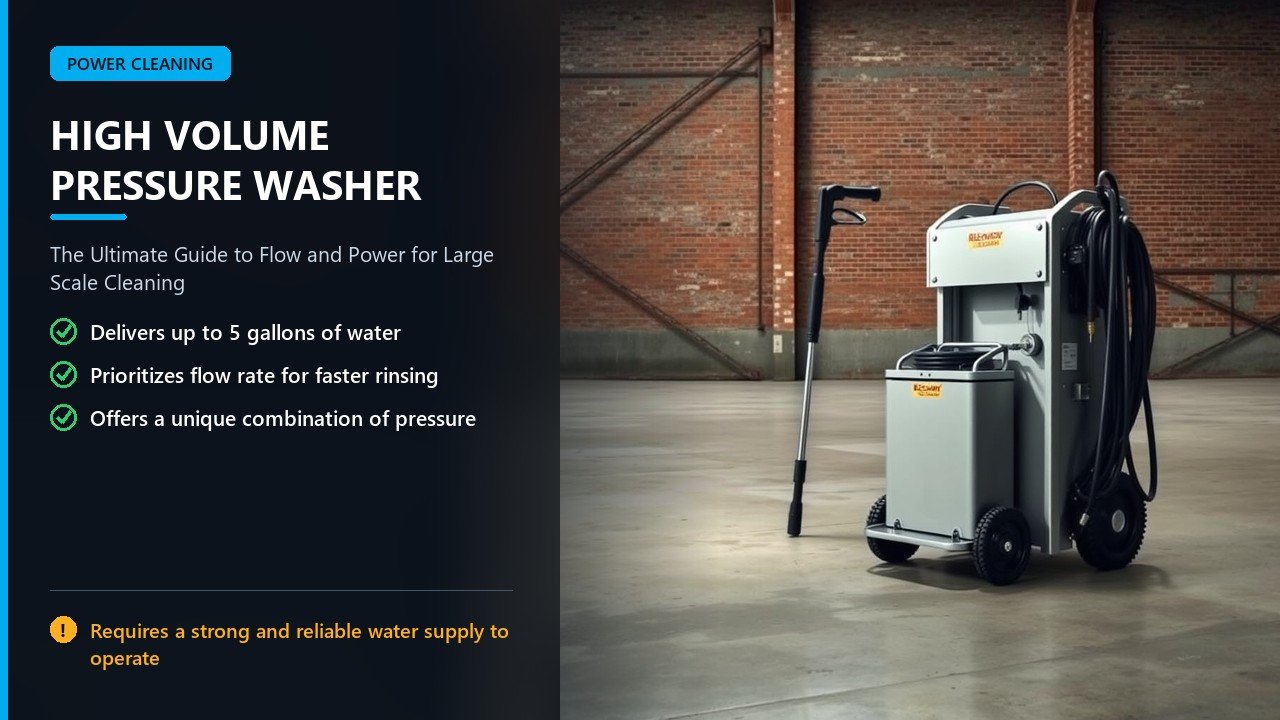
What “High Volume” Means
Volume refers to flow rate: how much water the machine pushes per minute, measured in GPM. A high-volume pressure washer delivers more GPM than a typical residential unit, even if its pressure is moderate.
- Flow rate — gallons per minute (GPM).
- Residential typical — around 1.2–2.5 GPM.
- High-volume — roughly 3–5+ GPM.
- Cleaning units — PSI × GPM, the best single measure of power.
Quick Note: Two machines at the same PSI can clean very differently if their GPM differs. Higher flow means faster rinsing and more surface covered per minute.
Pressure vs Flow: Why Both Matter
Pressure breaks the bond between dirt and the surface. Flow carries the loosened dirt away and keeps the nozzle working efficiently. Neither is enough alone.
| Machine Type | PSI | GPM | Cleaning Units |
|---|---|---|---|
| Light electric | 1,800 | 1.5 | 2,700 |
| Typical gas | 3,000 | 2.5 | 7,500 |
| High pressure | 4,000 | 3.0 | 12,000 |
| High volume | 3,500 | 5.0 | 17,500 |
Short Note: The high-volume machine above has less pressure than the 4,000 PSI unit but far more cleaning power, because its flow is much higher.
Specifications That Matter
| Specification | What to Understand |
|---|---|
| Flow rate (GPM) | The defining feature of a high-volume machine |
| Pressure (PSI) | Enough to lift the dirt you target |
| Pump type | Triplex pumps handle high flow best |
| Drive type | Belt and gear drives suit sustained flow |
| Inlet size | Larger inlets feed more flow |
| Hose diameter | Bigger hose preserves flow to the nozzle |
For a high-volume machine, everything in the system must support flow — a big pump, a big inlet, and a big hose. A small hose will throttle even a powerful pump.
How High Volume Compares
| Type | Strength | Best For |
|---|---|---|
| High pressure, low flow | Cutting through hard grime | Stripping, tough stains |
| High volume, moderate pressure | Fast rinsing, wide coverage | Large flatwork, flood cleanup |
| Balanced | Good all-round performance | Most general cleaning |
High volume is not better than high pressure in every case — it is better for jobs where flushing and coverage matter more than raw force.
Where High-Volume Machines Shine
- Large flatwork — parking lots, driveways, and plazas.
- Fleet and equipment washing — trucks, trailers, and machinery.
- Flood and mud cleanup — moving water and debris fast.
- Agricultural use — barns, stalls, and equipment.
- Municipal and industrial cleaning — streets and drains.
- Surface cleaning at scale — paired with large surface cleaners.
Whenever the job is measured in area per hour rather than force at a single spot, high volume wins.
Who Should Buy a High-Volume Machine
- Contractors and cleaning businesses.
- Farm and ranch operators.
- Fleet and facility managers.
- Municipal and industrial users.
- Serious property owners with large hardscape.
Residential users with modest driveways rarely need high volume. It is a professional and heavy-duty tool for jobs where time and coverage matter.
Water Supply: The Real Limiting Factor
High volume needs a high-volume water supply. This is the most common obstacle owners discover.
| Supply Source | Typical Flow | Adequate? |
|---|---|---|
| Standard garden hose | Varies | Often too low for high GPM |
| Large-diameter hose | Higher | Often required |
| Buffer tank | Set by tank | Yes, reliably |
| Water tank + feed pump | High, anywhere | Best for remote work |
Note: A common solution is a buffer tank that stores water at the machine, letting a modest supply line replenish it while the pump draws at full flow.
Pump and Drive Types
| Type | Notes |
|---|---|
| Triplex plunger pump | Standard for high flow and durability |
| Direct drive | Simple, but runs at engine speed |
| Belt drive | Smoother, cooler, easier on the pump |
| Gear drive | Compact and reliable |
For sustained high volume, belt-drive and triplex pumps are the professional standard because they handle continuous flow with less heat and wear.
Setting Up for Full Flow
- Use a large-diameter inlet hose. Small hoses throttle flow.
- Keep the inlet run short. Long suction lines lose flow.
- Use a high-flow hose (usually 3/8-inch or larger).
- Match the nozzle so it does not restrict the pump’s output.
- Consider a buffer tank if supply is marginal.
- Check for kinks and clogged filters that cut flow.
A high-volume machine is only as good as its plumbing. Every restrictive component between the supply and the nozzle reduces the flow you paid for.
Using a High-Volume Machine Effectively
- Pair it with a surface cleaner sized to its flow.
- Use wide nozzles suited to high flow.
- Work in wide, steady passes.
- Keep the pump cool with continuous water supply.
- Manage runoff — high volume produces a lot of wastewater.
- Match nozzle size to flow rate to avoid back-pressure.
- Check supply flow before starting large jobs.
High-volume machines reward a smooth, continuous rhythm. Stop-start use wastes their main advantage.
Maintenance Schedule
| Task | Interval | Purpose |
|---|---|---|
| Check inlet filter | Every use | Protect the pump from debris |
| Engine oil (gas models) | Per manual | Engine longevity |
| Pump oil | Per manual | Pump longevity |
| Check hose and fittings | Regularly | Preserve flow and safety |
| Inspect nozzles | Regularly | Maintain spray pattern |
| Winterize / store dry | Off-season | Prevent freeze damage |
High-volume commercial machines run hard, so disciplined maintenance is essential. Pump oil and inlet filtration matter most.
Common Mistakes to Avoid
- Buying high volume without checking water supply. The machine starves.
- Using a small hose. It throttles flow.
- Undersizing the nozzle. Back-pressure strains the pump.
- Running dry. Damages the pump quickly.
- Ignoring pump oil. Shortens pump life.
- Neglecting winterization. Freeze damage is expensive.
- Choosing pressure over flow for coverage jobs. Volume cleans large areas faster.
Cost and Value
| Class | Typical Price | Best For |
|---|---|---|
| High-volume residential | $500–$1,000 | Large home hardscape |
| Professional/commercial | $1,000–$3,000+ | Contracting and fleet work |
| Industrial/hot water | $3,000+ | Heavy-duty continuous use |
High-volume machines cost more upfront, but for professional users the time saved often justifies the investment quickly.
Surface Cleaners: The Perfect Partner
High-volume machines pair best with large surface cleaners, which use the flow to clean flat areas evenly and quickly.
| Surface Cleaner Size | Recommended GPM | Best For |
|---|---|---|
| Small (12–16 inch) | 2–3 GPM | Residential work |
| Medium (18–24 inch) | 3–4 GPM | Commercial flatwork |
| Large (up to 36-inch) | 4–8 GPM | Industrial and municipal |
Short Note: A surface cleaner sized to your flow is the single biggest productivity upgrade for a high-volume machine — it converts flow into finished square footage.
Nozzle Sizing for High Flow
Nozzles must be matched to flow and pressure, or the machine cannot perform as designed.
- Undersized nozzle — restricts flow and raises pressure, straining the pump.
- Oversized nozzle — lowers pressure so the spray loses cleaning force.
- Correct size — balances pressure and flow at the rated output.
- Nozzle charts list the correct orifice size for each PSI/GPM combination.
Note: A high-volume machine with the wrong nozzle can underperform a much smaller machine. Always size the nozzle to the machine.
Heating the Water
| Water Type | Benefit |
|---|---|
| Cold water | Simple, no heat source needed |
| Hot water | Cuts grease and oils far faster |
| Steam | For the toughest industrial grime |
Many high-volume machines offer a hot-water option, which multiplies their effectiveness on grease, oil, and food-processing grime. Hot water plus high volume is a powerful combination.
Estimating Productivity
You can estimate how much area a high-volume machine can cover per hour by considering flow and the surface cleaner’s width.
- Flow sets the rinse speed.
- Cleaner width sets how much area passes per pass.
- Overlap and pass speed reduce practical coverage.
- Grime level determines how slowly you must move.
Higher GPM generally means you can move faster while still rinsing clean, which is exactly why professionals choose volume for large-area work.
Safety With High Flow
- Respect the nozzle spray. Flow increases the volume of water, not the safety margin.
- Wear eye protection and boots. Large volumes splash widely.
- Watch for slippery surfaces. Rinsing creates runoff fast.
- Manage electrical safety around outlets and equipment.
- Direct runoff responsibly to avoid pollution and drainage issues.
The U.S. Environmental Protection Agency’s guidance on stormwater and washing (EPA) is worth reviewing, since high-volume work produces a lot of runoff.
Choosing the Right High-Volume Machine
| Priority | What to Prefer |
|---|---|
| 1. GPM and PSI balance | Enough flow plus the pressure your jobs need |
| 2. Water supply match | Your source must meet the machine’s GPM |
| 3. Pump type | Triplex for durability |
| 4. Drive type | Belt or gear for sustained flow |
| 5. Hose and inlet size | Large diameter to preserve flow |
| 6. Portability and support | Needed features and service network |
For most buyers, the deciding factor is the water supply. A high-volume machine is only as good as the flow feeding it.
High Volume vs High Pressure: A Quick Decision
| Your Job | Better Choice |
|---|---|
| Stripping paint or tough stains | High pressure |
| Washing large fleets | High volume |
| Cleaning big parking lots | High volume |
| Removing rust or graffiti | High pressure |
| Flood and mud cleanup | High volume |
| General home cleaning | Balanced |
If speed over large areas is the goal, choose volume. If force at a stubborn spot is the goal, choose pressure. Many professional rigs combine both.
Real-World Scenarios
Scenario 1: A fleet washing company. A high-volume belt-drive machine with a buffer tank washes dozens of trucks a day far faster than a high-pressure residential unit.
Scenario 2: A farmer cleaning a barn. High flow flushes stalls and equipment efficiently, carrying waste away rather than just blasting it.
Scenario 3: A contractor cleaning a parking lot. A high-volume machine paired with a large surface cleaner covers the area in a fraction of the time.
Frequently Asked Questions
What is a high-volume pressure washer? A machine that delivers more gallons per minute (typically 3–5+ GPM) than standard residential units, for faster rinsing and coverage.
Is volume more important than pressure? Neither is universally better. Volume excels at coverage and rinsing; pressure excels at cutting through tough grime.
What is a cleaning unit? PSI × GPM. It combines pressure and flow into one number that better reflects real cleaning power.
Will a high-volume machine work on a garden hose? Often not at full flow. Many require a larger hose, a buffer tank, or a feed pump.
Why do high-volume machines use belt drives? Belt drives run the pump slower and cooler, improving durability under continuous high flow.
Do I need high volume for home use? Rarely. It suits professional, agricultural, and large-scale cleaning rather than typical residential tasks.
Final Thoughts
A high-volume pressure washer trades some raw pressure for flow, and that trade pays off whenever the job is measured in area covered and time saved. For fleets, farms, municipalities, and large hardscape, high volume is the productivity tool of choice.
The key is the water supply: match the machine’s GPM to a source that can feed it, use large-diameter hose, and keep the pump maintained. For related reading, see our guides on the gas engine pressure washer and 4000 PSI power washer.