There is a moment every pressure washing business hits where the machine stops being the problem and the engine starts becoming the conversation. The crews that outgrow a single-cylinder workhorse typically end up in the same conversation about the same powerplant. A honda gx690 pressure washer is built around a 688cc V-twin that has quietly become the default answer for high-flow commercial rigs in the United States.
It is not a fashion choice. Contractors land on a honda gx690 pressure washer for a few stubborn reasons that have very little to do with marketing and everything to do with how a production machine behaves at four in the afternoon on the fourth job of the day. It carries torque that single-cylinder engines cannot, starts reliably when electric start is wired correctly, and parts for it exist in nearly every small engine shop in the country. When your revenue depends on the machine running tomorrow, parts availability is not a minor detail.
This guide looks at the engine honestly, including where it is the right call and where it is genuinely overkill. We cover the specifications that matter, how it pairs with flow and pressure in real configurations, the pump and drive arrangements that suit it, fuel and maintenance economics, common buying mistakes, and the operating routine that keeps a V-twin rig productive for a decade.
What the GX690 Actually Is
Honda’s GX V-twin series sits above the GX390 and GX630 in the commercial lineup, and the specifications explain why builders reach for it on demanding machines.
- Displacement. 688 cubic centimeters across two cylinders, nearly twice the swept volume of a GX390.
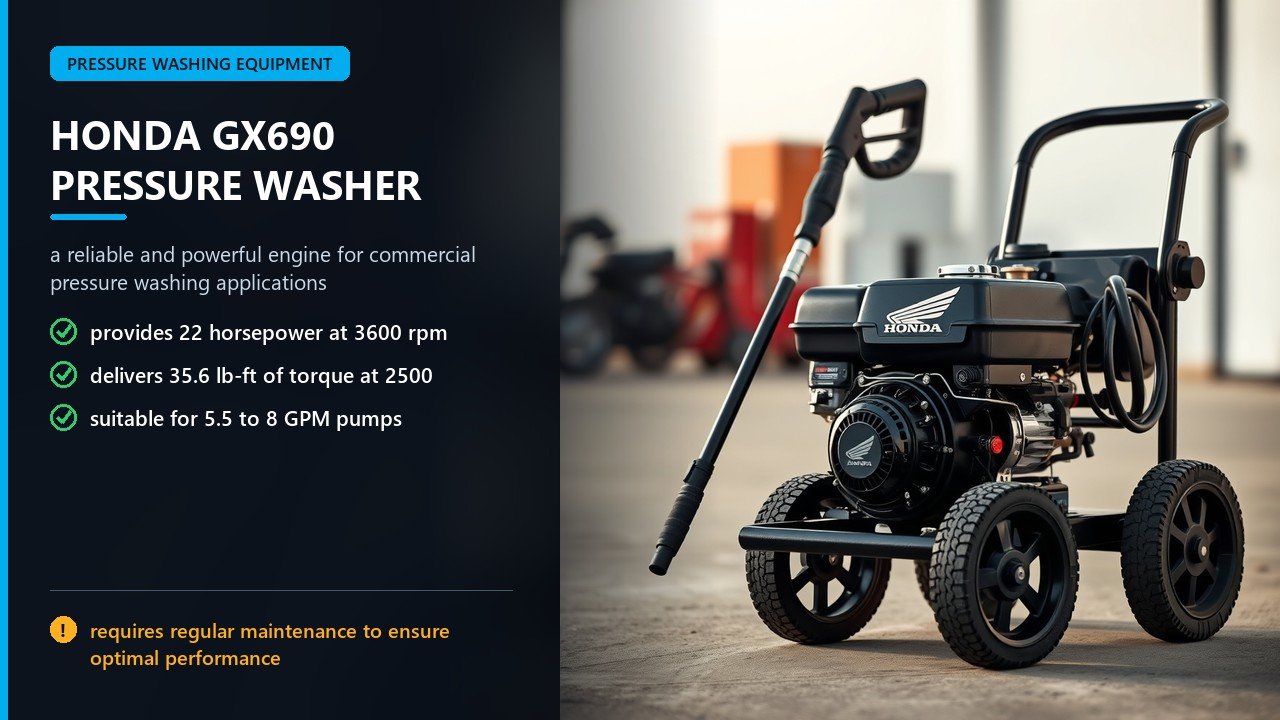
- Power. About 22.1 net horsepower at 3,600 rpm in the higher-output configuration, with a lower rating of roughly 20.8 hp depending on the specification variant.
- Torque. 35.6 lb-ft at 2,500 rpm, which is the figure that matters when a wide-orifice nozzle opens and the pump suddenly demands real work.
- Design. Horizontal shaft, overhead valve, hemispherical combustion chamber, two-barrel carburetor with internal venting.
- Lubrication. Full-pressure delivery with a high-capacity pump feeding crankshaft, connecting rod, and PTO bearings.
- Ignition. Digital CDI with variable timing, plus a rev limiter to prevent over-rev damage.
- Weight. Roughly 98 pounds dry, which is why it only makes sense on frames built to carry it.
- Warranty. Honda backs the series with a three-year domestic and commercial warranty.
Notice that torque peaks well below maximum rpm. That is the characteristic that separates a purpose-built commercial engine from a converted consumer one. When a pressure washer loads up, it does not stay politely at peak power; it drops into the torque band and needs to pull itself back. A V-twin with torque on its side recovers without bogging.
Why Contractors Standardize on It
The reasons a contractor reaches for a honda gx690 pressure washer show up in the field rather than on the spec sheet.
- It holds flow under load. High-GPM pumps need sustained power, not short bursts. A GX690 sits comfortably in its range while an underpowered engine hunts and overheats.
- Parts are findable. Carbs, air filters, plugs, starters, and switches are stocked across the country. A specialty engine can strand a machine for weeks.
- Electric start is standard on most builds. Once a machine is heavy enough to mount permanently on a truck or trailer, a key start is expected.
- It runs cooler than singles at comparable load. Two cylinders and more surface area spread the heat that cooks seals and varnish on long days.
- It holds resale value. A used rig with a GX690 in good condition sells faster and higher than the same frame with an unfamiliar engine.
- The service interval is honest. Oil changes, valve lash checks, and filter swaps follow a clear schedule that any technician can execute.
- It supports the whole class of accessories. Enough power to drive large surface cleaners, long hose runs, and chemical systems without sagging.
If you have been comparing the commercial tier more broadly, our guide to why contractors trust Honda engines covers the reasoning behind the brand loyalty.
How It Pairs With Pressure and Flow
The GX690 rarely appears on light machines. It earns its place only where the work demands it, and the common configurations cluster tightly.
| Configuration | Pressure | Flow | Typical Drive | Best Fit |
|---|---|---|---|---|
| Light commercial V-twin build | 3,500 PSI | 5.5 GPM | Gear or belt | Full-time residential and flatwork |
| Standard production rig | 3,000 PSI | 8.0 GPM | Belt, low-RPM pump | Commercial flatwork and fleet washing |
| High-flow build | 3,500 PSI | 8.0 GPM | Belt with cog or 3VX belt | High-volume washing and soft wash feed |
| Hot water conversion | 3,000 PSI | 4.0 to 8.0 GPM | Belt with burner load | Grease, food service, fleet bays |
The pattern matters: as flow climbs, pressure often steps down, and the engine is matched to cleaning units rather than to the biggest number on a sticker. A 3,000 PSI machine at 8.0 GPM produces 24,000 cleaning units, which is far more usable cleaning than a 4,500 PSI machine at 2.5 GPM, and it does the work with better rinsing.
Our explainer on 8 GPM Honda machines walks through the high-flow end of this range in detail.
Single Cylinder Versus V-Twin in Plain Terms
The comparison is not really about horsepower. Two engines can print the same figure and behave completely differently.
- Pulse. A single-cylinder engine delivers power in discrete thumps. A V-twin’s firing order smoothes delivery, so the pump sees steadier input and the water stream pulses less.
- Recovery. Open a large nozzle and the load jumps instantly. The V-twin’s torque reserve brings rpm back without the audible sag a smaller engine makes.
- Vibration. Fewer harsh impulse events means less shaking through the frame, the unloader, and the fittings. Vibration is what loosens hardware over a season.
- Heat. Two cylinders and more mass spread thermal load. Engines that run cooler do not cook their own oil.
- Smoothness under bypass. When the operator releases the trigger and the machine recirculates, a calmer engine reduces heat soak during those stretches.
The tradeoffs are cost, weight, and a slightly higher fuel appetite. On a machine that runs every working day, those tradeoffs usually resolve in favor of the V-twin.
If you are still deciding where the line falls, our piece on flow versus pressure explains why bigger does not automatically mean better for every operator.
Drive Types That Suit a GX690
How power reaches the pump matters as much as how much power exists.
Direct drive
Compact, inexpensive, and simple, but the pump spins at engine speed. On a big engine pulling high flow, that means heat, vibration, and wear concentrate in the pump. Direct drive suits smaller machines better than this one.
Belt drive
The common pairing for GX690 builds. A belt reduces pump rpm, runs it cooler, absorbs shock loads, and lets you service either side independently. Many commercial builds use a four-groove cog belt or a 3VX system for balanced power transfer.
Gear drive
Enclosed, efficient, and durable with a fixed ratio. Excellent when the ratio is right, less forgiving when it is not, since you cannot slip a belt to relieve a shock load.
The general rule is that a machine with a GX690 on it should not have an axial pump bolted straight to the crank. The engine deserves a rebuildable triplex on a reduction drive, and the frame deserves the structure to hold both without flexing.
For frame and packaging choices, see our guide to pressure washer carts and frames.
Water Supply Demands at This Level
A GX690 usually means a high-flow machine, and high flow means the supply becomes the weak link fast. An 8 GPM pump will happily outdrink almost any residential spigot.
The professional answer is a buffer tank with a float valve. The tank refills slowly from the site faucet while the pump draws freely from the reservoir, so pump demand and supply rate are decoupled. Tanks in the 100 to 325 gallon range cover most work, and a 100 gallon unit is the common minimum for a compact rig.
Feed plumbing deserves attention too. Use three-quarter inch or larger supply hose, keep the inline filter clean, open the valve fully, and never let the tank run dry. Cavitation is one of the fastest ways to destroy an otherwise excellent pump.
Our water tank mounting guide covers plumbing and placement, and our 8 GPM setup guide shows how the pieces fit together on a working rig.
Pump Options Worth Pairing With the Engine
The engine gets the attention, but the pump does the work. Rebuildable triplex pumps from established manufacturers are the norm at this tier.
| Consideration | What to Look For | Why It Matters With a GX690 |
|---|---|---|
| Pump type | Rebuildable triplex plunger | Sealed units waste the engine’s capability |
| Drive speed | Low-RPM pump through belt reduction | Runs cooler and extends seal life |
| Unloader | Adjustable, correctly sized for flow | Keeps bypass stable on a high-volume machine |
| Bypass cooling | Thermal relief or thermostat | Prevents heat soak during trigger-off periods |
| Inlet filtration | 50 mesh or finer, serviceable | Protects plungers when feeding from a tank |
| Parts access | Seals, valves, and oil locally available | Downtime is the real cost of a rare pump |
Check pump oil on schedule and after any heavy season. Our walkthrough on changing pressure washer pump oil covers the procedure.
GX690 Versus the Alternative Powerplants
The V-twin is not the only way to build a production machine. Here is how it stacks against the engines you will realistically be offered instead.
| Powerplant | Displacement | Typical Output | Typical Flow It Suits | Honest Assessment |
|---|---|---|---|---|
| Honda GX390 class single | 389 cc | 11 to 13 hp | Up to 4.0 GPM | Excellent value, runs out of breath on high flow |
| Honda GX690 V-twin | 688 cc | 20.8 to 22.1 hp | 5.5 to 8.0 GPM | The benchmark for sustained commercial duty |
| Other V-twin commercial engines | 600 to 750 cc | 18 to 24 hp | 5.5 to 8.0 GPM | Credible where parts and dealer support exist locally |
| Large singles in the 400 to 500 cc range | 400 to 500 cc | 13 to 16 hp | 4.0 to 5.5 GPM | A workable middle when the budget is tight |
The deciding factor is rarely peak output. It is whether parts, service, and support exist where you work. An engine that out-specs a Honda but cannot be repaired inside a week is a liability for a business that bills by the job. That single consideration explains most of the market’s behavior, and it is why a honda gx690 pressure washer remains such a common sight on American work trucks even when cheaper sheets of paper promise more.
Where the GX690 is genuinely the wrong choice is worth stating plainly. If your schedule is light, if your water supply is poor and you have no plan to fix it, or if the machine will sit idle for months at a time, the extra displacement buys you cost and fuel burn rather than capability. Buy the engine your workload can feed.
What to Inspect Before You Buy
Whether the machine is new or used, the inspection routine is the same.
- Confirm the engine is genuine. Check serials, casting marks, and dealer verification rather than trusting a sticker on a frame.
- Read the hour meter. Under a thousand hours is early life for a properly maintained unit; far beyond that, price the rebuild into your decision.
- Check both oils. Pull the engine dipstick and the pump sight glass. Milky oil, metal glitter, or burnt smell all end the conversation.
- Inspect the drive. Belt condition, cover presence, tension adjustment, and pulley wear tell you how the machine was treated.
- Look at the frame. Rust at mount points, cracked welds, or improvised repairs indicate structural neglect.
- Test cold start and charging. A machine that only starts warm has a problem the seller may not mention.
- Verify the pump model. Confirm it is a rebuildable triplex and that seals are stocked near you.
- Check the unloader and bypass. With the trigger closed, pressure should behave predictably and the machine should not heat-surge.
- Follow the plumbing. Look for kinked supply hose, missing strainers, and improvised fittings that hint at cavitation history.
- Ask for maintenance records. No records means you should assume none happened.
A seller who welcomes that inspection is usually selling a machine that will pass it.
Fuel Economy and Operating Cost
A 688cc V-twin consumes noticeably more fuel than a 390cc single, and honest budgeting should say so. Published figures put consumption around 6.7 liters per hour at rated load, which translates to roughly 1.8 gallons per hour under full power. Real-world pressure washing load cycles lower than continuous rated output, so typical burn often lands nearer one to one and a half gallons per hour with regular stoppages.
Those numbers look alarming until they are placed against the revenue the machine produces. A rig that finishes jobs forty percent faster generates meaningfully more billable work per tank, and the fuel line is usually far smaller than the labor line.
Worth budgeting alongside fuel:
- Oil changes on both engine and pump, more often under dusty or sustained conditions.
- Air filter elements, especially in dry, high-debris environments.
- Belt inspection and tension adjustment.
- Valve lash checks at recommended intervals.
- Battery maintenance on electric start machines.
- Spark plugs and fuel system cleaning on a fixed schedule.
None of these are expensive individually. Skipping them collectively is what shortens an engine’s life.
Buying Mistakes to Avoid
- Buying the engine and forgetting the pump. A V-twin driving a cheap sealed pump is a mismatch that wastes the investment.
- Skipping the drive reduction. Spinning a pump at engine speed on a big engine cooks it. Insist on belt or gear reduction.
- Ignoring water supply. A high-flow machine without a tank plan is a machine that develops mysterious pressure problems on day one.
- Undersizing the frame. Ninety-eight pounds of engine plus pump, belt guard, fuel tank, and battery needs real structure and proper isolation.
- Overlooking the battery. Electric start with a weak or undersized battery turns a feature into a daily frustration.
- Buying without service access. Confirm that a dealer near you can source Honda parts and that pump seals are stocked locally too.
- Choosing an oversized machine for light work. If most of your schedule is small patios, a V-twin rig costs more to run than it earns.
- Ignoring emissions rules by region. Some configurations are restricted for sale or use in certain states. Verify before purchasing, particularly for carbureted non-compliant fuel system variants.
A Maintenance Routine That Keeps It Alive
The engines that reach ten seasons all follow boring, consistent habits.
- Every day. Check engine oil, pump oil, air filter condition, fuel level, and belt tension. Glance at fittings and hose for wear.
- Every 50 hours. Change engine and pump oil, inspect plugs, clean or replace the air element, and check valve lash on schedule.
- Every 200 hours. Replace fuel filter, inspect the battery and charging system, and check belt condition and alignment closely.
- Seasonally. Drain fuel if the machine will sit, inspect the unloader, replace worn nozzles, and pressure-test hoses.
- Always. Let the machine idle briefly before shutdown after heavy work, and store it dry, covered, and out of freezing temperatures.
Track hours in writing. A log turns maintenance from a guess into a schedule, and it also transforms the resale conversation when you eventually upgrade.
Related reading on general upkeep lives in our business machine matching guide, where the cost of ownership is framed against the work you actually sell.
Is a Honda GX690 Pressure Washer Worth It?
It depends entirely on volume. For an operator running a full schedule of commercial flatwork, fleet washing, or soft washing, the answer is yes and usually without much hesitation. The machine pays back through speed, uptime, parts availability, and resale.
For a part-time or residential-focused operator, the honest answer is that a smaller machine will serve better and cost less. Buying more engine than your workload justifies is not an upgrade; it is overhead.
The middle path is to buy the machine sized for the work you have now and the work you can realistically book in the next season, not the dream workload. Engines of this class are built for hard duty and will reward a crew that uses them properly for years. They will also punish neglect, because a V-twin running without oil changes on a starved water supply fails just as thoroughly as any other engine.
Choose the right pump, install a tank, keep the belt cover on and tensioned, log your hours, and this powerplant will spend most of its life as the most boring component on your rig, which is exactly what you want an engine to be.
Frequently Asked Questions
How much horsepower does a Honda GX690 have? Roughly 22.1 horsepower at 3,600 rpm, with some specification variants rated near 20.8 hp. Torque is 35.6 lb-ft at 2,500 rpm.
What size pressure washer does a GX690 typically drive? Usually 5.5 to 8 GPM at 3,000 to 3,500 PSI, most often through a belt-driven triplex pump.
Is it better than a GX390? For high-flow commercial work, yes. A GX390 is an excellent single-cylinder engine for 4 GPM class machines, while the GX690’s V-twin torque and recovery suit sustained heavy loads.
Does it need a buffer tank? If it drives a high-flow pump, almost certainly. An 8 GPM machine will outdrink a typical faucet without a tank between them.
What drive type should it use? Belt or gear drive with pump speed reduction. Direct drive puts the pump under unnecessary stress at this power level.
How much fuel does it burn? Published consumption is around 6.7 liters per hour at rated load. Actual pressure washing duty cycles usually run lower, often between one and one and a half gallons per hour.
Is electric start standard? On most pressure washer builds in this class, yes, typically with a marine battery box and easy-access wiring.
What maintenance does it need? Regular oil changes, air filter service, valve lash checks, fuel filter replacement, spark plugs, and belt inspection, all tracked by operating hours.
How often should the oil be changed? Follow the interval in the Honda manual for severe service, which is typically every 50 hours or once a season for pressure washing duty. Check level daily, because a hard-working V-twin consumes a small amount over a long day.
Can it run a hot water burner? Yes, and it is a common pairing, but the machine must be engineered for it. Burner fuel, exhaust routing, heat shielding, and pump specification all change when a burner is added to the frame.
What frame suits it? A rigid welded or aircraft-grade aluminum frame with isolated mounts, oversized flat-free tires, and a single-bolt interlocking belt cover. Flex in the frame misaligns the drive and shortens belt life.
Will it idle all day? It will tolerate idling between jobs, but prolonged idling builds heat and carbon. Shut it down if the gap runs longer than a few minutes, and always let it cool briefly after sustained full-load work.
Is it worth paying more for genuine Honda parts? On critical components such as ignition, decompression, and gaskets, yes. On consumables like filters and plugs, quality equivalents are acceptable if they match the specified rating.
Final Thoughts
The Honda GX690 earned its reputation the unglamorous way, by being the engine that keeps working when the job runs long and the schedule runs tight. It brings real torque, smooth delivery, cold-start reliability, and a parts network that treats a breakdown as an inconvenience rather than a crisis.
Match it to a rebuildable triplex pump on a belt drive, feed it from a buffer tank, frame it properly, and respect its maintenance schedule, and a honda gx690 pressure washer becomes the least interesting part of your rig. That is the highest compliment you can pay a commercial engine.
The crews that treat engines this way tend to be the ones still washing full schedules years later, while the ones chasing the cheapest sheet of paper tend to be shopping for another machine sooner than they planned. Capability is what the spec sheet sells you. Reliability is what the next few seasons of work actually depend on.
Sources and Further Reading
- Honda Engines, GX V-twin model specifications and features: engines.honda.com
- Honda Engines, pressure washer engine applications: engines.honda.com
- Honda GX690 technical sell sheet: engine.honda.ca
- Honda GX690 product page, full specification data: honda-engines-eu.com
- U.S. Occupational Safety and Health Administration, pressure washing safety guidance: osha.gov