How Does Electric Snow Shovel Work? Inside the Auger, Motor, and Grip
An electric snow shovel is one of those tools that feels almost magical the first time you use it. You plug it in or drop in a battery, squeeze a trigger, and a compact piece of equipment throws snow off your walkway while you stand upright. But the mechanism behind that trick is simple once you break it down. Understanding how an electric snow shovel works helps you use it correctly, avoid the mistakes that clog it, and recognize when a problem is a quick fix rather than a dead machine.
In one sentence: An electric motor spins a rubber paddle auger inside a metal housing. The paddles scoop snow up off the pavement and fling it forward through a discharge, while a scraper blade keeps the housing tight to the surface.
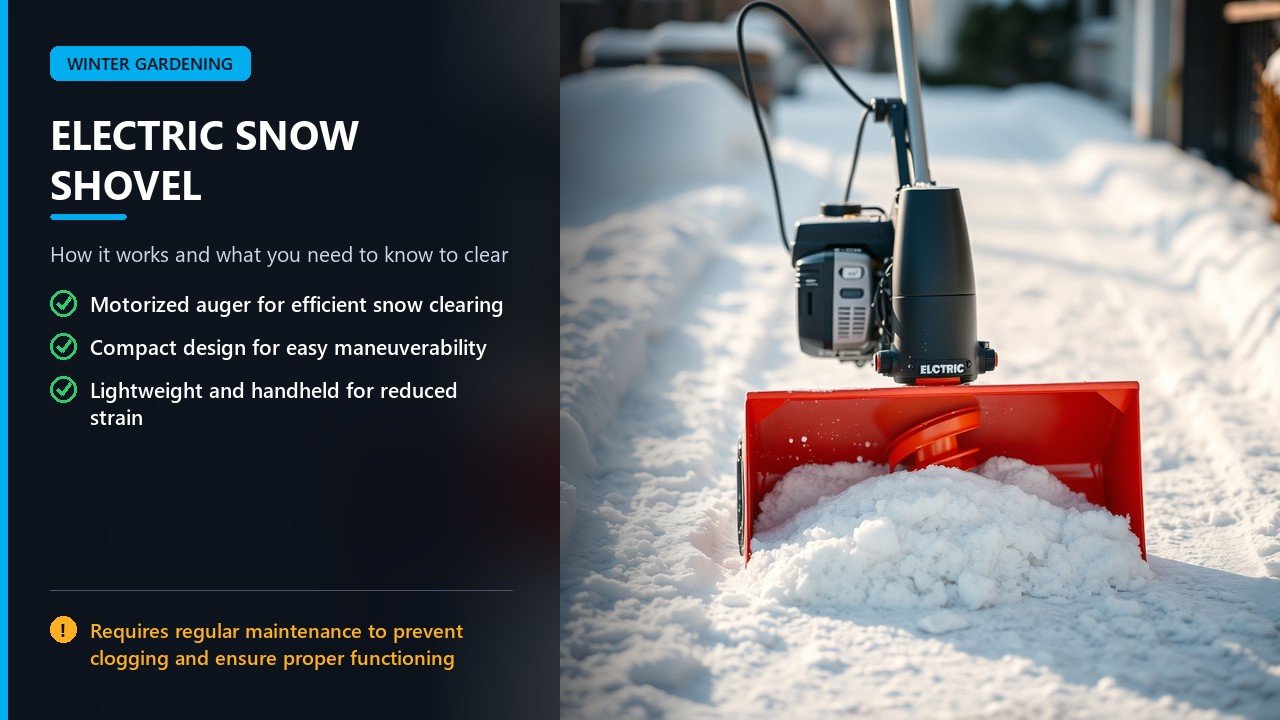
The Short Answer: What an Electric Snow Shovel Does
An electric snow shovel is a lightweight, handheld machine that clears snow from walkways, driveways, decks, and patios. Unlike a manual shovel, it does not ask you to lift and throw snow with your back. Instead, a motor-driven paddle auger scoops snow off the ground and discharges it forward, typically 15 to 25 feet, at a pace dictated by how fast you walk.
The machine is essentially a compact, single-stage snow-clearing tool. Its working part is a two-blade paddle auger that spins fast inside a curved housing. Push the shovel forward and the spinning paddles catch the snow, lift it, and throw it out the front. The electric snow shovel is best thought of as a motorized scoop rather than a full snow blower, and that distinction explains both what it does well and where it struggles.
The Four Core Parts of an Electric Snow Shovel
Nearly every electric snow shovel, corded or cordless, shares the same four-part architecture. Learn these and you understand the whole machine.
- The motor: an electric motor in the housing that converts electricity into rotation. It is the only power source; there is no engine, no fuel, and no exhaust.
- The auger: a rubber or high-impact paddle assembly mounted on a horizontal axle in front of the motor. This is the part that contacts and moves the snow.
- The rotor housing: the curved metal shell that surrounds the auger and shapes the direction the snow is thrown.
- The handle and controls: the pole, grips, trigger, and safety lock that let you hold the machine, start it, and steer the discharge.
Everything else on the shovel, from the scraper blade to the extension-cord restraint hook, exists to support one of those four systems. If you can name them, troubleshooting becomes far less mysterious.
The Motor: The Power Source That Spins Everything
The motor is the heart of the machine. On a corded model, it runs on standard household alternating current, usually 120 volts, and draws anywhere from 8 to 13 amps depending on the model. On a cordless model, it runs on a lithium-ion battery pack, often 24 volts, 40 volts, 60 volts, or 80 volts. A hybrid model such as the Snow Joe iON13SS-HYB can run on either a battery or an AC cord, which is why it lists both a battery voltage and an amp rating.
Motor construction matters more than most buyers realize. A brushed motor is simpler and cheaper; a brushless motor is more efficient, quieter, and longer-lived. A brushless motor of 500 watts can outperform a brushed motor of higher rated watts because less energy is wasted as heat and friction. The motor spins at a fixed no-load speed, often between 1,500 and 2,600 rpm, and that speed is what drives the auger.
| Motor type | Typical spec | What it means for you |
|---|---|---|
| Brushed AC (corded) | 8–13 A, 120 V | Unlimited runtime, needs an outlet and cord |
| Brushed DC (cordless) | 400 W, 24–80 V | No cord, runtime limited by battery |
| Brushless DC | 500 W, 40–80 V | More torque per watt, longer life, quieter |
The Auger: The Part That Actually Moves Snow
The auger is the working heart of an electric snow shovel. In almost every model it is a two-blade paddle auger: two curved blades, usually rubber-edged or made of high-impact, low-temperature-resistant plastic, mounted opposite each other on a horizontal shaft. The paddle shape and rubber edge are deliberate. Rubber flexes over uneven pavement and small obstacles, reducing damage to both the blade and the surface, while the wide flat face catches a broad ribbon of snow with each rotation.
When the motor spins, the auger turns at the same no-load speed as the motor, often 1,500 to 2,600 rpm. At that speed, the paddles act like a fast revolving scoop. They bite into the snow at the bottom of the housing, carry it up the curved back wall, and release it forward. Because the paddles are wide and the housing is shallow, the snow is thrown rather than carried; the machine only needs to move forward at walking pace to clear a continuous path.
The auger is also the part most associated with injury, which is why every manual warns you never to clear a clog with your hands. The 8-amp electric snow shovel manual is blunt about it: hand contact with the rotating paddle is the most common cause of injury. Stop the motor and unplug the machine before you touch the housing, always.
The Rotor Housing and Scraper Blade
The rotor housing is the curved metal shell that wraps around the auger. It does two jobs. First, it protects the spinning paddles and the operator from each other. Second, its shape controls the direction snow travels once the paddles release it. The housing is open at the front so snow can be thrown forward, and its curved back wall guides the snow upward and out.
At the very bottom of the housing sits the scraper blade, a flat metal or plastic strip that rides along the pavement. The scraper does not spin; it simply sits between the spinning auger and the ground, scraping the last fraction of an inch of snow and protecting the auger edge from direct contact with the surface. A worn scraper is why a machine starts leaving a thin layer of snow behind, and replacing it is one of the simplest repairs you can make.
The Handle, Trigger, and Safety Lock
The handle assembly is more than a place to hold on. It contains the controls that start and stop the motor safely. Almost every electric snow shovel uses a two-step start: a safety lock switch plus the main trigger. You press and hold the safety lock with your thumb, then squeeze the trigger. On a cordless model such as the cordless snow shovel tested by Lowe’s, you can release the safety lock once the machine is running, but you must re-engage it to start again. Release the trigger and the motor stops almost instantly.
The handle also carries an extension-cord restraint hook on corded models. This small hook takes the strain of the cord so the plug does not pull loose from the machine while you work. It is easy to ignore until your cord unplugs mid-pass on a cold morning. The pole is usually jointed so you can set the handle height, and many models add an auxiliary handle partway down the shaft for a second grip point when you push into deeper drifts.
How the Parts Work Together, Step by Step
Here is the whole sequence, from trigger to thrown snow, in order.
- You start the motor. The safety lock and trigger close the circuit, and the electric motor begins to spin.
- The motor turns the auger. Rotation is passed from the motor to the auger axle, either directly or through a belt.
- The paddles bite the snow. As the auger spins, its rubber-edged blades scoop snow off the pavement at the bottom of the housing.
- The curved housing redirects the snow. The back wall of the rotor housing lifts the snow and channels it toward the open front.
- Centrifugal force throws the snow clear. At speed, the snow leaves the paddles and flies forward 15 to 25 feet.
- You walk forward. The scraper blade keeps the housing tight to the surface, and the machine clears a continuous swath as you advance.
That is the entire mechanism. There is no combustion, no impeller fan, and no second stage. The simplicity is the point, and it is why these machines are so light and easy to start.
Why the Auger Pulls the Shovel Forward
One surprise for new owners is that the machine seems to walk itself. Push the auger into a bank of snow and you feel a gentle forward tug. This is not your imagination. As the paddle bites snow and rotates, the reaction between the blade and the snow produces a small forward force, and many testers report the auger actually propelling the unit forward. The effect is mild, but it is why these shovels feel easier to push through snow than bare pavement. You still steer and set the pace; the auger simply helps.
Corded vs Cordless: The Same Mechanism, Different Power
From a mechanical standpoint, a corded and a cordless electric snow shovel are nearly identical. Both use a motor driving a paddle auger inside a rotor housing with a scraper blade. The difference is where the electricity comes from.
A corded model draws continuous power from an outlet, so runtime is limited only by your patience and the cord’s reach. The trade-off is a cord to manage, which is a genuine hazard in wet snow. A cordless model runs on a rechargeable battery, giving you freedom from the cord but a runtime measured in minutes per charge, often enough for a walkway or a short driveway. Many shoppers find that a hybrid approach, or simply accepting the cord, suits larger jobs best.
What Determines How Much Snow It Can Clear
The mechanism is simple, but the numbers tell you what a given machine can handle. Clearing width, depth of cut, plowing capacity, and throw distance are the specs that matter, and they all trace back to the motor and auger.
| Spec | Typical range | Driven by |
|---|---|---|
| Clearing width | 11–13 in | Auger length and housing width |
| Depth of cut | 6–7 in per pass | Housing height and motor torque |
| Plowing capacity | 300–400 lbs/min | Motor power and auger speed |
| Throw distance | 15–25 ft | Auger speed and housing curve |
| Runtime (cordless) | 20–45 min | Battery capacity and snow load |
Notice that every one of those numbers scales with motor power and auger speed. That is why a 13-amp corded model or a 500-watt brushless cordless clears more than an 8-amp unit: more power spins the same basic auger faster and keeps it spinning when the snow gets heavy.
Belt Drive vs Direct Drive
How the motor connects to the auger matters for durability. Some electric snow shovels are direct drive: the motor shaft connects straight to the auger axle. Others use a belt, which is a toothed or plain loop running between a drive wheel on the motor and a pulley on the auger. A belt drive adds a wear part, but it also acts as a mechanical fuse. If the auger hits something it cannot cut, the belt can slip or break instead of burning out the motor.
If your motor runs but the auger stops turning, a belt is the first suspect. The troubleshooting table for these machines lists a damaged belt as the cause of a spinning motor with a dead auger, and belt replacement is a normal maintenance task rather than a sign of a fatal fault.
Directing the Snow: Angle and Downwind Technique
Because the rotor housing is open to the front, you steer the discharge simply by turning the machine. Hold the shovel at a slight angle to throw snow to the right or left, and always throw downwind so the snow lands where you want it rather than back on your path. Overlap each swath slightly and let the auger do the work; forcing the machine into a drift only slows the motor and risks a clog. In deeper snow, take it in layers, removing six to seven inches at a time and repeating, rather than trying to bury the housing in one heroic pass.
What an Electric Snow Shovel Cannot Do
Understanding the mechanism also sets realistic expectations. Because there is only one stage and one small motor, an electric snow shovel is not a snow blower. It cannot clear deep drifts in one pass, it cannot throw wet, heavy snow as far as a two-stage machine, and it should not be used on gravel or crushed rock, where loose stones can be flung by the paddles. Most manufacturers also rate these tools for paved surfaces only. If your driveway regularly sees more than a foot of snow, a compact shovel will clear it, but slowly and in layers.
Common Problems and What They Mean
When something goes wrong, the symptom usually points straight at one of the four core parts. Use this table as a starting point.
| Symptom | Likely cause |
|---|---|
| Motor runs, auger does not turn | Broken or slipping drive belt |
| Machine leaves a thin layer of snow | Worn scraper blade |
| Auger clogs repeatedly | Pushing too fast or snow too wet |
| Won’t start | Unplugged, dead battery, or safety lock not held |
| Abnormal vibration | Damaged auger or foreign object in housing |
Notice how rarely these problems point to the motor. The motor is usually the last thing to fail. Most electric snow shovel troubles trace to the belt, the scraper, or operator technique, all of which are cheap or free to correct.
Maintenance: What Actually Needs Attention
Here is the reassuring news: the mechanism is largely maintenance-free. The bearings are sealed and lubricated at the factory for the life of the product, and the manuals are explicit that the machine does not need lubrication. What does need attention is limited and simple.
- Check the scraper blade and replace it when it wears thin.
- Inspect the drive belt periodically if your model uses one.
- Keep the auger and housing clear of ice buildup between uses.
- Tighten fasteners, which can loosen from vibration.
- Store the machine dry and, for cordless models, remove and store the battery properly.
Treat the electric snow shovel like any other seasonal tool and it will start on the first trigger pull for years. For a closer look at off-season care, our guide to storing equipment for winter covers the storage habits that protect motors and seals.
Safety first: Never clear a clog with your hands or while the motor is running. Stop the motor, unplug the cord or remove the battery, then use a tool to clear the housing. The paddles spin at over 2,000 rpm and stop for no one.
Why the Mechanism Is Different From a Full Snow Blower
A two-stage snow blower uses an auger to gather snow and a separate high-speed impeller to throw it, which is why it can move wet, deep snow long distances. An electric snow shovel has only the auger, which does both jobs at once. That is the source of its lightness and simplicity, and also the cap on its capability. One stage means a simpler machine, fewer parts to break, and a tool you can carry with one hand. It also means the snow has to be within the machine’s comfort zone: dry to moderately wet, and no deeper than the housing allows in a single pass.
How This Relates to Your Other Outdoor Equipment
The electric snow shovel shares DNA with the other electric tools in your garage. Its motor, brushes, and bearings are cousins of the ones inside an electric pressure washer, and the troubleshooting logic is the same: check power, then the drive, then the working end. If you are comfortable diagnosing why an electric motor will not spin on a snow tool, you already understand most of what goes wrong with an electric motor on a pressure washer. The seasonal rhythms are similar too: both tools face freeze damage and off-season storage, which is why a pump saver protects a washer the way dry storage protects a snow shovel.
If you have already read our guide to the corded snow shovel, you know its strengths and limits. This look at the mechanism explains the “why” behind those strengths. Together they cover both choosing one and understanding one.
The Role of the Extension Cord on Corded Models
On a corded electric snow shovel, the extension cord is part of the power system, not an afterthought. The motor draws 8 to 13 amps at 120 volts, and an undersized cord will starve it, causing the motor to slow, heat up, and lose the torque it needs to spin the auger through heavy snow. Use a cord rated for outdoor use and matched to the amperage and distance. A short, heavy-gauge cord delivers full power; a long, thin one does not.
The cord also introduces the one real hazard of the corded design: managing a live cable in wet snow. Keep the cord behind you, never across your path, use the restraint hook on the handle, and route it so the spinning auger can never reach it. The mechanism itself is electrified only at the motor; the danger is the cord you drag behind it. Respect that and the corded machine is as safe as any tool in the garage.
How Snow Type Changes the Mechanism’s Job
The auger does not care what season it is, but it very much cares what kind of snow it meets. Light, dry powder offers almost no resistance, so the paddles throw it easily and the motor barely works. Wet, heavy snow is the opposite. It packs, sticks, and clings to the housing, demanding far more torque and often building up until the auger can no longer clear the housing fast enough. That is when a clog forms and the machine has to be stopped and cleared.
This is why the same machine can feel effortless after a cold, dry snowfall and sluggish after a warm, wet one. The mechanism has not changed; the load has. The fix is technique rather than hardware: push more slowly in wet snow, take shallower layers, and clear the housing before it builds up. Understanding that load, not the machine, is the variable helps you avoid the frustration of a shovel that “worked yesterday.”
Frequently Asked Questions
Does an electric snow shovel need gas or oil? No. It is fully electric, so there is no fuel, no oil change, and no exhaust. The only consumables are electricity or a rechargeable battery.
How fast does the auger spin? No-load auger speeds on these machines typically run from about 1,500 to 2,600 rpm. Brushed and brushless models both spin their paddles at similar ranges; brushless motors simply maintain that speed more efficiently under load.
Why does my electric snow shovel clog? Clogs almost always come from pushing too fast or from wet, heavy snow. Slow down, take the snow in layers, and clear any clog only after stopping the motor and unplugging the machine.
Can an electric snow shovel throw snow far? Most models throw snow 15 to 25 feet, which is plenty for walkways and driveways. Throw distance depends on auger speed and the curve of the rotor housing, not on a separate impeller.
Is a brushless motor worth it? Yes, if you want longer life, quieter operation, and better torque per watt. A brushless motor of lower rated watts can outperform a brushed motor, so the label alone does not tell the whole story.
Can I use an electric snow shovel on gravel? No. Manufacturers rate these tools for paved surfaces only. Loose gravel or crushed rock can be caught by the paddles and thrown, which is both a damage and an injury risk.
What is the scraper blade for? The scraper is the fixed strip at the bottom of the housing that rides the pavement. It protects the spinning auger from the ground and removes the last thin layer of snow. Replace it when it wears down.
How long does a cordless electric snow shovel run? Runtime depends on the battery and the snow load, but most cordless models clear a walkway or short driveway on one charge. Deep, wet snow drains the battery faster than light, dry snow.
Final Thoughts
An electric snow shovel works because of a beautifully simple arrangement of parts: a motor, a spinning paddle auger, a shaped housing, and a scraper blade, controlled by a two-step trigger. The motor spins the auger, the paddles scoop and throw the snow, the housing aims it, and the scraper keeps the machine tight to the pavement. Everything else supports that loop.
Once you understand that loop, you can use the tool better, avoid the clogs and jams that frustrate new owners, and diagnose common problems in seconds. You also stop expecting it to behave like a full snow blower. It is a compact motorized scoop, and for walkways, decks, and light driveways, that is exactly the right tool for the job.