Among the various gas pressure washers sold for home and light commercial use, the Intimidator pressure washer is a name buyers encounter when shopping for a machine with serious cleaning power. Like many gas washers in its class, it is built around the idea of delivering strong pressure and high flow for driveways, siding, vehicles, and equipment, without the cost of a full commercial rig.
This guide explains what the Intimidator pressure washer generally offers, the kinds of specifications to expect, how it fits into the broader market, who it suits, and how to operate and maintain it well.
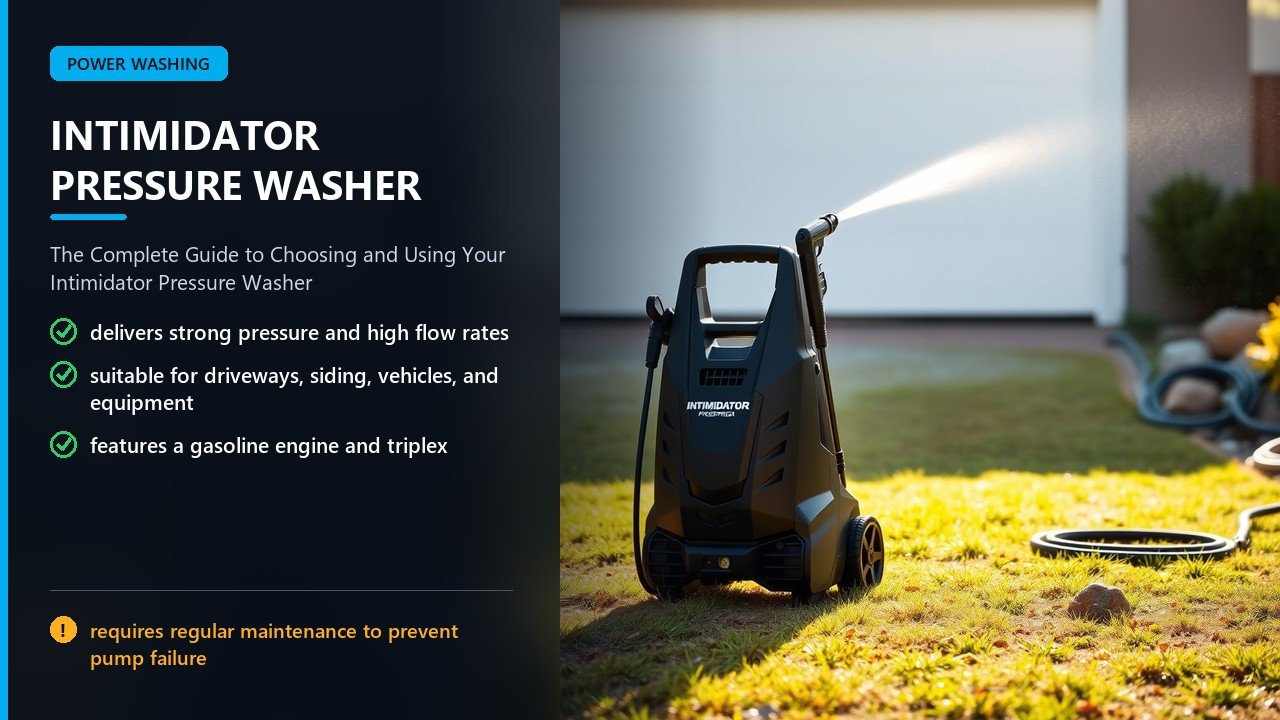
What the Intimidator Pressure Washer Is
The Intimidator is a gasoline-powered pressure washer sold under a general-purpose brand name, often found in the value-to-mid range of the gas washer market. Exact specs vary by model year and configuration.
- Gasoline engine — typically a small, air-cooled OHV engine.
- Triplex or axial pump — depending on the model.
- Moderate to high PSI — often in the 2,500–3,200 PSI range.
- Solid flow rate — usually 2.4–2.8 GPM.
- Wheeled cart frame — for portability over rough ground.
- Quick-connect nozzles — a full five-tip set is common.
Quick Note: Always confirm the rated pressure and flow on the specific unit’s label, since “Intimidator” has covered more than one configuration over the years.
What Machines in This Class Can Do
| Task | Result |
|---|---|
| Driveways and sidewalks | Excellent with a surface cleaner |
| House siding | Excellent; mind the pressure |
| Fences and decks | Excellent; can strip loose finish |
| Vehicles and equipment | Excellent with the right nozzle |
| Heavy paint and grime | Good; faster at higher PSI |
| Large commercial jobs | Possible but slow |
Machines at this pressure level handle nearly all residential cleaning and light commercial work, which is why they are popular with homeowners and small contractors alike.
Key Specifications to Check
| Specification | Why It Matters |
|---|---|
| Rated PSI | Determines cleaning force |
| Rated GPM | Determines cleaning speed |
| Engine brand | Reliability and parts availability |
| Pump type | Triplex lasts longer than axial |
| Hose length | Reach and convenience |
| Wheel and handle quality | Mobility over rough terrain |
| Warranty | Coverage on engine and pump |
Short Note: In this class, the pump and engine quality matter more than the headline PSI number. A well-made triplex pump defines the machine’s lifespan.
Typical Features
| Feature | Benefit |
|---|---|
| Five quick-connect nozzles | Versatility across surfaces |
| Downstream detergent injection | Easy soap application |
| Steel-braided high-pressure hose | Durability and flexibility |
| Pneumatic tires | Rolls over grass and gravel |
| Thermal relief valve | Protects the pump from heat |
| Low-oil shutdown | Prevents engine damage |
These features separate a machine that lasts from one that frustrates. Thermal relief and low-oil protection are especially valuable on any gas washer.
Where It Fits in the Market
| Tier | PSI Range | Best For |
|---|---|---|
| Entry gas | 2,000–2,400 | Light home cleaning |
| Mid gas (Intimidator class) | 2,500–3,200 | Most home and light commercial jobs |
| Heavy gas | 3,300–4,000+ | Large concrete and pro work |
Short Note: The Intimidator class sits in the practical sweet spot: more power than most electric machines, without the price and fuel appetite of heavy commercial units.
Who Should Buy One
- Homeowners with driveways and siding.
- Vehicle and equipment owners.
- Small contractors and landlords.
- Users who want a triplex pump for longevity.
- Anyone buying value over a premium brand.
- People comfortable with small-engine maintenance.
If you want gas-washer performance without paying premium-brand prices, a machine in this class is worth serious consideration.
Setting Up and Operating It
| Step | Action |
|---|---|
| 1. Check oil | Engine oil to the correct mark |
| 2. Connect water | Garden hose attached and flowing |
| 3. Bleed the line | Squeeze the trigger until water runs steady |
| 4. Add fuel | Fresh, correct-octane gasoline |
| 5. Start | Choke on, pull start, choke off |
| 6. Select a nozzle | Match the tip to the surface |
Note: A gas washer should be started only after the water supply is on, and should never run for long without the trigger being squeezed, because heat builds in the pump.
Nozzles and Accessories
| Nozzle / Accessory | Best Use |
|---|---|
| 0° (red) | Stubborn spots; high risk of damage |
| 15° (yellow) | Tough grime on hard surfaces |
| 25° (green) | General cleaning |
| 40° (white) | Rinsing and gentle work |
| Surface cleaner | Even, streak-free concrete |
| Foam cannon | Thick detergent foam for vehicles |
Because these machines flow plenty of water, a surface cleaner and foam cannon both work well and are the accessories owners use most.
Maintenance Schedule
| Task | Interval |
|---|---|
| Check engine oil | Every use |
| Check pump oil | Regularly (triplex pumps) |
| Clean inlet filter | Every use |
| Change engine oil | Per manual |
| Check spark plug | Seasonally |
| Clean air filter | Per manual |
| Winterize | Before freezing |
Sticking to a simple schedule keeps a gas washer reliable for years. The two biggest killers are old fuel and a pump left full of water over winter.
Triplex vs Axial Pumps
Pump type is one of the most important differences between individual units sold under the same brand name.
| Pump Type | Characteristics |
|---|---|
| Axial cam | Cheaper, lighter, shorter life |
| Triplex | Durable, serviceable, handles detergent better |
Short Note: If a machine offers a choice, the triplex pump is worth the extra cost for anyone who plans to use the washer regularly.
Fuel and Engine Care
- Use fresh gasoline. Avoid fuel older than a few weeks.
- Add fuel stabilizer for storage.
- Never use E85 unless the manual allows it.
- Check the oil before every session.
- Replace the air filter when dirty.
- Inspect the spark plug yearly.
- Run the carburetor dry before long storage.
Most hard-starting problems on gas washers trace back to old fuel or a dirty carburetor, not to the engine itself.
Safety and Carbon Monoxide
- Never run the engine indoors or in a garage, even with the door open.
- Keep the exhaust away from windows and air intakes.
- Refuel only when the engine is cool.
- Store fuel in approved containers.
- Wear eye and ear protection.
- Never point the wand at people or pets.
- Use both hands on the gun for control.
Carbon monoxide and high-pressure spray are the two real dangers. Always run the machine outside and treat the wand with respect. Authorities like the U.S. Consumer Product Safety Commission and the Occupational Safety and Health Administration publish related engine and pressure safety guidance.
Common Mistakes to Avoid
- Running without water. Destroys the pump quickly.
- Leaving the engine idling without triggering. Overheats the pump.
- Using the 0° nozzle on soft surfaces. Gouges wood and vinyl.
- Ignoring pump oil. Shortens triplex pump life.
- Neglecting winterization. Cracked pumps are common.
- Mixing old and new fuel. Creates gum and varnish.
- Over-speeding the engine. Strains pump and seals.
Nozzle Selection for Common Jobs
| Surface | Suggested Nozzle |
|---|---|
| Concrete | 25° or a surface cleaner |
| Brick | 25° with distance |
| Wood deck | 40° at low angle |
| Vinyl siding | 40° to avoid water intrusion |
| Car paint | 40° with a foam cannon |
| Roof | Avoid high pressure; use soft wash |
At higher pressures, nozzle discipline matters more, not less. The right tip protects both the surface and the machine.
Getting the Most From the Machine
- Pre-soak and let detergent dwell.
- Use a surface cleaner on flat concrete.
- Work top-down and overlap passes.
- Upgrade to a longer, flexible hose.
- Add a foam cannon for vehicles.
- Keep nozzles clean for full flow.
- Maintain the pump and engine on schedule.
What Sets a Good Machine Apart
Two washers with identical PSI and GPM numbers can differ enormously in how they feel and how long they last. Beyond the headline specs, the details below decide satisfaction.
| Detail | Why It Matters |
|---|---|
| Pump brand and type | The single biggest durability factor |
| Engine brand | Easy parts and reliable starting |
| Frame rigidity | Less vibration, longer life |
| Hose quality | Fewer kinks and leaks |
| Wheel size | Rolls better over uneven ground |
| Detergent system | Consistent, clog-free soap delivery |
Short Note: When two units look similar on paper, the one with the better pump and frame will outlast and out-serve the other.
Pressure and Flow: What the Numbers Mean
| Number | Effect |
|---|---|
| Higher PSI | Removes tougher material; greater damage risk |
| Higher GPM | Cleans faster and rinses better |
| PSI × GPM | A rough measure of total cleaning power |
For most owners, flow is the more rewarding number. It is why a 2,800 PSI machine with good GPM often feels stronger than a higher-PSI unit with weak flow.
Break-In and First Uses
- Follow the manual’s break-in period.
- Check the oil before the first start.
- Avoid full throttle for the first hour.
- Watch for leaks at all connections.
- Change the oil after break-in.
- Re-torque nothing unless specified.
- Keep the first session moderate.
Proper break-in seats the engine and pump and avoids the early failures that come from running a new machine hard.
Troubleshooting Common Problems
| Symptom | Likely Cause |
|---|---|
| Hard to start | Old fuel or fouled plug |
| Weak pressure | Air leak, worn nozzle, or clogged inlet |
| Pulsing spray | Air in the line; bleed the system |
| No soap | Clogged injector or empty reservoir |
| Water in the oil | Failed pump seals; service it |
Most field problems are minor and predictable. A few spare O-rings, a fresh plug, and clean fuel prevent most of them.
Storage and Winterizing
- Drain all water from pump, hose, and wand.
- Use pump antifreeze if the manual calls for it.
- Run the carburetor dry.
- Add fuel stabilizer if fuel remains.
- Store indoors and above freezing.
- Cover the machine to keep dust out.
- Coil the hose without kinks.
Winterization is the single most protective off-season step. Frozen water is the leading cause of cracked pumps on all gas washers.
Real-World Scenarios
Scenario 1: A homeowner with a long driveway. A mid-range machine in this class, paired with a surface cleaner, restores a large concrete driveway to an even, streak-free finish in an afternoon.
Scenario 2: A property manager. One gas washer handles driveways, walkways, and siding across several small rentals without the reach limits of a corded electric unit.
Scenario 3: A vehicle enthusiast. A foam cannon and the 40° tip turn the machine into a safe, effective car and truck washing setup.
Cost and Value
| Consideration | Reality |
|---|---|
| Upfront cost | Modest for the power delivered |
| Ongoing cost | Fuel, oil, and minor parts |
| Lifespan | Long with a triplex pump and care |
| Compared to pro units | Lower price; slightly less power |
| Compared to electric | More power and flow; more maintenance |
The value case is strong: mid-range gas machines deliver most of the cleaning power of premium units for a fraction of the price.
Checks Before You Buy
| Check | Why |
|---|---|
| Rated (not max) PSI and GPM | Real performance figures |
| Pump type and material | Lifespan and detergent tolerance |
| Engine brand | Parts and service availability |
| Warranty terms | Coverage on engine vs pump |
| Hose quality and length | Day-to-day convenience |
| Accessory availability | Easier upgrades later |
Reading the fine print on the pump and warranty tells you more about long-term value than the biggest number on the box.
Frequently Asked Questions
Is the Intimidator pressure washer good quality? Machines in this class are generally solid value gas washers. Quality depends heavily on the specific pump and engine fitted to the unit.
What PSI does it deliver? Models vary, but most fall in the 2,500–3,200 PSI range with roughly 2.4–2.8 GPM flow. Check the unit’s label.
Can it clean a driveway? Yes, effectively, especially with a surface cleaner attachment.
Does it need much maintenance? Yes — engine oil, pump oil, air filter, fresh fuel, and winterization. That is normal for any gas washer.
Is a triplex pump available? Some configurations use triplex pumps; always confirm the pump type before buying.
Can I use it for commercial work? It handles light commercial tasks, but heavy, all-day commercial work calls for a larger, purpose-built machine.
Final Thoughts
The Intimidator pressure washer represents the practical middle of the gas-washer market: powerful enough for driveways, siding, and vehicles, yet affordable and manageable for home users. Its real strengths are strong flow, portability, and — on triplex-equipped models — durability.
Confirm the pump and engine before you buy, keep the oil and fuel fresh, protect it from freezing, and this class of machine will deliver years of dependable cleaning. For related reading, see our guides on the 2000 PSI gas power washer and the gas engine pressure washer.