There is a moment every pressure washer owner recognizes. You finish a driveway, walk back to the machine, and find the hose coiled on the ground in a knot that looks like it was tied by someone who hates you. You spend five minutes untwisting it, three minutes winding it by hand around a hook, and you know the whole thing will do it again next weekend. It is a small annoyance, repeated hundreds of times over the life of a machine, and it is exactly the problem a power washer hose reel was invented to kill.
A hose reel looks like a simple accessory. A drum, a bracket, a swivel. In practice, it is one of the highest-value upgrades you can make to any pressure washer setup, because a hose is the most abused and most frequently damaged part of the entire system. Kinks, abrasion, dragging over gravel, and UV exposure are what kill hoses, and almost all of that damage happens between jobs, not during them. Put the hose on a reel and you remove the cause of most of it.
This guide covers how to think about power washer hose reels the way a working operator does. Not “which one is cheapest,” but which reel matches your hose diameter, your pressure rating, your mounting surface, and the way you actually work. By the end you will know how to spec a reel once and never think about it again.
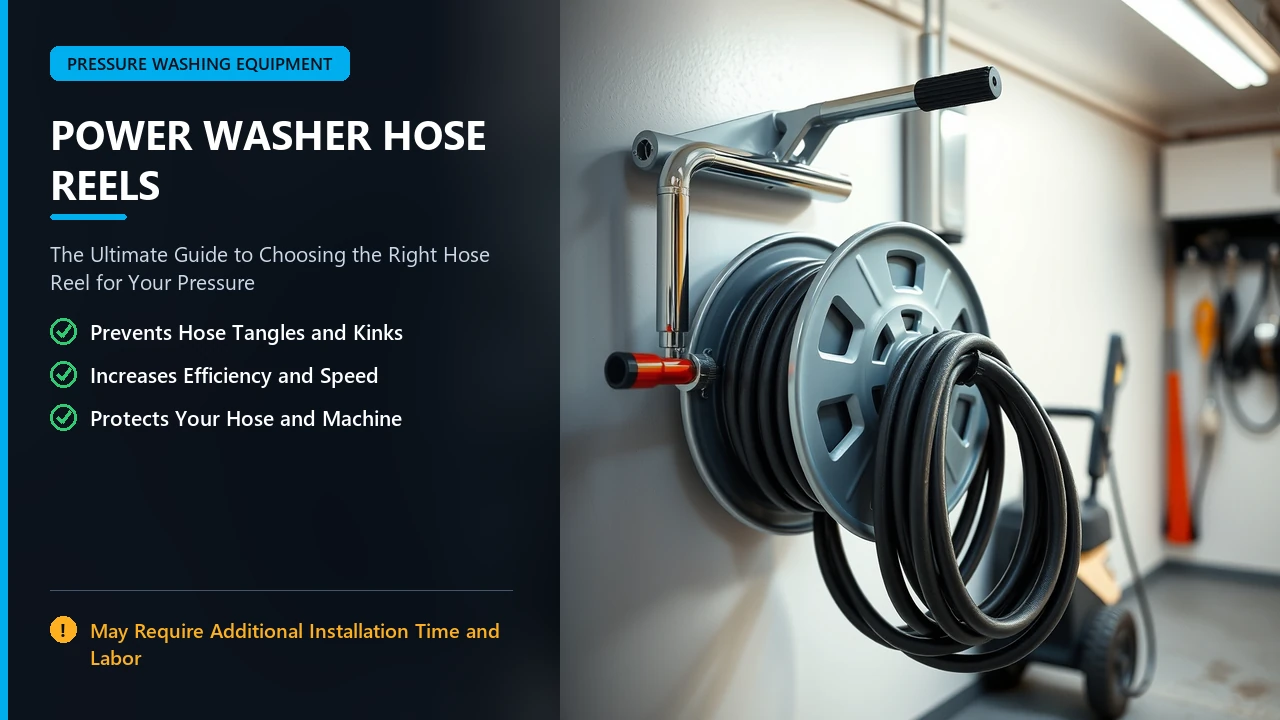
Why a Hose Reel Changes How You Work
The value of a hose reel is not cosmetic. It shows up in four measurable ways.
Setup and teardown speed. A reel turns a five-minute winding ritual into a thirty-second crank or a push-button rewind. For a contractor running six jobs a day, that is thirty minutes recovered, every day, for years. The math is not subtle.
Hose life. A hose that lives on a reel is not dragged across concrete, stepped on, or kinked at the same spot every time. Because the reel keeps the coil round, the hose does not develop the flat spots and pinhole leaks that eventually cause a pressure loss. A good reel can easily outlast the hose it holds several times over.
Safety. A loose hose is a trip hazard and, on a sloped driveway, a genuinely dangerous one. A reel keeps the working line organized and off the walking surface. The Occupational Safety and Health Administration treats exposed hoses and cables as slip-and-trip hazards on job sites, and a pressure washing setup is no exception.
Professionalism. This one is hard to measure but easy to feel. A clean reel and a tidy rig signal competence to a customer standing in their driveway. A tangled pile of hose signals the opposite.
Manual vs Retractable (Electric) Reels
Hose reels split into two families, and the choice between them is mostly about how often you use the machine.
Manual hand-crank reels are the workhorse of the pressure washing trade. You pull the hose out and crank it back, sometimes with a spring assist. They are simple, cheap, and nearly indestructible, and critically, they handle the heavy 3/8-inch hose and long runs that mobile rigs use. Crews run them on skids and trailers for a reason.
Retractable reels use a spring or a motor to pull the hose back automatically. Spring-driven retractable reels are convenient in a fixed wash bay or garage, but they are usually limited to lighter hose and shorter lengths. Powered (electric) reels use a 12-volt or 120-volt motor, rewind in under a minute, and shine for daily commercial use or for anyone who would rather not crank two hundred feet of wet hose after a long day.
| Reel Type | Best Use | Typical Cost | Main Trade-off |
|---|---|---|---|
| Manual crank, plastic | Occasional home use | Low | Fails fast under daily load |
| Manual crank, steel | Trucks, trailers, pro rigs | Mid to high | You wind it yourself |
| Spring retractable | Fixed garages and wash bays | Mid | Limited hose length and diameter |
| Electric (12V or 120V) | Daily commercial work | High | Cost and power needed |
The rule of thumb from operators is blunt: manual for weekly or less, electric for daily. If you run four or more jobs a day, a powered reel pays for itself in time within a couple of months. If you wash your own driveway on Saturdays, a good steel manual reel will outlive the machine.
The Specs That Actually Matter
Hose reels are sold on capacity and pressure rating, and getting those two numbers wrong is the most common and most expensive mistake.
Hose diameter. Pressure washer hose comes in different internal diameters, and the reel must be built for the diameter you run. A reel designed for 1/4-inch hose will not hold much 3/8-inch hose, because the larger diameter takes up more space per foot. Get this wrong and you either cannot fit your hose or you force it and damage the seals.
Capacity. Capacity is usually quoted as a length at a given diameter, and the relationship is not linear. A reel that holds two hundred feet of 3/8-inch hose might hold three hundred fifty feet of 1/4-inch. Buy more capacity than you need today, because reels are cheap compared with replacing them when you upgrade your hose.
Pressure rating. The reel itself is only half the story. The swivel, the internal fitting that lets the drum spin while the hose stays connected, is the part that fails first and the part that determines your real pressure ceiling. A 4,000 PSI reel covers almost every gas machine used for residential and light commercial work. If your pump runs higher, the reel, the swivel, and the hose all have to clear that number.
Mounting: Where Most Reel Problems Begin
A hose reel is bolted to something that vibrates, gets wet, and takes a constant pulling load every time you drag hose around a corner. That combination destroys weak mounts, and a loose reel is worse than no reel at all.
Wall mounting. For a garage or wash bay, the reel should anchor into studs or masonry, never drywall alone. Use a level to mark both holes, because a reel mounted even slightly out of level will feed the hose at an angle and promote kinks. Mount the reel at a height that lets the hose fall away cleanly, generally shoulder height or a little above, so you are not bending to reach it all day.
Truck and trailer mounting. On a mobile rig, bolt through the frame or a skid plate, not just the floor. Use vibration-dampening washers and lock washers, and orient the outlet so the hose pulls in the direction you actually work. A swing-arm or pivoting mount is worth the small extra cost on a trailer, because it lets the reel follow the hose instead of fighting it.
Ceiling and overhead mounting. Some fixed setups hang the reel overhead so the hose drops straight down to the work. This works beautifully in a wash bay with a vehicle underneath, but only if the ceiling can carry the load and the reel’s mounting bracket is designed for vertical or overhead orientation. Not every reel is. Check the specs before you drill.
A reel that wobbles, drips at the swivel, or binds when you pull is telling you the mount or the hardware is wrong. Fix it early. Vibration does not stay localized; it works loose every fastener on the rig.
Matching the Reel to Your Hose and Machine
The reel, the hose, and the machine are a system, and the weakest link sets the performance of the whole setup. This table shows how the common combinations line up for typical applications.
| Setup | Typical Hose | Reel Style | Capacity to Buy |
|---|---|---|---|
| Home car washing | 1/4-inch, up to 2,500 PSI | Small manual or spring retractable | 50 to 100 feet |
| Home driveway and siding | 1/4 or 5/16-inch, up to 3,000 PSI | Wall-mount manual or retractable | 75 to 100 feet |
| Light commercial | 3/8-inch, 4,000 PSI | Steel manual or electric | 150 to 200 feet |
| Pro trailer rig | 3/8-inch, 4,000 PSI | Heavy steel manual or 12V electric | 200 to 300 feet |
| Soft wash and supply lines | 1/2-inch, lower pressure | Large steel manual | 100 to 200 feet |
Two details separate a comfortable setup from a frustrating one. First, use a leader or whip hose between the machine and the reel; it takes the bend and the constant flexing so the main hose does not have to. Our guide to the pressure washer whip line explains why this short section matters. Second, standardize your fittings so the reel connects without adapters. The quick-connect fittings guide and the M22 fitting guide cover the common thread standards you will run into.
The Cost of a Reel Setup, Honestly
People are often surprised at how much a complete reel setup costs, until they compare it with replacing hose every season.
A basic home setup pairs a steel manual reel with a hose you already own. Expect a modest investment, and your only real cost after that is occasional O-rings.
A serious commercial setup adds an electric reel, a proper mounting system, a longer three-eighths hose, and the wiring or battery to run it. The price climbs, but it buys speed and a reduction in physical fatigue that matters when you are winding hose ten times a day.
The comparison that matters is not reel versus no reel. It is reel versus the cost of hoses, the cost of wasted labor, and the cost of an untidy rig that loses you a bid. A customer watching you untangle hose for five minutes before you even start is not the impression you want.
Mistakes That Waste the Money You Just Spent
Buying a garden-hose reel for a pressure washer. This is the most common and most dangerous error. Many reels under a certain price are built for garden hoses and rated at a few hundred PSI. Put a pressure line on one and it will fail, possibly violently. Always confirm the reel and swivel are rated for pressure washer use.
Ignoring the swivel. The swivel is where the reel either holds or leaks. A machined brass or stainless swivel with real bearings lasts. A cheap plastic swivel is a future drip. If you are choosing between two reels at the same price, pick the one with the better swivel and frame.
Mounting into drywall or a thin floor. Covered above, but worth repeating, because it is the mistake that causes the most damage. Mount to structure, always.
Overfilling the reel. Cramming more hose onto a reel than it is rated for stresses the frame, pinches the hose, and makes winding miserable. Respect the stated capacity at your hose diameter.
Letting the reel free-spool. A reel without a working brake or tension drag will unwind itself as you drag hose, leaving a loose coil that kinks on the next pull. Set the drag so the drum holds position but still feeds smoothly.
Installation in Six Steps
Whether it is a wall in a garage or a skid on a trailer, the process follows the same logic.
Choose the location by how you work, not by where the wall looks best. The reel should sit near the machine, near the wand holster, and at a height that lets the hose fall away without dragging over anything.
Find the structure. Locate studs, a frame member, or solid masonry. If none is available, install a backing plate rated for the load and bolt the reel to that.
Mark and level. Use a level and mark both mounting holes. A level reel feeds a level hose.
Pre-drill and fasten. Pre-drill to prevent splitting or cracking, then use fasteners rated for the load. On mobile rigs, add lock washers and vibration dampers.
Connect the plumbing. Route a whip hose from the pump to the reel inlet, then the main hose from the swivel to the gun. Check the swivel connection for the correct thread and seal.
Test under load. Run the machine at full pressure, pull the hose out completely, and watch the swivel and all connections for drips. Rewind slowly and confirm the drag or brake behaves.
If the reel is electric, wire it to a switched circuit or battery with a properly rated fuse, and keep the wiring away from the high-pressure plumbing and any heat source.
Maintenance That Doubles the Life of the Setup
Reels need almost nothing, but the little they need matters. Inspect the swivel O-rings and replace them at the first sign of a drip, because a weeping swivel slowly sprays water onto the frame and the fasteners. Lubricate any grease fittings on the drum, especially on reels built for commercial duty. Keep the reel out of standing water and, if it lives outdoors, out of direct summer sun where UV degrades plastic parts.
Watch the hose where it meets the reel and the gun; those two points account for the majority of hose failures. Our guides to pressure washer O-rings and hose connector types cover the small seals that stop small leaks from becoming big ones. And when the season ends, don’t forget the hose itself; a little care at shutdown goes a long way. The winter storage guide walks through draining and protecting the whole rig.
How Hose Diameter and Reel Bore Affect Flow
One of the least understood parts of a reel setup is how hose diameter and the reel’s internal bore affect the pressure you feel at the wand. Water flowing through a narrow passage loses more energy to friction than water flowing through a wide one. That is why a machine can feel strong with a short shooter hose and noticeably weaker after you add a hundred feet of thin hose and a restrictive swivel.
The fix is not complicated. Keep the internal diameter consistent through the whole chain, from the pump outlet through the leader hose, the swivel, the main hose, and the gun. A single narrow point, often the swivel bore, becomes the bottleneck. Contractors avoid this by running larger hose on the pressure line and by choosing reels with a bore matched to that hose, even when it costs a little more. If you have ever wondered why a long hose feels weaker, the answer is almost always restriction and friction rather than a failing pump. Our guides to how hose length affects pressure and hose size charts break down the math.
When Diameter Rules: Soft Wash and Supply Hose
Not every hose on a reel carries high pressure. A surprising number of reels in the field hold supply hose or soft wash line, and confusing the two is a recipe for buying the wrong reel.
A supply hose feeds water from a tank or spigot to the pump. It runs at low pressure, often a half inch or larger, and it is chosen for flow rather than pressure rating. A soft wash line carries cleaning solution at low pressure with high flow, again favoring a large diameter. Both want big capacity and low pressure ratings, which is the opposite of a high-pressure reel.
High-pressure hose, by contrast, runs a small diameter at high PSI, and its reel needs a swivel rated for that pressure. If you run both kinds of hose on one rig, as many soft wash and pressure washing setups do, you will likely need two reels. Buying one reel and trying to make it serve both roles is where the swivel gets abused and the hose gets pinched. Our overview of soft wash attachments and pressure washing detergents covers the low-pressure side in depth.
Material Choices and What They Cost You
Reels are built from steel, stainless steel, aluminum, or plastic, and each material tells you something about where it belongs.
Plastic reels are light and cheap and belong on light-duty home use. They fade, crack, and their internal lock mechanisms wear out. Fine for a couple of washes a month, poor for a business.
Powder-coated steel is the workhorse. Strong, affordable, and durable in normal conditions. It will eventually rust at chips and scratches, so touch them up. This is what most commercial trailer reels are made of.
Stainless steel costs more but shrugs off road salt and the chemicals used in soft washing. If you run sodium hypochlorite mixes, stainless is not a luxury; it is the difference between a reel that lasts years and one that corrodes in a season.
Aluminum sits between the others. Light and corrosion-resistant, popular on mobile rigs where weight matters. It is softer than steel, so its hardware needs checking more often.
| Material | Durability | Best For | Watch Out For |
|---|---|---|---|
| Plastic | Low | Occasional home use | UV fading, cracked locking parts |
| Powder-coated steel | High | Trailers, general commercial | Rust at chips and scratches |
| Stainless steel | Very high | Soft wash, coastal, chemical work | Higher price |
| Aluminum | Medium to high | Mobile rigs where weight counts | Softer threads and hardware |
Hose Reel Questions Owners Ask Most
Are retractable pressure washer hose reels worth it? For a fixed garage or wash bay with short to medium hose, yes. For mobile work with long 3/8-inch hose, a steel manual reel is usually the more durable, higher-capacity choice.
Can I put a pressure washer hose on a garden hose reel? Only if the reel and swivel are explicitly rated for pressure washer use. Most garden reels top out far below the working pressure of even a small electric machine, and using one is a real safety risk.
What size reel do I need for a 50-foot hose? Buy for the next hose, not this one. If you run 50 feet now, size the reel for 100 feet at your diameter so an upgrade does not force you to buy a second reel.
Does the reel reduce my pressure? A properly sized reel and swivel add negligible pressure loss. A reel that is too small, or a swivel with a restricted bore, can rob flow. Match the internal diameter of the swivel to your hose and you will not notice it.
Manual or electric for a small business? If you are doing a handful of jobs a week, manual is fine and cheaper. Once you are running daily and can feel the fatigue, the powered reel earns its price back in recovered time.
Where should I mount the reel on a trailer? Toward the rear or side where you pull hose, bolted through the frame, with the outlet pointed at the work area. Avoid anywhere the hose will rub across the trailer edge, and keep the swivel clear of the road spray.
The Reel Is the Cheapest Upgrade With the Biggest Payoff
Compared with a new pump, a bigger engine, or a trailer, a hose reel is a small line item. Yet it is the upgrade that owners notice every single day, because it touches the one task they repeat more than any other: handling the hose. It protects the hose, speeds the setup, tidies the rig, and removes a small daily frustration that adds up to a lot of lost minutes over a year.
Choose the type by your usage, match the diameter and pressure rating to your machine, mount it into real structure, and keep the swivel clean. Do that and the reel quietly disappears into the background, which is exactly what the best equipment does. If you are building out the rest of your setup, our guide to matching a reel to your machine, the best pressure washer hose reel guide, and the overview of pressure hose reels pick up where this leaves off. For the reputation side, the US reel manufacturers Reelcraft and Coxreels both publish detailed capacity and pressure tables that are worth matching against your hose before you commit.