The driveway should be a twenty-minute job. Instead, the first ten minutes vanish while you untangle a stubborn length of hose, then watch it kink every time you round a corner. By the time the concrete is clean, your shoulders ache from fighting a wet snake that refuses to coil. If that scene feels familiar, a power washing hose reel is the upgrade that ends it. A reel does not just store a hose. It protects the hose, speeds up setup, and turns a messy job into a controlled one.
This guide covers everything a homeowner, mobile detailer, or pressure washing pro needs to know about hose reels. You will learn how they work, which types fit which jobs, how to match one to your hose and PSI, how to install and maintain it, and the mistakes that shorten hose life. Along the way you get comparison tables, side notes, and straight answers to the questions people ask most.
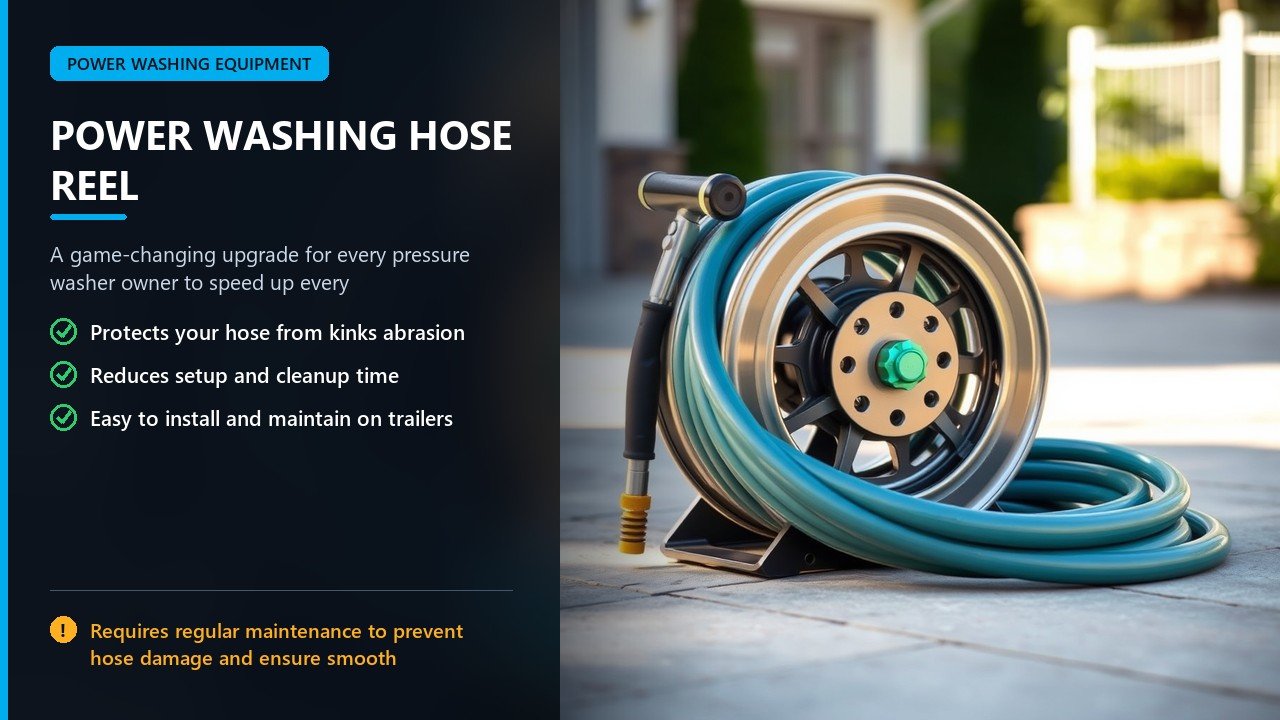
What Is a Power Washing Hose Reel
Definition and purpose first.
A power washing hose reel is a spool or drum that holds, guides, and dispenses the high pressure hose connected to your pressure washer. Instead of leaving a coiled pile of hose on the ground, the reel keeps it wound around a central drum and feeds it out through a guide or roller as you work. Most reels include a mounting bracket, a swivel fitting that lets the hose turn without twisting, and a connection point that links the reel to your machine’s pump or gun.
The word “reel” covers a wide range of products. At one end sits a simple manual wall bracket that holds fifty feet of hose. At the other end sits a heavy duty, motorized, stainless steel unit rated for 4000 PSI that lives on a commercial pressure washing trailer. All of them share the same core job: keep a long, heavy, stiff high pressure hose under control so you can move freely and work faster.
Understanding the parts helps you shop smarter. The drum is the core the hose wraps around. The frame or housing supports the drum and takes the load. The swivel is the rotating joint that connects the moving drum to the fixed supply line, and it is the part that most often fails if it is made cheaply. The guide arm or roller keeps the hose feeding in a straight line, which prevents the kinks and overlaps that damage hose. Finally, the mounting plate or bracket anchors the whole assembly to a wall, cart, or trailer.
A reel is not a luxury item for large operations only. Even a casual weekend user benefits, because a stored hose lasts longer and a tidy hose is a safer hose. That is why a pressure washer hose reel has become one of the most recommended pressure washer accessories for anyone who cleans more than once a month.
Why Every Pressure Washer Owner Needs One
The benefits go far beyond tidiness.
The first benefit is hose protection. A pressure washer hose is not a garden hose. It carries water at 2000 to 4000 PSI, and its inner braid and outer cover are built to handle that pressure, but they are not built to be dragged over rough concrete, crushed under tires, or kinked into tight loops. Every kink weakens the reinforcement. Every scrape wears the cover. Winding a hose on a reel keeps it off the ground, away from sharp edges, and free of the sharp bends that eventually cause a burst. Replacing a good high pressure hose costs far more than a decent reel, so the reel pays for itself the first time it saves a hose.
The second benefit is speed. A reel lets you pull out exactly the length you need and leave the rest wound. Setup drops from several minutes of uncoiling to a few seconds of pulling. Cleanup is just as fast, and a fast cleanup means you use the machine more often instead of dreading it.
The third benefit is safety. A loose hose on the ground is a trip hazard, especially when it is wet and slippery. It snags on bushes, wraps around ankles, and can yank a spray gun out of your hand. A reel keeps the slack contained and the working section controlled. Professional crews follow strict workplace standards for high pressure equipment, and the Occupational Safety and Health Administration (OSHA) is the source many of them reference for safe handling practices.
The fourth benefit is organization and a professional image. If you run a pressure washing business, a clean rig with a properly mounted hose reel signals competence to customers. It also protects your investment and reduces downtime from kinked or damaged hose on a paid job.
Types of Power Washing Hose Reels
Match the style to how and where you work.
Hose reels come in several configurations, and the right choice depends on whether you clean at home, in a garage, on a cart, or from a truck or trailer. Manual reels are the simplest and cheapest. You wind the hose by hand using a crank handle. They are reliable and have nothing electronic to fail, which makes them a favorite for home setups and backup units.
Motorized or electric reels use a motor to wind the hose at the push of a button or a switch. They are a huge time saver on long hoses and heavy commercial hoses, but they cost more and need a power source. Spring-return or automatic reels retract the hose with an internal spring, similar to a retractable air hose reel. They are convenient but usually handle shorter lengths and lower pressures.
Mounting style matters just as much. Wall mount reels bolt to a wall, post, or the side of a vehicle and are ideal where the machine stays in one place. Cart mounted reels attach to a wheeled cart so the whole setup moves together. Trailer mounted and truck mounted reels are built for mobile pressure washing, where the reel is part of a rolling rig. Some reels are open frame, meaning the drum is exposed, while others are enclosed with a housing that shields the hose from sun and debris.
The table below compares the main types so you can see the tradeoffs at a glance.
| Reel Type | Best For | Strengths | Tradeoffs |
|---|---|---|---|
| Manual crank | Home and light commercial use | Low cost, no power needed, reliable | Slower winding, physical effort |
| Motorized / electric | Commercial rigs and long hoses | Fast, effortless winding | Higher cost, needs power, more to maintain |
| Spring return / automatic | Short hose, tidy garage setups | Hands-free retraction | Limited length and pressure |
| Wall mount | Fixed shop or garage location | Space saving, out of the way | Not portable, needs solid mounting |
| Cart mounted | Homeowners who move around a yard | Portable, self-contained | Adds bulk, limited capacity |
| Trailer / truck mounted | Mobile pressure washing business | Rugged, high capacity, pro look | Highest cost, needs a rig |
This table shows that manual reels win on simplicity and price, motorized reels win on speed for heavy pro use, and mounting style should follow wherever your machine actually lives, whether that is a garage wall, a cart, or a commercial trailer.
Key Features That Decide Quality
Look past the shiny finish.
The pressure rating is non-negotiable. A reel must be rated at least as high as your washer’s output, and preferably higher for a safety margin. If your machine runs 4000 PSI, buy a reel rated for 4000 PSI or more. A reel rated at only 3000 PSI can fail under the pressure and heat of a stronger machine, and a burst high pressure hose is a real injury risk.
The hose capacity matters next. Reels are rated by how much hose of a given diameter they hold. A reel sized for 100 feet of 3/8-inch hose cannot hold 150 feet of the same hose. Always match capacity to your hose length and diameter, and remember that thicker hose takes more room per foot. If you plan to upgrade to a longer hose later, buy extra capacity now.
The material and build tell you how long the reel will last. Stainless steel and powder coated steel handle outdoor and commercial abuse best. Aluminum is lighter but softer. Plastic or composite housings are fine for light home use but crack under heavy loads and UV exposure over time. The swivel is the critical wear part, so a reel with a quality brass or stainless swivel and replaceable seals will outlast a cheap one by years.
Look for connection compatibility: the inlet and outlet fittings should match your hose and gun, or come with adapters. Many modern reels ship with quick connect fittings, which pair well with a quick connect power washer hose for fast changes. A roller guide, a locking mechanism to hold the hose at a set length, and a mounting plate with multiple bolt holes are small features that make a big daily difference.
How to Choose the Right Power Washing Hose Reel
Start with the hose, then size the reel.
Choosing well means working backward from your hose and your machine. First, note your hose length, its diameter (commonly 1/4 inch or 3/8 inch), and its pressure rating. Second, note your washer’s PSI and GPM. Third, decide where the reel will live: wall, cart, or trailer.
If your hose is 3/8-inch and 50 feet long, a mid-size reel with a 4000 PSI rating and 3/8-inch swivel is ideal. If you run 100 feet of 3/8-inch hose for reach, you need a large-capacity reel, and you should check that the pressure drop over that length still leaves usable pressure at the nozzle. If your hose is 1/4-inch, a compact reel works, and the lighter hose is easier to wind.
Match the swivel and fittings to your hose thread. M22, 3/8 NPT, and quick connect are the common options, and adapters exist for almost every combination, but it is simpler and cheaper to buy a reel that fits out of the box. The table below shows typical capacity relationships to guide your sizing.
| Hose Diameter | Typical Length | Reel Size Needed | Good For |
|---|---|---|---|
| 1/4 inch | 25 to 50 ft | Compact reel | Cars, small patios, light home use |
| 1/4 inch | 50 to 100 ft | Mid-size reel | Home driveways and siding |
| 3/8 inch | 50 ft | Mid to large reel | General home and light commercial |
| 3/8 inch | 100 to 150 ft | Large reel | Commercial and mobile rigs |
| 3/8 inch high flow | 200 ft and up | Heavy duty reel | Professional pressure washing |
This table shows that as hose diameter and length rise, so does the reel size and strength you need. Buying a reel that is one size larger than your current hose gives you room to grow without overloading the frame.
Finally, think about your climate and storage. An enclosed reel shields hose from UV and rain if the machine sits outside. In freezing regions, an easy-to-drain reel makes winterizing a power washer simpler. A reel that is easy to access and drain reduces the chance of trapped water cracking the pump or hose when temperatures drop.
Installing a Power Washing Hose Reel
Good mounting prevents most problems.
Where you mount the reel decides how well it works. On a wall, choose a spot close to the machine and high enough that the hose clears the ground but low enough to reach comfortably. Bolt into solid framing or use appropriate anchors for masonry, because a reel full of water-filled hose is heavy and will pull loose from drywall. On a cart or trailer, mount the reel so the hose feeds out toward the work area and never crosses the machine or the operator.
Route the supply line carefully. The feed hose from the pump to the reel inlet should be short, protected, and free of sharp bends. Connect the working hose to the reel outlet and the gun to the other end. Once connected, pull the hose out fully and rewind it once to confirm the swivel turns freely and the hose does not twist. If the hose twists, check that the reel is oriented correctly and that the swivel is not seized.
Test under pressure before you commit. With the machine off, pull out about ten feet and check the guide roller alignment. Then start the machine and run water through at working pressure, watching every connection for drips. Tighten fittings a quarter turn at a time and never over-tighten, which crushes washers and causes the very leaks you are trying to avoid.
Maintaining Your Hose Reel
Small habits, long life.
Maintenance is simple but it must be consistent. After every use, relieve the pressure by squeezing the gun trigger with the machine off, then drain the hose. Rewind the hose evenly so it does not pile up on one side of the drum, which stresses the frame. Wipe grit off the hose before it winds in, because trapped sand acts like sandpaper on the hose cover and the swivel seals.
Periodically inspect the swivel and fittings for wear, and replace o-rings and seals at the first sign of a drip. Lubricate moving parts per the manufacturer’s guidance, usually a light oil on the crank or a grease point on motorized units. Check that mounting bolts stay tight, since vibration loosens hardware over time. On motorized reels, keep the power connection dry and inspect the cord or switch for damage.
In cold weather, drain the reel and hose completely or run a power washer antifreeze through the system. Water left in a swivel or hose can freeze, expand, and split metal or rubber. A five-minute drain in fall can save a reel and a hose in spring. When you dispose of wash water, respect local runoff rules, and the EPA WaterSense program is a helpful starting point for responsible water use.
Common Hose Reel Mistakes to Avoid
Most failures come from a few avoidable errors.
Buying a reel rated below your machine’s PSI is the most dangerous mistake, because it risks a burst under full pressure. Choosing too little capacity is the most common annoyance: the hose will not fit, so it hangs off the drum and rubs against the frame. Cheap swivels are the most frequent failure point, leaking within months under heavy use. And mounting to weak surfaces is the most common installation error, causing the reel to rip free when loaded.
Other mistakes include kinking the hose during winding, where a twist creates a weak spot that later bursts; leaving the hose pressurized for long periods; and never draining the system, which leads to freeze damage or stagnant water. Skipping the roller guide, or mounting the reel so the hose drags over a sharp edge, quietly chews through the hose cover.
Each of these is easy to prevent. Read the pressure and capacity ratings before you buy. Buy a little more reel than you think you need. Spend a few extra dollars on a quality swivel. Mount it solidly. Wind without twists. Release pressure and drain after use. Do those things and your reel becomes a background tool that simply works, season after season.
Hose Reels for Trailers and Mobile Pressure Washing
On a rig, the reel is part of the machine.
For a mobile pressure washing business, the hose reel is not an accessory. It is part of the workstation. Pros running a pressure washer trailer for sale setup typically mount a heavy duty reel on the trailer frame or the truck bed, sized for the long 3/8-inch hose needed to reach around buildings, fences, and driveways.
In this environment, capacity and durability rule. Commercial hoses are thicker, heavier, and often longer than home hoses, and the reel has to swallow them without strain. Motorized reels save real time on a paid job, where every minute lost to winding hose is a minute not billed. Stainless steel frames resist rust from constant moisture, and a solid swivel holds up to daily pressure cycling.
Placement on a rig should keep the hose path clear and the operator safe. The hose should feed out and retract without crossing the engine, the water tank, or the walking area. Many builds pair a reel with a power washer with trailer configuration for a fully mobile cleaning station that arrives ready to work. Trade groups such as the Power Washers of North America (PWNA) offer training and standards that many commercial operators follow. A well-planned reel setup is one of the differences between a hobby rig and a professional one.
Hose Reels vs Other Hose Storage Options
Why not just coil it on a hook?
The simplest alternative is a wall hook or a ground stake. These cost almost nothing, but they force the hose into tight, uneven loops that kink and trap water. They also expose the hose to the ground and sun. A reel costs more but spreads the hose evenly, protects it, and drains it better.
A garden hose reel is a common cross-shopper, but it is usually built for low pressure and light use. Using a garden hose reel for a high pressure hose risks failure and injury, because the frame and swivel are simply not rated for 3000 or 4000 PSI. If you already own a garden hose reel, keep it for the garden and buy a properly rated power washing reel for the washer.
A bucket or tote is another cheap option that keeps the hose contained, but it still allows kinks and does not drain or dry the hose well. The reel remains the best all-round answer because it manages the hose at every stage: storage, dispensing, protection, and drainage.
What a Power Washing Hose Reel Costs
Prices scale with build and power.
Simple manual wall reels for home hoses are the most affordable. Mid-range manual and open-frame reels with better swivels and higher pressure ratings cost a bit more but last far longer. Motorized and large commercial reels sit at the top of the range, especially stainless units rated for heavy flows on a pressure washing trailer. The right way to judge cost is not the sticker price but the cost per year, since a $90 reel that lasts eight years is cheaper than a $40 reel that fails in one.
When a reel is part of a larger rig, factor it into the overall build budget alongside the pump, engine, tank, and hose. A modest reel on a strong machine is far better than a cheap reel that fails on the first commercial job and takes the hose with it.
Frequently Asked Questions
Can I use a garden hose reel for a pressure washer? No. Garden hose reels are rated for low pressure and will fail under the 2000 to 4000 PSI of a pressure washer, which can cause a dangerous hose burst. Always use a reel rated for your machine’s pressure.
What size hose reel do I need for a pressure washer? Match the reel’s capacity to your hose length and diameter, and its pressure rating to your machine. A reel sized for 50 feet of 3/8-inch hose will not hold 100 feet of the same hose. When in doubt, size up.
Are hose reels worth it for a pressure washer? Yes. A reel protects the hose from kinks and abrasion, speeds up setup and cleanup, and improves safety. For anyone who cleans regularly or professionally, the time and hose savings quickly outweigh the cost.
Can a pressure washer hose reel increase pressure loss? A reel adds a small amount of restriction through its swivel and fittings. Quality reels minimize this, and the effect is minor. If you run very long hose, choose a larger diameter and a high-flow swivel to keep pressure at the nozzle strong.
How do I stop my pressure washer hose from kinking on the reel? Feed it evenly, avoid sharp bends, use the guide roller, and never force a twist. Pulling the hose out fully and rewinding once after connecting helps the hose settle into its natural lay.
Should I leave water in the hose reel? No. Drain the hose and reel after every use to prevent stagnant water, freeze damage, and seal wear. In cold climates, run antifreeze or blow out the line before storage.
What is the best material for a pressure washer hose reel? Stainless steel or powder coated steel handles commercial use best. Aluminum is lighter but softer, and plastic or composite is fine for light home use. The swivel quality matters as much as the frame material.
Final Verdict on Power Washing Hose Reels
A power washing hose reel is one of those upgrades that quietly improves everything about using a pressure washer. It protects an expensive high pressure hose from the kinks and abrasion that cause most failures. It turns a five-minute untangling ritual into a two-second pull. It keeps the workspace safe and the rig looking professional. And it lets you drain and store the hose the right way, which protects the whole machine.
Choose by working backward from your hose and machine: match the pressure rating, match the capacity to your hose length and diameter, pick the mounting style that fits where you work, and invest in a quality swivel and frame. Mount it solidly, wind it without twists, and drain it after every job. Do that, and your reel becomes invisible in the best way, a tool that simply makes the work easier, faster, and safer every single time.