Pressure Washer 1500 PSI Power and What It Cleans
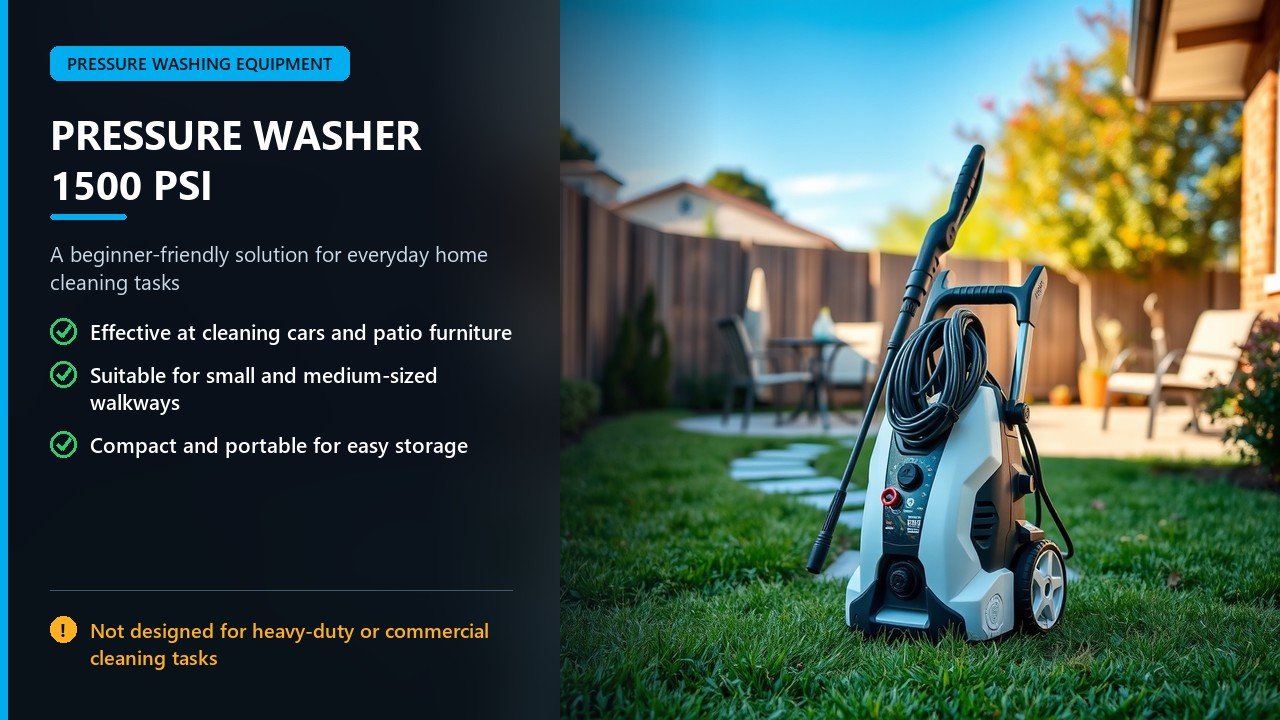
A pressure washer 1500 PSI model is the light-duty class that covers most everyday home cleaning with safety and ease. At 1500 PSI an electric washer has enough force to clean cars, patio furniture, fences, and small walkways without the risk of damaging delicate surfaces that higher pressure can cause.
This guide explains what 1500 PSI really delivers, how pressure and flow work together, what this class can and cannot clean, how to choose a good model, and how to use and maintain it. If you are shopping for a 1500 PSI pressure washer, the details below will help you buy the right one and set realistic expectations.
What 1500 PSI Really Means
PSI, or pounds per square inch, measures the force of the water. At 1500 PSI, the machine delivers moderate pressure: enough to lift dirt, mud, and light mildew from most surfaces, but not so much that it strips paint or etches wood with casual use. It is a beginner-friendly level.
Pressure is only half the picture. Flow, measured in gallons per minute, decides how fast the machine works. Most 1500 PSI washers move around 1.2 to 1.6 GPM, which is modest but adequate for small and medium jobs. The two numbers together set the cleaning power.
Note: A 1500 PSI washer is not built to restore paving or strip paint. Expect it to clean, not to transform. If you need to remove deep stains, old paint, or heavy grime, a higher-pressure machine is the right tool.
Typical Specs of a 1500 PSI Washer
Most 1500 PSI washers are compact electric units designed for home use. They run on standard household power, weigh little, and include a set of nozzles and a soap applicator. Their simplicity is a big part of their appeal.
| Spec | Typical Value |
|---|---|
| Pressure | 1500 PSI max |
| Flow | 1.2 – 1.6 GPM |
| Power | 120V electric |
| Weight | Light and portable |
| Nozzles | Several quick-connect tips plus soap |
| Hose | Usually 20 to 25 feet |
Because the machine is light, it is easy to carry, store, and set up, which means you are more likely to use it often. For small homes, apartments, and quick jobs, that convenience is worth more than extra power you do not need.
Cleaning Units and Real Cleaning Power
Multiply the rated PSI by the rated GPM and you get cleaning units, a rough measure of how much work a machine can do. A 1500 PSI washer at 1.4 GPM scores about 2100 cleaning units, which places it at the entry level for home cleaning.
| Machine | PSI | GPM | Cleaning Units |
|---|---|---|---|
| 1500 PSI electric | 1500 | 1.4 | 2100 |
| 1800 PSI electric | 1800 | 1.5 | 2700 |
| 2000 PSI electric | 2000 | 1.6 | 3200 |
| 3100 PSI gas | 3100 | 2.5 | 7750 |
Use the score to set expectations. A 1500 PSI washer cleans well but takes its time on larger surfaces, and it is not meant for heavy concrete restoration. Understanding that keeps you from asking the machine to do a job that belongs to a bigger one.
What a 1500 PSI Washer Can Clean
The strength of this class is gentle, controlled cleaning of everyday surfaces. It handles cars, bikes, patio furniture, grills, fences, siding, and small paved areas. It is ideal for anyone who wants a safe, easy tool for routine cleaning rather than heavy restoration.
| Task | Suitability |
|---|---|
| Cars and bikes | Excellent |
| Patio furniture and grills | Excellent |
| Fences and small decks | Very good, use wide tips |
| Siding and walls | Good |
| Small walkways and patios | Good, slower on large areas |
| Driveways and big concrete | Limited, slow |
| Paint stripping | Not suitable |
Our guide to what 1500 PSI pressure washers can do covers the practical limits in more detail, and the safe all-rounder view explains why this class suits families and beginners.
Pressure and Flow at 1500 PSI
At this level, flow is often the difference between a machine that feels capable and one that feels weak. A 1500 PSI washer with 1.6 GPM cleans noticeably faster than one with 1.2 GPM, even though the pressure is the same. When comparing models, check the flow as carefully as the pressure.
Higher flow also makes soap application and rinsing easier, and it lets the machine keep up with a wider spray pattern. For a small electric washer, choosing the higher-flow option is usually the smarter buy. Our guide to what GPM means explains why flow matters so much.
Electric Power and Portability
Almost all 1500 PSI washers are electric, running on standard 120-volt household power. That makes them quiet, fume-free, and safe for use near a home or in a garage. There is no fuel, no engine maintenance, and no exhaust, so they are ideal for casual use.
The trade-off is the power cord and the need for an outlet. Use a grounded outlet and a cord rated for outdoor use, and never run the machine where the cord or connections can sit in water. Our guide to 1500 PSI electric cleaning power covers the practicalities.
Note: Electric pressure washers need a ground-fault circuit interrupter, or GFCI, for outdoor use. Many have one built into the plug. If yours does not, plug into a GFCI outlet to protect against shock, especially on wet ground.
Choosing a 1500 PSI Pressure Washer
When you shop, look at flow, build quality, and the accessory kit. A slightly higher GPM, a durable pump, and a decent set of nozzles make the machine far more useful. A cheap unit with a low flow and fragile parts will frustrate you regardless of its PSI rating.
| Feature | What to Prefer |
|---|---|
| Flow | Higher GPM for the class |
| Pump | Durable, well-reviewed |
| Nozzles | Full set plus soap applicator |
| Cord and hose | Long enough, GFCI protected |
| Warranty | Solid coverage |
Reputable brands make reliable light-duty washers, and buying from an established maker protects you with parts and support. Brands such as Westinghouse and Sun Joe offer light electric models worth comparing.
Nozzles and Accessories for 1500 PSI
Nozzle choice controls how the machine applies its moderate power. The 15 and 25-degree tips handle general cleaning, the 40-degree tip is for gentle rinsing, and the soap nozzle draws detergent at low pressure. Avoid the 0-degree tip on anything but the toughest spots, since it concentrates the full force on one point.
Accessories extend what a light-duty washer can do. A foam cannon makes car washing easier, and a soft brush attachment helps with siding and vehicles. A surface cleaner is rarely worth it at 1500 PSI, since the flow is too low to spin it well. Match accessories to your flow.
Our guides to light-duty electric cleaning and to flow-first electric cleaning show how the next step up performs.
Using a 1500 PSI Washer Well
Technique gets the most from a light-duty machine. Keep the nozzle at a reasonable distance and let the water do the work. Use the wider tips for larger surfaces so the pattern covers more ground, and use the narrow tips only for isolated tough spots.
Work top to bottom on vertical surfaces so dirty water runs down over already-cleaned areas. Pre-soak stubborn grime and let it soften before you blast it away. Apply soap at low pressure, let it dwell, then rinse. Patience replaces raw power at this level.
Safety and Maintenance
Even a 1500 PSI washer can injure, so treat it with respect. Never point the nozzle at a person or animal, and wear eye protection. Keep the cord and connections away from water, and use a GFCI for outdoor work. Unplug the machine before checking or clearing the nozzle.
Maintenance is simple. Keep the inlet filter clean, flush the pump and let it dry, and drain the machine before freezing weather, since trapped water can crack the pump. Check the hose and nozzles for wear, and store the unit indoors. Simple care keeps a light washer running for years.
Common Mistakes With a 1500 PSI Washer
The most common mistake is expecting heavy-duty results. A 1500 PSI washer cleans everyday surfaces well but cannot restore a driveway or strip paint. Choosing it for the wrong job leads to disappointment, so match the machine to the work.
Another is skimping on flow and buying a machine at the very bottom of the range, then finding it slow. People also misuse the narrow nozzle on soft surfaces and damage them, or neglect the pump and let it freeze. A little care and the right expectations make this class a pleasure to own.
Note: Accessories rated for higher pressure can still be used safely on a 1500 PSI machine, but never use a 1500 PSI accessory on a higher-pressure washer. Ratings are limits, and using a part beyond its rating risks failure and injury.
1500 PSI vs Higher Pressure Classes
Placing 1500 PSI in context helps you choose well. It sits at the entry of the electric range, below 1700, 1800, and 2000 PSI, and far below gas machines at 3000 PSI and up. Each step adds cleaning speed and capability, but also weight, cost, and risk to delicate surfaces.
| Class | Best For | Typical Power |
|---|---|---|
| 1500 PSI | Cars, furniture, light siding | Electric |
| 1800 – 2000 PSI | Fences, patios, small driveways | Electric |
| 2500 – 2800 PSI | Driveways, deeper cleaning | Electric or gas |
| 3000+ PSI | Heavy concrete and commercial | Gas |
If your work is routine home cleaning, 1500 PSI is plenty and the safest choice. If you regularly tackle driveways or stubborn concrete, step up a class. Our guides to the 2000 PSI class on concrete and to flow-first electric cleaning at 1800 PSI show what the next steps deliver.
1500 PSI for Siding and Walls
Siding is a natural job for a light-duty washer because the risk of damage is lower than with higher pressure. Vinyl, vinyl-coated, and painted surfaces clean well at moderate pressure, especially with a wide tip and a steady, overlapping pass.
Work from the bottom up first to avoid streaking, then rinse from the top down. Keep the nozzle a good distance away and use a wide pattern. For stubborn spots such as mildew, apply a suitable cleaner, let it dwell, then rinse rather than raising the pressure.
Note: Never direct high-pressure water upward under siding, siding seams, or around windows and vents. Water forced behind siding can trap moisture and cause rot or mold. At 1500 PSI, spray downward and keep the tip back to stay safe.
1500 PSI for Cars and Detailing
Vehicle washing is where a 1500 PSI washer shines. The pressure is enough to strip road grime and loosen dirt without damaging paint, if you use the right nozzle and keep a safe distance. Many owners buy a light electric washer for exactly this reason.
Use a wide tip, keep the nozzle a good distance from the paint, and never hold it in one spot. Pre-soak with foam, wash from the top down, and rinse with the widest tip. Avoid spraying directly at seals, badges, and wheel bearings, where pressure can force water where it does not belong.
1500 PSI for Decks and Fences
Wood decks and fences need care because too much pressure raises the grain and etches the surface. Here a 1500 PSI washer is an advantage: it cleans dirt and mildew without the aggressive stripping that high pressure causes. Use a wide tip and keep the nozzle moving.
Follow the grain, keep a consistent distance, and avoid dwelling in one spot. For a thorough clean, apply a wood-safe cleaner first and rinse gently. If the wood fuzzes up, you were either too close or using too narrow a tip, so back off and widen the pattern.
Comparing 1500 and 2000 PSI
The jump from 1500 to 2000 PSI is noticeable but not dramatic. A 2000 PSI washer cleans somewhat faster and handles a bit more grime, but it is still an electric, light-duty class with similar flow. The real increase in capability comes when you move to gas-powered machines.
| Factor | 1500 PSI | 2000 PSI |
|---|---|---|
| Everyday cleaning | More than enough | Plenty |
| Concrete cleaning | Light and slow | A little better |
| Portability | Very high | High |
| Surface safety | Very safe | Safe with care |
For most households, 1500 PSI covers the tasks that come up, and the extra pressure of a 2000 PSI model is a marginal gain. Buy the larger machine only if you know you need the extra speed. Our take on 2000 PSI on concrete explains the difference.
Water and Detergent Use
Light-duty washers use little water, which is one of their advantages. A 1500 PSI machine at around 1.4 GPM uses far less than a garden hose running wide open, so you clean more effectively while wasting less. This makes them a good fit for dry regions and small homes.
Detergent use is simple with a soap nozzle or a foam cannon. Apply at low pressure, let it dwell, then rinse at high pressure with a wide tip. Use detergents matched to the surface, and never use caustic cleaners on paint, aluminum, or wood, where they can cause damage.
Lifespan and Care
A well-cared-for 1500 PSI electric washer can last many years of regular home use. The pump is the heart of the machine, and protecting it from dirt, heat, and freezing is the key to a long life. Run clean water, never let it run dry for long, and drain it before cold weather.
Store the machine indoors, coil the hose without kinks, and check the inlet filter. Replace worn O-rings and nozzles as needed. These small habits prevent the most common failures and keep a light washer reliable season after season.
| Habit | Benefit |
|---|---|
| Clean inlet filter | Protects the pump |
| Drain before freezing | Prevents cracked pump |
| Store indoors | Avoids weather damage |
| Replace O-rings | Stops leaks |
Troubleshooting a 1500 PSI Washer
Most problems with light electric washers are simple. Low pressure usually means a blocked nozzle, a clogged inlet filter, or air in the line. Pulsing pressure often means air in the system or a low water supply. Weak spray usually means a worn nozzle or a partly closed water valve.
If the machine will not start, check the outlet, the GFCI, and the power cord. If it runs but will not build pressure, check for air leaks on the inlet side and clear any blockage. Most issues trace back to water supply, air, or a clogged part, not a failed pump.
Note: Always unplug the machine and release pressure before checking the nozzle, hose, or filter. A pressure washer can hold pressure after it is switched off, and loosening a connection under pressure can cause injury or a soaking surprise.
Nozzle Guide for 1500 PSI
The color-coded nozzle set is the main control you have over the spray. Each tip sets a spray angle, and the angle decides how concentrated the force is. Choosing well protects surfaces and makes each job faster and cleaner.
| Color / Angle | Use |
|---|---|
| 0 degree | Rare isolated tough spots only |
| 15 degree | Hard surfaces and stubborn dirt |
| 25 degree | General cleaning, fences, patios |
| 40 degree | Gentle rinse, siding, cars |
| Soap nozzle | Low-pressure detergent application |
Note: Never use the 0-degree nozzle on wood, siding, cars, or any soft surface. Its concentrated jet can gouge and etch in an instant. On a light-duty washer, the 25 and 40-degree tips do almost everything, and the narrow tips are for hard material only.
Attachments That Suit This Class
Not every accessory is right for a 1500 PSI machine. Light-duty washers have limited flow, so attachments that depend on flow to spin or perform may underperform. Choose accessories designed for electric, low-flow machines and skip the ones meant for gas power.
A foam cannon, an extension wand, a soft brush, and a rotating brush all work well at this level. A surface cleaner typically does not, because low flow cannot spin it evenly. If you want a surface cleaner, that is a sign you may need a more powerful machine.
| Attachment | Verdict at 1500 PSI |
|---|---|
| Foam cannon | Excellent |
| Soft brush | Good |
| Extension wand | Good |
| Rotating brush | Good with enough flow |
| Surface cleaner | Usually underpowered |
Washing a Car With 1500 PSI
A light electric washer is one of the best tools for washing a car at home. The routine is simple: rinse, foam, wash, and rinse again. Done in the shade and in sections, it produces a clean finish without swirl marks, and it uses far less water than a hose.
Start by rinsing loose dirt with the widest tip. Apply foam and let it dwell so it lifts grime, then wash with a soft mitt. Rinse from the top down with the wide tip, and dry with a soft towel. Keep the nozzle back and never focus the stream on one spot, trim, or seal.
Cleaning Furniture and Grills
Patio furniture and grills are quick work for a 1500 PSI washer. Metal, plastic, and resin furniture rinse clean quickly with the 25-degree tip, while the 40-degree tip safely handles more delicate pieces. Grills benefit from a pre-soak with degreaser before the rinse.
Keep the nozzle back on painted and powder-coated surfaces to protect the finish. For grills, clean the grates and the firebox carefully, and avoid spraying directly at control knobs, burners, and any electronic ignition parts, which water can damage.
Power and Extension Cords
Because it is electric, a 1500 PSI washer depends on a safe power supply. Use a grounded outlet, ideally protected by a GFCI, and an outdoor-rated extension cord that is thick enough for the machine’s draw. A cord that is too thin or too long causes a voltage drop and weak performance.
Keep all connections dry and off the ground, and never handle the plug with wet hands. If the machine trips a breaker, the cord or circuit may be the cause. A little care with power keeps an electric washer safe and running at full strength.
Note: Water and electricity are a serious combination. Position the machine and its outlet so the cord runs uphill away from the water, and use a drip loop. If the plug or outlet ever feels hot, stop and correct the setup before continuing.
Frozen Weather and Storage
Freezing is the biggest threat to a light electric washer. Water left in the pump or hose expands when it freezes and can crack the pump, ending the machine’s life. Always drain and dry the unit before the first freeze, and store it somewhere that stays above freezing.
Run the machine briefly to clear water, disconnect the hose, and store everything indoors. If the machine has a detergent tank, empty and rinse it too. A few minutes of winter prep protects the whole unit and avoids a costly replacement.
When to Move Up in Power
A 1500 PSI washer is the right tool for gentle, everyday cleaning. You should move up when the jobs outgrow it: restoring a stained driveway, deep-cleaning large concrete, stripping paint, or working commercially. Those tasks need more flow and pressure than this class provides.
Moving up also means more weight, more cost, and more care with delicate surfaces. For a homeowner with routine needs, there is no reason to go bigger. For someone whose work grows, the next classes open up faster, tougher cleaning. Match the machine to the job you actually do.
Frequently Asked Questions
Is 1500 PSI enough for a pressure washer? For everyday home cleaning such as cars, furniture, fences, and small paved areas, yes. For driveways, deep stains, or paint removal, a higher-pressure machine is needed.
What can you clean with 1500 PSI? Cars, bikes, patio furniture, grills, fences, siding, and small walkways. It is a gentle, safe class for routine cleaning rather than heavy restoration.
Is a 1500 PSI washer good for cars? Yes. It is well suited to vehicle washing because the moderate pressure removes dirt without risking the paint when used with the right nozzle and distance.
Can a 1500 PSI washer clean concrete? It can clean light dirt on small concrete areas, but it is slow and will not restore heavily stained or marked concrete. A higher-pressure machine is better for that.
What GPM should a 1500 PSI washer have? Aim for the higher end of the range, around 1.4 to 1.6 GPM, since more flow cleans faster and makes soap application easier at the same pressure.
Are 1500 PSI pressure washers electric? Almost all are electric, running on household power. That makes them quiet, fume-free, and simple to maintain compared with gas machines.
Final Thoughts
A pressure washer 1500 PSI model is the safe, simple choice for everyday home cleaning. It handles cars, furniture, fences, and small surfaces with ease, and its electric power makes it quiet, clean, and easy to own. It is not for heavy restoration, but it is not meant to be.
Choose a machine with good flow and solid build quality, use the right nozzle for each surface, and keep the pump clean and dry. Do that, and a 1500 PSI washer will be the tool you reach for again and again. For gentle, reliable cleaning around the home, this class does far more than many people expect.
Note: Buy from sellers that stock parts and accessories for light-duty electric washers, so a worn hose or a lost nozzle never stops you. Good sources include Amazon, the accessories at Pressure Wash Supply, and the broad range at Grainger.