A 1500 PSI electric pressure washer is the entry point to real pressure washing, and for a huge number of households it is all the machine anyone needs. It is quiet, corded, maintenance-light, and cheap to run. It plugs into a standard outlet, needs no fuel, and starts instantly with the pull of a trigger. For cars, patios, grills, fences, and light siding, it is genuinely capable.
But 1500 PSI sits in a crowded market of electric washers, and the pressure figure tells only part of the story. Flow, pump type, and features separate a machine that frustrates from one that quietly does the job for years. Buying on PSI alone is how people end up disappointed in a washer that stalls on grime or dies in its second season.
This guide explains what a 1500 PSI electric pressure washer is, what it can and cannot clean, how flow and pump design matter as much as pressure, what features to look for, representative models, and how to maintain one so it lasts.
Quick Note: A 1500 PSI electric pressure washer is a light-to-medium-duty, cold-water, corded machine meant for cars, patio furniture, grills, fences, decks, and light siding. Flow (GPM), pump type, and a Total Stop System matter as much as the PSI number when judging capability.
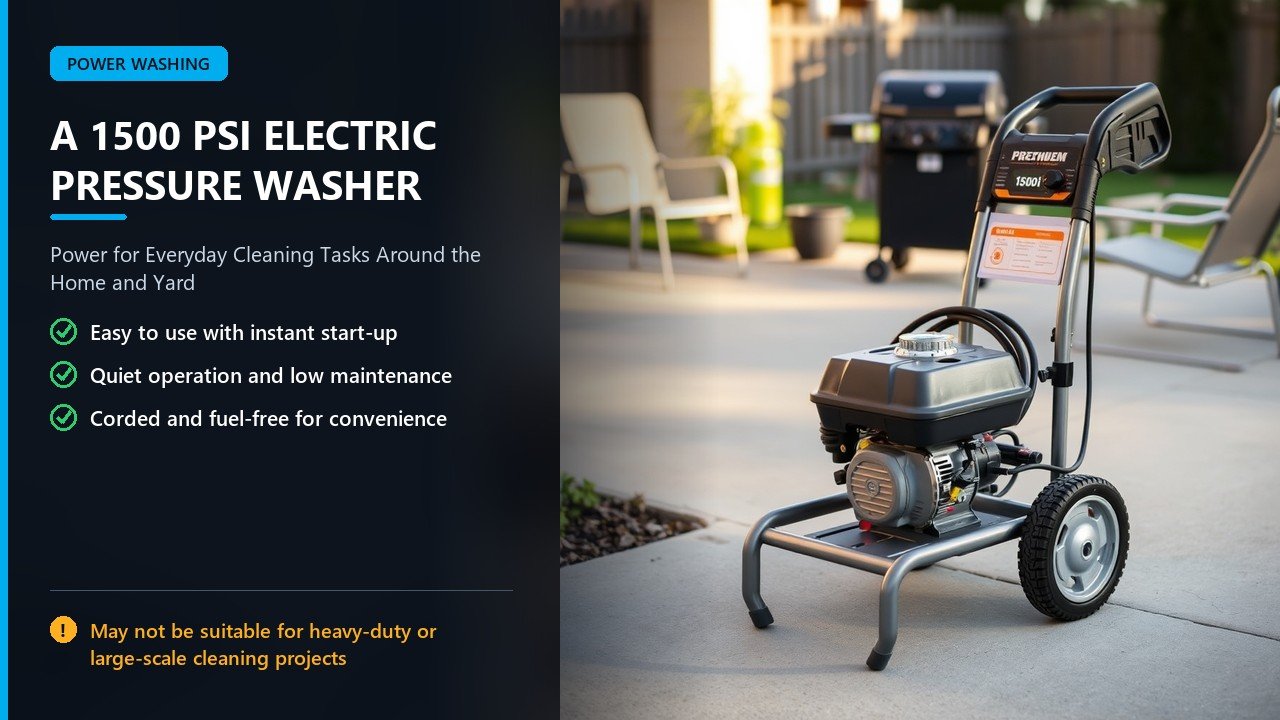
What a 1500 PSI Electric Washer Is
Machines in this class share a common profile. They run on standard household 120-volt power, draw roughly 12 to 13 amps, and use an axial cam or similar pump. They are cold-water only, meaning they do not heat the water they spray. They are compact, often under 35 pounds, and typically roll on small wheels or carry by a handle.
Pressure is measured in pounds per square inch (PSI), and flow in gallons per minute (GPM). A typical 1500 PSI electric washer moves somewhere between 1.2 and 2.0 GPM. The combination of the two, often called cleaning units or cleaning power, is what actually determines how fast a machine removes grime. This is why a 1500 PSI washer with 2.0 GPM can out-clean a 1500 PSI washer with 1.2 GPM on the same surface.
The DeWalt DXPW1500E illustrates the class at its stronger end: 1500 PSI at 2.0 GPM, a 1.5 HP enclosed fan-cooled electric motor, an axial cam pump with thermal relief, a 25-foot hose, and a welded steel frame on 8-inch tires. It is a cold-water machine for residential work, and the 2.0 GPM flow is what makes it more useful than a 1.2 GPM machine of the same pressure.
What a 1500 PSI Washer Can Clean
Set expectations correctly and this class of machine delights. Used with the right nozzle and technique, 1500 PSI handles the everyday cleaning most homeowners actually do.
| Task | Suitability | Notes |
|---|---|---|
| Cars and trucks | Excellent | Low pressure preserves paint |
| Patio furniture, grills | Excellent | Fast and safe |
| Decks and fences | Good | Use fan tips; mind wood grain |
| Light siding | Good | Keep nozzle moving; avoid seals |
| Driveways, patios | Fair | Works for light grime; slow on stains |
| Heavy concrete stains | Poor | Needs more pressure or a gas machine |
Where the machine shines is in the gentle, everyday jobs. Low pressure is a virtue around paint, glass, and delicate surfaces, and an electric washer’s soft spray is exactly right for washing a car without risking the finish. For a homeowner whose cleaning is mostly vehicles, furniture, and the occasional deck, 1500 PSI is plenty.
Where it struggles is deep, set-in grime on hard surfaces: oil-stained driveways, heavy mildew on concrete, and thick buildup that needs sustained high pressure or hot water. For those jobs, a stronger gas machine or a commercial unit is the honest recommendation. Our guides to the 4,000 PSI pressure washer and the 4,000 PSI gas pressure washer cover the other end of the market.
Flow (GPM) Matters as Much as PSI
The most common mistake in this class is buying on PSI and ignoring GPM. Pressure strips grime; flow carries it away. A machine with reasonable pressure and good flow cleans faster and more evenly than one with higher pressure and a trickle of water.
Consider two 1500 PSI machines. The first delivers 1.2 GPM; the second, 2.0 GPM. On the same nozzle, the second moves two-thirds more water every minute, flushing loosened dirt away instead of leaving a streaky film. On a car or a deck, that difference is immediately obvious. When you compare 1500 PSI electric washers, read the flow figure first and treat the pressure figure as a floor, not the headline.
Flow also sets what accessories will work. A surface cleaner needs enough GPM to drive its spinning bar; too little flow and it leaves tracks. Nozzle size must match flow as well — too small an orifice with too much flow over-pressurizes the pump, and too large an orifice with too little flow wastes power. Our nozzle guide and surface cleaner guide explain the matching.
Quick Note: Cleaning power is pressure times flow. A 1500 PSI washer at 2.0 GPM cleans better and faster than the same pressure at 1.2 GPM. When shopping, weigh GPM heavily and make sure nozzle and accessory sizes match the machine’s flow.
Pump Type: Axial Versus Triplex
Under the housing, the pump determines durability and how hard the machine can work. Two types dominate this class.
An axial cam pump is compact and inexpensive, and it is what most budget electric washers use. It is fine for light, occasional use and typically maintenance-free, but it runs at high speed and does not tolerate long continuous sessions or a lack of water flow. Running an axial pump dry or against a closed trigger without a bypass wears it quickly.
A triplex plunger pump is built like a commercial pump: three ceramic or stainless plungers, replaceable seals, and much greater durability. Some higher-end 1500 PSI machines, such as the DeWalt DXPW1500E, use a triplex pump and a thermal relief valve, which is a meaningful durability upgrade. Triplex pumps last far longer and can be rebuilt, which is why they command a premium even at modest pressure.
For occasional homeowner use, an axial pump is acceptable if you follow the rules: never run the machine without water supply, and let it rest between long sessions. For anything approaching regular or commercial use, a triplex pump is worth the extra cost. Our guide on whether to rebuild, replace, or buy new helps when a pump eventually needs attention.
Features Worth Having
| Feature | Why It Matters |
|---|---|
| Total Stop System (TSS) | Shuts off motor when trigger is released; saves pump wear and power |
| GFCI power cord | Electrical safety outdoors; often required |
| Thermal relief valve | Prevents pump overheating; extends life |
| Good GPM (1.4-2.0) | Faster, streak-free cleaning |
| Quick-connect nozzles | Change spray angles tool-free |
| Onboard soap tank | Convenient detergent application |
| Longer hose (25-35 ft) | Reach without moving the machine |
| Onboard storage | Keeps nozzles, wand, and cord organized |
A Total Stop System is the feature people appreciate most without realizing why. It senses when you release the trigger and stops the motor, so the machine is not running and heating water while you reposition. This saves energy, reduces noise, and dramatically extends pump life. Many 1500 PSI machines include a TSS; on the ones that do not, that is a real drawback.
A GFCI power cord is standard and important — it is electrical safety for outdoor use. Thermal relief protects the pump if water overheats. Onboard storage and a soap tank are conveniences, but they make the machine genuinely more pleasant to use.
Representative 1500 PSI Models
- DeWalt DXPW1500E. 1500 PSI at 2.0 GPM, 1.5 HP enclosed fan-cooled motor, triplex pump with thermal relief, 25-foot hose, five nozzles, welded steel frame on 8-inch tires. The stronger end of the class.
- AR Blue Clean AR112S. 1500 PSI at 1.4 GPM, 12-amp universal motor, Total Stop System, 20-foot hose, 35-foot GFCI cord, detergent bottle, and a compact wheeled frame. An affordable, tidy homeowner machine.
- Greenworks GPW1501. 1500 PSI at 1.2 GPM, 20-foot hose, 25-degree and 40-degree quick-connect tips, soap applicator, and a 35-foot GFCI cord. A basic, light-duty option.
- Cam Spray 15003XS (industrial). A different league: 1500 PSI at 3.0 GPM, a 3 HP totally enclosed motor, triplex plunger pump, 230-volt power, and a heavy tube steel cart. This is a commercial machine that happens to share the pressure figure.
Notice how the same 1500 PSI spans an $80 homeowner unit and a commercial machine costing many times more. The difference is flow, pump type, motor, frame, and durability — none of which the PSI number reveals. Match the class of machine to the work, not just the pressure.
Electric Advantages and Real Limits
Electric pressure washers win on convenience. They are quiet enough to use in a neighborhood without drawing complaints, produce no exhaust, need no fuel or oil changes beyond the basics, start instantly, and can be used in a garage with the door shut. They are light, easy to store, and require little maintenance.
Their limits are cold water, modest power, and dependence on an outlet and a garden hose. On a large property, the cord and hose become a maze. For heavy or commercial cleaning, they simply lack the power and flow. And because they cannot heat water, they rely on detergent and dwell time for greasy or oily messes that a hot-water machine would cut through effortlessly.
For the homeowner who washes cars, furniture, and the occasional deck, those limits rarely matter. For someone tackling a large driveway, restoring a deck, or cleaning for a living, they eventually will — and that is when a gas or commercial machine enters the picture.
Maintaining a 1500 PSI Electric Washer
- Winterize before the first freeze. Blow out or protect the pump with a pump saver; trapped water cracks pump heads and fittings. See our pump saver guide.
- Never run it dry. Connect the water and open the supply before starting; running without water destroys the pump in minutes.
- Use the TSS. Release the trigger when not spraying rather than leaving it running against a closed line.
- Flush detergent. Run clean water through after using soap so chemical does not sit in the pump and seals.
- Check O-rings and hose. A soft or kinked hose and worn O-rings cause most leaks; see our electric hose guide and wand parts guide.
- Store indoors and drain the hose, wand, and pump.
- Keep the inlet strainer clean so debris does not reach the pump.
Follow those habits and even a budget axial-pump machine can last several seasons. Neglect them and an axial pump will fail early, which is the most common cause of premature death in this class.
Who Should Buy a 1500 PSI Electric Washer
This machine suits a specific owner: someone with a normal suburban property, a handful of vehicles, some outdoor furniture, a deck or fence, and light siding, who values quiet, clean, plug-in convenience over maximum power. It is also a great first pressure washer, letting a new owner learn technique on a forgiving, low-pressure machine.
It is the wrong choice for someone with a large, stained driveway, a heavy commercial schedule, or a need to clean thick grease and mildew. Those owners should look at higher-pressure electric machines, or step up to gas. Being honest about which owner you are prevents the most common purchase regret in this category.
Choosing Between 1500, 1800, and 2000 PSI Electric Washers
Buying an electric pressure washer can feel like comparing a wall of nearly identical machines. Pressure, flow, motor, pump, and features vary in small increments, and the price range is wide. It helps to understand where 1500 PSI sits relative to its neighbors.
Entry class (around 1500 PSI, 1.2-1.4 GPM). The most affordable machines. They handle cars, furniture, and light surfaces, and they are light and easy to store. Their flow is modest, so they clean slowly on larger areas. Best for occasional, gentle cleaning.
Mid class (around 1800-2000 PSI, 1.2-1.6 GPM). A small step up in pressure that helps on siding, decks, and moderately dirty concrete. Flow is often similar, so the gain is mostly in stripping power. These machines cost a little more and are a sensible middle ground for a homeowner with a mix of jobs.
Higher electric class (2500-3400 PSI, 1.1-2.0 GPM). These push into gas-machine territory on pressure, though flow remains limited by household power. They cost more, weigh more, and are best when you need extra stripping power but must stay with electric for noise, fumes, or convenience reasons.
Where does 1500 PSI fit? It is the value sweet spot for gentle cleaning. If your jobs are cars, grills, furniture, and light deck or siding work, it removes grime safely and costs the least. If you routinely face dirtier concrete or larger areas, moving up to around 2000 PSI with good flow is money well spent. The wrong move is paying for extra pressure you never use, or buying the cheapest machine for jobs that need more flow and durability.
How to Use a 1500 PSI Washer Effectively
Technique matters even more on a modest machine, because you cannot brute-force with power you do not have. A few habits get the most from 1500 PSI.
- Soak first. Wetting a surface loosens dirt so the washer flushes it away rather than fighting dry grime.
- Use detergent and dwell time. With only cold water, chemical does the heavy lifting. Apply soap with the low-pressure nozzle, let it sit a few minutes, then rinse.
- Prefer wider angles. Fan tips (25 and 40 degrees) clean more area and are safer on surfaces; save the narrow tip for stubborn spots.
- Keep the nozzle moving. A held stream etches streaks and can damage soft materials.
- Work top to bottom and overlap passes so dirty water runs onto already-cleaned surface.
- Mind the distance. Closer means more impact; back off on paint, glass, and wood.
- Match the nozzle to the pump. Use the correct orifice size so the machine runs at its rated pressure and flow.
Used this way, a 1500 PSI machine often cleans a car or furniture better than a more powerful washer in careless hands, because it cannot damage what it touches and the operator relies on chemistry and patience instead of force. Our nozzle guide explains how each angle behaves.
Accessories That Extend Capability
A few accessories let a modest machine do more, and because they mount on standard fittings, they carry over if you later upgrade the washer.
- A foam cannon blankets a vehicle in clinging foam, which does the bulk of the cleaning before the spray ever touches the paint. Ideal for a low-pressure machine.
- A turbo or rotary nozzle concentrates the available pressure into a spinning point for stubborn spots without needing a bigger pump.
- A surface cleaner speeds up flatwork, though match its size to your GPM so it does not leave stripes.
- An extension or gutter wand adds reach for siding and gutters without a ladder.
- A quality replacement hose resists kinks and lasts longer than the stock hose; our electric hose guide explains the difference.
- Quick-connect couplers and spare O-rings keep connections leak-free and let you swap accessories fast; see our coupler guide.
Because these use 1/4-inch quick connect, M22, or standard threads, they fit almost any 1500 PSI machine and survive an upgrade. Buying a foam cannon and a turbo nozzle is usually a better investment than paying for extra pressure you will rarely need.
Note: Accessories use the same fittings as higher-pressure machines, so they carry over when you upgrade. Match nozzle and surface cleaner sizes to your machine’s GPM, though, or they will perform poorly and can stress the pump.
Common Mistakes to Avoid
- Buying on PSI alone. Flow and pump type often matter more; a 1.2 GPM machine cleans slowly no matter the pressure.
- Running it dry. Starting without water supply destroys the pump in minutes — the single most common way these machines die.
- Ignoring the Total Stop System. Leaving the motor running against a closed trigger cooks the pump; release the trigger between passes.
- Using the wrong nozzle size. Too small an orifice over-pressurizes and can damage the pump or unloader.
- Expecting hot-water performance. These are cold-water machines; greasy messes need detergent and dwell time.
- Skipping winterization. Trapped water splits pump heads on the first freeze.
- Overworking an axial pump. Long continuous sessions wear cheap pumps; let them rest.
- Pointing the stream at people, pets, or windows. Even 1500 PSI can injure or break glass.
Safety and Electrical Tips
An electric pressure washer combines water and 120-volt power, which makes basic electrical safety non-negotiable. A few precautions keep the operator safe and the machine reliable.
Always plug into a GFCI outlet or use a machine with an inline GFCI cord. Ground-fault protection trips the circuit if current leaks to ground, which can happen when water and electricity mix. Most quality machines include an auto-reset GFCI module for exactly this reason.
Avoid extension cords if possible. Many manuals warn against them, because voltage drop under load can overheat the motor and cord. If you must use one, choose a heavy-gauge, outdoor-rated cord rated for the machine’s amperage, keep it as short as practical, and never use a damaged cord.
Keep connections dry. Route the cord away from the spray, do not stand in water while plugged in, and unplug the machine before moving or servicing it. Never handle the plug with wet hands.
Respect the spray. Even 1500 PSI can cause injury. Never point the wand at people or pets, and use eye protection. The stream can also damage glass, so avoid windows and car windshields at close range.
Watch the water supply. Never let the machine run without water. Attach the garden hose, open the tap, and purge air before squeezing the trigger. Running dry is the fastest way to ruin a pump.
These habits are simple and quickly become automatic. They also protect the warranty: many failures that look like defects trace back to an extension cord, a dry run, or a frozen pump, none of which warranty covers.
Frequently Asked Questions
What can a 1500 PSI electric pressure washer clean? Cars, trucks, patio furniture, grills, decks, fences, light siding, and light concrete grime. It is a light-to-medium-duty cold-water machine best suited to gentle, everyday residential cleaning.
Is 1500 PSI enough for a driveway? For light surface dirt, yes, especially with good flow and a surface cleaner. For heavy, set-in stains and oil, no — those need more pressure, more flow, or hot water.
What is more important, PSI or GPM? Both matter, and their product is cleaning power. Flow carries dirt away, so a 1500 PSI machine with high GPM (1.4-2.0) cleans better than the same pressure with low GPM (around 1.2).
Axial or triplex pump? Axial pumps are cheap and fine for occasional use; triplex pumps last far longer and can be rebuilt, and they suit regular or heavier use. Some 1500 PSI machines use triplex pumps as a durability upgrade.
Can I use hot water in a 1500 PSI electric washer? No. These are cold-water machines; most list a maximum inlet water temperature around 104 degrees Fahrenheit. Hot water can damage seals and the pump.
How do I keep it from freezing? Drain and blow out all water after use and protect the pump with a pump saver, or store the machine in a heated space. Never leave water inside through a freeze.
What nozzle sizes should I use? Match the nozzle orifice to your machine’s flow at its pressure, and use the angle that suits the surface. Wider angles (25 and 40 degrees) for general cleaning, a narrow tip for stubborn spots, and a soap nozzle for detergent. Using an undersized nozzle over-pressurizes the pump.
How long should a 1500 PSI electric washer last? With proper care — no dry running, winterizing, and letting an axial pump rest — a homeowner machine can serve several seasons. A triplex-pump model typically lasts considerably longer and can be rebuilt rather than replaced.
Final Thoughts
A 1500 PSI electric pressure washer is a quiet, affordable, plug-and-play machine that handles the cleaning most households actually do. Judged on pressure alone it looks modest, but paired with good flow, a reasonable pump, and a Total Stop System, it is capable of washing cars, furniture, decks, and light siding cleanly and safely for years.
When you shop, weigh GPM as heavily as PSI, prefer a triplex pump and a TSS if the budget allows, insist on a GFCI cord and thermal relief, and match your nozzles and accessories to the machine’s flow. Maintain it — no dry running, no freezing, detergent flushed, O-rings fresh — and it will reward you with easy, dependable service. Buy the right class for your work, and a 1500 PSI electric washer is one of the best-value tools a homeowner can own. It will not replace a gas machine for restoring a stained driveway or a commercial unit for daily professional cleaning, and it is not meant to. What it does — quietly, safely, and affordably — is keep a home’s vehicles, furniture, decks, and siding clean season after season, which is exactly the work most people actually have.