The frame of a pressure washer is the part nobody photographs and everybody curses. It is the gray steel skeleton that the engine, pump, and hose reel all bolt to, the thing with the wheels and the vertical handle that you drag around a driveway. Buyers cross-shop engines and pumps and PSI numbers for weeks, then discover in the third season that the frame is what actually died first. The bolt heads rusted and seized, the handlebars wobbled, a weld at the axle cracked, and the whole rig started lurching sideways on a job. Dana learned this the hard way with a cheap cart whose frame gave out under a heavier pump she had installed, leaving the machine lying on the pavement mid-job. The frame, it turns out, is not packaging for the engine; it is the machine that carries the machine, and it deserves the same scrutiny as the pump.
A pressure washer frame, also called the cart, chassis, or skid, holds the whole assembly and defines how the machine moves, how stable it stays, and how long the tool survives the weather. Frames come in materials from powder-coated steel to aluminum to molded plastic, in layouts from a rolling wheelbarrow-style cart to a flat skid to a full trailer, and the frame choice shapes the entire ownership experience as surely as the engine does. This guide explains what a frame is responsible for, how materials and layouts compare, the wheels and hardware that decide real-world handling, the care that prevents rust and rail death, and how to choose or build one that outlives the pump it carries.
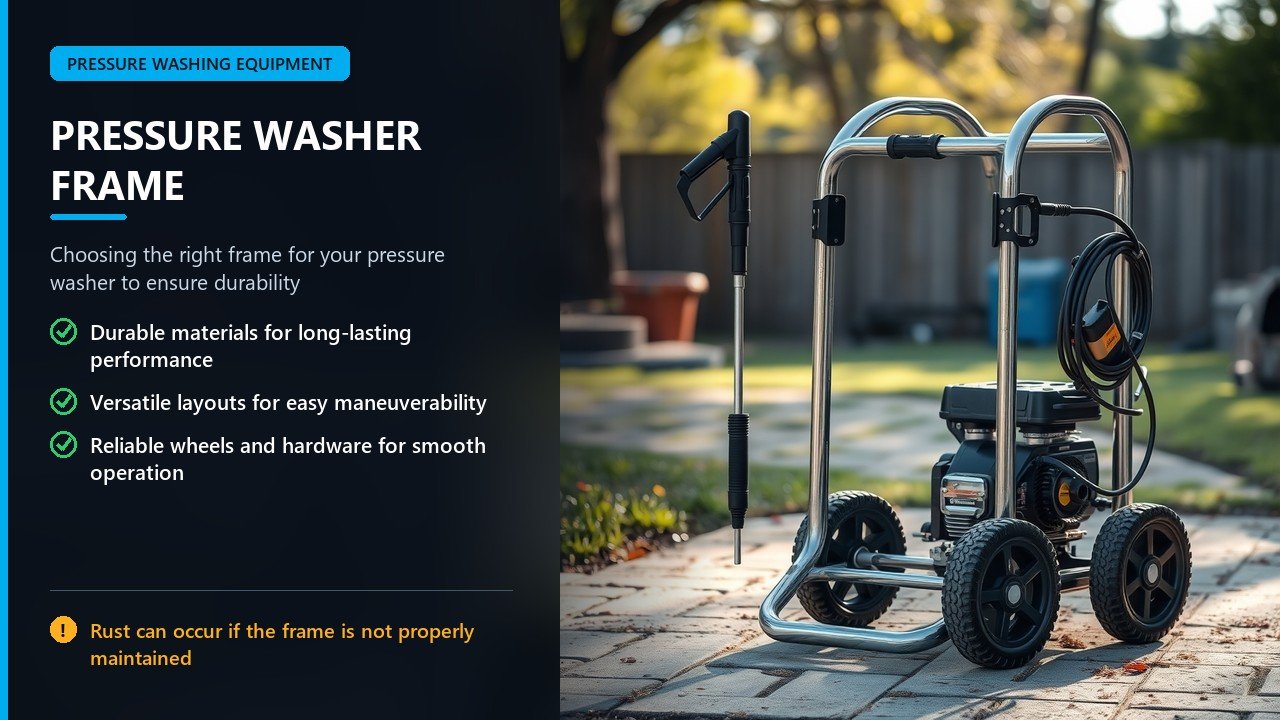
What the Frame Is Responsible For
It is easy to dismiss the frame as a shelf, so it is worth naming exactly what it does on a working machine.
It carries the load. Engine, pump, tank, reel, and the water in the lines, all of it rests on the frame, and when the machine rolls over a curb or a paver, the frame takes the shock. The frame’s rigidity is what keeps the pump and engine aligned and their mounts intact. A flexing frame works the mounts loose and eventually cracks.
It keeps the machine stable. A wide, low frame resists tipping, and a top-heavy rig on a narrow frame rolls over at the first hard turn. Stability is a frame geometry question, and it matters most where the machine is loaded and moved, like a trailer or a site with slopes.
It provides the handle and the wheels’ anchor. The handle and axle are only as solid as the frame they attach to. A wobbling handle or a bent axle is the frame’s welds and plates complaining, and those two failures make a machine exhausting to move and dangerous to load.
It manages the hose and the reel. Most well-designed frames include anchor points for a hose reel, gun clips, nozzle holders, and a hose lead routing. Good frames organize the whole rig into one rollable unit; bad frames leave the hose to drag and tangle.
It resists the weather. Outdoor machines live in sun, rain, and freeze-thaw. The frame’s coating and materials decide whether the machine is a sound tool in year five or a pile of rust holding an engine hostage. This is the responsibility owners notice last and suffer most.
Frame Materials
The material sets the frame’s weight, strength, cost, and rust resistance, and the differences are real.
Powder-coated steel. The most common choice on gas machines. Steel is strong, cheap, stiff, and easy to fabricate into carts and skids. A good powder coat resists chipping and rust for years. The catch is that once the coating is breached by a scratch or a bad weld, rust finds the bare steel and spreads. Powder-coated steel is the right value for most homeowner and mid-range rigs when the coating is good.
Aluminum. Lighter, naturally rust-resistant, and a premium choice on machines where portability matters. Aluminum is softer and more expensive, and it can gouge rather than dent, but it never turns to orange flakes the way bare steel does. For a machine that lives outside or is carried a lot, aluminum frames earn their cost.
Stainless steel. The corrosion-proof premium, used on high-end commercial skids and marine-adjacent rigs. Stainless frames are heavy and costly and essentially rust-free. For a daily commercial machine that lives on a wet trailer, stainless is the frame that never becomes the repair list.
Molded plastic and composite. Found on lighter electric machines, plastic frames are cheap, light, and rustproof, and they are entirely adequate for the light duty their machines do. They do not tolerate a heavy pump or hard loading, and they crack under shock, so they suit exactly the forces the small machines carry, no more.
| Material | Weight | Rust Resistance | Cost | Best For |
|---|---|---|---|---|
| Powder-coated steel | Heavy | Good until damaged | Low | Gas carts, value rigs |
| Aluminum | Light | Excellent | Higher | Portable, outdoor machines |
| Stainless steel | Heavy | Essentially rust-proof | Highest | Commercial, wet duty |
| Plastic/composite | Lightest | Total | Lowest | Light electric units |
Frame Layouts
Beyond material, the frame’s shape decides how the machine is used, and the three common layouts map to three kinds of owner.
The rolling cart. The familiar wheelbarrow-style frame with two wheels and a rising handle. It is the homeowner default: light enough to roll, compact enough to store, and stable enough for a driveway. The cart’s weakness is stability under a heavy or tall load, since two wheels and a handle means the operator balances it. A loaded cart on a slope or a curb can tip, so the layout suits machines that are moved gently and in the open. Our article on picking a cart that will not tip turns that into a buying test.
The skid or frame-only base. A flat, low frame without wheels, made to be bolted to a trailer, a truck bed, or a bench. Skids are the commercial norm: the machine is a component in a rig, not a stand-alone cart, and the skid’s job is a solid, stable, fully mounted base. A skid frame should be rigid and generously sized so the pump and engine have room and the whole assembly sits flat.
The full trailer rig. At the top, a frame becomes the trailer itself, carrying the machine, a water tank, reels, and chemicals as a complete mobile business. Here the frame is a proper engineering project, and the load-bearing, balance, and axle choices matter as much as any pressure washer spec. Our guide to commercial rig building treats the frame as its foundation.
Wheels, Tires, and Hardware
The frame’s usability is decided as much by its wheels and hardware as by the steel, and these are the parts that fail first on cheap carts.
Wheel size and type. Small hard plastic wheels clatter over driveways and dig into gravel; larger pneumatic or semi-pneumatic wheels roll smoothly and absorb shock. For a machine that moves far, larger wheels are worth the space. For flat concrete work only, smaller wheels are fine.
Axle and bearings. The axle carries the rolling load and the bearings keep it turning. Cheap carts use plain bushings that grind and wobble within a season; better carts use sealed or easily greased bearings. A bent or worn axle is the wobble most owners blame on the frame.
Bolts, nuts, and welds. Stainless or well-plated hardware resists the seized bolts that turn a simple repair into a drilled-out ordeal. Well-executed welds are the frame’s strength; poor welds and thin metal are where cheap frames crack under load. Inspect the welds at the handle and axle before buying, since those two joints take the hardest life.
Mounting plates and bushings. The engine and pump mount on plates with anti-vibration bushings that isolate the frame from engine shake. Missing or crushed bushings transmit vibration into the frame and loosen every bolt over time. A frame with proper bushings lasts far longer than one without.
Choosing a Frame on a New Machine
Most buyers will not buy a frame separately; they will buy a machine and inherit its frame. A few checks make that inheritance wise.
Test the stability. A good cart should not tip when it is rolled over a curb with the tank full. Push the machine and turn it sharply; if it feels like it wants to fall, it will. A wider wheelbase and lower center of gravity are the fixes, and if the machine lacks them, it is the wrong machine for your terrain.
Weigh the machine mentally. A frame that flexes under light handling will not survive daily commercial loads. Flex is the early warning sign; a frame that visibly bows under a strong pump is overmatched and will fail at a weld.
Look at the coating, welds, and hardware. Run a hand along the welds and check for thin spots, chipping, and bare metal. Check whether the bolts are plated and the bushings present. These small details separate a frame that outlives the pump from one that becomes the first repair list.
Confirm the mounting provisions. Does the frame offer anchor points for a hose reel, gun holster, nozzle storage, and a hose lead? A frame that organizes the whole rig saves daily frustration, while a bare frame forces the owner to bolt on their own storage or live with the tangle. Our article on choosing a hose reel pairs with the frame’s mounting design.
Rust Prevention and Frame Care
A frame is only as good as its maintenance, and the care list is short and cheap.
Touch up chips immediately. A scratch through the powder coat is the seed of a rust bloom. Keep a small can of matching paint or a rust-converting primer and touch up chips as they appear. Ten seconds now prevents a frame-scale repair later.
Keep it dry and ventilated. Store the machine under cover and off wet concrete where possible. A machine stored on damp ground rusts from the bottom up, and the bottom is exactly where the frame’s structure and axle live. The annual storage routine includes a frame inspection for this reason.
Lubricate the moving points. A drop of oil at the axle bearings and any folding-handle pivot keeps the machine rolling and the handle folding cleanly. Seized pivots force the operator to fight the machine, which stresses the welds.
Check the bolts seasonally. Vibration loosens fasteners. A seasonal pass with a wrench over the engine mounts, pump mounts, and handle bolts prevents the wobble that ends with a cracked mount. It takes a minute and saves a weld.
Free the fasteners before they freeze. On an older machine, apply penetrating oil to the axle and mounting bolts before they seize, especially before a winter layup. A frame is repairable; a frame with rusted-solid fasteners becomes a machine nobody can service.
Building or Rebuilding a Frame
When an original frame fails or a build needs a custom base, a home-built or rebuilt frame is a genuinely viable project, and the principles are the same whether you are repairing a cart or welding a skid from scratch.
Start from the load, not the look. Add up the engine, pump, full tank, reel, and hose weights, then size the steel and the wheelbase for that total with margin. A frame that just holds the parts when still will flex when rolling over a curb with water sloshing, and flex is what cracks welds. Overbuild the base and you build it once.
Keep the center of gravity low and the wheelbase wide. Mount the heavy items, pump, engine, and tank, as low as possible and spread the wheels as wide as the machine must travel. A low, wide frame resists tipping through turns and curb drops, which is exactly where a top-heavy cart fails. This single design rule prevents most frame-related accidents.
Isolate vibration at the mounts. Between the engine and the frame, use rubber anti-vibration bushings and grade-appropriate fasteners with lock washers or thread locker. Rigid metal-to-metal mounts transmit engine vibration into the frame and shake the whole assembly loose within a season. A cheap bushing set is the highest-value part of a rebuild.
Design the hose and reel routing. Leave anchor points for a reel, a gun clip, nozzle storage, and a clean path for the hose lead. A custom frame is the perfect chance to fix the routing that the factory got wrong, and letting the working hose move smoothly off a reel is worth more daily than any feature on the pump. Building the frame around the reel and its feed angle pays back every job.
Finish it to survive outdoors. Prime and paint or powder coat any bare steel, seal the weld areas, and plug any tube ends so water cannot collect inside the frame. A frame that traps water at the bottom of its tubes rusts from the inside, invisible until the steel gives. Good finishing is what separates a rebuild from a temporary fix.
Frames for Commercial Rigs and Special Loads
At the commercial end, the frame’s demands scale with the rig, and getting it right is both a safety and a profitability question.
Trailer frames carry a system, not a machine. A professional trailer frame carries the pressure washer, a water tank that may hold a hundred gallons or more, reels, chemical injectors, and hose, all moving down a road. The frame must be stiff enough that the tank does not slosh the rig apart, and the axle and tongue must be rated for the whole loaded weight with margin. This is engineering territory, and our guide to building a mobile pressure washing rig treats the frame and axle as the gating decisions.
Skids need a permanent, flat base. A skid bolted into a truck bed or a shop bench needs a flat, rigid mounting surface and a plan for vibration isolation, drainage, and access to the pump for service. A skid that sits on an uneven bed twists, and a twisted skid misaligns the pump and destroys belts or couplings. Flat, bolted, isolated, done.
Integrated rigs multiply the frame’s responsibilities. Once a frame holds multiple machines, a heater, and chemical tanks, it is a vehicle chassis in everything but name, and the load rating, balance, and tie-downs become regulatory and safety concerns, not preferences. Commercial builders plan the frame around service access, weight distribution, and the route the rig will travel, because a frame failure on a working trailer is a lost business day and a road hazard.
The commercial frame’s real payoff. A purpose-built commercial frame does something a cheap cart never does: it lets one operator run the whole rig efficiently, with the hose where it is needed, the chemicals staged, the tank centered, and the machine serviceable on site. That efficiency is revenue, and it is why professional rigs are built on frames that cost more than an entire homeowner machine. The frame is not the accessory to the business; it is the platform the business stands on.
Common Frame Mistakes
Judging the machine only by engine and PSI. A great pump on a failing frame is a dead machine. Inspect the frame like the structural part it is.
Overloading a light cart. Bolting a heavy tank or an oversized reel onto a flimsy cart overloads the frame and cracks it. Match the load to the frame’s design.
Ignoring the mating of wheels to terrain. Tiny wheels on a gravel or slope job make the machine a hazard. Choose wheels for where the machine actually rolls.
Letting chips and scratches rust. Every bare steel spot is a future hole. Touch-ups are the cheapest maintenance on the machine.
Storing wet on the ground. Damp concrete and a lingering puddle rust the frame worst at the base. Store it up and dry.
Skipping seasonal bolt checks. Vibration loosens everything. A minute with a wrench protects the welds and the mounts.
Frequently Asked Questions
What is a pressure washer frame? The frame, or cart or skid, is the structural chassis that carries the engine, pump, tank, and reel, and provides the wheels and handle. It is the machine that holds the machine.
Steel or aluminum frame, which is better? Powder-coated steel for value and stiffness; aluminum for lighter weight and rust resistance at a higher cost. Stainless is the premium, near-rust-proof choice.
Can I replace or upgrade a pressure washer frame? Yes. Skids and cart frames are sold separately, and a sturdy replacement can rescue a machine whose original frame failed. Match the mounting pattern to the engine and pump.
Why do pressure washer carts tip? A narrow wheelbase and a high, heavy load, usually the pump and a full tank. Choose a wider, lower frame and larger wheels for uneven ground.
How do I stop a frame from rusting? Touch up paint chips immediately, store the machine dry and off the ground, and keep the axle and hardware lubricated and free of standing water.
Do I need a cart or a skid? A cart for a machine that rolls around a home or lot; a skid for a machine bolted to a trailer or bench as part of a larger rig.
Final Thoughts on the Pressure Washer Frame
The pressure washer frame is the part owners shop last and rely on most, and it is the difference between a machine that serves for a decade and one that dies on a driveway with a perfectly good pump still bolted to it. It is not glamorous, and it is exactly the kind of structural part that rewards a buyer who stops to inspect welds, coating, wheels, and mounting provisions before choosing, rather than trusting the engine badge and the PSI sticker to speak for the whole machine.
Choose a frame material and layout by where the machine will live and roll: powder-coated steel or aluminum for a value cart, stainless for wet commercial duty, a skid for a trailer build. Check the stability, the welds, the axle, and the hardware as carefully as you check the pump. Then keep it alive with the cheap rituals, touch up the chips, keep it dry, oil the bearings, and tighten the bolts once a year. Do that, and the frame becomes the silent partner it should be, carrying the engine and the work without complaint, season after season, while the rest of the machine gets all the credit for a clean that only happened because the structure underneath held its ground.