Standing in the driveway, Dan could not understand why his pressure washer sprayed like a watering can. He had a solid machine, plenty of water, and a nozzle in the end of the wand – yet the jet was weak and the concrete still wore a decade of gray grime. The problem was one small, cheap part: his high pressure nozzle was the wrong size. He had swapped a worn tip for one with a larger opening, and a bigger hole simply lets the water pour out faster than the pump can pressurize it. Ten dollars later, with the correct orifice, the same machine blasted clean lines through the dirt like it had been rebuilt.
That little lesson captures why the pressure washer high pressure nozzle deserves more attention than it usually gets. The nozzle is where pressure becomes cleaning power, and choosing the right one – by spray angle and by orifice size – is the difference between a machine that works beautifully and one that disappoints. This guide decodes both variables, explains the colors and the numbers, shows you how to read the markings on a tip, and helps you build a nozzle set that handles every surface around your home.
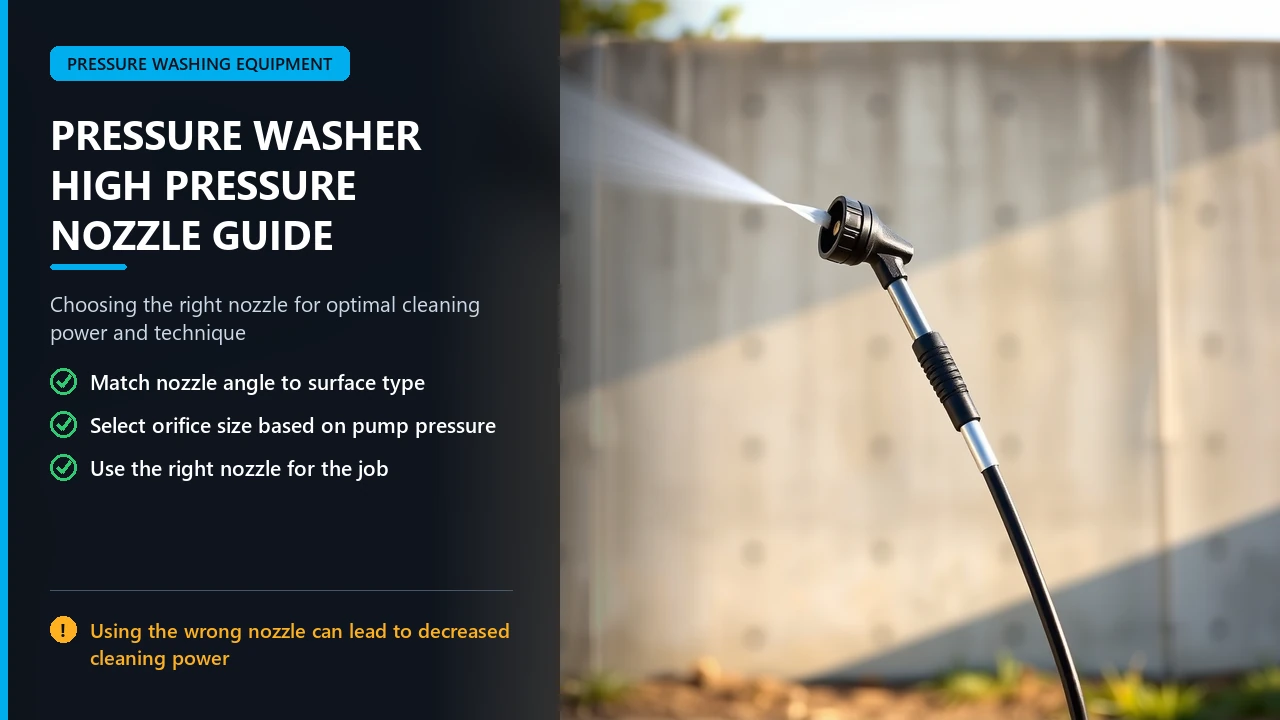
What a High Pressure Nozzle Actually Does
Inside a pressure washer, the pump pushes water at high volume and moderate pressure. The nozzle restricts that flow into a tight stream, and that restriction is what creates the intense cleaning pressure at the tip. In a real sense, the pressure washer high pressure nozzle is where the machine’s force is either channeled or wasted. A smaller opening forces the same water through a smaller space, raising pressure; a larger opening lets water gush out with less force. This is the entire physics of a nozzle in one sentence.
A high pressure nozzle is the one you use for actual cleaning – the focused, powerful tips that strip grime from concrete, siding, decks, and equipment. It stands opposite the low pressure or soap nozzle, which has a deliberately oversized orifice so the water dribbles out gently and picks up detergent on the way. Swapping between them is how you go from applying soap to rinsing it off, and understanding that pair is the foundation of everything else.
The Spray Angles and Their Colors
Every standard high pressure nozzle set uses color coding to signal the spray angle at a glance. Commit these five colors to memory and you will never fumble for the right tip mid-job.
| Color | Angle | Pattern | Best Uses | Risk |
|---|---|---|---|---|
| Red | 0 degrees | Pencil-thin stream, maximum force | Blasting stubborn stains, gum, graffiti, cracks in concrete | Very high – etches and gouges most surfaces |
| Yellow | 15 degrees | Tight fan, strong impact | Heavy-duty stripping, tough dirt, paint prep on concrete and brick | High – can damage wood and soft surfaces |
| Green | 25 degrees | Medium fan, balanced force | General cleaning – patios, decks, siding, most flatwork | Moderate – the everyday workhorse |
| White | 40 degrees | Wide fan, gentle impact | Windows, vehicles, siding, delicate surfaces, rinsing | Low – safest for finishes |
| Black | 65 degrees | Very wide, low pressure | Applying detergent and soap | Low – almost no cleaning force |
The 25-degree green tip is by far the most used, because it balances coverage and force for the widest range of jobs. The 40-degree white tip is your safe choice for anything painted or delicate. The 0-degree red tip is the one to respect – at full pressure it can carve into wood, strip paint, and cut lines into concrete, so it is reserved for spot work where nothing else will do.
The Nozzle Number: Orifice Size Decoded
If color tells you the pattern, the number tells you the flow. This is the part most people miss, and it is where Dan’s machine lost its power.
The nozzle number is a flow-capacity rating equal to the gallons per minute that nozzle passes at 4,000 PSI. In other words, a number 4.0 nozzle flows about 4.0 GPM at 4,000 PSI. Because that convention is fixed, the number also becomes the key that unlocks a nozzle chart for any pressure. The relationship between nozzle number, flow, and pressure is expressed by a simple formula:
- GPM per nozzle equals nozzle number times the square root of (your PSI divided by 4,000).
- Rearranged, nozzle number equals your GPM times the square root of (4,000 divided by your PSI).
You rarely need to do the math by hand, because every nozzle chart applies it for you. What matters is the principle: for a given pump, a nozzle that is too small chokes the flow and drives pressure dangerously high, while a nozzle that is too large lets water surge through unpressurized and kills your cleaning power. The correct nozzle matches your pump’s GPM at its working pressure, so the machine runs at its rated performance.
Nozzle Chart: Matching Orifice to PSI and GPM
The table below shows roughly how much water a nozzle passes at common pressures. Find your machine’s working pressure across the top, follow that column down to the flow that matches your pump, then read the nozzle number on the left. A homeowner with a 3,000 PSI, 2.5 GPM machine, for example, needs about a number 3.0 nozzle.
| Nozzle # | 1,500 PSI | 2,000 PSI | 2,500 PSI | 3,000 PSI | 3,500 PSI | 4,000 PSI |
|---|---|---|---|---|---|---|
| 2.0 | 1.22 | 1.41 | 1.58 | 1.73 | 1.87 | 2.00 |
| 2.5 | 1.53 | 1.77 | 1.98 | 2.17 | 2.34 | 2.50 |
| 3.0 | 1.84 | 2.12 | 2.37 | 2.60 | 2.81 | 3.00 |
| 3.5 | 2.14 | 2.47 | 2.77 | 3.03 | 3.27 | 3.50 |
| 4.0 | 2.45 | 2.83 | 3.16 | 3.46 | 3.74 | 4.00 |
| 4.5 | 2.76 | 3.18 | 3.56 | 3.90 | 4.21 | 4.50 |
| 5.0 | 3.06 | 3.54 | 3.95 | 4.33 | 4.68 | 5.00 |
Two practical rules fall out of this chart. First, if you have two identical nozzles feeding different parts of a machine – for example, the twin nozzles on a surface cleaner – divide the machine’s total flow by the number of nozzles before selecting each one. A 4 GPM machine feeding two nozzles needs each tip sized for 2 GPM, not 4. Second, undersizing is the dangerous direction: a nozzle that is too small raises pressure beyond the pump’s rating and accelerates wear, while one that is slightly too large merely cleans a bit less forcefully.
For a deeper walk-through of reading these charts and picking tips for real jobs, our guide to the pressure washer tip size chart pairs well with this section. Manufacturer references are also worth keeping on hand: General Pump publishes an official nozzle chart with physical orifice diameters, and Envirospec maintains a nozzle selection chart that walks through the same PSI-and-GPM matching method for field use.
How to Read the Markings on a Nozzle
Real nozzles carry their identity stamped or laser-etched on the side, usually as two numbers where the angle comes first and the orifice second. A tip marked “2506” is a 25-degree nozzle with a number 6.0 orifice; “1504” is a 15-degree tip with a 4.0 orifice. Orifice numbers below 10 are written with a leading zero – a 3.0 orifice appears as “03” – and half sizes show a decimal point, so a 6.5 orifice reads as “6.5.”
This marking system matters because color coding only tells you the angle, and colors can fade, wear off, or vary between brands. The engraved numbers are the ground truth. If a tip has lost its color, check the stamped angle number before you use it. If the numbers themselves have worn away, retire the tip – guessing wrong with a red-angle nozzle where you expected a white one is a fast route to a scarred surface.
Quick-Connect vs. Threaded (MEG) Nozzles
High pressure nozzles come in two mounting styles, and knowing which you own prevents a frustrating purchase mistake.
Quick-connect nozzles are the color-coded tips that push into a quick coupler on the wand and lock with a collar. They are the standard for homeowners and general cleaning because they swap in a second without tools. The critical habit with quick-connects is verifying that the collar locks fully after every change – an improperly seated tip can be launched from the coupler under pressure, which is both a repair bill and a safety hazard.
Threaded nozzles, often called MEG nozzles after a common style, screw directly onto the gun, lance, or surface cleaner. They are not color coded; instead they are identified purely by their angle and orifice number, such as a “2502” MEG nozzle for 25 degrees and a number 2.0 orifice. Professionals favor MEG nozzles for surface cleaners and high-pressure systems because the threaded connection is more secure and durable under constant use. If you own a surface cleaner, check whether it takes MEG nozzles before you buy spares.
Turbo and Rotary Nozzles: Specialty High Pressure Tips
Beyond the standard fan tips, two specialty nozzles deliver the cleaning power of a narrow angle across a wider area – and they are worth understanding because they can dramatically speed up tough jobs.
A turbo nozzle, also called a rotary nozzle, fires a zero-degree stream that spins in a tight circle as you spray. The result is the aggressive impact of a 0-degree tip spread over a 25-degree-style footprint, so it blasts stubborn stains on concrete without the tedium and gouging risk of a static pencil stream. For driveways, sidewalks, and heavy masonry, a turbo nozzle can cut cleaning time noticeably compared with a standard tip. The trade-off is that it is still aggressive – keep it off wood, paint, and soft surfaces.
The one caveat with rotary nozzles is that they wear faster than static tips because of their moving parts, and they prefer higher flow to operate well. On a low-GPM machine, a turbo nozzle may simply spin too slowly to help. Match the tool to your pump, as always.
Our rundown of a rotary pressure washer nozzle goes deeper on when one earns its place in your kit.
How the Different Nozzle Types Compare
Fan tips are the core of any kit, but they are not the only option. Knowing how the main nozzle types differ helps you choose deliberately instead of grabbing whatever is closest.
| Nozzle Type | How It Works | Pressure Created | Best Use |
|---|---|---|---|
| Standard fan tips (0-40 degrees) | Fixed orifice and fixed spray angle | Full working pressure | All general high pressure cleaning; one angle per job |
| Turbo / rotary | Zero-degree stream spun in a circle by a bearing | Full pressure, wider footprint | Concrete and tough masonry stains; faster than a static tip |
| Soap / chemical nozzle | Oversized orifice, wide angle | Low pressure | Applying detergent before rinsing |
| Adjustable nozzle | Twist collar changes angle between stream and fan | Low to full pressure | Convenience on light jobs; less precise than fixed tips |
| MEG / surface cleaner tips | Threaded, matched in pairs or sets | Full pressure per tip | Surface cleaners and professional equipment |
The takeaway is that each type solves a specific problem. Fixed fan tips give the most control and the most accurate pressure; turbo nozzles trade a little precision for speed on flatwork; the soap nozzle exists solely to apply chemistry gently; adjustable nozzles are convenient but rarely match the exactness of a dedicated tip. A complete kit uses several of these together.
When the Nozzle Is the Problem, Not the Pump
When a pressure washer loses its bite, the pump gets blamed first – but the nozzle is a far more common culprit and a much cheaper fix. Two scenarios account for the majority of “weak pressure” complaints.
The first is a worn nozzle. Abrasive grit and hard water slowly enlarge the orifice, and a pressure washer high pressure nozzle that has grown even slightly passes more water at lower pressure. The machine sounds fine, the engine and pump are healthy, and yet the spray dribbles. Swapping in a fresh, correctly sized tip usually restores full performance instantly. If you have been using the same tips for several seasons, this is the first thing to check.
The second is simply the wrong orifice size – the mistake that started this whole guide. Someone replaces a lost tip with whatever was on the shelf, and the new one is one or two sizes off. On the high side, the water gushes out unpressurized; on the low side, the pump strains against a restriction it was never rated for. Both are solved the same way: look up your machine’s GPM at its working pressure, read the chart, and fit the matching number. Before you spend a dollar on pump parts, spend two minutes confirming the nozzle is right.
Choosing the Right High Pressure Nozzle for the Job
With the two variables understood, matching a nozzle to a task becomes straightforward.
- Concrete driveways and sidewalks: start with a 25-degree green tip for general cleaning; switch to a 15-degree yellow tip or a turbo nozzle for stains.
- Siding and fences: use a 25-degree tip at a downward angle, or a 40-degree tip for delicate or painted surfaces.
- Wood decks: stay at 40 degrees, keep distance, and follow the grain – narrower angles fuzz and splinter wood.
- Vehicles and windows: always a 40-degree white tip, at a distance, to protect paint, glass, and trim.
- Spot stains (gum, graffiti, rust): a 0-degree red tip or a turbo nozzle, used briefly and carefully.
- Applying soap: the black low-pressure soap nozzle, not a high pressure tip.
A practical tip set for a homeowner is one each of the 0, 15, 25, and 40 degree tips plus a soap nozzle, sized to the machine’s orifice. Add a turbo nozzle for concrete work and you can handle nearly anything. Our illustration of which tip color to use for concrete is a handy quick reference for the most common surface of all.
High Pressure Nozzle Safety
A high pressure nozzle concentrates enormous energy into a tiny stream, and that energy does not care about skin, eyes, or soft surfaces. A few habits keep the work safe.
- Never point a nozzle at a person or animal. A high pressure jet can cause serious injury. Treat every tip as loaded.
- Confirm the quick-connect is locked before pulling the trigger, and always aim at the ground for the first burst in case a tip releases.
- Wear eye protection and closed footwear. Flying debris and overspray are constant companions of pressure washing.
- Respect the red and yellow tips. Test an unfamiliar surface with a wider, gentler angle before working up to a narrow one.
- Never reach into a running nozzle to clear a blockage. Release the trigger, shut off the machine, and clear the tip safely.
If you also switch between soap and rinse around vehicles, our companion guide to the pressure washer color code for every nozzle reinforces the same safety-first approach.
Maintenance and When to Replace a Nozzle
Nozzles are wear items. The abrasive grit that rides along in water slowly erodes the orifice, and the harder the water and the more you use the machine, the faster it happens. A nozzle that has enlarged from wear passes more water than intended, so pressure drops and cleaning suffers – often mistaken for a failing pump.
- Clean tips regularly. Use the supplied nozzle cleaning tool to poke out mineral deposits and debris before each session.
- Descale hard water buildup. Soak clogged tips in a mild descaler or vinegar, then rinse thoroughly.
- Replace at the first sign of a weak or fanning stream. If a tip that once cut clean now sprays soft, it is worn – replace it rather than blame the machine.
- Prefer stainless steel over brass where available; stainless resists erosion far better and holds its rated size longer.
- Keep spares. Nozzles are inexpensive. Carrying a spare set means a worn or lost tip never ends your day.
A worn nozzle can also be the root cause of pressure complaints elsewhere. If you are troubleshooting a weak machine, our tip size guide helps you confirm whether the nozzle, not the pump, is the culprit.
Building a Complete Nozzle Kit
The best time to assemble a nozzle set is before you need it, not while a job sits half-finished. A well-chosen kit turns one pressure washer into a tool that fits almost every surface around a home.
- Start with the four angles – 0, 15, 25, and 40 degrees – sized to your machine’s orifice. This covers spot blasting through gentle rinsing.
- Add a soap nozzle so you can apply detergent at low pressure without hand-pumping a sprayer.
- Add a turbo nozzle if concrete, brick, or heavy masonry is part of your regular work.
- Keep stainless steel tips where you can; they hold their rated size far longer than brass.
- Carry spares of your most-used angles, especially the green 25-degree tip that does most of the work.
- Match the mounting style to your equipment – quick-connect for the wand, MEG for a surface cleaner.
- Store tips together in a small pouch or the machine’s accessory holder, so a lost or misplaced tip never stalls a job.
The cost of a full set is modest, and the payoff is large: the right high pressure nozzle for every task, no more ruined surfaces from grabbing the wrong tip, and no more guessing why the machine seems weak. Think of nozzles the way a woodworker thinks of blades – the tool is only as good as the edge you put in it, and keeping the right ones on hand is what separates smooth work from constant frustration.
Frequently Asked Questions
What is a high pressure nozzle on a pressure washer?
It is the tip that restricts the water flow to create the intense, focused cleaning pressure. Standard high pressure nozzles come in spray angles – 0, 15, 25, and 40 degrees – each color coded. They are distinct from the low pressure soap nozzle, which has a larger opening and gentler flow for applying detergent.
What do the numbers on a pressure washer nozzle mean?
The number is the orifice size, expressed as the gallons per minute the nozzle passes at 4,000 PSI. A number 4.0 nozzle flows about 4.0 GPM at 4,000 PSI. The first number in a marking like “2506” is the spray angle (25 degrees) and the second is the orifice (6.0). Nozzle manufacturers publish the same convention in their selection resources, such as the Pumptec nozzle selection guide.
Which nozzle is the most powerful?
The 0-degree red nozzle delivers the most concentrated force and the highest impact, which is why it is used for stubborn spot stains and why it can damage surfaces so easily. A turbo or rotary nozzle delivers similar force in a spinning pattern that covers more ground. Neither should be used on wood, paint, or delicate materials.
Can the wrong nozzle damage my pressure washer?
Yes. A nozzle with too small an orifice chokes the flow and drives pressure above the pump’s rating, which can damage seals, hoses, and the pump itself. Always size the nozzle to your machine’s GPM at its working pressure using a nozzle chart. A slightly oversized nozzle is safer but cleans less forcefully.
Does the spray angle affect nozzle size selection?
No. The spray angle changes the pattern only; it does not change the flow. A 15-degree and a 40-degree nozzle of the same number pass the same amount of water and produce the same pressure. Choose the angle for the surface and the number for the machine.
What nozzles do professional pressure washers use?
Many professionals favor threaded MEG nozzles for their secure connection and durability, especially on surface cleaners, along with stainless steel tips that resist wear. They still rely on the same color-coded angles for hand-held work, and they know that a pressure washer high pressure nozzle properly matched to the pump is worth more than any single feature on the machine.
The Bottom Line
The high pressure nozzle is the smallest and cheapest part of a pressure washer, and it is also the one that decides how the whole machine performs. Spray angle sets the pattern and the risk; the orifice number sets the flow and the pressure. Get both right and a modest washer cleans like a much bigger one; get them wrong and a powerful machine sprays like a hose.
Build a set that covers the angles you actually use – 0, 15, 25, and 40 degrees plus a soap tip, sized to your machine’s orifice – and add a turbo nozzle if concrete is in your future. Read the stamped numbers when the colors fade, verify your quick-connects lock, respect the aggressive tips, and replace worn nozzles the moment a stream weakens. Do that, and the pressure washer high pressure nozzle stops being an afterthought and becomes the reason your cleaning jobs finish fast, clean, and without damage.