Marcus had spent twenty minutes wrestling with his pressure washer hose before he even touched the driveway. It kinked near the middle, looped itself around the water spigot, and somehow tangled around the wheel of his car. By the time he finally got the spray going, half his energy was gone and a good mood was not far behind. The next weekend he bolted a pressure washer reel onto the back of his machine, and the same setup went from a daily annoyance to a two-second pull. That single piece of hardware is the upgrade most owners put off for years and then wonder how they ever lived without.
A pressure washer reel is more than a storage accessory. It protects the most expensive wear item on your rig, keeps your workspace safe, and shaves real minutes off every job. This guide walks through how reels work, the types available, how to size one correctly, and the mistakes that shorten the life of both the reel and the hose wrapped around it.
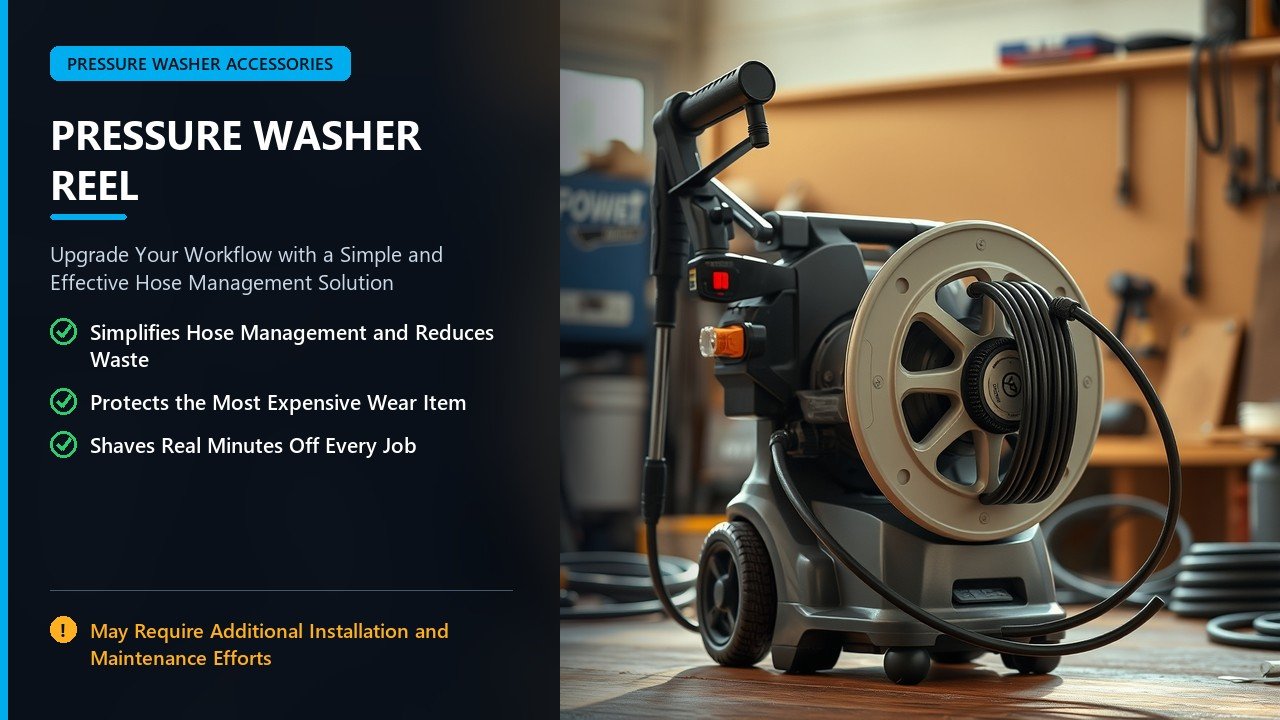
What a Pressure Washer Reel Actually Does
A pressure washer reel is a rotating spool that stores and feeds high-pressure hose. You pull off as much hose as you need, the reel spins freely, and when the job is done you crank or push a button to wind it back. The water travels through a swivel joint at the center of the drum, so the hose stays connected even while the spool turns.
That swivel is the heart of the design. A poor swivel restricts flow, drops pressure, and leaks. A good one — typically ball-bearing supported and rated for your machine’s pressure — lets water pass with almost no loss. This is why professional reels cost more than a plastic garden hose winder: they are built to survive thousands of PSI and constant rotation without failing.
Why a Reel Pays for Itself: Time, Hose Life, and Safety
Hoses are the weakest link in any pressure washing setup. They kink, crack, get driven over, and bake in the sun. Coiling a high-pressure hose by hand also creates tight bends that stress the inner tube over time. A reel solves several problems at once:
Faster setup and teardown. Rewinding by hand can take ten minutes of fussing; a manual reel takes about two, and a motorized reel takes seconds. On a paid job, that time is money.
Longer hose life. Hose stored at a consistent radius avoids the sharp creases that cause blisters and bursts. It also stays off the ground, away from gravel, glass, and hot pavement.
Fewer trip hazards. A loose coil across a driveway is an accident waiting to happen. A reel keeps the slack controlled and the work area clean.
Less strain on your body. Winding 100 feet of heavy 3/8-inch hose by hand is hard on shoulders and wrists. A reel does the work for you.
Quick Note: Even the best reel will not save a cheap hose. Pair a quality reel with a reinforced hose rated above your machine’s output, and check our pressure hose buying guide before you buy.
Types of Pressure Washer Reels
Reels fall into a few clear categories, and the right one depends on how often you clean and how much hose you carry.
Manual (Hand-Crank) Reels
The most affordable and reliable option. You wind the hose by hand using a handle, usually with a spring-loaded pin or drag brake to lock it in place. Fewer moving parts means fewer failures, which is why many pros still prefer them. Best for homeowners, part-time work, and tight budgets.
Spring-Rewind Reels
These use a wound spring to pull the hose back automatically, similar to an air hose reel. They are convenient for shorter hose runs but generally top out at lower pressure ratings, so they suit light-duty water and garden use more than 4,000 PSI rigs.
Motorized / Electric Reels
Powered by a 12V or 120V motor, these rewind at the push of a button and often include a powered feed that lays the hose evenly. They are the standard for full-time professionals running 200 feet or more of 3/8-inch hose, and for anyone who wants to avoid physical strain.
Retractable Reels
A retractable pressure washer reel combines a spring or motor return with a self-contained, tidy housing. They excel where appearance and space matter, such as a wall-mounted garage setup. Learn more about matching and caring for them in our guide to retractable pressure washer hose reels.
| Reel Type | Rewind | Typical Capacity | Best For |
|---|---|---|---|
| Manual / hand-crank | By hand | 50–200 ft | Homeowners, part-time pros |
| Spring-rewind | Auto spring | 30–75 ft | Light-duty, lower PSI |
| Motorized / electric | Push button | 100–300 ft | Full-time commercial use |
| Retractable | Spring or motor | 25–100 ft | Wall-mount, tidy spaces |
Sizing: Hose Diameter, Length, and Pressure Rating
Three numbers decide whether a reel will serve you well: the hose inside diameter (ID), the hose length, and the reel’s pressure rating. Get any of them wrong and you will deal with leaks, restricted flow, or a drum that will not hold your line.
Diameter. Standard pressure hose is 3/8-inch, though 1/4-inch and 5/16-inch are common on lighter machines and larger 1/2-inch hose shows up on big rigs. The reel’s spool and swivel must match. A 3/8-inch swivel on a 1/2-inch hose starves flow.
Length. Reels are usually rated by how much hose they hold. A reel labeled 200 feet may only fit 150 feet of thicker or stiffer hose, so build in margin.
Pressure. Always choose a reel rated at least 1,000 PSI above your machine’s output. Pressure can spike above the working rating every time you release the trigger, and those spikes are what crack cheap swivels. If your washer runs 4,000 PSI, look for a 5,000 PSI reel.
Note: For hot water applications, confirm the reel and swivel are rated for your temperature — often up to 212°F for standard seals and higher for special builds. Never trust a cold-water reel with a hot-water machine.
Materials and Build Quality
Professional reels are made from heavy-gauge steel with an e-coat or oven-cured powder finish to fight rust. Aluminum frames are lighter and resist corrosion, which is why they are popular on mobile rigs and trucks. Stainless steel is the choice for soft washing and sodium hypochlorite, where corrosive chemicals will eat a painted frame in a season or two.
Look at the details: sealed ball bearings instead of bushings, a strong non-sparking ratchet or pin lock, and a swivel with a grease fitting for service. These small features are the difference between a reel that lasts three years and one that lasts fifteen. For an idea of how serious the engineering gets, browse the pressure wash reel lineup from Reelcraft, an industry manufacturer that publishes full pressure and temperature specs for every model.
Mounting Options: Wall, Cart, Skid, Trailer, and Truck
Where you mount the reel matters as much as which one you buy. The hose should pull out smoothly without dragging across the machine or your shins.
Wall mount. Ideal for a garage or wash bay. A pivoting bracket lets the reel swing so the hose always pulls straight. Our guide to adding a hose reel to your machine covers the hardware you need.
Cart and skid mount. Keeps the reel with the pump so the whole rig moves as one unit.
Trailer and truck mount. Commercial setups often carry two reels — one for high-pressure hose and one for soft wash — stacked on a frame. Confirm the mounting footprint matches the reel’s bolt pattern.
Whatever the location, mount the reel high enough that the hose exits above knee level, and orient the guide so the line feeds straight to the gun. A sideways pull wears the hose edges and fights the swivel.
How to Choose the Right Pressure Washer Reel
Run through this checklist before you buy. The same logic helps whether you are shopping for a home machine or outfitting a fleet, and it pairs well with the guidance in our reel types and mounting guide.
1. Match the swivel to your hose ID and PSI. No compromises here.
2. Estimate your real hose length. Add a buffer if you plan to grow.
3. Pick the rewind you will actually use. A manual reel you enjoy beats a motorized one that annoys you.
4. Choose materials for your chemicals. Stainless or aluminum for corrosive mixes.
5. Check the brake and lock. A drag brake or pin lock keeps the hose from unspooling as you walk.
6. Verify mounting hardware and footprint. Measure before you drill.
7. Confirm parts availability. Swivels and seals should be replaceable, not disposable.
Installing and Setting Up Your Reel
Installation is straightforward for most owners. Bolt the bracket to a solid surface using the correct hardware, or mount the reel to the machine frame. Then connect the machine’s outlet to the reel inlet, and the reel outlet to your gun hose. Use the correct fittings — M22, 3/8-inch NPT, or quick-connect — and apply thread sealant only on tapered NPT threads, never on straight-threaded or O-ring fittings.
Before the first real job, run water through the reel with the gun open to purge air and check every joint for weeping. A few drips at the swivel usually mean a loose connection or a dry O-ring, not a defective reel. Tighten gently and re-test.
Maintenance to Keep It Spinning
A reel is simple, but it still needs a little attention. Rinse it after contact with detergent or bleach. Keep the swivel and bearings greased if they have fittings. Store the hose fully wound but not under tension. In freezing weather, drain the hose and reel completely so trapped water does not expand and split the line.
When the reel starts turning hard, do not force it. Check for an overfilled spool, a misaligned guide, or worn bearings. Replacing a cheap swivel seal is far cheaper than replacing the hose it leaks onto.
Common Mistakes to Avoid
Overfilling the reel. Cramming on more hose than intended makes the layers bind and the reel bind with them.
Winding wet hose and leaving it. Moisture trapped against the spool promotes rust and mildew.
Pulling the hose around a corner. Sharp angles strain the swivel and abrade the cover. Move the machine or add a guide.
Ignoring the pressure rating. Undersized reels fail without warning, sometimes with the hose in your hand.
Coiling a hot hose on a cold reel. Always check temperature ratings before hot-water work.
Do You Need a Reel? The ROI Math
For a homeowner who cleans twice a year, a reel is mostly about convenience and hose longevity. For a working professional, the math changes. If a reel saves ten to fifteen minutes per job and you charge around $100 per hour, a $400 reel pays for itself in roughly twenty to forty jobs — well within a single busy season. Add the savings from hoses that last longer and fewer callbacks for tangled or damaged lines, and the return is clear.
Frequently Asked Questions
Can I use a garden hose reel for a pressure washer? No. Garden reels and their swivels are not built for high pressure. They will fail, often dangerously, under a pressure washer’s load.
Do I need to unreel all the hose before starting? For hot water, yes — trapped coils can expand and crush the spool. For cold water, you can leave some wound, but a full pull gives the smoothest flow and least strain.
How much hose can a reel hold? It varies by drum size and hose diameter. Always leave about 10 to 15 percent of capacity free for easier winding.
Are motorized reels worth it? If you clean daily or handle long, heavy hose, absolutely. For occasional home use, a manual reel is simpler and more durable.
Final Thoughts
A pressure washer reel is one of those purchases that seems optional until you use one. It turns a frustrating tangle into a smooth, controlled pull, protects the hose that takes the most abuse, and makes any setup look and feel professional. Match the swivel to your hose and pressure, choose a build that suits your water and chemicals, and mount it where the hose feeds cleanly.
Do that, and you will spend your time cleaning surfaces instead of untangling hose — which is exactly how it should be. When you are ready to go further, explore our full pressure washer hose reel guide and our breakdown of how hose length and diameter affect pressure to build a rig that works as hard as you do.