Pressure Washer Retractable Reel: How Spring Rewind Reels Work and Fit
A pressure washer retractable reel is one of those upgrades that seems like a luxury until you own one, and then it feels obvious. Instead of coiling a stiff, heavy high-pressure hose by hand and stuffing it into a bucket or over a hook, you give the hose a gentle tug and it winds itself back onto the drum in seconds. The reel keeps the hose off the ground, out of the sun, and away from the tangles that shorten a hose’s life. But a retractable reel is also a pressurized component, and the wrong one can restrict flow, leak, or fail outright. This guide explains how a retractable reel works and how to choose and fit one that lasts.
The short version: A retractable reel uses a coiled flat spring to pull the hose back onto a rotating drum. Pull the hose out, it latches at a set length; tug it again and the spring rewinds it. The reel must be rated above your machine’s pressure and flow, and its swivel joint is the part that decides whether it lasts.
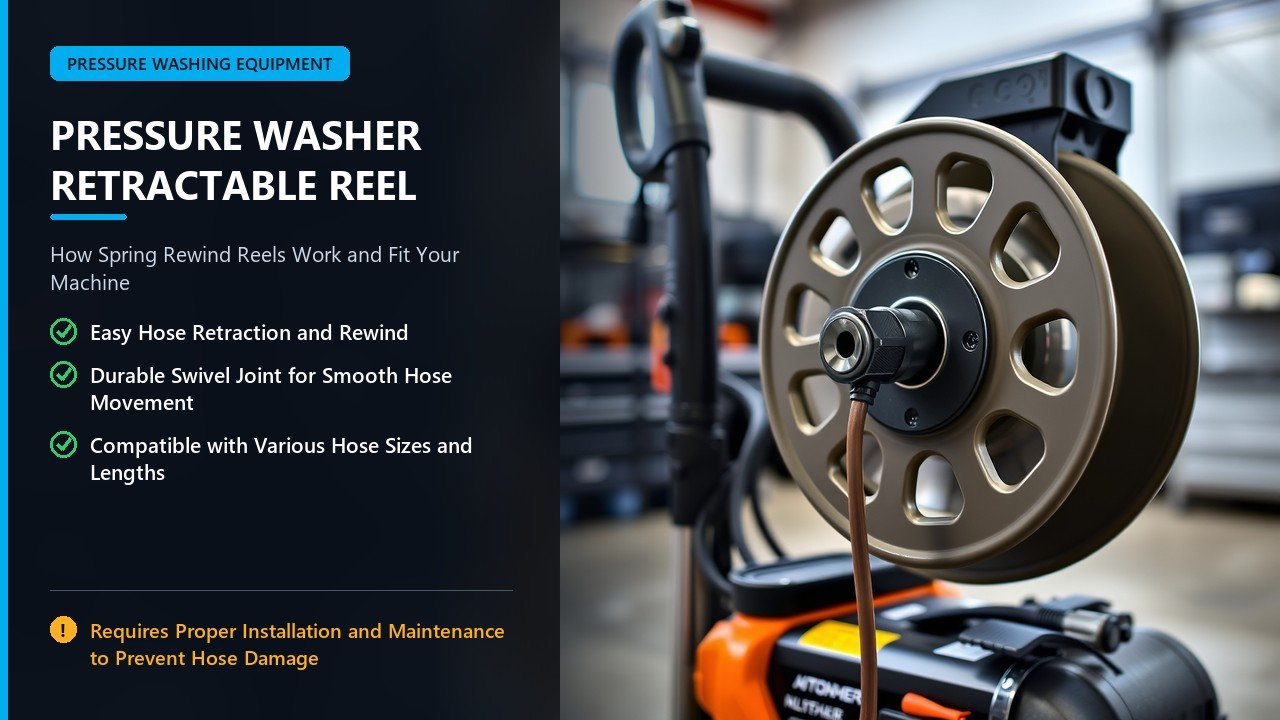
What Makes a Reel Retractable
All hose reels hold a hose; a retractable reel is defined by how it gets the hose back. A manual reel has a crank that you turn by hand, so you do the winding. A retractable, or spring-rewind, reel contains a coiled spring that stores energy as you pull the hose out and releases it to wind the hose back in. Nothing is plugged in and no motor is involved, which is why these reels are simple, reliable, and inexpensive to run.
The trade-off is that the retraction force is fixed by the spring, so the reel is matched to a specific hose length and diameter at the factory. Pull out more hose than the reel is designed to hold, or fit a heavier hose than it expects, and the spring will not have enough force to retrieve it cleanly. That is the single most important thing to understand before you buy. A retractable reel is a matched system, not a universal one.
The Parts of a Retractable Reel
Most retractable reels share the same handful of components. Knowing them makes specification and troubleshooting far easier.
| Part | Job |
|---|---|
| Drum | The rotating spool the hose winds onto |
| Rewind spring | Stores and releases energy to retract the hose |
| Swivel joint | Lets the hose drum spin without leaking at the inlet |
| Latch / ratchet | Holds the hose at a chosen length |
| Guide arm / rollers | Feed the hose evenly and reduce abrasion |
| Mounting bracket | Attaches the reel to a wall, ceiling, or floor |
Every failure you will ever have with a retractable reel traces to one of these parts. The spring can weaken, the swivel can leak, the latch can stick, or the guide rollers can wear a flat spot in the hose. That is a short list, and it is why these reels are worth repairing rather than replacing.
How the Rewind Mechanism Works
The heart of a retractable reel is a flat clock-style spring coiled inside the drum. When you pull the hose out, you rotate the drum against the spring and load it with tension. The spring wants to return to its relaxed state, and when you release the hose, that stored energy spins the drum backward and winds the hose on. A separate latch mechanism decides whether the hose stays out or snaps back.
The latching works on a simple but clever principle. As the drum turns, a cam and pawl pass a latching zone. Pulling the hose out and stopping at the right moment lets the latch drop into a notch and hold the hose at that length. Pull a little further, or tug the hose, and the latch is knocked out of the notch, allowing the spring to retrieve the hose. The drum turns a set amount per revolution, so the latch points repeat at fixed intervals; on many reels that interval is roughly three feet. Commercial reel makers such as Hannay Reels build their spring-rewind pressure washing lines on exactly this mechanism, adding a declutching arbor to protect the spring from reverse winding and a non-sparking ratchet assembly for safety.
Free-Run vs Latching Mode
Some retractable reels offer a mode switch that changes how the latch behaves. In latching mode, the reel holds the hose at set intervals, which is useful when you want to stop mid-job and keep the hose extended. In free-run mode, the latch is bypassed, and the hose retracts fully as soon as you let go. The Levelwind reel manual from a major retailer describes exactly this: a single latching zone the drum passes once per revolution, with a clicking sound as the latch crosses it.
Understanding the mode matters more than it sounds. If a reel keeps snapping the hose back when you want it held, it is in free-run mode or the latch is not engaging. If it will not retract at all, the latch may be stuck or the spring may be slack. Neither is a fatal problem, and both are addressed in the repair guide for failures worth fixing before you buy a new reel.
The Swivel: Where Retractable Reels Live or Die
The swivel joint is the pressurized pivot that lets the drum spin while the inlet hose stays still. It is the hardest-working seal on the reel, because it must hold full pressure and rotate, often thousands of times over a hose’s life. On a good reel it is a solid brass, leak-proof swivel rated for the reel’s full working pressure; on a cheap one it is the first thing to weep. Retailer listings for pressure-rated reels make a point of the 360-degree swivel inlet in solid brass precisely because it is the failure point.
When a retractable reel starts dripping at the inlet or losing pressure, the swivel is almost always the cause. Sometimes it is a worn O-ring that can be replaced; sometimes the swivel body itself is scored and the reel needs service. Because the swivel sits under pressure, a leak here is not just an annoyance, it is a performance loss at the nozzle and a slipping hazard on the floor. Spec a reel with a swivel rated for your machine, and treat any weeping as a repair signal, not a minor drip.
Specifications That Matter
A retractable reel is sold against a set of ratings, and every one of them must meet or exceed your machine. Buy below them and the reel becomes the weak link.
| Spec | Why it matters |
|---|---|
| Maximum pressure | Must exceed your machine’s PSI with margin |
| Maximum temperature | Caps hot water use, often 140–212°F |
| Hose inside diameter | Sets flow; must match your hose and gun |
| Hose capacity | How much hose the drum and spring can handle |
| Fitting type | M22 or NPT; must connect to your machine |
| Material | Powder-coated steel for outdoor durability |
Pressure and temperature are the two ratings people overlook most. A reel rated to 3,200 PSI on a 4,000 PSI machine is a failure waiting to happen, and a reel rated to 140°F has no business on a hot water washer that puts out far more. Match the reel to the hottest and highest-pressure condition, not the average. As a sense of the market’s range, a popular 50-foot, 3/8-inch retractable reel is rated to 4,000 PSI and 212°F, while a lighter 65-foot, 1/4-inch reel tops out at 3,200 PSI and 150°F. The difference shows why you must read the ratings rather than assume a reel is universal.
Choosing Hose Size and Length
Because a retractable reel is a matched system, hose size and length are not free choices. The drum and spring are built for a specific inside diameter and maximum length, and going heavier or longer throws off the retraction balance and can overload the swivel. A reel rated for 50 feet of 3/8-inch hose will happily hold that combination; ask it to swallow 65 feet of the same hose and it may retract weakly, if at all.
On the machine side, hose diameter sets flow. A 3/8-inch hose is the standard high-flow choice for serious machines, while 1/4-inch suits lighter units. If you are unsure which diameter your machine wants, our guide to why 3/8-inch hose is the standard explains the flow math. Length is the other half: more reel capacity means more reach but also more pressure loss and a heavier pull on the spring. Match both to your job rather than buying the biggest reel you can find.
Mounting Locations and Brackets
One of the practical advantages of a retractable reel is that it swings on its bracket to follow you as you work, so it can be mounted almost anywhere that makes sense. The three common positions each have trade-offs.
- Wall mount: the classic choice for a garage or wash bay, with the reel at chest height and a clear path to the work area.
- Ceiling mount: keeps the hose overhead and off the floor entirely, ideal for a fixed wash station.
- Floor or cart mount: mobile setups, where the reel travels with the machine.
Many reels ship with a bracket that locks in several positions, so you can angle the hose feed to suit the layout. Whatever the position, the mounting surface must be strong enough to take the pull of a fully extended hose, which is a surprising load. Bolt into structure, not into drywall alone. If you want a reel that travels with the machine, a cart with a hose reel is a tidy way to combine both.
Installation Steps
Fitting a retractable reel is a modest job if you take it in order. The single biggest mistake is pressurizing before you confirm every connection is tight.
- Choose and prepare the mounting point, bolting the bracket into solid structure.
- Attach the reel to the bracket and set the swing angle you want.
- Connect the short inlet (jumper) hose from the machine to the reel’s swivel inlet, using the correct thread and sealant.
- Thread the working hose onto the reel’s outlet and fit the stopper ball at the correct length.
- Check every fitting by hand before starting the machine, then run at low pressure to confirm there are no leaks.
The short inlet line deserves its own attention, because a poor jumper connection is a common source of grief. Our guide to the jumper hose between pump and reel covers the fittings and routing. If you want the sequence laid out end to end, the installation walkthrough covers doing it right the first time.
Retractable Reel vs Manual Reel vs Coil Hose
A retractable reel is not the only way to manage a hose, and the alternative you choose should match your habits. A manual crank reel is cheaper and simpler, with no spring to weaken, but you wind it by hand every time. A coil hose is portable and tangle-prone under pressure, and our look at the coil hose trap explains why it frustrates so many owners.
A retractable reel wins when convenience and hose longevity matter. Because the hose is stored off the ground and out of the sun, it lasts longer, and because it winds evenly through guide rollers, it kinks less. It wins further on a fixed wash station where the reel stays mounted and the hose is always ready. If neatness and speed are the goals, a spring-rewind reel is the right answer, and the deeper mechanics are covered in our guide to how rewind reels work.
Matching the Reel to Your Machine
Matching is where retractable reels reward careful buyers and punish impulsive ones. Start with pressure: the reel’s rating must exceed your machine’s maximum PSI with headroom, because pressure spikes when you release the trigger. Then temperature: if your machine heats water, the reel must be rated for the hottest output. Then hose diameter and capacity, which must line up with your working hose. Finally fittings, which must connect to your machine without a stack of adapters that add leak points.
A matched set is always better than a pile of parts. Buying the reel and hose together, from the same rating class, removes the guesswork and the adapter leaks. Our guide to why a matched reel and hose beats mixing parts makes the case in detail. And if you are still weighing which reel fits your job, the overview of how to pick a hose reel by job is a good starting point.
Common Failures and How to Prevent Them
Because a retractable reel has so few parts, its failure modes are well known. Almost all of them are preventable with correct spec and basic care.
| Symptom | Cause and fix |
|---|---|
| Hose won’t hold out | Latch stuck or in free-run; reset or repair |
| Weak or no retraction | Slack spring; increase tension or replace |
| Leak at the inlet | Worn swivel O-ring; service the swivel |
| Hose flat-spotted | Worn guide rollers; rewind evenly, replace rollers |
| Pressure loss at nozzle | Reel under-rated or hose too long |
The most common cause of flat-spotted hose is letting the reel snap the hose back at full speed and jam. Guide the hose in with your hand instead of releasing it, and the guide rollers will feed it evenly without chewing a groove. It is a small habit that adds years to a hose.
Maintenance and Winter Care
A retractable reel needs very little, but what it needs matters. Keep the swivel clean and watch it for the first sign of weeping. Do not over-tension the spring in search of a stronger pull; a spring loaded too tight snaps hose and wears the drum. Guard the guide rollers, since a rough roller is what damages hose. And in freezing weather, drain the hose and reel or store them where they will not freeze, because trapped water expands and can damage the swivel and the hose alike.
Freeze damage is worth special attention because it is the failure that turns a working reel into scrap. The same discipline that protects a pump protects a reel and hose: drain them, store them dry, and never leave water trapped under pressure. Our guide to protecting a pump with a pump saver covers the freeze-prevention habit that applies to every pressurized part on the machine, reel included.
Safety Considerations
Two safety points apply specifically to retractable reels. First, never let the hose end fly; if the hose comes free of the gun while the spring is loaded, it can whip and strike. Keep the stopper ball fitted so the hose cannot retract past the guide. Second, respect the pressure rating. A reel pushed beyond its rated PSI can rupture a swivel or burst a fitting, and the failure is sudden and forceful. Inspect fittings regularly and replace anything swollen, cracked, or weeping. A retractable reel stores energy in a spring and in pressurized water; treat both with respect.
What a Retractable Reel Costs
Retractable pressure washer reels span a wide price range, from inexpensive consumer units to commercial reels built for daily abuse. The cheap end uses lighter steel, a smaller swivel, and a shorter hose capacity; the expensive end uses heavy-gauge steel, a robust brass swivel, and a longer, higher-pressure rating. For a homeowner running a machine a few weekends a season, a mid-range reel is plenty. For a commercial wash bay where the reel runs all day, the premium is money well spent on the swivel and frame alone.
The calculation is simple: a reel that matches your machine’s pressure and temperature will outlast several cheap ones that do not. Buy to the ratings, not to the price tag, and the retractable reel stops being a maintenance item and becomes a permanent part of the station. If you want the professional-grade end of the market in view, the high-pressure reel specification guide shows what separates the durable from the disposable.
What to Look for in a Quality Retractable Reel
Two reels with similar ratings can still differ sharply in how long they last, and the difference is in the details. The frame is the first clue: heavy-gauge, powder-coated carbon steel resists corrosion and the twisting load of a fully extended hose, while thin painted steel buckles and rusts at the mounting holes. The swivel is the second: a solid brass, 360-degree swivel with a replaceable seal will outlast a pot-metal one many times over. The third is the guide; four smooth non-snag rollers feed the hose without chewing it, and they are the difference between a hose that lasts for years and one that fails in a season.
Beyond materials, look at how the reel is serviced. A reel with accessible spring tension adjustment, a replaceable swivel, and standard fasteners can be repaired for years; a sealed, riveted one cannot be opened without destroying it. The best reels are designed to be maintained, which is why commercial brands publish parts tables and repair procedures for every model. For a homeowner, that level of service is a nice-to-have; for anyone running a reel daily, it is the whole point. Our overview of reel types and mounting compares the options at a glance.
Common Buying Mistakes
Most retractable reel disappointments trace to a handful of avoidable errors. Watch for these before you order.
- Buying on price alone: the cheapest reels use small swivels and thin steel, and they fail first under real pressure.
- Ignoring the pressure and temperature ratings: an under-rated reel is a leak or rupture waiting to happen, especially on hot water.
- Exceeding the hose capacity: fitting a longer or heavier hose than the drum and spring allow causes weak retraction.
- Overlooking the fittings: a reel that does not thread onto your machine forces adapters, which add leak points.
- Mounting to weak structure: a loaded hose pulls hard, and drywall alone will not hold a reel for long.
- Skipping freeze protection: trapped water splits swivels and hose, turning a working reel into scrap over one winter.
Avoid these six and you are unlikely to be disappointed. Each one is a question you can answer before checkout: what is the reel rated for, how much hose does it hold, what threads does it use, and where will it live. If you want to sanity-check your reach needs before choosing capacity, our guide to how far a hose reel really reaches is a useful reality check. And if you are weighing a retractable reel against a fixed wash station, the wider overview in our reel and hose guide puts both in context.
Frequently Asked Questions
How does a retractable pressure washer reel work? A coiled spring stores energy as you pull the hose out and releases it to wind the hose back onto the drum. A latch holds the hose at set lengths until you tug it to release the spring.
Can a retractable reel handle hot water? Only if it is rated for it. Many reels cap out around 140°F, so a hot water machine needs a reel rated for its hotter output. Always check the temperature rating before use.
Why won’t my hose stay pulled out? The latch is not engaging, either because the reel is in free-run mode or because the latch mechanism is stuck. Resetting or repairing the latch usually solves it.
Why does my reel leak at the inlet? The swivel joint has a worn O-ring or scored body. The swivel is the pressurized pivot, so it is the most likely leak point and often the easiest to repair.
Can I use a longer hose than the reel is rated for? No, not reliably. The drum and spring are matched to a specific length, and exceeding it causes weak retraction and can overload the swivel. Stay within the rated capacity.
Where should I mount a retractable reel? Anywhere structural and convenient: a wall at chest height, a ceiling overhead, or a floor and cart for mobile setups. The bracket usually swings to follow your work, so the reel can track you around a wash bay.
Are retractable reels worth it? For most owners, yes. They eliminate hand coiling, store the hose off the ground and out of the sun, and reduce kinks, all of which extend hose life. The payoff is largest on a fixed station used regularly.
Can I repair a retractable reel? Often, yes. Springs can be re-tensioned or replaced, latches reset, swivel seals renewed, and guide rollers swapped. Repair is usually cheaper than replacement, especially on a quality reel.
Final Thoughts
A pressure washer retractable reel turns hose handling from a chore into a non-event. Give the hose a tug, it latches; give it another, it rewinds. Under the shell is a simple system of a spring, a drum, a latch, and a swivel, and once you understand those four parts, choosing and maintaining a reel becomes straightforward.
The rules are the same as for any pressure component: match the ratings to your machine, keep the hose within the reel’s capacity, protect the swivel, and drain it before the freeze. Do those things and a retractable reel is one of the best small upgrades you can make to a pressure washer, keeping your hose intact, your workspace tidy, and your setup ready to work.