The first time someone hands you a pressure washer rotary head, it feels like cheating. You have been scrubbing a stained concrete driveway with a 25-degree fan tip, inching back and forth, watching the wand leave pale stripes on a gray slab. Then you thread on the little bulb-shaped nozzle, squeeze the trigger, and the water disappears into a tight, furious spinning jet that peels the dirt off in one smooth pass. The driveway looks new in half the time, and you wonder why anyone uses a fan tip on concrete at all.
That reaction is well earned, and it is also where people get into trouble. A pressure washer rotary head, often called a turbo nozzle or rotary nozzle, concentrates the full force of a zero-degree pencil jet into a spinning pattern. It cleans faster than almost anything else you can put on a wand. It also carries the destructive potential of a zero-degree jet, which means it can ruin the wrong surface in a heartbeat. Understanding it is the difference between a powerful time-saver and an expensive mistake.
This guide explains how a rotary head works, how to size the orifice correctly, where it belongs, where it absolutely does not, and how to use it without damaging surfaces or yourself. By the end you will know exactly when to reach for it and when to keep it in the toolbox.
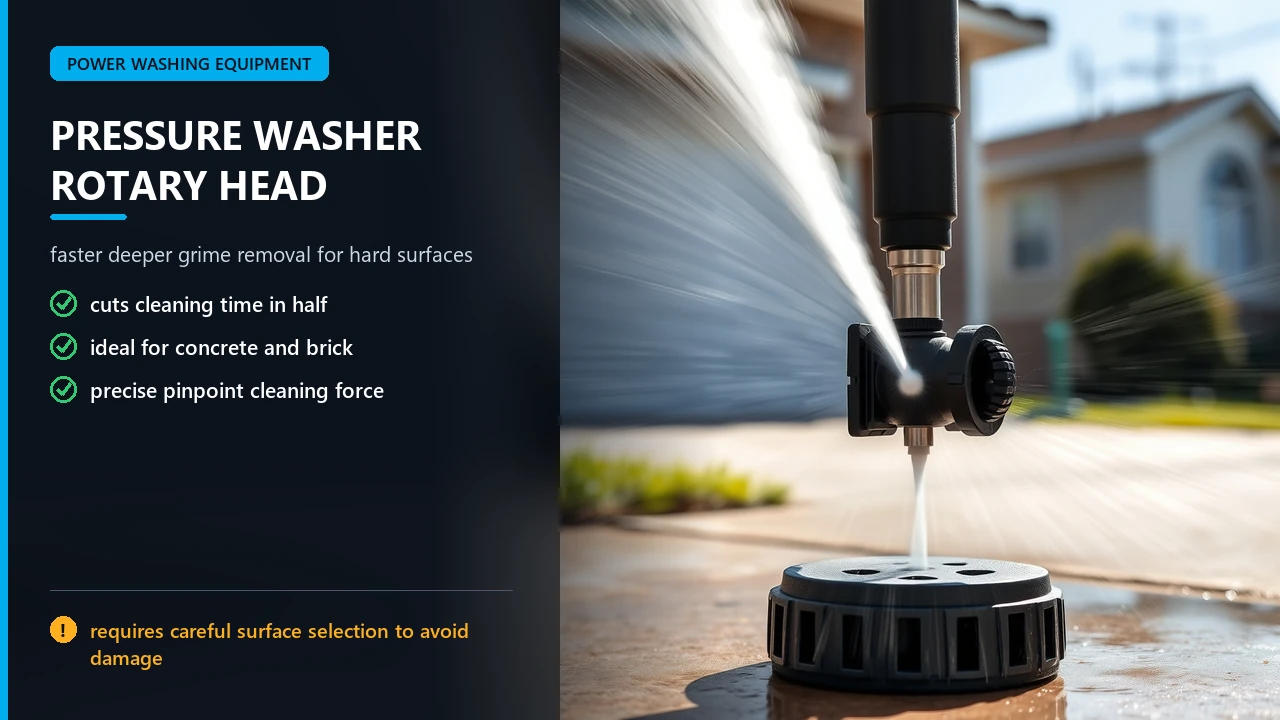
What a Rotary Head Actually Is
The name can be confusing because pressure washers use several spinning accessories. A rotary head is a nozzle, not a wand or a brush. Inside its housing you will find a small ceramic or steel tip mounted on a spinning mechanism, usually driven by the water itself. As high-pressure water flows through, it forces the tip to rotate rapidly. The result is a single high-impact jet that sweeps a small circle many times per second.
The genius of the design is that it takes the one thing a fan tip cannot give you, the full concentrated impact of a zero-degree stream, and spreads it across a working area. A standard zero-degree tip is so narrow that it is impractical for large surfaces. A rotary head turns that same jet into a moving point of maximum force, so every spot on the concrete receives the full punch of the machine rather than a diluted fan of water.
Manufacturers describe the effective pattern as roughly equivalent to a 25-degree spray, but the impact force is closer to a zero-degree jet. That combination, wide-ish coverage with pinpoint force, is why the rotary head cleans concrete so much faster than anything else. Our related guide to a rotary nozzle for a pressure washer covers the same mechanism from a slightly different angle.
How It Works Under the Surface
The magic is in the nozzle’s internal geometry. Inside a typical rotary head is a ceramic or steel ball, cone, or turbine that the water forces into rapid rotation. As it spins, the water exits through a tiny orifice and sweeps a circular path several inches wide. The rotation speed is driven entirely by water flow, which is why flow rate matters so much when choosing one.
This design has two important consequences. First, the spinning is powered by the machine, so a rotary head needs enough GPM to spin properly. Second, because the tip is always firing at full pressure, the impact at any given point on the surface is enormous. The rotation does not soften the blow; it simply spreads the blow around. According to AR North America’s knowledge base on turbo versus rotary nozzles, the internal spinning ball acts like a turbine, converting water pressure into the rotational motion that defines the tool.
That is the key insight for operators: a rotary head is not a gentler version of a fan tip. It is a sharper version of a pinpoint jet, dressed up to look friendly. Treat it that way.
Rotary Head vs Standard Nozzles
Pressure washer nozzles are usually color coded by spray angle, and each angle trades coverage for force. The rotary head sits in its own category because it breaks that trade-off.
| Nozzle | Spray | Impact Force | Coverage | Risk |
|---|---|---|---|---|
| Red, 0° | Pinpoint | Extreme | Tiny | Very high |
| Yellow, 15° | Narrow fan | High | Small | High |
| Green, 25° | Fan | Moderate | Medium | Moderate |
| White, 40° | Wide fan | Low | Large | Low |
| Rotary head | Spinning pinpoint | Extreme | Medium | Very high |
Read the table and the rotary head’s personality is obvious. It gives you the impact of a red tip with the coverage of a green tip, which is a genuinely powerful combination for hard surfaces. It also inherits the red tip’s danger. Our guide to color coded pressure washer tips explains the standard color system so you can see how the rotary head departs from it.
Sizing the Orifice: The Step Everyone Skips
A rotary head is not a one-size-fits-all accessory. It must be matched to the PSI and GPM of your machine, and the matching is done through the orifice size. Get it right and the nozzle spins smoothly and cleans beautifully. Get it wrong and you either starve the machine or overwork it.
If the orifice is too small, it restricts flow, the pump builds excess pressure, the internal mechanism may fail to spin properly, and you risk damaging the pump or the nozzle.
If the orifice is too large, the impact force drops, the spinning mechanism may not have enough energy to rotate, and you get weak cleaning with a nozzle that flutters instead of screaming.
The correct size comes from a chart that plots your machine’s pressure against its flow. Turbo nozzles are sold by orifice number, and the right number rises as flow increases.
| Machine PSI | Machine GPM | Recommended Orifice |
|---|---|---|
| 2,500 PSI | 2.5 GPM | 3.0 |
| 3,000 PSI | 3.0 GPM | 3.5 |
| 3,500 PSI | 3.5 GPM | 4.0 |
| 4,000 PSI | 4.0 GPM | 4.5 |
| 4,500 PSI | 4.5 GPM | 5.0 |
Most homeowner gas machines sit around 2.5 to 3.5 GPM, which points to orifice sizes in the 3.0 to 4.0 range. Commercial machines running higher flow need larger nozzles. If your machine has a pressure gauge, a quick check after installing the nozzle tells you whether you got it right; if the pressure reads noticeably above the machine’s rating, the orifice is too small. Our guide to reading a nozzle chart and the overview of choosing the right high-pressure nozzle go deeper on orifice math.
Where a Rotary Head Belongs, and Where It Doesn’t
The rotary head is a specialist. Used on the right surfaces it is unbeatable. Used on the wrong ones it causes damage that cannot be undone.
Great for: concrete driveways and sidewalks, garage floors, brick and pavers, stone patios, and stripping heavy caked mud from machinery. On these hard surfaces, the aggressive pinpoint force is exactly what you want, and the speed advantage is dramatic.
Never use it on: cars and vehicle paint, wood decks and fences, vinyl or aluminum siding, asphalt shingles, window screens, or anything painted or soft. On a wooden deck, a rotary head can carve visible grooves in seconds. On vehicle paint it can lift clear coat instantly. On siding it can punch through or score the surface. The spinning motion makes it look gentle, but the impact is a zero-degree jet being driven into the material.
A useful comparison is the difference between a rotary head and a surface cleaner. A rotary head is handheld and works on edges, slopes, and tight spaces. A surface cleaner is a wide spinning disc that cleans large flat areas evenly and keeps the wand a set distance from the ground. For big flatwork, a surface cleaner is usually the better tool. Our guide to a surface cleaner attachment explains where that accessory takes over from the rotary head.
How to Use a Rotary Head Correctly
Even with the right nozzle and the right surface, technique decides whether you get a clean slab or an expensive lesson.
Start from a distance. Before you commit, hold the nozzle a foot or more from the surface and observe the pattern. The spinning jet should be tight and even. Move closer only as needed, and maintain a consistent standoff so the cleaning is even.
Keep it moving. Never hold the nozzle in one spot. A stationary rotary head etches a ring into concrete and cuts a groove into anything softer. Sweep in steady, overlapping passes, the way you would paint a floor.
Work with the grain where it applies. On pavers and brick, a consistent direction gives a more even result than random scrubbing.
Mind the rebound. Because the water is fired at full pressure, spray bounces back at you. Wear eye protection, gloves, and long pants, and keep the nozzle angled slightly so the rebound is not directed at your body.
Use a filter on the inlet. Grit and debris are the enemies of a spinning nozzle. Install a high-pressure inlet filter to keep the orifice and the internal mechanism clean, which preserves both performance and the life of the nozzle. The inlet filter guide explains the part that costs a few dollars and saves a nozzle.
Myths That Get People in Trouble
“It’s safe because it spins.” This is the most dangerous myth. The spinning creates the coverage, not the safety. The impact is that of a zero-degree jet, and it can damage surfaces and cause injuries just as readily as a red tip.
“Bigger is always more powerful.” Choosing a rotary head with too large an orifice gives you a fluttering, weak spray because the mechanism cannot spin correctly. Match the orifice to the machine, not to an imagined ideal of “more.”
“I can use it on my car if I’m careful.” Rotary heads are strongly discouraged on vehicle bodywork. The rotating jet can lift paint and clear coat and damage rubber and plastic trim. Use a 40-degree tip and moderate pressure for vehicles.
“One rotary head fits every machine.” Orifice sizing makes that false. A nozzle sized for a 4 GPM commercial machine will underperform on a 2.5 GPM homeowner unit, and vice versa.
Rotary Head vs Turbo Nozzle vs Surface Cleaner
These three tools come up together constantly, and buyers often do not realize they are related but distinct. A rotary head and a turbo nozzle are the same thing under different names, a handheld spinning pinpoint jet. A surface cleaner is a different tool entirely, a housing with a spinning bar that keeps two or more jets at a fixed height above a flat surface.
The practical division of labor is simple. For flatwork, concrete slabs, big driveways, and parking areas, a surface cleaner gives you the most even result and the least streaking. For edges, curbs, steps, slopes, and tight areas a surface cleaner cannot reach, a rotary head is the tool. Many operators own both and alternate between them, using the surface cleaner for the field and the rotary head for the trim.
If your work is mostly flat concrete, our guide to the professional approach to surface cleaning and the ride-on surface cleaner overview will point you toward the larger tools. If your work is trimming, detail, and hard-to-reach grime, the rotary head is your everyday nozzle.
Caring for a Rotary Head
Rotary heads are precision parts, and they reward a little care. Flush the nozzle after every use, especially after running detergent, because dried chemical residue gums up the internal mechanism. Rinse the orifice with clean water, and inspect it for debris or mineral buildup. If your water supply is hard, a periodic soak in a mild descaling solution restores flow. Keep a spare on hand, since a nozzle failure mid-job is a nuisance you can avoid for the price of a spare. Our guide to replacing a pressure washer nozzle covers when a nozzle is genuinely worn out and needs replacing rather than cleaning.
What a Rotary Head Does to Your Pressure and Flow
Owners are sometimes surprised to find that a rotary head reads slightly lower on a pressure gauge than a fixed nozzle, or that their machine sounds different. That is normal, and understanding why removes the worry.
Every nozzle restricts flow to build pressure, and the relationship between orifice size, flow, and pressure is fixed physics. A rotary head is designed so the machine produces roughly its rated pressure at the rated flow, with enough surplus energy to spin the internal mechanism. On many machines, the gauge settles a little below the fixed-nozzle reading because some of the water’s energy is being converted into rotation rather than pure pressure at the tip. That is the cost of the spinning pattern, and it is a good trade.
The warning sign is a machine that reads well above its rating or labors hard after the nozzle is installed. That means the orifice is too small and the pump is straining against a restriction. If the nozzle flutters or fails to spin, the orifice is likely too large or the flow has dropped because of a clogged inlet filter or a worn pump. In either case, stop and fix the match before you keep running the machine. Our guide to pressure washer nozzle size and the overview of the best PSI for different tasks help you read the signs.
Ceramic, Stainless, and Cheap Nozzles
Rotary heads are not all built the same, and the price difference usually comes down to materials and tolerances. The orifice in a quality rotary head is ceramic or hardened stainless steel, materials that resist the erosion that comes from water blasting through a tiny hole at high pressure. Cheap nozzles often use softer materials that wear quickly, so the orifice grows larger over time and the nozzle progressively loses both pressure and the ability to spin.
The internal spinning mechanism matters just as much. A well-made nozzle uses precision bearings or a durable turbine that keeps spinning smoothly for years. A cheap one uses loosely toleranced parts that begin to wobble, chatter, and eventually seize. If you use a rotary head regularly, the premium versions pay for themselves in consistent performance and far fewer replacements.
| Feature | Budget Nozzle | Quality Nozzle |
|---|---|---|
| Orifice material | Softer metal, wears fast | Ceramic or hardened stainless |
| Spin mechanism | Loose tolerances, wobbles | Precision bearings or turbine |
| Pressure consistency | Degrades over time | Holds steady for years |
| Best for | Occasional home use | Regular and commercial use |
Hot Water and Chemical Considerations
Two conditions change how you should think about a rotary head. The first is heat. Not every rotary head is rated for hot water, and the internal seals and mechanism can fail quickly if they are not designed for it. If you run a hot water machine, confirm the nozzle’s temperature rating before use.
The second is chemicals, especially the bleach-based mixtures used in soft washing. Harsh chemicals can corrode the internal parts of a nozzle over time. When you finish a chemical job, flush the nozzle thoroughly with clean water. If you run aggressive solutions regularly, choose a nozzle with corrosion-resistant internals or keep a dedicated nozzle for chemical work so your everyday one stays clean. The pressure wash chemicals guide covers how to handle the solutions themselves safely.
A Practical Workflow for a Concrete Driveway
Here is how an experienced operator sequences a typical driveway, using the rotary head where it does the most good.
Pre-treat and soak. Apply a suitable cleaner and let it dwell. Chemistry loosens the dirt so the water does not have to do all the work. This is the step that makes the rest of the job fast.
Run the surface cleaner first. For the open field of the driveway, a surface cleaner covers ground fastest and leaves an even finish with no streaks.
Switch to the rotary head for the edges. Curbs, expansion joints, the apron at the street, and any area the surface cleaner cannot reach get the rotary head, held at a slight angle and kept moving.
Rinse and inspect. Rinse the whole area clean of loosened debris and chemical, then look for any missed spots and touch them up.
This combination, chemistry for loosening, a surface cleaner for the field, and a rotary head for the details, is how professional crews finish large flatwork quickly without over-blasting any one spot. Our overview of the surface cleaner workflow pairs well with this approach.
Rotary Head Questions Owners Ask
Is a rotary head the same as a turbo nozzle? Yes. The terms are used interchangeably, along with “rotary nozzle” and “rotating nozzle.” They all describe a nozzle that spins a zero-degree jet in a circular pattern.
Can a rotary head damage concrete? It can etch and streak concrete if held stationary, but concrete is hard enough to tolerate the jet when the nozzle is kept moving. The real danger is soft surfaces, not concrete.
Why is my turbo nozzle not spinning? The most common causes are too little flow, a partially clogged orifice, or debris in the mechanism. Check the orifice first, then confirm the nozzle matches your machine’s GPM.
Can I use a rotary head with hot water? Some are rated for hot water and some are not. Check the temperature rating before using one on a hot water machine, because the internal seals and mechanism may not be built for heat.
What size rotary head for a 3,000 PSI machine? It depends on flow, not just pressure. At 3,000 PSI and about 3 GPM, an orifice around 3.5 is typical. Use the sizing chart and your machine’s actual GPM.
Does a rotary head use more water? It uses the same flow as a comparable nozzle; the difference is how the flow is focused. The spinning mechanism converts the machine’s pressure into a concentrated rotating jet rather than a fan.
Rotary head or 25-degree tip for edges? For hard edges like curbs and concrete joints, the rotary head cleans faster and deeper. For softer surfaces or where you want more control, a 25-degree fan tip is the safer, gentler choice.
How long does a rotary head last? A quality ceramic-orifice nozzle used and flushed properly can last for years, even in commercial service. A cheap nozzle may lose pressure within a single busy season as its softer orifice erodes.
Can I leave a rotary head on the wand all the time? You can, but you should not. The nozzle is aggressive, so keeping a fan tip for soft surfaces and switching to the rotary head only for hard materials protects both your surfaces and the nozzle.
The Right Tool for Hard Surfaces, Nothing Else
A pressure washer rotary head earns its reputation. On concrete and brick it is one of the fastest, most satisfying cleaning tools you can own, turning a slow back-and-forth chore into quick, even passes. The key is to respect what it really is: a zero-degree jet in disguise. Match the orifice to your machine, keep it moving, and use it only on surfaces hard enough to take the impact.
Keep it away from wood, paint, siding, and vehicles, and it will serve you for years without a single disaster. Used with that discipline, the rotary head is exactly what it promises, a tool that removes grime faster and more thoroughly than any standard tip. Pair it with a surface cleaner for the big flat areas, and you have a concrete-cleaning setup that works at a professional pace. For related reading on getting the most from your nozzles, our guides to the rotary tip and the turbo nozzle at work on concrete pick up where this leaves off.