If you have ever cleaned a driveway with just the spray wand, you know the tedium: passing the stream over every strip of concrete, overlapping each pass, and still ending up with streaks and missed patches. The surface cleaner washer changes all of that. This attachment, a circular housing with a spinning bar of nozzles, cleans flat surfaces in wide, even passes, delivering uniform results in a fraction of the time. It is one of the most valuable accessories a pressure washer owner can add, and for anyone who cleans driveways, patios, and walkways, it is close to essential. This guide explains what a surface cleaner washer is, how it works, the types available, how to match one to your machine, and how to use it for professional-looking results.
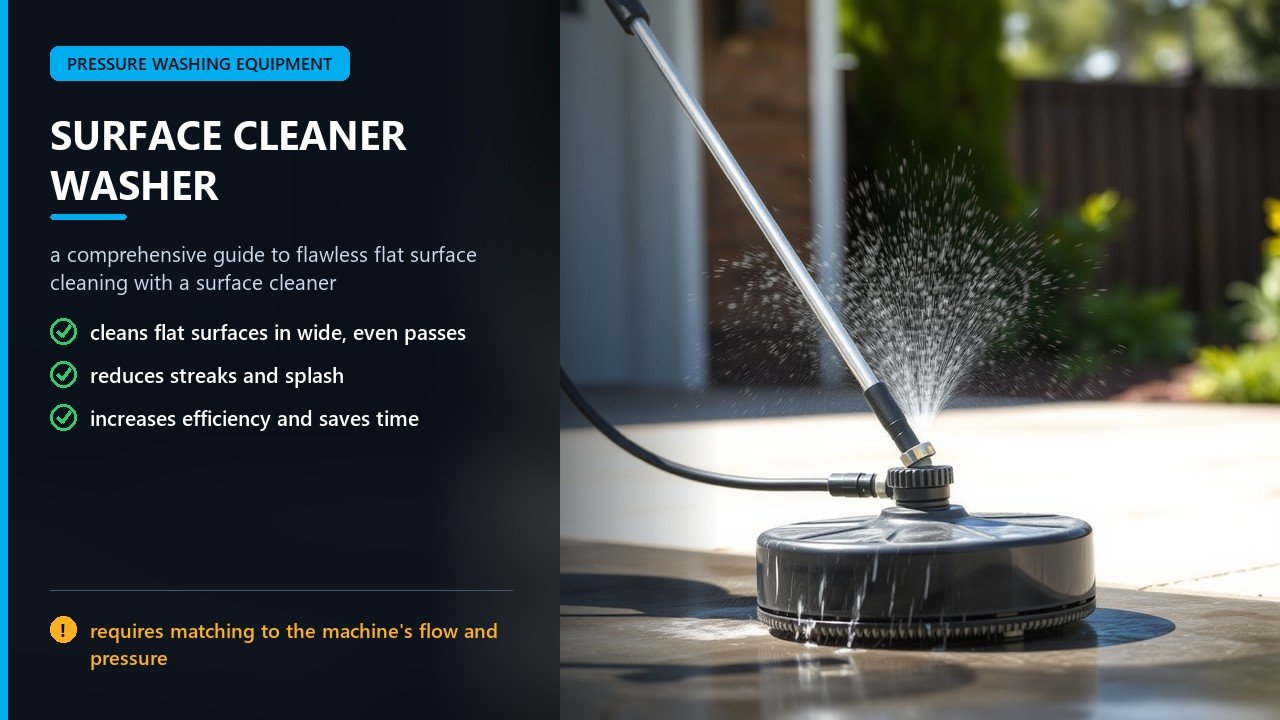
What a Surface Cleaner Washer Is
A surface cleaner, sometimes called a rotary surface cleaner or a floor cleaner attachment, is a device that connects to a pressure washer and cleans flat surfaces efficiently.
It consists of a circular or bell-shaped housing with one or more rotating nozzles underneath, and it is connected to the spray gun or wand. When the machine is running, the nozzles spin rapidly, directing high-pressure water at the surface within the housing. As the operator pushes the cleaner across the ground, it cleans a wide circular path evenly, much faster than a single nozzle could. The housing contains the spray, reducing splash and mess, and keeps the nozzles at a consistent height for uniform cleaning.
The result is a tool that cleans flat surfaces quickly, evenly, and with less effort and splash than a wand. For driveways, patios, sidewalks, and other flat areas, it delivers professional-looking results with far less tedium. This is why surface cleaners are so popular among homeowners and professionals alike, and why adding one is often the single best upgrade for flat-surface cleaning. Understanding what the attachment is and does is the first step to using it well. It is designed specifically for flat surfaces, and matching it to the machine’s flow is the key to good performance.
Because flat surfaces make up much of the cleaning many people do, a surface cleaner addresses the most common and tedious task directly. The attachment turns an hour of stripe-prone wand work into minutes of even cleaning, and it reduces fatigue and splash. With the right cleaner for the machine, flat-surface cleaning becomes fast and satisfying. This makes the surface cleaner a natural companion to the pressure washer and one of its most useful accessories. Our guide to pressure washer components shows how the cleaner fits into the machine’s spray system.
How It Works
Understanding the mechanism explains why a surface cleaner works so well.
Inside the housing, a bar or arm with nozzles rotates rapidly, driven by the force of the water exiting the nozzles. The nozzles are angled to create rotation and direct the spray at the surface, and the spinning motion sweeps the high-pressure stream over a wide circular area very quickly. The housing surrounds the nozzles, containing the spray so it does not splash outward, and holds the nozzles at a fixed distance from the surface, which ensures consistent cleaning and prevents the uneven results that come from varying distance with a wand.
Because the nozzles rotate, each point on the surface is hit by the spray multiple times as the cleaner passes, and the contained, consistent spray removes dirt evenly without streaks. The operator simply pushes the cleaner at a steady pace, and the spinning action does the work. This is why a surface cleaner cleans so much faster and more uniformly than a wand: it multiplies the effective coverage of the spray and eliminates the human error of inconsistent distance and overlapping.
The design’s effectiveness comes from speed of coverage, containment of splash, and consistency of distance, all of which a wand cannot match. The rotating nozzles cover ground rapidly, the housing reduces mess, and the fixed height ensures evenness. These advantages make the surface cleaner the tool of choice for flat surfaces, and they explain why it produces such superior results. Once you understand the mechanism, the benefits are obvious, and using one becomes a matter of matching it to the machine and learning a simple technique. Our guide to a sidewalk cleaner for pressure washer covers a very similar attachment in detail.
Types of Surface Cleaners
Surface cleaners come in several designs.
Consumer rotary cleaners. Lightweight and affordable, these are designed for typical electric and smaller gas pressure washers. They clean flat surfaces well and are ideal for home driveways and patios. They have size and flow requirements that must match the machine.
Professional and larger rotary cleaners. Heavier and larger, these clean wider paths and are built for frequent, demanding use, requiring more flow to spin and clean effectively. They suit larger gas machines and professional operations.
Water brooms. A related tool that uses multiple nozzles on a bar to sweep and rinse large flat areas at lower pressure, useful for pushing debris and water rather than deep cleaning. Water brooms are handy for quick rinsing and moving water.
Dual-nozzle and multi-nozzle designs. Some cleaners use more nozzles or a single rotating arm, and higher-end units may include features like swivels to reduce hose tangling and caster kits for easier movement.
Surface cleaners for specific machines. Some pressure washer brands offer cleaners designed for their machines, ensuring compatibility and balanced performance.
Each type suits different needs, from occasional home cleaning to professional use. The key is matching the cleaner’s size and flow requirement to the machine, since a cleaner too large for the machine will not spin and clean properly, and one too small is merely slower. Choosing among these designs based on the machine and the intended use ensures good performance. Understanding the types lets you select a surface cleaner that fits, delivering the fast, even cleaning that makes the attachment so valuable. Our guide to a hot water surface cleaner shows how heat pairs with surface cleaning for tough grime.
Matching a Cleaner to Your Machine
Matching the surface cleaner to the pressure washer’s flow is the most important factor.
Surface cleaners are rated by the flow, in gallons per minute, they require to spin and clean effectively. A cleaner that requires more flow than the machine provides will spin slowly or stall, cleaning poorly, while a cleaner matched to the machine spins properly and cleans well. Larger cleaners cover more area but need more flow, so the right size is the largest cleaner the machine can properly drive. This is why flow, more than pressure, determines which cleaner suits a machine.
The cleaner’s connection must also match the machine’s gun or wand fitting, usually a quick-connect, so it attaches without adapters where possible. The cleaner should be rated for the machine’s pressure, and for larger machines, a heavier-duty cleaner may be needed. Some cleaners include swivels or caster kits that improve usability, and these can be worth having for frequent work.
| Machine Flow (GPM) | Typical Cleaner Size |
|---|---|
| About 1.2 to 1.5 (small electric) | Small consumer cleaner, 12 to 15 inch |
| About 2.0 to 2.5 (mid electric/gas) | Medium cleaner, 15 to 18 inch |
| About 3.0 to 4.0 (larger gas) | Larger cleaner, 18 to 20+ inch |
| Higher flow (pro gas) | Professional cleaner, large diameter |
Matching the cleaner to the flow ensures it performs, since a mismatched cleaner is the most common reason surface cleaners disappoint. The specifications give a starting point, and manufacturers often state the required flow for their cleaners. Choosing the largest cleaner the machine can drive balances speed and performance. This match is the foundation of good results, more important than any other feature, and getting it right makes the cleaner a joy to use. Our guide to a high pressure washer nozzle explains how nozzles affect the cleaner’s internal spray.
Benefits of a Surface Cleaner
The advantages of a surface cleaner over a wand are substantial.
Speed. A surface cleaner covers a wide path, cleaning flat surfaces in a fraction of the time a wand requires. Large driveways that would take an hour with a wand take minutes with a cleaner.
Even, streak-free results. The consistent distance and spinning action produce uniform cleaning without the streaks and missed patches common with a wand, giving a professional finish.
Less effort. The operator simply pushes the cleaner, rather than aiming and sweeping a wand, which is far less tiring and faster.
Reduced splash. The housing contains the spray, keeping the operator drier and the surrounding area cleaner than a wand’s open spray.
Better use of the machine. The cleaner makes the most of the machine’s flow and pressure on flat surfaces, delivering results that exceed what a wand can achieve.
These benefits accumulate on every flat-surface job, making the surface cleaner one of the best accessories available. The time saved and the improvement in results are dramatic, which is why the attachment is so widely recommended. For anyone who cleans flat surfaces regularly, the value is immediately apparent. Because flat surfaces are so common, the surface cleaner’s benefits apply to much of the cleaning most people do, making it a high-value addition to any pressure washer setup. Our guide to a pressure washer repair kit is a reminder that the cleaner’s nozzles and bearings are serviceable parts worth maintaining.
Using a Surface Cleaner
A simple technique gets the best results from a surface cleaner.
Pre-treat heavily soiled or stained areas, since loosening dirt first lets the cleaner remove it more easily and evenly, and use hot water or detergent where appropriate for tough grime. Start the machine and begin with the cleaner flat on the surface and the flow on, then push it at a steady, even pace, overlapping passes by about half the cleaner’s width to ensure full coverage. Keep the cleaner moving, since pausing can leave marks or damage delicate surfaces, and work in a systematic pattern so no areas are missed. For heavily soiled surfaces, make a second pass.
Keep the cleaner flat and at a consistent height, and avoid tipping it, which can reduce effectiveness or cause uneven cleaning. On uneven surfaces, a cleaner with a flexible skirt or a smaller unit may work better, and on delicate surfaces, take care and test first. After cleaning, rinse away loosened debris and standing water. If the cleaner spins weakly, check the flow, the nozzles, and the machine, since a surface cleaner that does not spin properly cleans poorly, and this is usually a flow or obstruction issue.
Good technique, combined with the right cleaner for the machine, produces the fast, even, professional results that make the attachment so valuable. The habits are simple: pre-treat, overlap passes, move steadily, keep it flat, and make a second pass where needed. With clean water and a matched machine, the surface cleaner transforms flat-surface cleaning. For tough jobs, it handles the bulk of the flat area while a wand addresses edges and details, together covering the whole surface efficiently. Our guide to pressure wash hose reel is a reminder that managing the hose makes using the cleaner even easier. Maintaining the cleaner’s nozzles and bearings keeps it spinning properly.
Maintaining a Surface Cleaner
Simple care keeps a surface cleaner performing.
Check and clean the nozzles regularly, since clogs reduce performance and cause uneven cleaning, and replace worn or damaged nozzles to maintain the spray. Inspect the rotating bar’s bearings and swivel, since these determine how smoothly the cleaner spins, and service or replace them as needed. Check the housing and skirt for damage, and ensure the connection to the gun or wand is secure and leak free. After use, rinse the cleaner to remove debris and detergent residue, and store it properly to protect the nozzles and bearings.
Because the cleaner’s performance depends on clean nozzles and smooth rotation, maintenance focuses on these areas. A cleaner with clogged nozzles or worn bearings spins poorly and cleans unevenly, so keeping them in good condition preserves the results. The maintenance is simple and infrequent, and it keeps the cleaner working like new for years. Given how much time and effort the cleaner saves, this modest care is well worth it, and it ensures the tool is ready whenever you need it. Our guide to pressure washer o ring kits covers the seals used at the cleaner’s connections.
Common Mistakes to Avoid
Several mistakes undermine a surface cleaner.
Mismatching the cleaner to the flow. A cleaner too large for the machine spins poorly. Match the cleaner’s flow requirement to the machine.
Moving too fast or too slow. Rushing leaves dirt behind; pausing can damage surfaces. Push at a steady, moderate pace.
Not overlapping passes. Failing to overlap leaves strips of uncleaned surface. Overlap by about half the cleaner’s width.
Tipping the cleaner. Tipping reduces effectiveness and can cause uneven cleaning. Keep it flat.
Ignoring nozzle and bearing wear. Clogged nozzles or worn bearings cause poor spinning and uneven results. Maintain them.
Using a cleaner on delicate surfaces without care. Some surfaces are damaged by the cleaner’s force. Test first and use care.
Avoiding these mistakes ensures the cleaner delivers its fast, even results. The themes are matching the cleaner to the machine, using good technique, and maintaining the nozzles and bearings. Because the cleaner is designed to make flat-surface cleaning easy and effective, using it correctly is what realizes that benefit. With the right cleaner and simple habits, flat surfaces come out uniformly clean with minimal effort, which is exactly why the surface cleaner is such a valued accessory. Our guide to a best pressure washer wand covers the wand that complements the cleaner for edges and details.
Surface Cleaner Versus Cleaning with a Wand
The contrast between a surface cleaner and a wand explains why the attachment is so valued.
With a wand, cleaning a flat surface means passing a single concentrated stream over every square inch, overlapping each pass, and holding a consistent distance and pace to avoid streaks. It is slow, tiring, prone to leaving stripes and uneven patches, and messy, since the open spray splashes everywhere and exposes the operator to mist. Even a skilled operator takes far longer than a surface cleaner and often produces a less uniform result. The wand is precise, which is useful for edges, corners, and details, but it is inefficient for wide flat areas.
A surface cleaner replaces the single stream with a spinning, contained spray that cleans a wide path uniformly as it is pushed. The result is dramatically faster, evenly clean without streaks, less tiring, and tidier, since the housing contains the splash. For large flat surfaces, the difference is transformative, turning an hour of tedious work into minutes of straightforward pushing. The cleaner also uses the machine’s flow more effectively on flat surfaces, delivering results that exceed a wand’s.
The ideal approach uses both tools: a surface cleaner for the bulk of the flat area and a wand for edges, corners, and details that the cleaner cannot reach. This combination gives the best of both, fast even cleaning across the main surface and precise cleaning of the boundaries. Recognizing the strengths of each makes an operator efficient and the results professional. The wand remains essential for what the cleaner cannot do, but for the main task of cleaning a large flat surface, the surface cleaner is far superior, and using one is the mark of an efficient operation. Our guide to a high pressure washer nozzle covers the nozzles used with a wand for detail work.
Getting the Best Results on Concrete
Concrete is the surface where a surface cleaner shines, and a few practices maximize results.
Start by removing loose debris, then pre-treat heavy stains, oil, and organic growth with an appropriate cleaner, allowing it to dwell. For mildew and algae, a bleach-based solution can help, and for oil and grease, a degreaser. Then clean with the surface cleaner, using hot water if the machine provides it, which dramatically improves results on tough grime. Work in overlapping passes at a steady pace, and make a second pass on heavily soiled areas. Rinse away loosened dirt and standing water afterward, and consider a post-treatment to inhibit regrowth of algae or mold, which commonly returns on concrete.
The technique matters: keep the cleaner flat and moving, overlap passes, and avoid pausing, which can leave marks or, on old or delicate concrete, damage. For very tough stains that remain, a second cleaning or a stronger pre-treatment may be needed. On painted or sealed concrete, take care, since the cleaner’s force can remove paint or damage sealer, and test first. With the right preparation and technique, concrete comes out uniformly clean, dramatically improving the appearance of driveways, patios, and walkways.
Because concrete is durable and common, it is the ideal surface for a surface cleaner, and mastering the technique produces impressive results. The combination of pre-treatment, adequate flow, and the cleaner’s even spray transforms stained, grimy concrete into a clean, uniform surface. This is the result that makes the surface cleaner so satisfying and valuable, and it is easily achieved with the right practices. For anyone with a concrete driveway or patio, the cleaner is the key to keeping it looking its best. Our guide to pressure wash chemicals covers the pre-treatments that boost surface cleaning results.
Choosing the Right Cleaner for the Job
Beyond flow matching, the job and the machine guide the choice.
For occasional home cleaning of driveways and patios with a typical electric or smaller gas machine, a lightweight consumer rotary cleaner matched to the machine’s flow is ideal. It cleans well, is easy to handle, and costs little. For frequent or professional use with a larger gas machine, a heavier, larger cleaner that covers more area per pass and withstands constant use is warranted, and features like a swivel to reduce hose tangling and caster kits to ease movement become valuable. For quick rinsing of large areas, a water broom may suit better than a deep-cleaning rotary cleaner.
Consider the surfaces you clean and the machine’s capabilities. If you mostly clean concrete driveways, a standard rotary cleaner is perfect; if you also clean delicate surfaces, you need care or a gentler approach. If your machine has limited flow, choose a smaller cleaner to ensure it spins well. Matching the cleaner to the machine and the job, rather than buying the largest or fanciest, ensures satisfaction, and the flow match remains the most important factor throughout.
Choosing thoughtfully means the cleaner performs as intended and lasts. Because a mismatched cleaner is the most common reason for disappointment, and because the right one quickly becomes indispensable, the selection deserves attention. Balancing flow, size, features, and use points to the best choice, and a well-chosen cleaner delivers the fast, even cleaning that makes the attachment so valuable. With the right cleaner in hand, flat-surface cleaning becomes easy and satisfying. Our guide to pressure washer repair kits is a reminder that even a good cleaner benefits from keeping its nozzles and bearings in shape.
Frequently Asked Questions About Surface Cleaner Washers
What is a surface cleaner washer? An attachment with spinning nozzles inside a housing that cleans flat surfaces in wide, even passes, connecting to the pressure washer’s gun or wand. It cleans faster and more evenly than a wand.
How do I choose a surface cleaner size? Match the cleaner’s flow requirement, in GPM, to your machine’s flow. Choose the largest cleaner your machine can properly drive, and check the connection type.
Does a surface cleaner need a certain pressure or flow? Flow matters most, since it drives the spinning nozzles. The cleaner must be matched to the machine’s GPM, and rated for its pressure.
Can a surface cleaner clean a driveway? Yes, it excels at driveways, patios, sidewalks, and other flat surfaces, cleaning them quickly and evenly with overlap passes and a steady pace.
Why is my surface cleaner not spinning? Usually because of insufficient flow, a clogged nozzle, or worn bearings. Check the machine’s flow, clean the nozzles, and inspect the bearings.
Can I use a surface cleaner on any surface? It is best on flat, durable surfaces. Take care on delicate or uneven surfaces and test first, since the cleaner’s force can damage some materials.
Final Verdict on Surface Cleaner Washers
A surface cleaner washer is one of the best upgrades for any pressure washer, turning the tedious, streak-prone job of cleaning flat surfaces into fast, even, professional-looking work. The spinning nozzles and contained housing clean a wide path quickly and uniformly, saving time and effort and reducing splash. The key to good performance is matching the cleaner to the machine’s flow, since a cleaner matched to the machine spins and cleans properly while a mismatched one disappoints.
Choose the largest cleaner your machine can drive, ensure the connection and pressure rating fit, and use good technique: pre-treat, overlap passes, push steadily, keep it flat, and maintain the nozzles and bearings. Paired with a wand for edges and details, a surface cleaner covers the whole job efficiently. For driveways, patios, walkways, and any flat surface, the surface cleaner washer delivers results that a wand cannot match, and it quickly becomes the accessory you reach for first. If you clean flat surfaces with any regularity, a surface cleaner is well worth adding to your setup.