My neighbor pulled into his driveway last spring with a shiny new box from the home center, unloaded a gas pressure washer, and spent the next four hours turning a grimy concrete slab back into something you could eat off. The next weekend, a different neighbor wheeled out her machine, pulled the trigger, and within twenty minutes had a spotless driveway, a rinsed car, and a cleaned fence. Same street, two totally different experiences. That is really what the simpson vs westinghouse pressure washer conversation comes down to. It is not a battle of brand logos. It is a question about what kind of cleaning you actually do, how much you want to spend, and how long you expect the machine to last before it either becomes a repair project or a trusted tool you reach for every season.
If you have been scrolling forums and watching comparison videos, you have probably noticed that fans of each brand get loud. Simpson owners point to Honda and Kohler engines and beefy frames. Westinghouse owners point to value, digital conveniences, and a price tag that leaves room for accessories. Both camps are right about their machine and wrong to dismiss the other. In this guide, we are going to settle the comparison with real specs, real ownership realities, and honest guidance so you can decide which name deserves a spot in your garage.
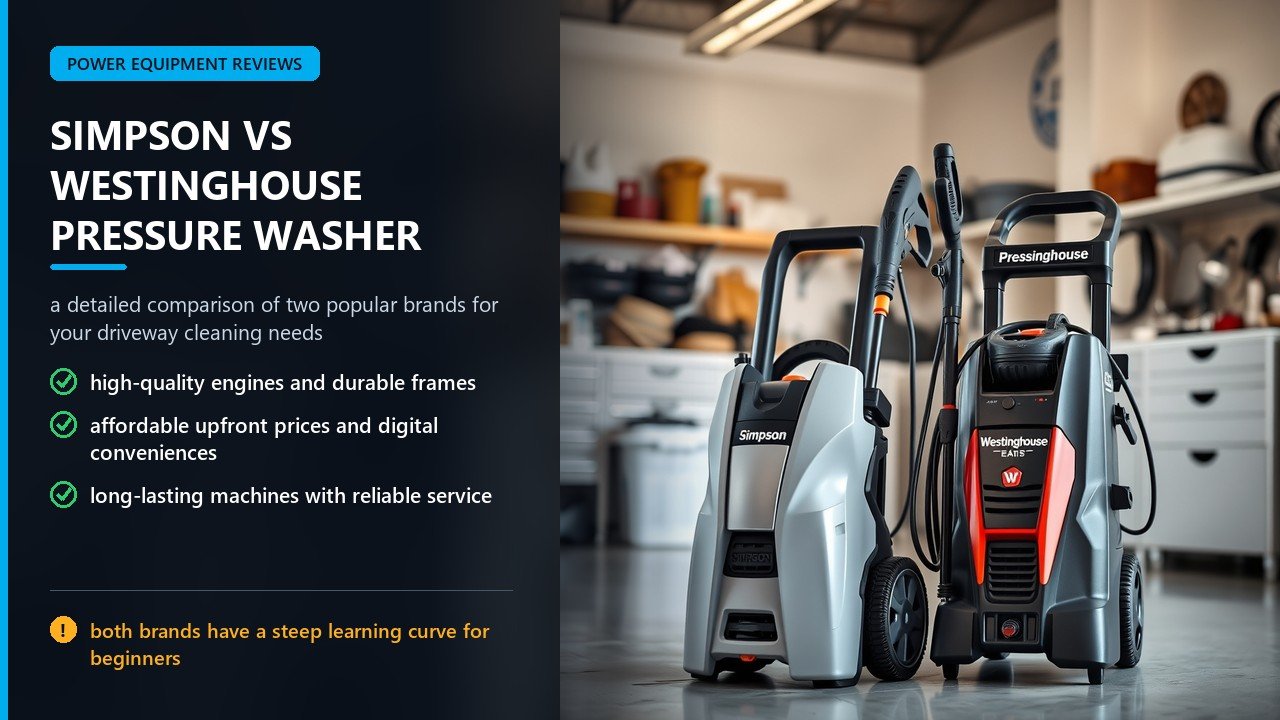
Quick Verdict: Simpson vs Westinghouse Pressure Washer at a Glance
Before we dig into the details, here is the short version for readers who want the answer fast. Think of Simpson as the work truck and Westinghouse as the versatile family SUV. One is built to take a beating on commercial jobs, the other is built to cover a lot of ground affordably and comfortably.
| Category | Simpson | Westinghouse |
|---|---|---|
| Best Known For | Gas machines with Honda and Kohler engines, commercial-grade frames | Value-priced gas and electric units with modern features |
| Typical PSI Range | 3,000 to 4,400 PSI (gas), some electric models | 1,700 to 4,200 PSI across electric and gas |
| Typical GPM | 2.5 to 4.0 GPM | 1.2 to 3.0 GPM |
| Engine Options | Honda GX, Kohler, Simpson-branded | Westinghouse-branded gas engines |
| Pump Type | Mostly triplex crankshaft pumps | Axial cam and triplex depending on tier |
| Price Sweet Spot | $350 to $1,200 and up | $120 to $700 |
| Best For | Heavy residential and light commercial work | Homeowners, light duty, budget-conscious buyers |
| Standout Strength | Durability and repairability | Features per dollar |
If your takeaway from that table is “it depends,” you are already thinking about this the right way. Let us unpack each row so the comparison becomes a decision instead of a debate.
Why This Simpson vs Westinghouse Pressure Washer Debate Matters
A pressure washer is one of those purchases people make in a hurry and then live with for years. Buy wrong, and you either overspend on muscle you never use, or you underspend and burn out a cheap pump cleaning a driveway it was never meant to touch. The stakes are real. Average residential concrete cleaning jobs require sustained pressure and flow, and undersized machines force you to hold the wand in one spot until the surface finally gives up its grime. That is the fastest way to etch concrete and the quickest way to kill an axial cam pump.
Understanding the simpson vs westinghouse pressure washer split also helps you avoid a trap that catches a lot of first-time buyers. Marketing departments love to slap a big PSI number on the box. PSI sells boxes. But PSI alone does not clean. Cleaning power is really a function of pressure times flow, which the industry calls cleaning units. A 3,000 PSI machine at 1.2 GPM and a 3,000 PSI machine at 2.5 GPM are wildly different tools. Knowing where each brand lands on that spectrum is the entire point of comparing them.
A Quick History of Each Brand Before We Compare
Brand history sounds like fluff until you realize it explains why the two products feel so different in your hands. Where a company comes from shapes what it optimizes for.
Simpson (FNA Group)
Simpson has been associated with pressure washing equipment for decades and is now part of the FNA Group, a company that also owns brands like AAA and Delco. Simpson built its reputation on gas-powered machines, particularly units paired with Honda engines. The Honda GX series became almost a signature: if you see a Simpson with a Honda GX200 or GX390 under the hood, you are looking at a machine designed to run hard for years with basic maintenance. That engine-first mindset is why Simpson machines feel heavier, sound more substantial, and command higher prices. The company’s catalog still leans toward residential and light-commercial gas units, with electric models filling out the entry tier.
Westinghouse Outdoor Power Equipment
Westinghouse as an outdoor power brand is a licensing play, but the machines themselves are real and widely available. The brand covers generators, chainsaws, and yes, pressure washers, with a heavy emphasis on features and accessibility. Westinghouse optimized for the homeowner who wants a complete package at a fair price: onboard soap tanks, multiple nozzles, digital readouts on some models, and specs that look impressive on paper. The result is a lineup that spans tiny electric units all the way to gas machines with substantial pressure, each priced to undercut traditional workhorse brands.
Neither approach is wrong. One company decided to win on the engine and frame. The other decided to win on what is in the box and what it costs. Now let us see how that plays out.
Simpson vs Westinghouse Pressure Washer: Core Specs Side by Side
Let us get concrete. The table below is representative of the popular tiers each brand competes in, not a single model. Use it to understand where each brand tends to sit rather than as an absolute spec sheet.
| Spec | Popular Simpson Gas Unit | Popular Westinghouse Gas Unit |
|---|---|---|
| PSI | 3,200 to 3,600 | 2,900 to 3,400 |
| GPM | 2.5 to 2.8 | 2.4 to 2.5 |
| Engine | Honda GX200 or Simpson OHV | Westinghouse OHV |
| Pump | Triplex, oil-filled | Axial cam on base tiers, triplex on higher tiers |
| Wheel Type | Pneumatic, large diameter | Pneumatic or plastic, medium diameter |
| Detergent System | Downstream injector or onboard tank | Onboard tank common |
| Warranty | 2 to 5 years depending on model | 2 to 3 years typical |
Notice the pattern. On paper, the two machines can look neck and neck. The difference lives in the details that a spec sheet hides: the pump type, the metallurgy of the frame, and the engine’s serviceability. Those details show up on year three, not on day one.
Cleaning Power: PSI, GPM, and the Cleaning Units That Actually Matter
Here is where the simpson vs westinghouse pressure washer comparison gets genuinely useful. Cleaning power is pressure multiplied by flow. A machine rated 3,600 PSI at 2.6 GPM delivers roughly 9,360 cleaning units. A machine rated 3,400 PSI at 2.5 GPM delivers about 8,500. That is a modest gap, but on a large driveway it translates into real time saved and less dwell time per square foot.
Simpson tends to push both numbers up together, especially on its triplex-pump gas machines. Westinghouse tends to chase a headline PSI figure while accepting slightly lower flow. For most homeowners, that difference is invisible. For anyone cleaning long stretches of concrete, restoring a fence, or running a small side business, the extra flow of a Simpson machine is money well spent because it lets you move faster without sacrificing cleanliness.
Where Westinghouse shines is in the electric segment. A stationary electric pressure washer from Westinghouse, or even a compact corded unit, can be plenty for washing a car, cleaning patio furniture, or touching up siding. Just do not expect a 1,700 PSI electric unit to strip years of grime from a concrete driveway. It will remove surface dirt and make things look better, but the deep clean that a gas machine delivers is simply not in its wheelhouse.
Engines: Honda and Kohler vs Westinghouse-Branded Power
This section is where Simpson’s heritage shows up most clearly. Many Simpson machines ship with Honda engines, and the Honda GX line is legendary in outdoor power equipment for cold starts, fuel efficiency, and long service life. A pressure washer running a Honda GX200 or GX390 is easy to service, has parts available at almost any small engine shop, and holds resale value unusually well. Simpson also offers Kohler-equipped and Simpson-branded engine options, giving buyers flexibility across price tiers. If you have ever owned a Honda engine, you already know the reliability you are buying.
Westinghouse generally powers its gas washers with its own branded engines. These are competent, modern OHV designs that start reliably and run well for typical homeowner use. They are not Honda GX clones in the durability sense, but they are not junkyard material either. The tradeoff is service familiarity. A small engine mechanic has probably rebuilt a hundred Honda GX engines and maybe a handful of Westinghouse engines, so parts and knowledge are simply more common for the Honda path.
For someone who plans to run the machine a few weekends a year, a Westinghouse engine is perfectly adequate. For someone who wants the machine to outlive three cars, engines like the 13 HP Honda class or the smaller GX series inside a Simpson are the safer long-term bet.
Pumps: Axial Cam, Triplex, and What Lives Inside Each Machine
The pump is the most misunderstood component in the entire comparison, and it is arguably the most important. There are two broad pump types you will encounter.
An axial cam pump is compact and inexpensive. It uses a wobbling plate to drive pistons and is common on entry-level electric and gas machines. It works fine for intermittent use, but it does not tolerate running dry, and it is generally not designed to be rebuilt. When it fails, you replace it.
A triplex pump uses a crankshaft to drive three pistons inside an oil bath. It is heavier, more expensive, and dramatically more durable. It can often be rebuilt with a seal kit, and it handles sustained pressure far better. This is the pump type you want if you plan to clean driveways, fleet vehicles, or run any kind of commercial operation.
Simpson leans heavily into triplex pumps on its serious machines. Westinghouse uses axial cam pumps on many base-tier gas units and reserves triplex for its higher-end models. That single difference explains a large part of both the price gap and the longevity gap. If your Westinghouse budget model dies after a few hard seasons, the pump is usually the reason. If your Simpson triplex machine is still thumping along after a decade, the pump is the hero.
Electric or Gas: Where Each Brand Plays Strongest
Not everyone needs gas. Electric pressure washers are quieter, emit no fumes, need no fuel, and are ideal for car washing, patio furniture, and light siding work. This is the territory where Westinghouse competes very well. Compact corded electric units from Westinghouse, along with rivals like the 1,800 PSI class and small Karcher models, cover the everyday homeowner perfectly.
Simpson’s electric lineup is smaller and less feature-forward, but its electric machines tend to be sturdier when they exist, and the brand’s real strength remains gas power. If you need to power through years of caked mud, oil stains, and moss, gas is the tool, and Simpson builds more of the gas machines that professionals reach for.
There is one more category worth mentioning: dedicated hot water equipment. If your work involves grease, oil, or commercial kitchens, neither a standard Simpson nor Westinghouse gas washer will fully do the job. You need a diesel hot water pressure washer or a hot box heater unit, which is a completely different class of machine that neither brand targets directly. Keep that in mind if a salesman tries to sell you a cold-water gas unit to clean a greasy engine bay.
Build Quality, Frame, and Hardware
Pick up a Simpson and a similarly priced Westinghouse and the difference is immediate. Simpson frames tend to use thicker tubing, welded (rather than bolted) joints on premium models, and larger pneumatic wheels that roll over curbs and gravel without drama. Hardware is often stainless or coated to resist the corrosion that comes from years of water exposure.
Westinghouse frames are lighter and often use more plastic and thinner gauge metal. That is not automatically a flaw. Lighter frames are easier to lift into a truck bed or carry up a ramp, and for a homeowner who uses the machine a few times a season, the weight saving is an advantage. But on a construction site or a full-time detailing rig, that lightness is a liability, because the frame flexes, the wheels wear, and the hardware rusts sooner.
If your machine lives on a trailer or gets dragged over rough ground weekly, Simpson’s overbuilt approach pays off. If it lives in a garage and comes out on sunny Saturdays, Westinghouse is perfectly happy.
Nozzles, Wands, and Accessories in the Box
This is the one category where Westinghouse frequently wins outright. Westinghouse often ships its machines with a generous nozzle selection, a turbo nozzle, an onboard soap tank, and sometimes extras that Simpson charges for or omits at the same price point.
That said, accessories are the least brand-locked part of the whole purchase. Nozzles, wands, and quick connects are largely universal. You can upgrade a Simpson or Westinghouse with a turbo nozzle, swap to a quick connect fitting, or add a hose reel regardless of the brand stamped on the frame. So do not let a slightly better accessory bundle drive a major purchase decision. Buy the machine you need, then upgrade the parts around it.
Price and Value: What You Pay and What You Get
On pure price, Westinghouse wins the entry tier. You can get into a Westinghouse electric pressure washer for a fraction of the cost of any gas Simpson, and you can get a decent Westinghouse gas unit for less than a comparable Simpson as well. That is real value for a homeowner who wants good-enough performance without a large outlay.
On value over time, the math flips. Simpson machines cost more, but they hold up longer, hold resale value better, and often come with better engine platforms and triplex pumps that avoid a mid-life pump replacement. When you spread the cost across a decade of use, a Simpson frequently ends up cheaper per year of service than a budget machine you replace twice.
The right question is not “which is cheaper?” It is “which is cheaper for how I actually use it?” A weekend car washer should not pay a premium for a commercial frame. A driveway-cleaning homeowner who hates buying things twice probably should.
Parts Availability, Service, and Long-Term Ownership
Ownership is where brand reputation is truly earned or lost. Simpson’s use of widely known engines is a huge advantage here. A Honda or Kohler engine means you can find an air filter, spark plug, or carburetor rebuild kit at virtually any small engine shop or online retailer. Simpson also supports its machines with parts diagrams and a reasonably deep catalog of wear items like pump oil, o-rings, and unloader valves.
Westinghouse support exists and offers parts for its machines, but the ecosystem is thinner. Fewer mechanics have deep experience with the brand, and aftermarket parts are less abundant. For a machine that rarely breaks, that is fine. For a machine you intend to repair rather than replace, it makes the path harder.
One thing that levels the playing field: many components are shared across the industry. Pumps, guns, hoses, and fittings often come from the same handful of manufacturers, so a Westinghouse owner can frequently fit a replacement pump or gun from a third party. The friction is less about finding a part and more about knowing which part you need.
Noise, Weight, and Everyday Usability
Gas machines from both brands are loud. There is no polite way to say it. If noise matters to you, an electric unit wins decisively, and both brands offer electric options, though Westinghouse’s electric catalog is broader and more feature-rich.
Weight is a nuanced story. Simpson machines are heavier, which makes them more stable and less likely to tip but harder to lift. Westinghouse machines are lighter and easier to move but can feel flimsy under load. For anyone with back issues or limited storage space, the lighter Westinghouse may be the friendlier machine regardless of specs.
Ergonomics also matter. Look at handle design, wheel size, and where the center of gravity sits. A machine that is annoying to roll out of the garage is a machine you will use less, and a pressure washer that never leaves the shelf is worthless no matter how good its specs are.
Warranty and Customer Support Compared
Warranty terms vary by model and change over time, so always read the paperwork on the specific unit you buy rather than trusting a brand-level generalization. That caveat aside, Simpson’s higher-end machines often carry longer warranties, sometimes stretching toward the multi-year range that reflects confidence in the engine and pump. Westinghouse typically offers shorter coverage on its value models, which is consistent with its price positioning.
When you call support, the experience depends less on the brand name and more on the specific retailer and product line. Buying from a seller with a clear return policy and strong customer service can matter more than a year of extra warranty. Protect yourself by keeping the receipt, registering the product, and photographing the serial plate the day it arrives.
Real-World Use Cases: Which Brand Wins for Which Job
Here is the most practical way to decide. Match the machine to the job you genuinely have, not the job you imagine having.
Car washing and light detailing. Westinghouse wins on value, and a small electric unit is ideal. If you plan to run a mobile detailing business, however, you need something with more flow and a feed system that does not starve the pump. That is a commercial problem, and it pushes you toward rigs built around a water tank and pressure washer setup that neither brand sells off the shelf.
Driveways, sidewalks, and patios. A gas machine with real flow is the answer, and Simpson’s triplex-pump units with higher GPM are the safer choice. Pair it with a surface cleaner and the job becomes fast and even. Westinghouse gas units can do this too, but budget models will work harder and wear faster.
Fences and decks. You need controllable pressure and the right tip, not maximum force. Either brand works if you respect the wood. A softer nozzle and a pre-treatment with a cleaning detergent do more for the result than extra PSI.
Small commercial work. Simpson is the stronger pick because of engine and pump durability, serviceability, and the ability to keep running day after day. A Westinghouse can serve as a backup but is not built to be a daily commercial workhorse.
Occasional homeowner touching up. Westinghouse takes this category easily. The machine is cheaper, lighter, and more than capable for the handful of jobs most homeowners actually do.
Common Mistakes Buyers Make With Both Brands
A surprising number of pressure washer disappointments have nothing to do with the brand and everything to do with the buyer. Avoid these traps and either machine will serve you better.
Chasing PSI and ignoring GPM. A big PSI number with tiny flow cleans poorly. Always check both.
Running the pump dry. Air in the line, a closed water valve, or a kinked hose can destroy a pump in seconds. Prime the system and keep water flowing before you pull the trigger.
Using the wrong nozzle on the wrong surface. A high-pressure tip will strip paint and etch concrete. Match the tip to the surface every single time.
Leaving fuel and water in the machine over winter. Old gas gums up carburetors, and trapped water cracks pumps when it freezes. Proper winterizing is not optional.
Ignoring pump oil. If your machine has an oil-filled pump, check and change the oil per the manual. Neglecting it is one of the most common causes of premature pump death.
Buying too much machine. A commercial-grade unit for a once-a-year patio cleaning is money wasted. Match the tool to the task.
Maintenance Tips That Keep Either Machine Alive for Years
Whether you choose Simpson or Westinghouse, these habits will stretch the machine’s life well beyond the warranty period.
Flush the system after every use, especially after running detergents. Soap left in the lines and pump can harden and clog. Store the machine indoors or in a heated space, and winterize it thoroughly before the first freeze by running a pump protector or antifreeze through the system. Check the oil in oil-filled pumps regularly and change it according to the manual, ideally using the exact oil type specified rather than whatever is on the shelf. Inspect o-rings and quick connects for wear, and replace cheap seals before they turn into expensive leaks. Keep the engine maintained with fresh oil, a clean air filter, and a properly gapped spark plug if it is gas. Finally, store hoses coiled and out of direct sun to prevent cracking.
Do these things and the difference between a three-year machine and a ten-year machine is often just consistency, not brand.
Simpson vs Westinghouse Pressure Washer: Frequently Asked Questions
Is Simpson better than Westinghouse? Not universally. Simpson is better for heavy use, durability, and long-term ownership. Westinghouse is better for value, features, and light-duty homeowner work. The right answer depends entirely on your workload.
Are Westinghouse pressure washers reliable? For typical homeowner use, yes. They start reliably and handle regular seasonal cleaning well. They are simply not built to the same commercial standard as premium Simpson machines, so hard daily use shortens their life.
Which brand is easier to get parts for? Simpson generally, because its Honda and Kohler engines share parts with a huge number of other machines. Westinghouse parts are available but less abundant in local shops.
Can I use the same nozzles and accessories on both? In most cases yes. Nozzles, wands, guns, hoses, and quick connects are broadly standardized, so accessories are largely interchangeable with the right adapters.
Which is better for cleaning a car? A low-PSI electric unit from either brand is safer for paint. Westinghouse offers more affordable electric options, while Simpson’s strength is in gas machines for harder surfaces.
Do I need gas or electric? Choose electric for cars, furniture, and light jobs near an outlet. Choose gas for driveways, long runs, and any work that needs sustained pressure and flow.
Final Verdict: Simpson or Westinghouse for Your Driveway
The simpson vs westinghouse pressure washer decision does not have a single winner because the two brands are built for two different owners. Buy a Westinghouse if you want a capable, affordable, feature-rich machine for the seasonal cleaning most homeowners actually do. It will wash your car, rinse your patio, and handle light fence and siding work without emptying your wallet, and its lighter build is genuinely easier to live with.
Buy a Simpson if you want a machine that treats cleaning as real work. If you have a long driveway, a fleet of vehicles, a fence line that runs the length of your property, or any ambition to earn money with your equipment, Simpson’s engines, triplex pumps, and heavy frames are the difference between a tool and a toy. You will pay more up front and thank yourself for years.
Either way, remember that the machine is only half the equation. The right nozzle, the right detergent, and a little maintenance discipline turn a mid-tier pressure washer into a reliable workhorse. Pick the brand that fits your workload, learn its limits, and take care of it. That is how you win the comparison in real life, no matter which logo is on the box.