The second story humbles every pressure washer owner who only ever cleaned the ground floor. The siding above the first-floor line goes grey, the soffit gathers its own weather film, and the ladder wobbles under the weight of a spraying rig. Then the operator discovers the telescoping pressure washer extension wand, a pole that collapses to the length of a broom and extends to clear the roofline from a standing position, and the whole up high world of the house becomes part of the wash. It is the reach tool that quietly retires the ladder from most of house cleaning.
The story of the telescoping extension wand is the story of two ends. One end holds the gun and the water, the other carries the nozzle up the wall, and the pole between them trades a little pressure for a lot of height while keeping the operator’s feet planted and both hands steady. Choosing the right reach, using it without a wobble, and keeping the sections free and rated is the craft, and this guide covers the pole, the technique, and the safety that makes second-story work a standing job.
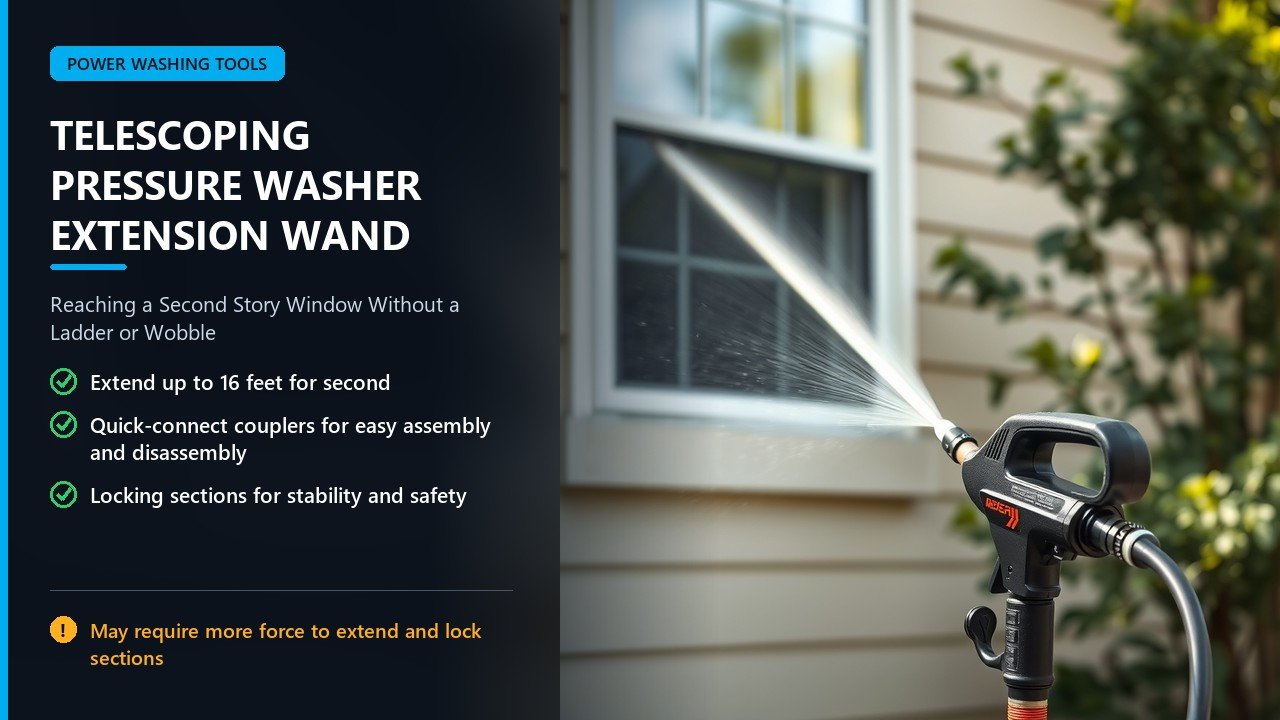
What a Telescoping Extension Wand Is
A telescoping pressure washer extension wand is a multi-section pole that extends and locks between the gun and the nozzle, with a quick-connect coupler at the base for the gun and a quick-connect seat at the tip for the color-coded tips. It collapses to roughly three or four feet for travel and extends to eight, twelve, or sixteen feet or more, and each section slides through the next and locks with a quarter-turn collar or a twist-and-set feature. The water flows from the gun up through the pole to the tip under the machine’s pressure.
The design is the telescopic wand, covered from the angle of that category in the telescopic wand guide, and the extension wand is the same idea sized to hang a nozzle clear of a second-story wall. The pole carries the full stream, rated to the machine’s pressure, and the operator stands on the ground, the pole’s base braced, the tip walking the wall, and the second story cleaned as calmly as the first.
The parts that matter are the sections and the seals. Quality poles use o-ring seals between the sections, so the water travels the length without dribbling out the joints, and lock collars that hold each section firm at the set length. The two quick connects, rated and matched to the kit, carry the flow at both ends, and the whole assembly, pole, seals, and collars, must wear a rating at or above the machine, since a seal failure at height sprays the operator’s face and drops the reach.
How Far Should the Reach Go
Reach is chosen wall by wall, not by the biggest number on the box. A single-story home with low eaves works an eight to ten foot pole; a two-story wall where the operator stands well back wants twelve to sixteen feet; and a pole that overreaches a modest house spends the day flexing and fighting the operator. The honest rule is to measure the work, add the operator’s arm reach, and buy the pole that covers it with a little margin, not a lot of idle length.
The height math has three parts. The pole’s full extension, the gun’s position in the hand, and the operator’s own height-stance all stack into the actual reach, and a nominal sixteen-foot pole with a hunched arm may still fall short of a very tall wall, while the same pole on a long one-story row is far more reach than the job needs. Adding a fixed extension section to the kit, or stepping the pole, both covered in the lance extension guide, tunes the reach without buying a second pole.
The flex penalty grows with length. Beyond about fourteen feet, a purely hand-held pole becomes a flag in the wind, and the reach that cannot be braced against the target tames its own usefulness, which is why professional two-story work often pairs the pole with a stabilizer or a second set of hands on the base. The operator who sizes the reach to the work instead of the catalog gets a pole that stands steady, extends smoothly, and cleans the wall it was bought for, which is the entire point of the tool.
Using It From the Ground Without Wobble
The technique that steadies an extended pole is a craft of bracing and rhythm. Grip the gun or the base of the pole with the support hand lower on the shaft, brace the tip lightly against the siding so the wall absorbs the flex, and steer the movement from the shoulders in slow, even rows, so the nozzle tracks the wall instead of waving at it. The wall contact is the secret, since a pole touching its target stops swinging and begins cleaning, and the operator who finds that gentle brace gets the same steadiness at sixteen feet as at four.
Work the wall in the same discipline every pass. Start at the bottom corner and climb upward in overlapping rows, so the rinse runs over clean rather than re-dirtying it, hold the pole at a consistent angle, and keep each pass the same length so the fan overlaps without streaks. The telescopic sections extend silently to the height the wall needs, and the tip at the top does the work the operator’s wrist guides, and the whole motion becomes a rhythm once the first few rows prove the stability.
The base and the stance close the loop. Plant the feet wide, brace the base of the pole against the hip or the chest where the lever arm sits comfortably, and never lean the whole body back to chase the tip, because that is the instant the pole wavers and the spray strays. A hat brim and safety glasses keep the rebound out of the face, and the balanced stance is what turns a long reach from a wobble into a wash, which is the practical difference between the new pole and a tired wrist.
Matching the Pole to the Machine and Tip
The rating is the first match and the non-negotiable. A telescoping pole rated for 2,500 PSI carried in front of the face on a 3,500 PSI machine is a rupture waiting for a trigger squeeze, so the pole, its seals, and its couplers all carry the machine’s class with margin, and the honest operator reads the stamp before the extension. The fittings close the second match, the gun’s quick connect at the base and the tip’s quick connect at the top, both in the standard the kit already uses, so the pole clicks straight in without adapters.
The tip plan decides the finish. At the top of a two-story wall, a 25 degree tip rinses siding gently and a 40 degree fan soft-washes, while a 15 degree earns its place on stubborn strips, and swapping means lowering the pole, so plan the fan before the height, as the nozzle chart teaches. The distance at which the pole works, four to six feet off the wall, softens the delivered pressure, which is usually a blessing overhead, and the operator budgets it by the angle and the standoff.
The gun choice rides the balance. A heavier, long-barreled gun at the base adds counterweight that steadies a long reach, and a compact snub nose, from the snub nose gun guide, tucks the balance into the palm for close work at the pole’s short end. The pole is the length; the gun is the balance; and the operator who matches both to the machine gets a rig that steers at any height, which is the quiet reason the reach work feels effortless.
Safety at Height With an Extended Wand
Reach tools remove the ladder, and they create their own share of rules. Never extend a live pole straight overhead and crane the neck to look up into it, never let the extended tip swing in an arc where a bystander or a window stands, and never fire the stream at power lines, gutters, or sills with electrical lines attached, since water carries current and height makes the surprise bigger. The pole amplifies the sweep of every careless wrist, so the operator keeps the aim deliberate and the zone clear.
The joints take the preflight. Feel each collar lock, check the o-rings at the sections, and confirm the tip connector seats before the pole ever rises, and never extend or collapse a section while the machine is live and pressurized under trigger pressure. The OSHA elevated-work guidance and the NIOSH hearing guidance frame the working baseline, and the operator who checks the reach the way a pilot checks a wing keeps the height work boring, which is exactly how it should be.
Know the limit of the ground-reach method too. Sloped footing, vehicles and glass in the arc, genuine three-story heights, and power-line-dense eaves all argue for a pole, a scaffold, or a professional crew with the right gear, and the honest operator calls in that expert rather than stretching the telescoping wand past its own physics. The telescoping extension wand is the right answer to an enormous share of house washing, and using it within its honest limits is what keeps it the right answer every time.
Telescoping Versus Fixed Extension: Choosing the Tool
The telescoping pole earns its place against a fixed extension, and the choice follows the transport and the job. A telescoping pole collapses to a broom’s length for the truck, and it extends to reach a range of heights on demand, which suits an operator who carries the reach to a variety of sites and walls. A set of fixed extension sections is heavier and rides awkwardly but locks into an absolutely rigid reach, which suits fascia, figures, and the hard, precise rows that a long, slightly flexible pole struggles to hold.
The stiffness trade is the heart of the comparison. A telescoping pole at full extension bends a little under the nozzle, and that flex is tamed by bracing against the wall; the fixed stack has no flex to tame, so it aims with surgical repeatability. The operator whose work is routine house washing values the collapsible packability; the operator whose work is long partitions and commercial heights values the rigidity, and many carry one of each, the telescoping pole for the daily houses and a pair of fixed sections for the long fascia runs.
The buying logic follows the work, not the loyalty. Measure the reach the truck needs to store, count the jobs that actually rise two stories, and weigh the flex tolerance against the finish the customer expects, and the extension family guide on the site maps both roads. The telescoping pole and the fixed sections are teammates, not rivals, and the operator who matches each to the wall gets the safest and smoothest reach for every job the calendar brings.
Buying Guide: Seals, Locks, and Materials
The factory specs hide the daily differences. The o-ring seals between the sections decide whether the pole dribbles a stream down its own length or carries every drop to the tip, and the lock collars decide whether the set length holds firm or slides mid-row. Look for o-ring-sealed sections with a positive twist-and-lock, tested in the hand before purchase, since a pole that extends smoothly and holds its length is the pole that makes the technique easy and the finish clean.
Aluminum carries the balance, carbon fiber the pro-grade price. Aluminum poles balance the stiffness, weight, and cost that most operators want, and stainless or composite poles pay for heavier durability where the reach does heavy daily work, while a flimsy budget pole flexes embarrassingly at twelve feet. The reviews of the exact model tell the real flex story better than the catalog, so read the owners’ photos and complaints before trusting the look, and the honest owner decides on test and feel, not the sticker.
Kit completeness closes the purchase. A package that includes a spare tip set, a clip, and a rated coupler rides ahead of the bare stick, and a seller with a warranty or a return policy stands behind the reach. The price is the last consideration after the rating and the fit check, because a cheap pole that fails at height costs more than the difference ever saved, and the well-built telescoping pole, checked once and relied on for years, is the standard the working reach demands.
Pairing the Pole With Detergent and Soft Wash
The extension wand meets the world of chemistry at the tip. A soft wash, the low-pressure bleach-and-water routine that cleans siding and roofs without the blast, runs perfectly from a telescoping pole, since the operator stands on the ground while the chemical reaches the eves, and the wide white or soap tip at the top applies the wash gently. The pole’s softening of the delivered pressure is a benefit here, exactly the reason the soap selection guide and the soft wash practice pair the two.
Applying the chemical takes the same low-to-high discipline as the rinse. Work the soap fan up the wall in overlapping rows, let the wash dwell while the pole drops for a fresh tank or a tip change, and rinse from the same low-to-high order so the runoff leaves the clean area above it untouched. The telescoping pole and a dedicated solution or a downstream injector, from the soap injector guidance, complete the soft wash kit, and the second story joins the clean side of the house on the same standing pass as the first.
The chemistry and the pole share a care rule, flush, rinse, dry. A bleach wash left to dry on the pole’s seals attacks the rubber faster than water ever would, so the operator rinses the sections after every chemical job, flushes the injector, and stores the pole clean and dry, and the seals repay the moment with years of service. The telescoping extension wand, the soap, and the soft wash discipline together turn a two-story house from a ladder project into a standing one, which is the quiet transformation the reach was built to deliver.
Maintenance and Winterizing the Sections
The sections need the machine’s discipline. Rinse the pole’s exterior and the couplers after each job so detergent and grit do not work into the o-rings, wipe the sections dry before collapsing, and light grease the seal rings so the extension stays smooth, because a stiff section that resists the quarter-turn lock is a section that will fight at the top of a wall. Check the o-rings at the couplers and the tip seat and replace the tired ones, since a length that drips wastes both the pressure and the job.
Winter settles the storage. Drain the pole completely, dry the bore, and stand it collapsed indoors, away from the freeze that splits a collar, and re-check the seals come spring before the first high job. The winterizing ritual from the winterizing guide protects the reach as much as the pump, and a pole stored dry collapses and extends the same way a year later.
The seasonal service is ten minutes and invisible. Grease the collars, replace the seals that aged, and verify the rating stamps on the assembly, and the pole that was bought rated and stored dry will keep reaching a second story for a decade. The telescoping extension wand is a simple, mechanical tool, and the twenty minutes of annual care it asks is the small price for the height, the safety, and the steady day it delivers in return.
Common Telescoping Extension Wand Mistakes
The mistakes follow the physics. The first is over-length, buying the tallest catalog pole for a one-story wall and fighting its flex all day, when the honest reach for the work would have been steady. The second is a rating mismatch, a cheap pole not rated to the machine held over the operator’s face, which is not a bargain but a rupture budget. The third is crude extension, fighting a sticky section with a wrench or a yank, when a clean, greased collar extends with a twist instead of a struggle.
Fourth is ignoring the seals until the drip becomes a wall, when the o-rings were the whole water-path. Fifth is storing it wet, greeting the spring with a frozen collar and a rusted section, when a dry stand through the winter would have preserved it. Each of these is fixed the same way the rest of the kit is fixed, match the rating, size the reach, service the seals, store it dry, and the pole returns to its role as the quiet extension of the arm.
Finally, forgetting the pole’s limits. A telescoping extension wand reaches walls; it does not make ladders, slopes, or wiring vanish, and the operator who stretches the method past its physics pays in rebound, strain, and the occasional stray fan. The discipline is the same as every pressure tool, choose the right reach, respect the rating, take the stable stance, and call in the expert solution when the ground-reach ends, and the telescoping wand stays the safe, productive workhorse it was always meant to be.
Frequently Asked Questions
How tall can a telescoping pressure washer extension wand reach? Most consumer models extend to eight to twelve feet, and professional poles reach fourteen to sixteen feet or more, covering a second story from the ground. Match the reach to your highest routine surface.
Does a telescoping extension wand reduce the pressure? Somewhat. The longer run and the extra sections add a little friction and flow loss that softens the spray at the tip, a help on high, gentle work. Match the pole’s rating to the machine to avoid failures.
Can I use it without a ladder? Yes, that is the purpose. The pole lets a standing operator clean siding, soffits, and a second story from level ground, provided the stance is stable and the pole is matched to the reach and the rating.
Will it fit my pressure washer? Check the base fitting against your gun and the tip seat against your nozzles, usually the 1/4-inch quick-connect standard, plus the PSI rating. A matched pole clicks in without adapter stacks.
How do I stop the pole from wobbling at full length? Brace the tip lightly against the wall, work in even rows from a stable stance, and drive the movement from the shoulders. A stiffer pole with seated o-ring seals reduces the whip better than loose joints.
Final Thoughts on the Telescoping Pressure Washer Extension Wand
The telescoping pressure washer extension wand turns a standing operator into a reach machine, clearing second-story siding, soffits, and gutter lines from the safety of flat ground. It trades a little pressure for a lot of height, and when it is rated to the machine, sized to the wall, and worked with a braced, even rhythm, it retires the ladder and the wobble from most of house washing. The pole is a simple tool; its craft is in the match, the technique, and the care, and that craft is what makes the height effortless.
Choose the reach that fits the structure, keep the rating and the fittings matched to the kit, and plan the tip before the pole climbs. Work low to high in overlapping rows with the tip braced, keep the base steady and the face clear, and store the sections dry and greased through the season. The result is a clean two-story wall, safe feet on the ground, and a reach tool that earns its place beside the machine every spring, which is the quiet promise of the telescoping extension wand.