A pressure washing contractor named Dean lost a pump on the first hard freeze of the season. He had drained the hose and stored the machine in an unheated shed, sure that draining was enough. What he had not cleared was the water trapped inside the pump itself and in the unloader and gun. Overnight it froze, expanded, and cracked the pump housing. The replacement cost more than a gallon of pump saver fluid a hundred times over. Dean learned the lesson every winter: draining removes most of the water, but a pump saver gets the rest, and that last bit is the difference between a working machine and a cracked one.
A pump saver for a power washer is a fluid, and often a tool, that protects the pump from freeze damage and internal corrosion during storage. It is one of the cheapest forms of insurance in pressure washing, and one of the most overlooked. This guide explains what a pump saver is, why pumps fail in winter, how the fluid works, when and how to use it, how it compares to plain antifreeze, and how to build it into a simple routine that keeps your pump alive for years.
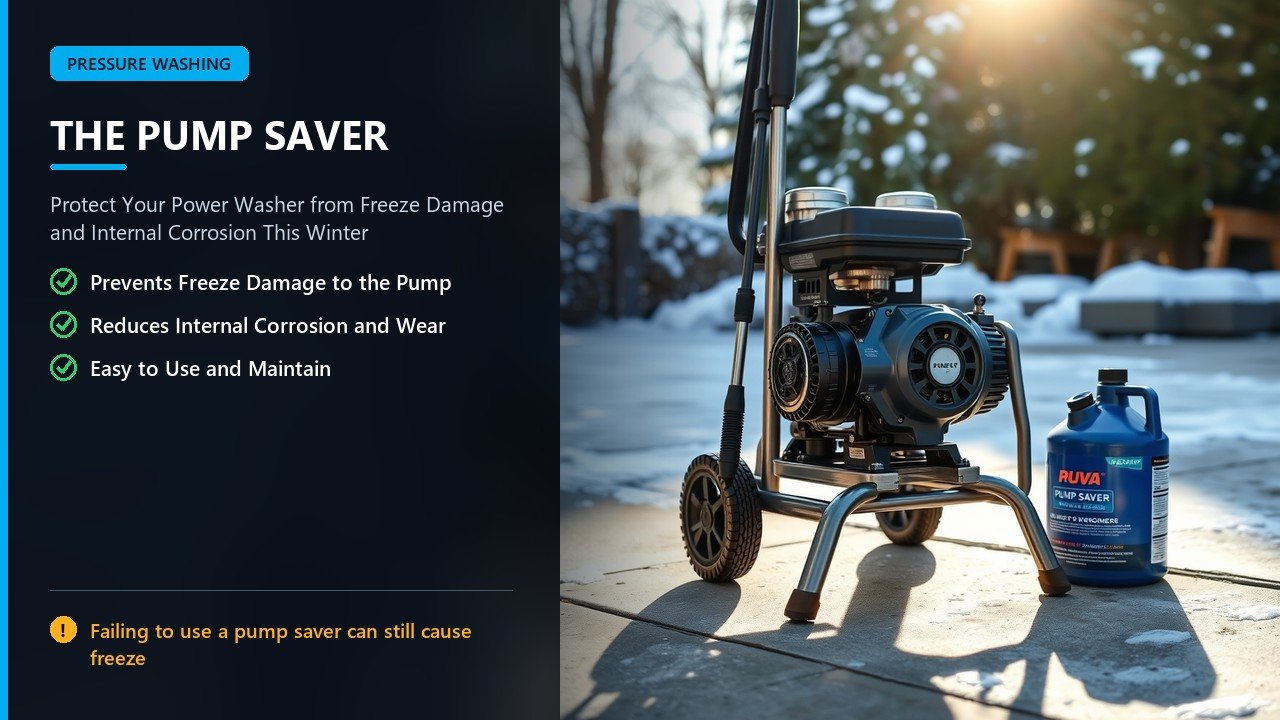
What a Pump Saver Actually Is
Understanding what the product is and what it does helps you use it correctly instead of guessing.
It is a protective fluid. Pump saver fluid is a liquid, usually an antifreeze-type solution, that you pump into the pressure washer’s pump, coil, and lines before storing the machine in cold weather. Because it does not freeze at normal winter temperatures, it cannot expand inside the pump and crack it. Good formulations also include lubricants and corrosion inhibitors that coat the internal parts and prevent rust during months of inactivity. Our guide to pump protector fluid covers the formulation.
It is also the tool. Many pump savers come as a small hand pump with a bottle of fluid and a fitting that connects to the machine’s water inlet. You attach it, pump the fluid through the system, and you are done. The same word describes both the chemical and the delivery device, which is why some people call the whole process “pumping the saver.”
It is seasonal insurance. A pump saver costs a fraction of a pump. It takes minutes to apply and protects the single most expensive and vulnerable component of a gas pressure washer. For anyone who stores a machine through winter or leaves it idle for weeks, it is not optional. Our guide to how a pump saver prevents freeze damage makes the case.
Why Pressure Washer Pumps Freeze and Fail
Water has a rare and destructive property: it expands when it freezes. Inside a pressure washer pump, that expansion has nowhere to go.
Water hides in the pump. When you finish using a machine, water remains in the pump, the unloader valve, the gun, and any low spots in the plumbing. Simply disconnecting the hose and tilting the machine does not remove all of it. The trapped water sits in tight internal passages, and when the temperature drops below freezing, it expands with enormous force. A pressure washer pump manufactures thousands of pounds of pressure; ice does the same, and it does not care whether the pump is rated for it.
The damage is often invisible. A freeze crack may be obvious, splitting the housing, but it can also be a hairline fracture or a pushed-out seal that fails later. That is why a machine that “survived” a freeze can still lose pressure in the spring, or start leaking from a seal that was damaged months earlier. Freeze damage is a common cause of pump death, and it usually happens to machines that were stored in the cold without protection.
Idle machines corrode too. Freezing is the dramatic threat, but it is not the only one. A pump left idle for months with residual water inside can corrode internally. The water sits against metal and slowly rusts it, pitting the plungers and damaging the seals. Good pump saver fluid displaces that water and leaves a protective film, addressing both the freeze risk and the corrosion risk in one step. Our guide to what fails inside a pressure washer pump covers the internals.
What a Pump Saver Does
The fluid does several jobs at once, which is why it outperforms simply draining the machine.
Prevents freezing. The fluid has a lower freezing point than water, so it stays liquid through winter and cannot expand inside the pump. This is its headline job, and the reason most people buy it.
Fights corrosion. The fluid includes corrosion inhibitors that coat the internal surfaces, preventing the rust that eats an idle pump. This matters even in climates that do not freeze hard, because a machine left wet all winter can still corrode.
Lubricates internal parts. Many formulations include lubricants that keep seals and plungers supple during long storage, so the pump starts the next season smoothly instead of dry and stiff.
Covers the whole system. Properly applied, the fluid travels through the pump, the unloader, the coil on a hot water machine, and the high-pressure line, protecting every part that holds water. That completeness is what draining alone cannot achieve.
| Protection Method | Prevents Freeze | Fights Corrosion | Effort |
|---|---|---|---|
| Drain only | Partially, leaves water in pump | No | Low, but risky |
| Pump saver fluid | Yes, when properly applied | Yes | Low |
| RV antifreeze | Yes | Some | Low, with care |
| Heated storage | Yes, if never interrupted | No | Ongoing cost |
When to Use a Pump Saver
Pump saver is most important for winter storage, but it has a place in other situations too.
Before winter storage. This is the classic use. If your machine will sit through freezing weather, apply the saver before the first freeze. Do it as part of your end-of-season routine, alongside a full inspection and an oil change. Our guide to storing a power washer for winter lays out the complete process.
Before long idle periods. Even without freezing, a machine that will sit unused for weeks or months benefits from pump saver, because it prevents the internal corrosion that idle water causes. If you use a machine only a few times a year, this is worth doing.
Before shipping or transporting in cold weather. Moving a machine in a cold truck or trailer can freeze residual water. Running saver through it first removes that risk.
After a repair. If a pump has been rebuilt or serviced, applying pump saver before storage protects the fresh seals and surfaces. Our guide to pump saver versus RV antifreeze helps you choose the right fluid.
How to Apply a Pump Saver
Application is simple, but doing it thoroughly is what makes it work. The goal is to fill every water-holding part with fluid, not just the pump housing.
Gather what you need. You need the pump saver fluid, a delivery method such as a hand pump or a funnel-and-hose kit, the proper fitting for your machine’s inlet, and a container to catch the fluid that comes out the other end.
Connect to the inlet. Turn the machine off and disconnect the water supply. Connect the pump saver tool or funnel to the water inlet, then open the path by removing the nozzle or detaching the high-pressure hose so fluid can flow through and out.
Pump until it flows out. Fill the system with saver fluid and keep pumping gently until fluid emerges from the outlet end. This confirms the fluid has displaced the water and reached the far end of the system, including the gun and wand if they are connected. Catch the initial output, which is mostly water, and discard it properly.
Close and store. Once clean saver fluid is coming through, stop, reconnect or cap the fittings, and store the machine in a dry spot above freezing if possible. You now have a full system of freeze-resistant fluid instead of trapped water. Our guide to winter storage covers the rest of the routine.
| Method | How It Works | Best For |
|---|---|---|
| Hand pump kit | Pumps fluid through the inlet | Most owners, quick and clean |
| Funnel and hose | Gravity-feeds fluid through the inlet | Simple setups, no pressure needed |
| Chemical injector | Draws fluid through the soap system | Machines with a built-in injector |
| Gravity drain plus fill | Drains then fills manually | When a kit is unavailable |
Pump Saver Versus RV Antifreeze
Owners often ask whether they can use RV antifreeze instead of dedicated pump saver fluid. The answer is yes, with caveats.
What they share. Both are formulated to resist freezing and are widely available. RV antifreeze is designed for potable water systems and is generally safe for pumps and seals. Many people use it successfully as a pump saver, especially the pink, non-toxic variety.
Where pump saver wins. Dedicated pump saver fluids are often blended specifically for pressure washer pumps, with corrosion inhibitors and lubricants tuned for that application. They may also be formulated to be gentler on pump seals and o-rings over long storage, and some are sold with the exact fitting your inlet needs.
Where RV antifreeze works. RV antifreeze is inexpensive, easy to find, and does the freezing job well. If you use it, choose the non-toxic, propylene-glycol type, and check that it is compatible with your pump’s seals. Avoid any automotive antifreeze, which is toxic and can attack seals. Our guide to pump saver versus RV antifreeze compares them in detail.
Dispose of it responsibly. Even non-toxic antifreeze should be disposed of properly, not poured down a drain or onto the ground. The Environmental Protection Agency publishes guidance on safe handling and disposal of such fluids, and your local waste facility can advise on the correct method.
What a Pump Saver Cannot Fix
Pump saver is powerful protection, but it is not a repair. Understanding its limits keeps your expectations honest.
It cannot undo freeze damage. If a pump has already cracked from freezing, pump saver will not seal the crack. It is prevention, not cure. If a pump has frozen, inspect it for leaks and lost pressure before relying on it again.
It cannot repair a worn pump. A pump that has lost pressure from worn seals or valves needs a rebuild, not a saver fluid. The saver protects a healthy pump; it does not restore a tired one. Our guide to choosing the best pump oil covers the related maintenance.
It does not replace pump oil changes. Pump saver protects during storage, but the pump’s oil still needs changing on schedule to protect internal parts during use. The two jobs are separate and both matter. Our guide to what oil to use in a pump explains the oil side.
It does not protect a machine that runs dry. Running a pump without water overheats and damages it, and no storage fluid prevents that. Always prime the pump and confirm water flow before starting.
Building It Into Your Routine
The best pump saver routine is the one you actually follow. A few habits keep it simple.
Keep supplies on hand. Store a bottle of pump saver and the fitting with the machine, so the task is never delayed by a missing part. When the first freeze is forecast, you are ready in minutes.
Use a checklist. Combine pump saver with the other end-of-season steps: drain the fuel or add stabilizer, change the engine oil, check the air filter, change pump oil, clean the machine, and store it dry. A written checklist turns a forgotten chore into a two-minute habit. Our guide to winter storing provides one.
Inspecting before the first use. In spring, run fresh water through the system to flush the saver fluid, check for leaks, confirm pressure, and change the pump oil if it is due. A machine brought out of storage carefully starts the season strong.
| Season | Key Steps | Pump Saver Role |
|---|---|---|
| End of season | Drain, change oils, clean, store dry | Fill the pump and lines |
| Winter | Store above freezing if possible | Prevents freeze and corrosion |
| Spring startup | Flush, inspect, test pressure | Flush out before first use |
| Long idle | Protect from corrosion | Apply before idling weeks |
Choosing the Right Pump Saver Fluid
Not all fluids are equal, and the wrong one can do more harm than good. Choosing well takes only a few checks.
Confirm it is made for pressure washers. Dedicated pump saver products are blended for pressure washer pumps and carry the right additives and the correct fitting. They are the safest default, especially for a machine you care about.
Check the freeze point. The fluid must stay liquid below the coldest temperature your storage area will reach. Read the label and choose a rating with margin, because a fluid that freezes does the pump no good at all.
Prefer non-toxic formulations. Propylene-glycol-based fluids are far safer than the ethylene-glycol type used in cars. Automotive antifreeze is toxic and can attack pump seals, so avoid it entirely. If you use RV antifreeze, choose the pink, non-toxic variety.
Buy the right quantity. A small machine may need only a modest amount to fill the pump and lines, while a hot water machine with a long coil takes more. Buying the kit that includes the fitting saves a return trip and ensures compatibility. Our guide to pump protector fluid covers formulations.
Match the fitting to your inlet. Most machines use a standard garden-hose-thread inlet, but some use quick connects or metric threads. Confirm your inlet type before buying, or choose a kit that includes adapters. A mismatched fitting is the most common reason a pump saver sits unused on a shelf.
Pump Saver Mistakes to Avoid
Even a good product fails if it is used the wrong way. These are the errors that leave a pump unprotected.
Not removing the nozzle. Fluid cannot flow through a closed nozzle, so the far end of the system stays full of water. Remove the nozzle or detach the high-pressure hose so the saver can push water out and fill the whole path.
Stopping too early. The fluid that first comes out is mostly water. Keep pumping until clean fluid emerges, because stopping at the first drip leaves water trapped inside, exactly where it will do damage.
Forgetting the gun and wand. Many owners protect the pump but leave water in the gun and wand, which then freeze and crack. Either run the saver through the connected gun and wand, or drain and store them separately and carefully.
Skipping the coil on hot water machines. A hot water machine traps a surprising volume of water in its heating coil. That coil must also be protected, and it often takes more fluid than expected. Do not assume the pump is the only part that matters.
Reusing contaminated fluid. The fluid that comes out mixed with water should be discarded, not poured back into the machine. Reusing cloudy, water-contaminated fluid defeats the purpose. Our guide to how a pump saver prevents freeze damage reinforces the importance of a thorough fill.
Frequently Asked Questions
What does a pump saver do? It protects a pressure washer pump from freeze damage and internal corrosion during storage by filling the water-holding parts with a fluid that will not freeze and that coats the metal against rust.
Can I use RV antifreeze as a pump saver? Yes, in most cases. Choose non-toxic, propylene-glycol RV antifreeze and confirm it is compatible with your pump’s seals. Dedicated pump saver fluid may offer better corrosion and lubrication additives. Never use toxic automotive antifreeze.
How often should I use it? Before any winter storage, before long idle periods, and before transporting a machine in freezing weather. If your machine is exposed to freezing temperatures while holding water, it needs protection.
Does draining the machine replace a pump saver? No. Draining leaves water trapped inside the pump, unloader, and lines, where it can freeze and crack them. Pump saver fills those spaces with freeze-resistant fluid, which draining cannot do.
Will pump saver damage my pump? No, when you use a product intended for pressure washers or compatible RV antifreeze. It is designed to protect pumps. Only use the correct fluid and the correct fitting, and avoid any automotive-grade antifreeze.
Do I need pump saver if I store the machine indoors? If the storage area never freezes, freezing is not a risk, but corrosion during idle months still is. Pump saver still helps by displacing water and coating the pump, so it remains a good habit even for indoor storage.
How do I know the pump saver reached the whole system? Pump fluid through until clean, unclouded fluid comes out of the far end, whether that is the removed nozzle port, the hose end, or the gun. Seeing clear fluid at the outlet confirms the water has been displaced all the way through.
What should I do if I forgot and the machine froze? Let it thaw completely and slowly in a warm space, then inspect for cracks and leaks and test the pressure. Do not run it while frozen, and do not force anything. If it leaked or lost pressure after thawing, the pump likely needs a rebuild or replacement.
Final Thoughts on the Pump Saver for Power Washer
A pump saver for a power washer is one of the best bargains in equipment care. For the price of a bottle of fluid, it shields the pump from the two things that kill it during storage: freezing and corrosion. It takes minutes to apply, and it protects the most expensive component on the machine through the season when it is most at risk.
Understand what it is, both the fluid and the tool you use to move it, and apply it thoroughly so the fluid reaches the pump, the unloader, and the lines, not just the pump housing. Choose a dedicated pump saver or a compatible non-toxic RV antifreeze, dispose of it responsibly, and label your containers clearly. Remember that it prevents damage rather than repairing it, so inspect and rebuild a pump that has already suffered, and never let it stand in for routine pump oil changes.
Build pump saver into a simple end-of-season routine, and the first hard freeze stops being a threat. Dean never lost another pump after he made the saver part of his checklist, and neither will you. It is the small step that keeps a good machine ready for the season ahead.