Every spring, Priya faced the same two-part chore. First she ran the string trimmer along the fence line and around the trees, then she grabbed a separate edger to cut a crisp line along the driveway and sidewalk. Two machines, two cans of fuel, two pull cords, and twice the storage in an already crowded garage. When a neighbor showed her a gas weed eater and edger combo, a single engine with a swappable head that did both jobs, she wondered why she had never bought one sooner. One machine, one tank, and a clean, finished lawn edge in a fraction of the time.
The gas combo trimmer and edger is one of the smartest tools for anyone who maintains a real yard. It combines the reach and power of a straight-shaft string trimmer with an edger attachment that cuts a clean border along walks and drives, all driven by one gas engine. Understanding how these combos work, which type suits your property, and how to keep a gas engine running well is the key to getting years of reliable service from a single purchase.
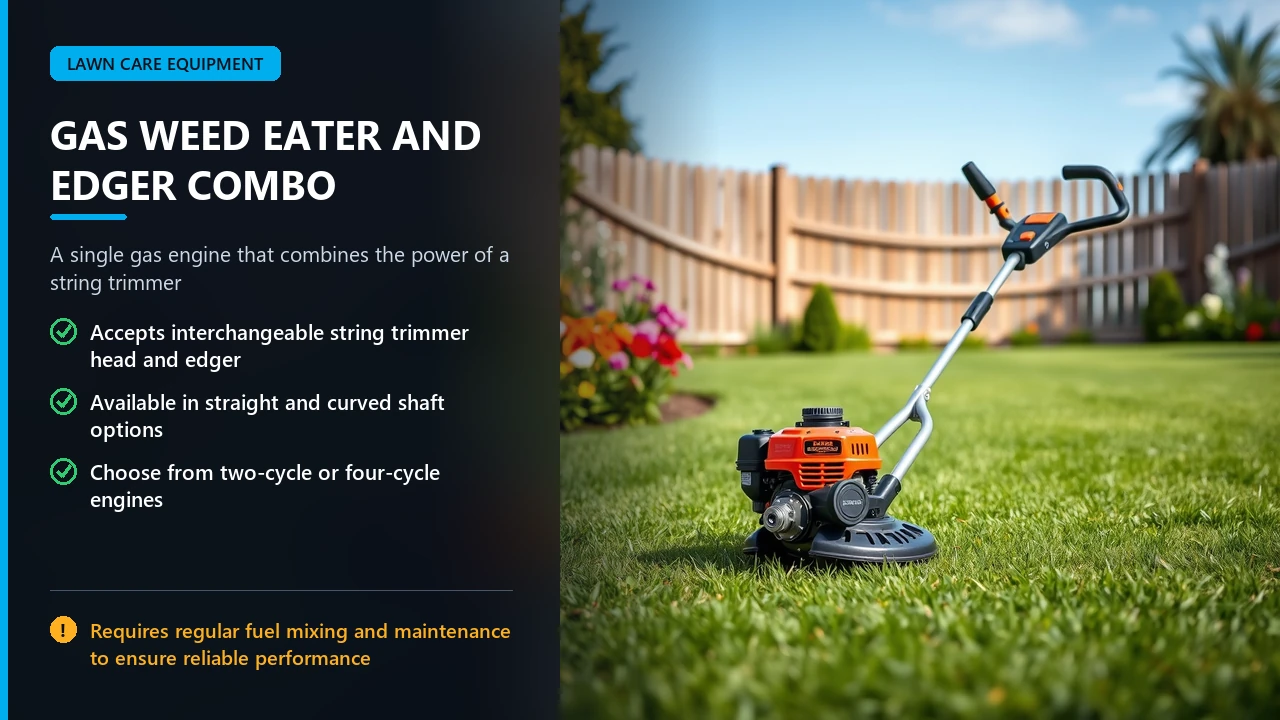
What a Combo Tool Really Is
The idea behind a combo is simple and practical. Instead of buying a dedicated trimmer and a dedicated edger, you buy one power head, the engine and shaft unit, and swap attachments on the end. The trimmer head handles grass and weeds, while the edger attachment cuts a sharp line along hard surfaces.
Most gas combos use a split-shaft design. The shaft separates at a coupler, often about halfway down, so you can remove the trimmer head and click on an edger, a brush cutter, a hedge trimmer, a pole saw, or a cultivator. The engine stays the same; only the working end changes. This is why these tools are often called attachment-capable or power-base trimmers.
The appeal is obvious for a homeowner with a normal-sized property. One engine to fuel, one engine to maintain, and one tool to store, doing the work of several. The tradeoff is that combo attachments are sometimes less specialized than a dedicated stand-alone tool, and switching heads takes a moment. For most residential yards, though, the convenience of a single powerhead wins easily.
Attachment Systems Explained
Not all combos use the same attachment system, and this is the single most important compatibility question to answer before you buy.
Brands such as Echo, Stihl, Husqvarna, and Troy-Bilt each have their own attachment ecosystems, and attachments are generally not interchangeable between brands. A power base from one maker accepts that maker’s attachments and, in some cases, a limited set of adapters. If you plan to add tools over time, staying within one brand’s system keeps your options open.
The most common setup includes the trimmer head as standard, with an edger attachment sold either as part of a kit or separately. Some packages, like popular Echo and Troy-Bilt combos, include both the string trimmer and the gas edger attachment in the box, which is exactly what a homeowner shopping for this keyword usually wants. Before buying, confirm three things: that the edger attachment is included or available, that it fits your specific power head, and that the connection style matches.
Two-Cycle vs Four-Cycle Engines
Gas string trimmers and combos come with one of two engine types, and the difference affects fueling, weight, and maintenance.
Two-cycle engines are the most common on gas trimmers. They are lighter, rev higher, and produce strong power from a small displacement. The catch is that they run on a mixture of gasoline and two-cycle oil, which you either mix yourself or buy pre-mixed. Getting the ratio wrong can damage the engine, so measure carefully or use pre-mixed fuel for convenience.
Four-cycle engines run on straight gasoline and have a separate lubrication system, much like a car, which means no fuel mixing and cleaner, quieter operation. The tradeoffs are extra weight, a higher price, and the need for regular oil changes. For a homeowner who dislikes mixing fuel, a four-cycle combo is appealing, but it will feel heavier after a long session.
For most people buying a gas combo, a two-cycle engine offers the best balance of light weight, power, and low cost. If you value simple fueling and cleaner running over the lightest possible weight, the four-cycle option is worth considering.
Straight vs Curved Shaft
The shaft shape changes how the tool feels and what it can do, so it is worth choosing deliberately.
| Shaft Type | Strength | Best For |
|---|---|---|
| Straight shaft | Longer reach, more torque, better under obstacles | Larger yards, heavy growth, edging, attachment systems |
| Curved shaft | Lighter, easier to maneuver in tight spots | Small yards, light trimming, budget tools |
| Telescopic shaft | Adjustable length for comfort | Users wanting custom reach and height |
Most attachment-capable gas combos use a straight shaft, and that is no accident. A straight shaft transmits more torque, reaches farther, and works better with edger and brush-cutter attachments. It also lets you trim under low obstacles like decks and shrubs. Curved-shaft trimmers are lighter and cheaper, and some shorter users find them easier to control, but they rarely support the full range of attachments.
If you mainly trim a small yard and edge a short walkway, a curved-shaft combo can work. If you want a serious attachment platform for a larger property, choose a straight shaft.
The Edger Attachment: How It Cuts
The edger head is what separates a combo from a plain string trimmer, and understanding how it works helps you use it well.
Most gas edger attachments use a small metal blade or a set of rigid lines to cut a clean vertical edge where the lawn meets the pavement. Some use a hardened star blade that slices through grass and roots, while others use a string-line edger that spins line against the edge. A guide wheel or a depth guide controls how deep the cut goes, and a debris shield keeps clippings from flying.
To edge, you walk along the pavement with the edger head positioned at the boundary between grass and hard surface, letting the guide ride on the pavement while the blade cuts a clean line in the turf. The result is a sharp, defined border that makes an entire lawn look professionally maintained. Many people find edging oddly satisfying once they get the rhythm, because the visual improvement is immediate.
What to Look For When Buying
A handful of specifications separate a combo that serves you well from one that disappoints.
| Feature | Why It Matters |
|---|---|
| Engine size (cc) | More displacement means more power for thick growth |
| Attachment system | Determines which heads fit and how you expand later |
| Shaft type | Straight for reach and torque, curved for light and light-duty |
| Included attachments | Confirm the edger is included or available for your model |
| Handle and grip | Adjustable, comfortable controls reduce fatigue |
| Starting system | Easy-start features reduce the pull-cord struggle |
| Brand ecosystem | A deep attachment lineup protects your investment |
Engine size is the headline number. Small-displacement engines around 21 to 25 cc handle typical residential trimming and edging, while larger engines in the high 20s and beyond suit heavy growth and larger properties. A translucent fuel tank is a small but genuinely useful feature, since you can see the fuel level without opening the cap.
A comfortable handle and a reliable starting system matter more than people expect. You will start this tool dozens of times a season, and a machine that fires on an easy pull is far more pleasant than one that fights you every time. If starting is a priority, look for spring-assisted starting features.
Combo vs Separate Tools
Buying a combo is not automatically better than buying a trimmer and an edger separately. The right choice depends on your yard and your preferences.
| Consideration | Combo Tool | Separate Tools |
|---|---|---|
| Cost | Lower for multiple functions | Higher, one tool each |
| Storage | One engine and shaft | Two full tools |
| Fuel and maintenance | One engine to service | Two engines to service |
| Performance per task | Very good, sometimes less specialized | Optimized for each job |
| Convenience | Swap heads between jobs | Grab the right tool instantly |
The combo wins clearly on cost, storage, and maintenance because you own one engine instead of two. The case for separate tools is that each is optimized for its single job and you never have to stop and swap a head mid-project. For most homeowners with average yards, the combo is the smarter purchase. For a professional or someone with a very large property who edges and trims constantly, dedicated tools can make sense.
Independent testing is worth checking before you buy. Consumer Reports tests string trimmers for trimming and edging performance and notes that combo attachments can perform below dedicated tools, while retailer buying guides from stores such as Lowe’s explain which attachment heads fit which power bases. Reading both gives you a realistic picture of what a combo can and cannot do.
Our guide on choosing a trimmer and caring for string trimmers covers the trimmer side in more detail if you want to compare before deciding.
Fuel and Mixing for a Gas Combo
If you buy a two-cycle combo, fuel handling is the part most likely to cause problems, so it deserves care.
Mix fresh gasoline with the correct two-cycle oil at the ratio the manufacturer specifies, which is often around 50 to 1 but varies by brand. Use only the exact ratio in your manual, since too little oil wears the engine and too much fouls the plug and clogs the exhaust. Use fresh fuel and add a fuel stabilizer, because ethanol-blended gasoline can degrade in a few weeks and cause hard starting and carburetor trouble. Never use fuel older than about a month in a small engine if you can avoid it.
The simplest path for many owners is pre-mixed, ethanol-free fuel sold in cans at hardware and outdoor power stores. It costs more per ounce, but it eliminates mixing errors, stores well, and makes small engines start reliably. For occasional use, pre-mixed fuel is often the difference between a tool that starts on the first pull and one that sits idle because it is a hassle to fuel.
Maintaining a Gas Combo Trimmer and Edger
A gas combo rewards basic maintenance with years of service, and the routine is not complicated.
After each use, check the trimmer line and refill it as needed, and clean grass and debris from the cutting head and the engine’s cooling fins. Keep the air filter clean, since a clogged filter causes hard starting and rough running. Check the spark plug periodically and replace it when worn. Keep the cutting line at the right length for your head, since too much line overloads the engine and too little leaves the cut uneven.
At the end of the season, run the engine until it stops to burn off remaining fuel, or add stabilizer and store the tool with treated fuel. Store it somewhere dry, and if you left fuel in it, expect to clean the carburetor in the spring. For the edger attachment, keep the blade or line in good condition and check the guide wheel and shield for damage. Taking a few extra seconds to rewind the trimmer line correctly or replace a dull edger blade keeps both functions working cleanly instead of dragging the engine down.
Safety When You Run a Combo
A gas trimmer and edger spins a cutting head at high speed, and safety habits are not optional.
Wear eye protection, hearing protection, long pants, and sturdy closed shoes. Gas trimmers are loud enough to require ear protection, and the cutting line can throw debris far and fast, so glasses or goggles are essential. Keep bystanders, children, and pets well clear of the work area, and never operate the edger near other people. Be aware that a spinning blade or line can kick back off hard surfaces or hidden objects, so hold the tool firmly and stay alert.
Follow the same common-sense rules you would with any powered outdoor tool. Inspect the unit before each use for loose fasteners, cracked shields, or damaged heads. Never reach into a spinning cutting head, and shut the engine off before you clear a jam, change an attachment, or refuel. A few seconds of caution prevents the accidents that ruin a season.
The Cutting Head and Trimmer Line
The trimmer head is the business end of the combo, and its design affects how easy the tool is to live with. Understanding the options helps you get the most from a gas powerhead.
Single-line heads hold one strand of line and are simple to load, though they cut more slowly than dual-line designs. Dual-line heads cut twice with every revolution, which means faster work and cleaner results. Bump heads feed new line when you tap the head on the ground, the most common system on gas trimmers. Fixed-line heads use pre-cut lengths that you replace by hand, which some users find faster and tidier than winding a spool.
Line diameter matters as well. Thicker line handles heavier weeds and wears more slowly, while thinner line cuts delicate grass more cleanly. Match the line diameter to your head and to the growth you cut most often, and keep a spare spool on hand so a line-out never ends your session. The right line, correctly wound, makes a gas trimmer feel far more powerful than a poorly loaded one.
How to Edge a Clean Line
Edging is the skill that turns a mowed lawn into a sharp, cared-for landscape. The technique is simple once you understand the goal: you are cutting a clean, vertical border where the grass meets the pavement.
Position the edger head so its guide rides along the edge of the hard surface, with the cutting blade or line slicing into the turf at the boundary. Start at one end and walk steadily forward, keeping a consistent pace and angle so the depth of cut stays even. Do not press down or force the tool; let the blade do the cutting and guide it smoothly. A steady walk produces a straight, uniform edge, while hurrying or weaving produces a wavy line.
The first pass of the season may need a slightly deeper cut to define the edge, after which routine passes keep it crisp. Once the border is established, going over it every few weeks keeps the line clean and takes only a few minutes. Many people find that a fresh, sharp edge is the single biggest visual improvement they can make to a lawn, and a gas edger makes it fast and repeatable.
Blade Edgers vs String Edgers
Edger attachments generally fall into two styles, and each has a place.
Blade edgers use a small metal or hardened star blade to slice through grass, roots, and soil along the pavement. They cut a very clean, deep edge and hold up well to tough conditions, but they can throw debris and require a firm, steady hand. A guide wheel controls the depth and keeps the cut consistent.
String edgers use spinning line to trim the edge rather than cut into the soil. They are gentler and less likely to dig deeply, which some users prefer for lightly defined borders, but they cut a less pronounced edge and the line wears against abrasive pavement. For a crisp, deep border, a blade edger is generally the better tool.
Whichever style your combo uses, the principle is the same: guide it steadily along the boundary and let the cutting edge, not your arm strength, do the work. For most properties, a blade edger produces the most professional-looking result.
Gas, Battery, or Corded: Which Power Source
Gas combos are not the only option, and it helps to know where they fit among the alternatives.
Gas trimmers and combos offer unlimited runtime, high power, and freedom from cords or charging, which makes them ideal for large properties and heavy growth. Their drawbacks are noise, exhaust, fuel mixing, and more maintenance than electric tools. For anyone maintaining an acre or more, or cutting thick weeds, gas remains a strong choice.
Battery-powered trimmers have improved dramatically and now handle most residential yards quietly, cleanly, and with almost no maintenance, provided you have enough charged batteries for the job. Corded trimmers are light, cheap, and quiet, but limited by the length of the cord and best suited to small yards near an outlet. If your property is modest and you dislike fuel and noise, a battery combo may serve you better, though gas still leads on raw power and runtime for big jobs.
The right answer depends on the size and toughness of your yard. Big and tough points to gas; small and easy-living points to battery. Both can edge and trim well when matched to the job, and both reward the same good technique.
Frequently Asked Questions
What is a gas weed eater and edger combo? It is a single gas engine on a split shaft that accepts different attachments, most commonly a string trimmer head and an edger head. One powerhead does the work of both tools.
Do I mix oil and gas in a gas trimmer? Two-cycle engines require a gas and oil mixture at the ratio your manual specifies, often around 50 to 1. Four-cycle engines run on straight gasoline and have a separate oil system.
Straight or curved shaft for a combo? Choose a straight shaft for reach, torque, and full attachment capability. A curved shaft is lighter and cheaper but supports fewer attachments and less reach.
Can I use an edger attachment on any trimmer? Only if your trimmer is attachment-capable and the attachment fits your brand’s system. Attachment systems are usually brand-specific, so confirm compatibility before buying.
Is a combo better than buying separate tools? For most homeowners, yes. A combo costs less, stores in less space, and needs only one engine to maintain. Separate tools make sense for professionals or very large properties.
How do I make a gas trimmer easier to start? Use fresh fuel or pre-mixed ethanol-free fuel, keep the air filter clean, replace a worn spark plug, and look for models with spring-assisted starting. Old or improperly mixed fuel is the most common cause of hard starting.
Final Thoughts
For a homeowner who wants a trimmer and an edger without buying and maintaining two machines, a gas weed eater and edger combo is one of the most practical tools in the shed. One engine, one fuel can, and a swappable head deliver the power of gas with the flexibility of an attachment system, and a straight-shaft model gives you the reach and torque to handle a real yard.
Choose a brand with a deep attachment lineup, keep your fuel fresh and your filters clean, and mind the safety basics every time you start the engine. Do that, and a single gas combo will keep your lawn looking sharp for years, with one tool doing the work you used to spread across two. If you are comparing power options more broadly, our guide on choosing and caring for string trimmers helps you weigh gas, battery, and corded choices before you commit.