Picture two pressure washers side by side on the same concrete driveway. The first is running a 0-degree tip, the kind that fires a needle-thin jet you could use to write your name. The second is running a 40-degree tip, which throws a broad, soft fan of water like an open garden hose scaled up. Same machine, same water supply, same operator, but the two jobs could not be more different. The first tip will carve into the concrete or ruin a car panel in seconds. The second will clean a fence, rinse a wall, and wash a truck without leaving a mark. The gap between them is not power; it is geometry. The 40 degree nozzle for pressure washer use is the wide-angle tip that trades raw concentration for coverage and safety, and it is the nozzle most owners should reach for far more often than they do.
Nozzle choice is the single biggest factor in whether a pressure washing job looks professional or leaves damage. The pump sets the ceiling, the hose and wand carry the water, but the nozzle decides how that water arrives at the surface. Change the tip and you change the entire behavior of the machine. This guide focuses on the 40-degree nozzle specifically: what it is, the physics of why it is gentle, how it compares with the 25-, 15-, and 0-degree tips, which surfaces it belongs on, and how to use it so that even a beginner can wash delicate surfaces with confidence.
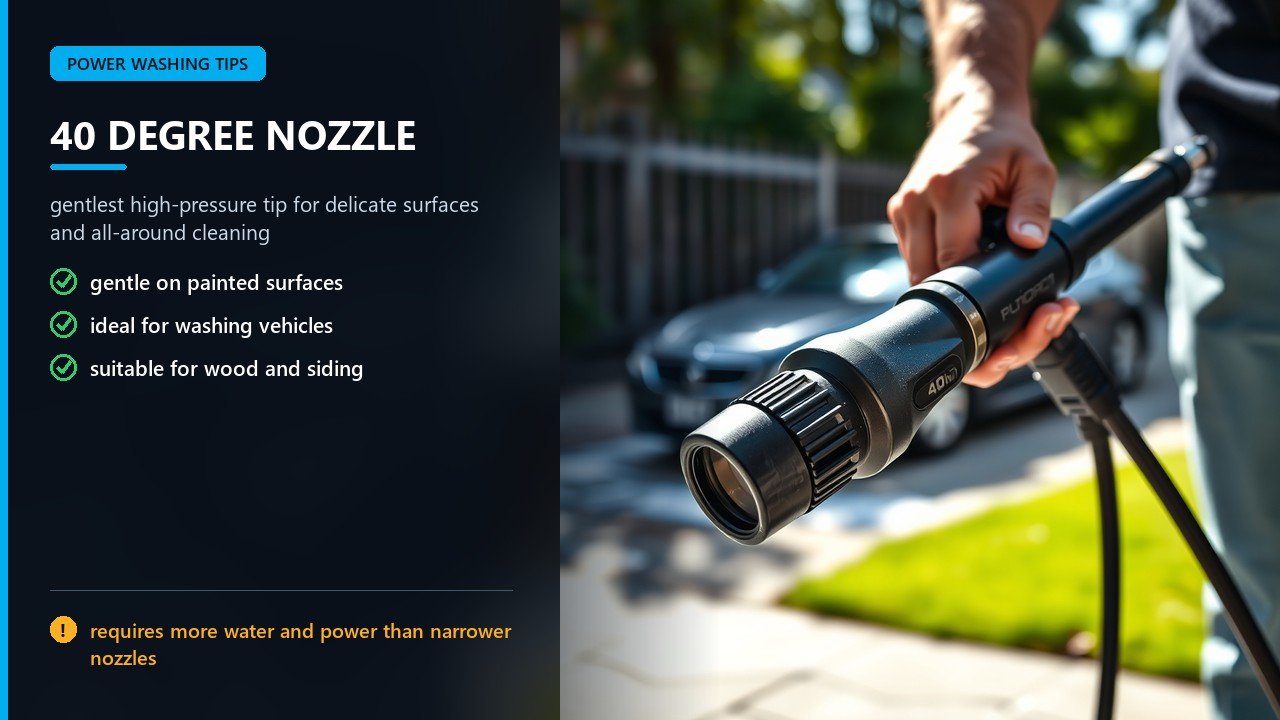
What a 40 Degree Nozzle for Pressure Washer Work Really Does
A pressure washer nozzle is essentially an aperture. Water forced through it under pressure exits as a fan, and the angle of that fan is fixed by the internal shape of the tip. A 40-degree nozzle opens that fan wide, so the stream of water spreads across roughly a 40-degree wedge. The wider the wedge, the more surface the same volume of water has to cover, and the lower the impact at any single point.
The physics in plain language. Your pump produces a fixed amount of energy. A narrow nozzle pours all of that energy into a small dot, which is why a 0-degree tip feels like a laser and can etch concrete. A 40-degree nozzle spreads the exact same energy across a large area, which dilutes the force per square inch at the surface. The machine is not weaker; the impact is simply spread out. This is the entire reason a tip that can damage one surface is perfectly safe on another.
Why “40 degrees” is a sweet spot. Angles below 40 are aggressive and meant for hard, unpainted targets. Angles above 40, in the standard set, only exist as the black low-pressure soap tip, which is not a cleaning tip at all. The 40-degree nozzle is the widest high-pressure angle available, which makes it the gentlest cleaning tip you can buy and the natural first choice when a surface’s finish matters.
Color matches the angle. Manufacturers standardized the color code so the angle is obvious at a glance: red is 0 degrees, yellow is 15, green is 25, white is 40, and black is 65 degrees at low pressure. The Generac nozzle guide and most major makers use this exact scheme, so any white 40-degree tip will behave the same way regardless of brand. Our full breakdown of pressure washer nozzle colors shows the complete system.
The Angle Chart Every Owner Should Know
To understand the 40-degree nozzle, you have to see it beside the others. The table below lays out the standard set, what each angle does, and where it belongs. Notice how pressure and coverage trade off as the angle grows.
| Color | Angle | Coverage | Best For |
|---|---|---|---|
| Red | 0 degrees | Tiny dot | Stripping paint, etching, cutting only |
| Yellow | 15 degrees | Narrow fan | Concrete, brick, heavy mildew, rust |
| Green | 25 degrees | Medium fan | Driveways, fences, general washing |
| White | 40 degrees | Wide fan | Siding, cars, wood, windows, rinsing |
| Black | 65 degrees (low pressure) | Very wide, low pressure | Applying soap and detergent |
Two insights jump out of that table. First, the 40-degree nozzle is one step above the soap tip, which tells you it is the gentlest real cleaning angle. Second, every step down in angle multiplies the impact, which is why the jump from a 25-degree green tip to a 0-degree red tip is not a small change but a dangerous one on the wrong surface.
Why Wider Fans Cover More Ground Faster
A common assumption is that a narrow, powerful nozzle cleans faster because it “hits harder.” In reality, on most surfaces the opposite is true. Cleaning is largely about flow, coverage, and consistency, and a wide 40-degree fan wins on all three for anything except heavy, caked-on grime on a hard surface.
Coverage per pass. A 40-degree fan at a typical working distance covers several times the area of a 15-degree fan in the same sweep. That means fewer passes, less time, and a more even result. On a whole house or a long fence, the time saved over a narrow tip adds up to a large fraction of the job.
Flow does the cleaning. Water carries dirt off a surface by volume and movement, not just by pressure. A wide fan delivers a steady sheet of water across the surface that lifts and carries debris away. A narrow jet punches a groove and pushes dirt sideways, sometimes leaving a striped pattern you then have to fix.
Less risk, fewer do-overs. The most expensive part of a pressure washing mistake is not the damaged surface, it is the rework or the repair. Because the 40-degree tip is forgiving, you spend less time worrying about that one spot you might have held too long, and more time finishing the job.
Where the 40 Degree Nozzle Belongs
The 40-degree tip is the go-to nozzle for any surface with a finish to protect. If the material is painted, soft, thin, or expensive, start here.
House siding. Vinyl, aluminum, and painted fiber cement are all vulnerable to concentrated pressure. The 40-degree fan knocks off dirt, pollen, spider webs, and light mildew without driving water behind the panels or stripping the finish. A soft wash routine, soap through the black tip and rinse through white, is the industry standard for siding for exactly this reason.
Cars, trucks, boats, and RVs. Automotive paint and clear coat are thin and easily marred. The 40-degree tip rinses off road film and loose dirt safely at a sensible distance. Detailers use it for pre-rinse and final rinse, and some use it for the entire wash on coated finishes.
Wood decks and fences. Wood fibers fur and gouge under narrow tips, which is why the near-universal rule, repeated across nozzle charts, is never to go tighter than 40 degrees on wood. The wide fan cleans the grain gently, especially when combined with a deck cleaner applied through the soap tip.
Windows, screens, and glass. Glass itself is hard, but window seals and frames are not. The 40-degree tip rinses glass clean while keeping pressure spread and away from the edges where water can sneak inside. It is a favorite for outdoor windows and patio doors.
Outdoor furniture and grills. Painted metal, resin, and powder-coated frames all clean safely under the wide fan. It removes dust, pollen, and old polish without chipping paint.
Rinsing after detergent. After applying soap and letting it dwell, the 40-degree tip is the ideal rinse partner. Its wide fan sweeps residue off quickly and evenly, leaving no soap streaks behind.
When Not to Use a 40 Degree Nozzle
Just as important as knowing where the 40-degree tip belongs is knowing where it does not. Using it on the wrong job wastes time and leaves dirt behind.
Raw concrete with caked grime. A driveway with embedded stains, tire marks, or years of baked-on dirt usually needs more bite. Step down to green for general concrete or yellow for tough stains, or switch to a surface cleaner attachment for fast, even coverage. The 40-degree tip will clean light dirt from concrete, but it will struggle with the heavy stuff.
Stripping and preparation work. Removing paint, rust, or loose coating requires the concentrated force of a narrow tip, not the gentle spread of a wide one. This is a case where the aggressive tips exist for a reason, but only on hard, unpainted surfaces.
Applying soap. The 40-degree nozzle cannot apply soap. Chemical injectors need the low back-pressure that only the black 65-degree tip provides. Use black to apply, white to rinse, and never mix the two roles.
Soft, weathered surfaces with existing damage. If paint is already peeling or wood is already splintering, even gentle pressure can lift flakes. In those cases, lower the pressure at the machine, widen your distance, or clean by hand and reserve the washer for a final light rinse.
White, Green, or Yellow: Choosing by Grime
The surface sets the ceiling on how much pressure is safe, and the grime sets how much you need. Read the surface first, then match the tip to the dirt on top of it.
| Job | Start With | Step Down To |
|---|---|---|
| Painted siding, light dirt | White 40 degrees | Nothing harsher needed |
| Painted siding, heavy mildew | White 40 + soap | Repeat soap, not a harsher tip |
| Car or truck wash | White 40 degrees | Keep white; use soap if needed |
| Wood deck cleaning | White 40 degrees | Never go tighter on wood |
| Paver patio or walkway | Green 25 degrees | Yellow 15 for stubborn stains |
| Concrete driveway | Green 25 degrees | Yellow 15 or surface cleaner |
The lesson in that table is subtle but important: when a surface is delicate, you do not solve stubborn grime by grabbing a more aggressive nozzle. You solve it with chemistry, dwell time, and repetition, because the surface cannot survive the extra force. Save the tighter angles for surfaces that can take them.
Getting the Orifice Right for the Angle
The color sets the angle, but a separate number sets the flow. Every nozzle has an orifice, measured as a small number that corresponds to how much water passes through per minute. Match the orifice to your machine and the 40-degree tip performs beautifully. Mismatch it and the machine either surges or feels flat no matter which color you install.
Too small an orifice. It restricts flow, raises back-pressure, and makes the pump work hotter than it should. Over time, that excess pressure shortens pump life. It can also make the machine pulse or the unloader valve cycle.
Too large an orifice. It lets too much water through for the pump to pressurize, so the stream feels weak and the machine never reaches its rated pressure. This is a common reason a new tip “does nothing.”
How to match it. Use the nozzle set that came with your washer; those tips are already matched to the pump. For replacements, note your GPM and PSI and consult a sizing chart, or simply replace the tip with the same orifice number stamped on the old one. A quality reference like the Dultmeier nozzle chart pairs colors, angles, and orifice ranges so you can choose with confidence.
Stainless steel over brass. A hardened stainless insert keeps the orifice from eroding and holds the 40-degree angle true for years. Cheaper brass tips wear into an oval shape and spray a lopsided fan that leaves streaks, which you then blame on the machine instead of the tip.
How Angle and Distance Work Together
The angle of the nozzle is only half of the pressure equation. Distance is the other half, and it is the lever most owners forget they have. Understanding how the two combine is what separates a careful operator from one who damages surfaces by accident.
Distance softens any tip. Move a pressure washer nozzle back and the impact at the surface drops quickly, because the fan spreads and the water loses energy over the air gap. That means a 40-degree tip held close can be nearly as aggressive at a single point as a 25-degree tip held farther away. Distance is your fine adjustment, and it is free.
Angle sets the ceiling. Distance can soften a spray, but it cannot make a narrow tip safe on a fragile surface over the long run. A 15-degree tip at any reasonable distance still concentrates far more energy than a 40-degree tip, and on painted wood or vinyl that concentration eventually shows. Think of angle as the safety ceiling and distance as the dial beneath it. Choose a high enough ceiling first, then tune with distance.
Reading the surface’s reaction. Watch the water as it hits. If it bounces back hard and mist fills the air, you are too close or the angle is too tight. If it sheets off in a calm, controlled wash, you have found the right combination. Adjust distance before you change nozzles, because changing nozzles changes the whole character of the job.
The practical range for a 40-degree tip. On siding and painted surfaces, a standoff of roughly twelve to twenty-four inches keeps the spray controlled. On vehicles, staying a bit farther back protects the clear coat. On wood, keep a generous gap and move steadily. The exact number matters less than keeping it consistent, because a steady distance produces a steady, streak-free finish.
Real Jobs and the Right Angle
Match the tip to the job and the work goes smoothly. Here is how the 40-degree nozzle fits into a handful of common weekend projects, along with the jobs where a different angle takes over.
A two-story siding wash. Start at the top with the black soap tip, apply a house-wash detergent, let it dwell for the recommended minutes, then rinse top to bottom with the 40-degree white tip. The wide fan lifts the loosened dirt and pollen without forcing water behind the panels. A shaded wall with heavy mildew gets a second dose of detergent, not a harsher nozzle.
A full vehicle wash. Pre-rinse with the 40-degree tip, foam with soap through the black tip, wash by hand or with a soft brush, then rinse again with white. Keeping the white tip on the wand for the rinse stages protects the paint and clear coat while still moving water fast.
A wooden fence refresh. Apply a wood cleaner with the soap tip, brush or let it dwell, then rinse along the boards with the 40-degree tip. Working with the grain and keeping the nozzle moving prevents the furring that a narrower tip would cause in seconds.
Patio furniture and a grill. A quick rinse with the 40-degree tip removes dust, pollen, and old polish from painted metal and powder-coated surfaces without chipping or scratching them.
When a different angle wins. A stained concrete driveway, a mildewed paver walkway, or an oil-spotted garage floor all call for a 25- or 15-degree tip, or a surface cleaner attachment, because those hard surfaces have no finish to protect and respond to more concentrated force. The skill is not in always using one tip; it is in switching to the right tip the moment the surface or the grime changes.
Technique: Making a Wide Fan Work for You
The 40-degree nozzle is forgiving, but a little technique turns a good result into a great one. These habits apply to every wide-fan job.
Overlap every pass. Because the fan is wide and the impact soft, you need a slight overlap to avoid missing strips. Let each pass cover about half of the previous one. This is how you get a streak-free, even finish on siding and vehicles.
Hold a steady distance. Pick a working distance and keep it constant. On siding, twelve to twenty-four inches is typical; on a car, a bit more. A consistent distance produces a consistent clean.
Work downward and across. Start high and work down, angling slightly across rather than straight up under seams. This sheds dirty water away from clean areas and keeps water from getting behind siding or under trim.
Pretreat the heavy zones. Corners, under eaves, and shaded walls collect more grime. Hit those spots with soap first, let it dwell, then rinse with the 40-degree tip. Letting the detergent work means you never need a more aggressive nozzle.
Keep the tip moving. Never hold a tip in one spot for long, even a gentle one. A moving fan cleans evenly; a parked one creates a bright or dull patch.
Test a hidden area first. Ten seconds on an out-of-sight patch tells you whether that tip, that distance, and that surface agree. It is the cheapest insurance in pressure washing. Our guide to how the right pressure washer angle tip decides cleaning power expands on matching angle to surface.
Common Mistakes With the 40 Degree Nozzle
Even the safest tip causes problems when it is used carelessly. Watch for these errors.
Assuming wider means useless. Many owners skip the white tip entirely and go straight to green or yellow because it “looks stronger.” On a delicate surface, that instinct is how damage happens. The wide tip is not weak; it is safe by design.
Confusing angle with flow. Thinking the 40-degree tip delivers less water than a 25-degree tip is a mistake. The angle changes the spray pattern; the orifice changes the flow. Two tips of different colors can flow identically.
Running the wrong tip on the wrong surface. The classic error is a narrow tip on siding, paint, or wood. Those surfaces need 40 degrees, and no amount of skill makes a 0-degree jet safe on them.
Skipping the o-ring. The rubber o-ring in the quick-connect socket is what seals the tip. When it wears, the nozzle drips or pops loose. Replacing it is a small fix that restores a solid, dry connection.
Ignoring a worn tip. When a 40-degree tip starts leaving stripes or spraying unevenly, the orifice has worn. Replace it rather than fighting it with technique.
Frequently Asked Questions
What is a 40 degree nozzle used for on a pressure washer? It is the gentlest standard high-pressure tip, used for cleaning and rinsing siding, vehicles, wood, windows, and other delicate surfaces. It covers ground fast and protects finishes.
Is the 40 degree nozzle the same as the white tip? Yes. In the universal color code, white is 40 degrees. Red is 0, yellow is 15, green is 25, white is 40, and black is the low-pressure soap tip.
Is a 40 degree nozzle strong enough to clean? Absolutely, for most surfaces. It cleans siding, cars, decks, and light dirt from concrete. For heavy grime on hard surfaces, step down to a 25- or 15-degree tip.
Can I apply soap with a 40 degree nozzle? No. Soap requires the low-pressure black 65-degree tip. Use black to apply detergent and the 40-degree white tip to rinse.
What is the difference between a 25 and 40 degree nozzle? The 25-degree green tip hits harder with a narrower fan and suits concrete and tougher surfaces. The 40-degree white tip is gentler with a wider fan and suits painted and delicate surfaces.
Will a 40 degree nozzle remove paint? Normally no, and that is the point. It is too gentle to strip paint. For paint removal you would need a narrow tip on a surface where stripping is intended.
Can I use a 40 degree nozzle on concrete? Yes for light dirt and rinsing, but for stains and embedded grime a 25- or 15-degree tip works far better.
Why does my 40 degree nozzle feel weak? Check the orifice size against your machine’s flow rating and look for a clogged or worn tip. A wrong-size or worn nozzle feels weak even on a strong pump.
Final Thoughts on the 40 Degree Nozzle for Pressure Washer Jobs
The 40-degree nozzle is the quiet workhorse of the pressure washer nozzle set. It will not strip paint or blast concrete, but that is precisely why it is so useful: it cleans the surfaces most people actually wash, safely and quickly, without leaving a trail of expensive damage. Siding, vehicles, wood, windows, and the rinse stage of every soft-wash job all belong to this wide, gentle fan. Keep it handy, size the orifice to your machine, and reach for it before anything sharper.
Start every delicate job with the 40-degree tip, add detergent where grime is stubborn, and step down to 25, 15, or 0 degrees only when a hard, unpainted surface truly needs the extra bite. Master this one angle and you will spend your weekends cleaning surfaces instead of repairing them. The widest fan in the box is, more often than not, the smartest choice you can make.