Two neighbors once cleaned identical concrete driveways with the same pressure washer. One spent four hours fighting the same stubborn stains over and over. The other finished in half the time with a cleaner result. The difference was not the machine and it was not the detergent. It came down to a small brass fitting screwed onto the end of the wand, the pressure washer angle tip, and the spray angle it produced.
That tiny part controls almost everything about how water behaves when it hits a surface: how wide the spray fans out, how much force lands on each square inch, how big the droplets are, and how gently or aggressively the water treats what it touches. Get the angle tip right and cleaning becomes faster and safer. Get it wrong and you either waste time or damage the surface you are trying to protect. This guide explains the angles in plain language and shows you how to match a pressure washer angle tip to every job around the home, the fleet, and the job site.
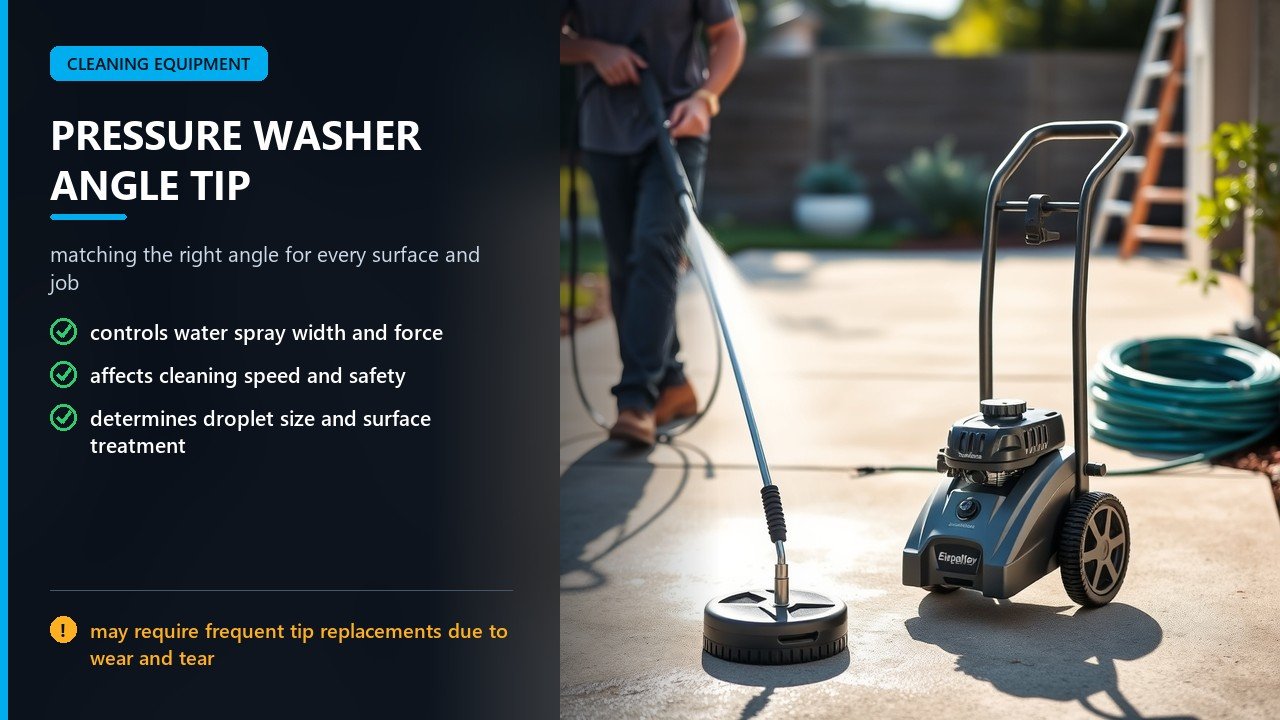
What a Pressure Washer Angle Tip Actually Is
A pressure washer angle tip is the nozzle fitted to the end of the wand. Inside it, a small orifice shapes the water into a fan as it exits. The number that matters most for the tip’s character is its angle, measured in degrees, which describes how wide that fan opens.
Angle versus orifice. It helps to separate two ideas that are often mixed together. The angle controls the spray pattern and the concentration of force. The orifice size controls how much water flows through the tip, and that must match the machine’s pressure and flow rating. The angle is the part you change to suit a surface. The orifice is the part you keep matched to your machine. A standard tip is stamped with both, such as 25030, where 25 is the angle and 3.0 is the orifice. Our detailed guide to pressure washer nozzle colors covers the full color system, while this article focuses on how the angle itself behaves.
Why the angle changes cleaning power. The pump produces a fixed amount of power. The angle tip decides how that power is distributed. Squeeze the same water through a narrower angle and it strikes a smaller area with greater force. Spread it through a wider angle and the force per square inch drops, but the water covers more ground. This is the single most important idea behind choosing an angle tip, and everything else follows from it.
The Science of Spray Angles
When water leaves a narrow tip, the droplets travel in a tight, fast-moving column. When it leaves a wide tip, the same water spreads into a broad, softer curtain. That difference in velocity and droplet size is why angle matters as much as pressure on the machine.
Concentration creates impact. A 0-degree tip focuses the entire output of the pump into a pencil-thin jet. At the point of contact that jet behaves like a cutting tool. Move up to 15 degrees and the stream widens into a tight fan, spreading the force over a larger strip. By the time you reach 40 degrees, the water is a wide, gentle spray that cleans by volume and flow rather than brute concentration.
Smaller droplets cut, larger droplets rinse. Narrow tips produce small, fast droplets that punch into the surface and break dirt loose. Wide tips produce larger droplets that move more slowly but carry more volume, which helps float debris away. This is why a narrow angle is used to cut through heavy buildup and a wide angle is used to rinse a surface clean once the grime has been loosened.
What actually reaches the surface. The pressure printed on the machine is not the pressure that lands on the wall. Impact drops sharply with distance and with angle. A fan-shaped tip spreads the force over its width, so the effective pressure on the surface can be far lower than the machine rating. A 25-degree tip at two feet may deliver a fraction of the pump’s pressure to the surface, and the same tip held twice as close can almost double that impact. Understanding this is what separates an operator who damages things from one who cleans safely. The commercial nozzle references from Alkota and the Generac nozzle guide both confirm how fan width changes force on the surface.
| Tip Color | Spray Angle | Pattern Width at Close Range | Relative Surface Force |
|---|---|---|---|
| Red | 0 degrees | 1 to 2 inches | Highest, cutting force |
| Yellow | 15 degrees | 3 to 4 inches | Very high |
| Green | 25 degrees | 6 to 8 inches | High, balanced |
| White | 40 degrees | 12 to 16 inches | Medium, gentle |
| Black | 65 degrees | 18 to 24 inches | Lowest, rinse only |
Some nozzles also carry a wider or narrower pattern than the standard set, and some brands use slightly different color conventions, but the degree scale itself is the universal language. Once you understand degrees, any tip on any machine makes sense. For more on matching attachments to work, see our guide on choosing power washer nozzle attachments.
Matching the Angle Tip to the Surface
The right angle depends entirely on what you are cleaning and how much abuse the surface can take. These are the practical pairings that professional operators rely on.
Concrete and masonry. Concrete is the most forgiving common surface, which is why it tolerates aggressive tips. A 0-degree tip suits spot work like a single oil stain or graffiti removal, used briefly and carefully. A 15-degree tip handles heavy buildup such as caked mud, moss, and deep-set grime. A 25-degree tip is the everyday choice for driveways, sidewalks, and patios because it balances speed and safety. Even on concrete, holding a narrow tip too long in one spot etches permanent lines that no amount of water will remove.
Siding and painted surfaces. Vinyl, aluminum, and painted siding need a wide angle. A 40-degree tip is the standard because its gentle fan lifts dirt and mold without driving water behind the cladding or stripping paint. Always start from a distance and move closer only if the dirt resists. A narrow tip on siding is one of the fastest ways to write a costly repair estimate. The SIMPSON pressure washer FAQ makes the same recommendation, pointing owners to the white 40-degree nozzle for most siding materials.
Wood and decks. Wood is delicate. A 40-degree tip at low pressure is the safe starting point, and many professionals use it exclusively on timber. Wood can be scarred, splintered, and its grain raised by aggressive pressure, so a wide angle used with distance protects the surface while still cleaning it. Pair the wide angle with a suitable wood cleaner and let the chemical do the heavy lifting.
Vehicles and glass. Cars, trucks, and windows call for a 25-degree or 40-degree tip, often paired with a foamy pre-wash. Auto paint and glass are easy to scratch or pit with concentrated pressure, so keep the tip angled and moving, and never use a 0-degree tip near a vehicle. For wheels and tires, a slightly narrower tip is fine because those surfaces are tougher, but the angle should still be chosen with care. For a full walkthrough, see our guide to turbo nozzles for the cases where a rotating angle beats a fixed one.
Turbo Nozzles: The Angle That Moves
There is a special category of angle tip that changes its angle continuously. A turbo nozzle, also called a rotating or rotary nozzle, spins an internal element so the jet traces a tight circle as it fires. The effect combines the cutting power of a narrow stream with the coverage of a wider fan.
How it earns its keep. On concrete and brick, a turbo nozzle strips stubborn buildup nearly as fast as a 0-degree tip while covering far more ground per pass. That combination makes it a favorite for large flatwork. The same intensity, however, makes it dangerous on soft surfaces. A turbo nozzle can mark wood, tear through weathered decking, and strip paint in seconds, so it belongs on hard, sound surfaces only.
Pair it with the right machine and purpose. Turbo nozzles work best on machines with enough flow to feed them, which is why high-flow commercial units get the most from them. On a small residential washer, a turbo nozzle may sputter or lose its spin because the flow is too low. If you run a high-output machine, the turbo nozzle is often the most productive angle you can add to the kit.
Distance and Angle Work Together
Choosing the tip is only half the job. How you hold the wand, how far you stand from the surface, and the angle at which the spray strikes all change the result as much as the tip itself.
Distance is a pressure knob. Moving closer increases impact, and pulling back softens it. When a surface starts to complain, step back before you change tips. A wide tip held close can be more aggressive than a narrow tip held far away, so distance gives you a second level of control that costs nothing.
Strike at a consistent angle. For most cleaning, keep the spray hitting the surface at roughly a right angle, between 45 and 90 degrees. A glancing angle pushes dirt sideways instead of lifting it, and it also drives water into places it should not go, such as under siding or into seams. On vertical surfaces, work from the top down so dirty water runs over the area you have already cleaned, not over the part you have yet to reach.
Keep the tip moving. Any angle tip becomes hazardous when held still. A stationary jet concentrates all its energy on one spot until the surface gives way. Smooth, overlapping passes spread the force evenly and produce a finish without streaks or grooves. This habit matters most with the narrowest tips and the turbo nozzle.
The Common Mistakes With Angle Tips
Most cleaning damage comes from a handful of repeatable errors. Recognizing them is the fastest way to avoid them.
Reaching for the narrowest tip first. A new operator often assumes the most powerful tip is the best tip. The opposite is usually true. Start with a 25-degree or 40-degree tip, and step down to a narrower angle only when the dirt genuinely resists. Starting narrow means starting with the greatest risk of damage.
Confusing angle with orifice. Two tips can share the same 25-degree angle but have different orifice sizes. Using an orifice that does not match the machine either starves the pump or over-pressurizes the system. Always check the stamped number and match the orifice to your pressure and flow.
Using a damaged or worn tip. A worn tip has an enlarged orifice and a distorted fan. It silently reduces pressure and leaves streaks. Inspect tips for nicks or wear, replace them when they look tired, and keep a spare set on the machine.
Ignoring the surface response. If paint begins to lift, wood fibers start to rise, or a surface starts to streak, the tip is too aggressive or too close. Stop, switch to a wider angle, and increase your distance. The surface always tells you when you are pushing too hard.
Building a Useful Tip Collection
A handful of tips covers nearly every job. You do not need a drawer full of them, but you do need the right few in good condition.
A practical starter set includes a 15-degree tip for heavy concrete work, a 25-degree tip as the everyday cleaner, and a 40-degree tip for siding, wood, and vehicles. Add a soap tip for applying detergent, and consider a turbo nozzle if you do a lot of flatwork on a machine with enough flow to feed it. Some operators also carry an adjustable nozzle that lets them dial the angle between wide and narrow without swapping tips, which is convenient but often less precise than fixed-angle tips. Our article on the adjustable nozzle pressure washer explains where that flexibility helps and where it falls short.
Label your tips, store them where grit cannot clog the orifices, and replace them as a set when they wear. Clean tips are consistent tips, and consistent tips produce consistent results.
| Job | Best Angle Tip | Why |
|---|---|---|
| Driveway and patio concrete | 25 degrees | Balanced force and coverage |
| Heavy concrete stains | 15 degrees | More concentrated impact |
| Spot stain or graffiti | 0 degrees, brief use | Maximum cutting force |
| Vinyl or painted siding | 40 degrees | Gentle, protects finish |
| Wood deck and fence | 40 degrees at low pressure | Avoids grain and fiber damage |
| Cars and glass | 25 or 40 degrees | Safe on delicate surfaces |
Safety and the Angle Tip
An angle tip concentrates water into something closer to a blade, so safety matters more here than almost anywhere else in pressure washing. High-pressure water can inject through skin and cause serious injury, so never point a wand at a person or an animal, and never test a tip by aiming at your hand or foot.
Protect your eyes and skin. Debris ricochets off hard surfaces, especially when using a narrow angle. Safety glasses, gloves, and closed-toe footwear are the minimum. Long pants protect the legs from flying grit and from any accidental exposure to the jet.
Be careful with ladders and heights. A narrow angle tip produces recoil and a strong bite, and both can throw an operator off balance. When working from height, favor a wider angle and steady footing, and consider an extension wand rather than a ladder so your attention stays on the surface instead of your balance. For high work, our guide to powerwash extension poles shows safer ways to reach.
Mind electrical and water lines nearby. Never spray toward electrical outlets, fixtures, or overhead lines, and be aware of what sits behind a surface before you increase pressure. Water travels through gaps, and a narrow tip can force it into hidden spaces faster than a wide one.
Angle Tips for Special Jobs
Some jobs do not fit the standard surface categories, and they call for a little more thought about angle and approach.
Roofs and shingles. Asphalt shingles are fragile and lose their protective granules under aggressive pressure, so a roof is never a place for a narrow tip. When soft washing a roof, the work is done at low pressure with a wide angle or a chemical application tip, letting the cleaner do the work rather than the water. High pressure on a roof can void a warranty and shorten its life, so the widest angle and the gentlest touch win here.
Gutters and downspouts. Blocked gutters need flow more than force. A 25-degree or 40-degree tip with a gutter attachment flushes leaves and debris without blasting the fascia, and a turbo or narrow tip should stay away from the fascia board and soffit. Working from the ground with an extension wand keeps the operator safe and the angle steady, which is exactly the kind of job where the wrong tip creates water damage behind the trim.
Fences and railings. Wood and vinyl fences are vertical surfaces with plenty of edges, and edges are where aggressive tips cause the most harm. A 40-degree tip held at a consistent distance cleans them evenly, while a narrow tip raised close to the wood fences and tears the surface. Where mold is heavy, apply a cleaner first and rinse with a wide tip, so the angle never has to do more than lift what the chemical has already loosened.
Second-story walls and high siding. Height changes the way a tip behaves because the operator is farther from the surface and less able to see the response. A wide angle tip on an extension wand keeps the pressure gentle at range and reduces the risk of driving water into the wall. Our guide to powerwash extension poles shows how to keep control when the tip is far from your hands.
Angled Tips and Bent Nozzles Explained
The phrase angle tip sometimes refers to something different from spray degrees, and it is worth clearing up because the two are easy to confuse.
Spray-angle tips. These are the standard color-coded nozzles whose degree defines the fan width. This is what most people mean by an angle tip, and it is the type discussed throughout this guide.
Angled or bent tips. A smaller group of nozzles and adapters are physically bent or angled so the spray can be directed sideways or upward without tilting the whole wand. These are useful for cleaning under the wheel arches of a vehicle, into a gutter, or across a surface that sits at an awkward angle. They change the direction of the spray, not its fan width, so they are chosen for reach and access rather than for delicacy or aggression.
Curved and swivel wands. Some wands combine an angled head with a swivel so the operator can adjust the direction constantly. These are handy for detail work, though they add weight and a potential leak point. For most routine cleaning, a straight wand with the correct spray-angle tip is simpler and just as effective. The key is to understand which kind of angle you actually need, because buying a bent tip to solve a pressure problem, or a wide tip to reach an awkward corner, leads to disappointing results.
Frequently Asked Questions
What is the best all-around pressure washer angle tip? The 25-degree green tip is the best everyday choice for most cleaning tasks. It balances force and coverage well enough for concrete, decks, and general washing, and it is far safer than a 0-degree tip.
Can I use a 0-degree tip on concrete? Yes, but only briefly and with care. A 0-degree tip is for spot cleaning stubborn stains and for cutting into deep buildup. Holding it in one place etches permanent marks into concrete, so keep it moving and test in an hidden area first.
Which angle tip should I use on a car? Use a 25-degree or 40-degree tip. Both are gentle enough for auto paint and glass when you keep the wand moving and maintain a sensible distance. Avoid 0-degree and 15-degree tips near any vehicle.
Does a wider angle tip clean slower? It covers more area per pass but delivers less force at the surface. For light dirt, a wide angle cleans faster because it covers ground quickly. For heavy buildup, a narrower angle removes stubborn grime with fewer passes. The best speed comes from matching the angle to the grime.
How do I know when to replace an angle tip? Replace it when the fan looks uneven, when pressure seems lower than it should be, or when you see visible wear around the orifice. Worn tips waste water and quietly reduce cleaning power, so keep spares on hand and swap them when performance drops.
Final Thoughts on Pressure Washer Angle Tips
A pressure washer angle tip is one of the least expensive parts of the whole setup and one of the most influential. It decides whether the machine cuts, cleans, or rinses, and it decides whether a surface survives the job untouched or needs repair. Choosing the right angle is not about picking the most powerful option, but about matching the spray to the material and the dirt in front of you.
Keep the fundamentals in mind. Start with a moderate angle like 25 degrees and step down only when the dirt demands it. Use wide tips for delicate surfaces and narrow tips for sound concrete. Let distance and movement do the fine tuning, and test on a hidden spot before committing to a whole surface. Build a small, quality set of tips, look after them, and replace them the moment they wear.
Do those things and the little angle tip at the end of the wand stops being a mystery. It becomes the control you reach for first, the part that turns a good machine into a precise one, and the reason one driveway takes four hours while the next is finished clean before lunch.