100 ft Power Washer Hose: Reach, Flow, and How to Choose One
There comes a point in every pressure washing job when the standard hose is too short. You move the machine, drag it across the driveway, and curse the twenty or thirty feet of hose that came in the box. A 100 ft power washer hose solves that problem by putting real distance between the machine and the work, letting you clean a whole driveway, the far side of a house, or a line of vehicles without repositioning the washer. But length is not free. A hundred feet of hose affects pressure, handling, and your choice of fittings, so buying the right one matters. This guide explains what a 100 ft hose does to your setup, how to pick the right diameter and material, and how to keep a long hose performing like a short one.
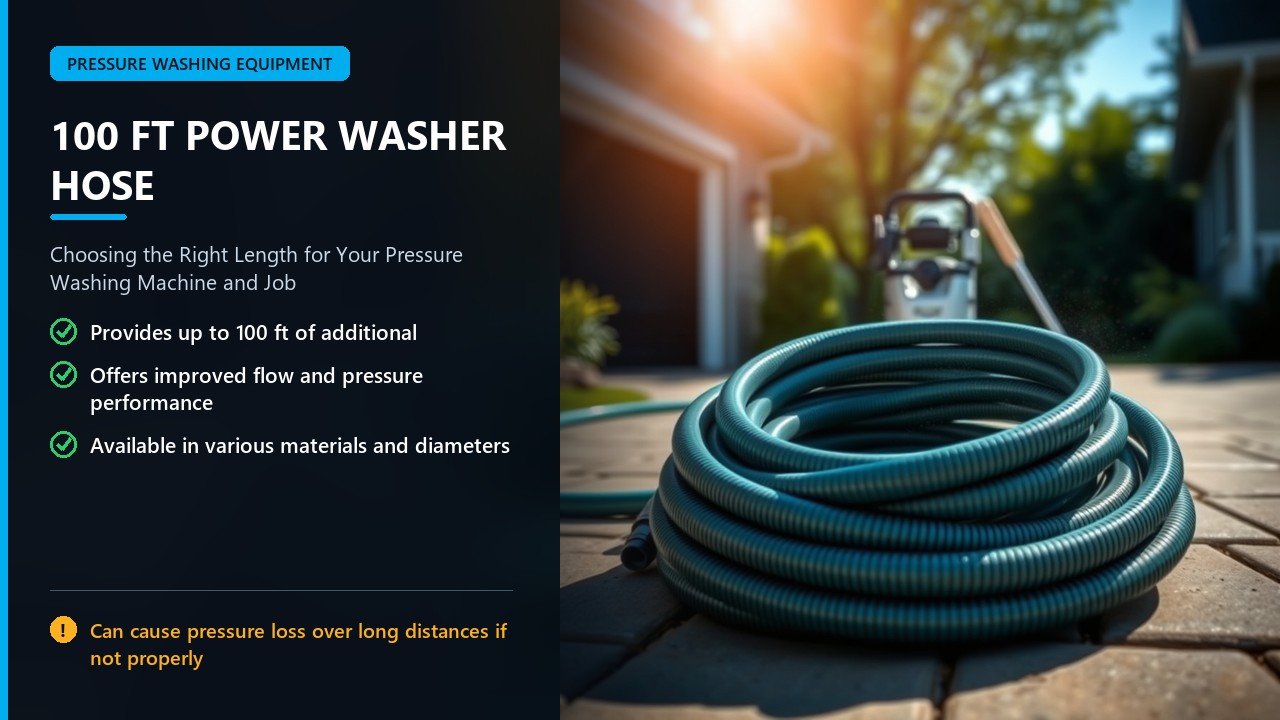
What a 100 ft Hose Changes
A 100 ft power washer hose changes two things: reach and pressure. The reach is the obvious win, since you can leave the machine parked and still cover a large area. The pressure is the tradeoff. Every foot of hose adds friction, and friction costs pressure at the nozzle. A longer hose therefore delivers slightly less working pressure than a short one at the same machine setting, and the effect grows as the hose gets longer and as its diameter gets smaller.
With a proper 3/8 inch hose, the loss over 100 feet is modest and rarely noticeable on a normal job. With a narrow 1/4 inch hose over the same distance, the restriction is far greater and the drop becomes real. The lesson is simple: if you want a hundred feet of reach, buy a 3/8 inch hose rather than stretching a smaller one. Our guide to length, diameter, and lost pressure breaks down the physics.
Why Diameter Matters Most
The diameter of a 100 ft power washer hose is the single biggest factor in how well it performs. A 3/8 inch hose moves a high volume of water with low friction, which is why it is the standard for gas machines and commercial work. A 1/4 inch hose flows less and adds more resistance per foot, so a long run in that size starves the nozzle and dulls the cleaning power.
For a hundred-foot hose, 3/8 inch is the sensible choice for almost everyone. It keeps pressure loss low, handles the flow of any gas pressure washer, and pairs naturally with the 3/8 inch quick connect fittings used on commercial equipment. Only a very small electric machine with a dedicated 1/4 inch system would warrant a smaller hose at this length, and even then the loss is worth weighing. Our overview of the 3/8 inch hose as the high-flow standard explains why it dominates.
Materials and Construction
A pressure washer hose is built around a rubber or thermoplastic tube wrapped in a reinforcing braid and covered with an outer jacket. The braid, usually one or two layers of high-tensile steel wire, gives the hose its strength and burst rating. The outer cover decides how it handles abrasion, weather, and whether it leaves marks on the surfaces you clean.
Most 100 ft hoses use a single-wire steel braid rated to 4,000 PSI, with a working burst ratio of three to one, meaning the hose can take three times its rated pressure before failing. Some use dual-braided steel over polyester for extra toughness, and the cover may be rubber for durability or polyurethane for flexibility and abrasion resistance. The tube itself is a water-resistant synthetic rubber or thermoplastic that stays flexible across a wide temperature range. Our guide to choosing and caring for hoses covers these materials in detail.
Non-Marking vs Standard Covers
One of the most practical choices on a long hose is whether the cover is non-marking. A standard black rubber hose can leave scuff marks on concrete, driveways, and painted surfaces, which is a real problem on a job where appearance matters. A non-marking hose uses a gray or light-colored cover formulated not to transfer pigment, so it drags across a clean surface without leaving streaks.
For commercial work, driveways, and any job where the customer will inspect the result, a non-marking 100 ft hose is worth the small premium. Homeowners cleaning their own property may not care, but once you have scrubbed a driveway clean only to leave hose marks across it, the value becomes obvious. Our article on non-marking hoses explores the difference.
Temperature Ratings
Hose temperature rating matters more than many buyers realize. A cold-water hose may be rated only to 140 degrees Fahrenheit, which is plenty for a cold-water machine but inadequate for a hot water washer that sends heated water through the line. A hot-water hose is typically rated to 250 degrees Fahrenheit, letting it handle the output of a heated machine without degrading the tube.
If you own or plan to own a hot water pressure washer, buy a hose rated for the heat, because running hot water through a cold-water hose shortens its life dramatically and risks a burst. Even on a cold machine, a higher temperature rating gives margin and often signals a more robust hose. Match the rating to your machine, and remember that steam requires a hose rated for steam, which is a different specification altogether. Our guide to high-pressure hoses that last covers ratings.
Key rule: Match the hose’s temperature rating to your machine. A cold-water hose rated to 140 degrees Fahrenheit will fail quickly on a hot water washer, while a 250-degree hose handles heated water safely. Never use a standard hose with steam.
Fittings: Quick Connect and NPT
A 100 ft power washer hose usually arrives with 3/8 inch fittings, either quick connect or threaded NPT, or both. The common configuration is a 3/8 inch male quick connect plug on one end and a 3/8 inch female quick connect socket on the other, letting the hose click between the machine and the gun. Some hoses instead use 3/8 inch male NPT threads with quick connect couplers screwed on, giving you the option to remove the couplers and thread the hose directly.
Understand what your machine and gun use before buying, because a mismatch means buying adapters on day one. Most gas pressure washers use 3/8 inch quick connect at the hose, while some smaller electric machines use M22 threaded connections. If your ends do not match, an adapter bridges the gap. Our guide to matching hose connector ends helps you get it right.
Bend Restrictors and Swivels
Look for a 100 ft hose with bend restrictors at both ends. These simple sleeves prevent the hose from kinking sharply where it meets the fitting, which is where hoses most often fail. A kink at the connector concentrates stress and can crack the tube or pull the fitting loose. Bend restrictors spread that stress over a longer section and add years to the hose’s life.
A swivel fitting at one end is another valuable feature on a long hose, because it lets the hose rotate freely rather than twisting as you work. Without a swivel, a hundred feet of hose stores the twist from every turn and eventually coils, tangles, and kinks. A swivel at the gun or machine end keeps the hose lying flat and easy to manage. Our guide to couplings that kill the twist explains the mechanism.
Representative 100 ft Hoses
Several 100 ft hoses show the range of what is available. The NorthStar non-marking hose, for example, is a 100 ft by 3/8 inch single-wire braid rated to 4,000 PSI, with a gray wrapped non-marking cover, bend restrictors, and 3/8 inch male NPT fittings coupled to straight-through industrial quick connects, rated to 250 degrees Fahrenheit. Pressure-Pro offers a commercial-grade 100 ft by 3/8 inch hose rated to 4,200 PSI with a single-wire steel braid and armor-flex gray rubber cover, swivel end, and brass quick connects, sold through retailers such as Grainger.
At the toughness end, the SIMPSON Monster 100 ft hose is rated to 4,500 PSI using dual-braided steel over polyester with a polyurethane jacket that is described as up to three times more abrasion resistant than rubber, though it is a cold-water hose rated to 140 degrees. For heavy commercial use, the commercial-grade 100 ft hose from TTS Products rates to 4,500 PSI with a non-marking armor-flex cover, while the Titan Fittings PW4000 100 ft hose uses a weather and ozone resistant cover rated from minus 40 to 212 degrees Fahrenheit.
| Hose | Rating | Notable Feature |
|---|---|---|
| NorthStar 3/8 in x 100 ft | 4,000 PSI, 250 deg F | Non-marking cover, 3:1 burst ratio |
| Pressure-Pro CHA1001GB | 4,200 PSI, 250 deg F | Armor-flex gray, swivel end |
| SIMPSON Monster 41030 | 4,500 PSI, 140 deg F | Dual braid, polyurethane jacket |
| Titan PW4000-06-100 | 4,000 PSI, -40 to 212 deg F | Weather and ozone resistant cover |
If you want to compare a full range of replacement and extension hoses, browsing SIMPSON accessories or the VEVOR hose range shows how prices and specifications vary. The pattern is consistent: a quality 100 ft, 3/8 inch, 4,000 PSI hose with a non-marking cover and good fittings costs more than a short hose, but replaces several shorter ones and eliminates constant repositioning. Our 50 ft hose guide helps if a hundred feet is more than you need.
100 ft vs Connecting Two Shorter Hoses
One common alternative to a single 100 ft hose is joining two 50 ft hoses with a coupler. This works and can be convenient, but each coupling adds a leak point, a snag point, and a small amount of restriction, and the joint is where hoses snag on corners. A single 100 ft hose has no mid-line connection to leak or catch, which is why many owners prefer one long hose for a permanent setup.
That said, two 50 ft hoses give flexibility: use one for small jobs and both for large ones. If you already own a 50 ft hose, adding a second and a coupler is cheaper than buying a new hundred-foot hose. The tradeoff is the extra joint. If reliability and smooth handling are the priority, a single 100 ft hose wins; if versatility on a budget matters more, the two-hose approach is fine. Our guide to hose kits covers both approaches.
Managing a 100 ft Hose
A hundred feet of hose is a lot to handle, and how you manage it determines whether it is a help or a headache. The best solution is a hose reel sized for the length, which coils the hose neatly and lets you pull out only what you need. A reel also prevents the tangles and kinks that shorten hose life and frustrate you mid-job. Our guide to hose reel types and mounting helps you pick one.
If you coil by hand, use the over-under method rather than wrapping around your arm, which puts twist into the hose and creates kinks. Store the hose out of direct sun and away from sharp edges, and drain it before storage to prevent freezing damage. A well-managed 100 ft hose lasts for years, while a neglected one fails at the worst moment. Our article on how far a long hose reaches is useful for longer setups.
Do You Need 100 Feet?
A 100 ft power washer hose is the right choice when your machine stays put and your cleaning area is large. Driveways, long fences, side-by-side vehicles, and multi-bay shops all benefit from the extra reach. If you are always moving the machine anyway, or your property is small, a 50 ft hose may be lighter and easier to handle without giving up real capability.
The honest test is simple: if you regularly run out of hose before you run out of job, buy the hundred. If you rarely need more than the standard length, a shorter hose is easier to live with. Reach is only worth paying for when you actually use it, so match the length to the work. Our pressure loss guide helps you weigh the reach against the small pressure cost.
Choosing the Right Length for Your Machine
The right length depends on your machine and your work, and 100 feet is a sweet spot for many setups but not all of them. A large gas pressure washer with high flow handles the friction of a long hose easily, so a hundred feet barely affects it, while a small electric unit with modest output notices the loss more. Match the hose to the machine’s capability rather than stretching a weak pump over a long run.
Think about the shape of your typical job. If you clean long, narrow areas such as a driveway or a fence line, length is valuable because the machine can stay at one end. If you work in tight, compact spaces, a long hose is mostly excess weight and coil to manage. The goal is a hose long enough to let the machine stay put through a normal job, and no longer, since extra length only adds drag, weight, and pressure loss. Our guide to the 50 ft residential sweet spot helps you judge whether you truly need the extra fifty feet.
Grounding, Dragging, and Surface Damage
A long hose spends most of its life dragging across the ground, and that has consequences. Sharp edges, broken glass, gravel, and hot surfaces all attack the outer cover, and abrasion is one of the leading causes of hose failure. A tough cover and a non-marking formulation help, but the real protection is route management: keep the hose out of traffic lanes when vehicles are present, and lift it over sharp corners rather than pulling it around them.
Dragging also affects the surfaces you are cleaning. A heavy rubber hose can scuff fresh concrete, tear up landscaping, and knock over plants. Routing the hose along a wall, through a doorway, or over the grass instead of across a freshly washed driveway keeps both the hose and the customer happy. On a hundred-foot run you have more opportunities to route smartly, so use them. Our article on choosing, using, and replacing hoses covers practical handling.
Winterizing and Freeze Protection
Water trapped in a hose freezes and expands, and a hundred feet of hose holds a surprising amount of it. In freezing weather, a hose left full can split its tube or crack its fittings, ruining it. The fix is discipline: after use in cold conditions, disconnect the hose, drain it fully, and coil it somewhere above freezing. Elevating one end and letting gravity do the work, or a short burst of air, clears the water quickly.
A hose left attached to an outdoor machine is doubly at risk, because the pump and hose are both vulnerable. Disconnect both, drain them, and store the hose indoors when frost threatens. This simple habit saves a hose that would otherwise fail the next time it is used. Our guide to hose care and the pump freeze-protection guide cover the full winter routine.
Extending Reach Even Further
If a hundred feet is still not enough, you have options short of buying an even longer hose. Upgrading to a larger bore, such as a 1/2 inch hose, reduces friction over a long run and suits high-flow commercial machines, though it is heavier and stiffer to handle. Telescoping wands and extension lances add reach at the working end without stretching the hose, and they let you clean second stories and high walls from the ground.
Some professional setups combine a long hose with a buffer tank and a mobile skid, letting the whole rig move with the operator rather than relying on hose length alone. The right answer depends on whether you are trying to reach, to move, or both. Our guides to 1/2 inch hoses and 150 ft reach explore the options.
Common Mistakes With Long Hoses
Most disappointments with a 100 ft power washer hose come from a handful of avoidable errors. Using too small a diameter is the biggest, since a 1/4 inch hose over a hundred feet starves the nozzle and makes the machine feel weak. Mismatching fittings wastes the first day with trips to buy adapters. Ignoring the temperature rating ruins a cold-water hose on a hot machine.
Other mistakes include buying a hose with no bend restrictors or swivel, which shortens its life and tangles constantly, and storing it wet or in freezing conditions, which invites mold and cracks. Finally, trying to manage a hundred feet by hand without a reel leads to kinks and frustration that make the length feel like a burden instead of a benefit. Avoid these and the hose simply works. Our guide to four mistakes that kill your hose is a useful checklist.
The Bottom of the Run: Couplers and Adapters
Every connection on a long hose is a potential leak, and a hundred feet can include several. If you join hoses, use quality brass couplers with fresh O-rings rather than plastic or worn fittings, which fail quickly under pressure. Inspect the O-rings at the machine, gun, and any coupler periodically, because a degraded ring is the most common source of a drip.
If your machine uses M22 threaded connections while the hose uses 3/8 inch quick connect, or vice versa, buy the correct adapter once and keep it with the hose. Cheap adapters rated below your working pressure are a false economy on the high-pressure side. Keep a spare O-ring set and an extra coupler in your kit, and a small leak does not end the job. Our guides to leak-free fittings and the adapter guide cover the details.
Cleaning and Storing a 100 ft Hose
A long hose deserves a little care to stay reliable. After use, wipe or rinse the cover to remove grit that would otherwise grind into the braid as it coils. Check the ends for damaged fittings and frayed cover, and replace anything that looks compromised before it fails under pressure. Store the hose coiled loosely, out of direct sun and away from sharp objects, because UV and abrasion are the two great enemies of any pressure hose.
Coil using the over-under method so the hose lies flat without stored twist, or better, wind it onto a reel sized for the length. Never hang a hundred-foot hose from a single point, which puts a permanent kink at the bend. Stored well, a good 100 ft hose lasts for many seasons, and the small effort of care is repaid in reliability. Our non-marking hose guide is a useful companion.
Frequently Asked Questions
Does a longer hose reduce pressure washer pressure?
Yes, slightly, because friction increases with length. With a 3/8 inch hose the loss over 100 feet is small and rarely noticeable. A smaller 1/4 inch hose over the same distance loses far more, so use 3/8 inch for long runs.
What size hose should a 100 ft power washer hose be?
3/8 inch is the standard for a hundred-foot hose. It keeps pressure loss low, handles the flow of gas machines, and matches the 3/8 inch quick connect fittings common on commercial equipment. Reserve smaller sizes for short, low-flow setups.
Can I use two 50 ft hoses instead of one 100 ft hose?
Yes. Joining two 50 ft hoses with a coupler works and offers flexibility, but adds a leak and snag point and a little restriction. A single 100 ft hose is smoother and more reliable for a permanent setup.
What pressure rating does a 100 ft hose need?
At least the working pressure of your machine, with margin. Most quality 100 ft hoses rate 4,000 to 4,500 PSI, which suits gas washers. A three-to-one burst ratio gives additional safety headroom.
Is a non-marking hose worth it?
For commercial work and clean driveways, yes. A non-marking cover will not leave scuff marks on concrete or paint. For basic home use it is optional, though many owners appreciate never having to scrub hose marks off a finished surface.
Can I run hot water through a 100 ft hose?
Only if the hose is rated for it. A cold-water hose rated to about 140 degrees Fahrenheit will fail quickly on a hot water machine. Choose a hose rated to 250 degrees Fahrenheit for heated water, and never use a standard hose with steam.
The Bottom Line
A 100 ft power washer hose buys real reach, letting your machine stay put while you clean far across a driveway, fence, or fleet. The cost is a little pressure, which a proper 3/8 inch hose keeps small, and a little more to manage, which a reel solves. Choose 3/8 inch diameter, a 4,000 PSI or better rating, a temperature rating that matches your machine, non-marking cover if appearance matters, and good fittings with bend restrictors and a swivel. Buy the right hundred-footer and the machine stops chasing the job. Buy a cheap narrow one and you trade reach for weak pressure. Match the hose to your machine and your work, and the extra length becomes pure advantage.