A shop owner in Ohio had a problem that will sound familiar to anyone who has bought an electric pressure washer from a big box store. Every machine he tried was quiet, light, and convenient, right up until it met a real job. He would get to a grease-stained concrete apron or a caked-up dumpster pad, squeeze the trigger, and feel the same letdown. The stream was fine for washing cars, but it had no punch for the work that actually paid. He owned four dead or disappointing electric units before a colleague told him the thing nobody tells first-time buyers. You are shopping in the wrong voltage.
That conversation is why the 220v power washer exists. A 220-volt, often written 240-volt, electric machine is a different animal from the 120-volt units most people own. It draws double the electrical potential, uses a stronger motor, and delivers cleaning power that approaches, and in some cases matches, a gas machine, all without the noise, fumes, and maintenance of an engine. This guide covers what a 220v power washer really is, who should own one, how the electrical requirements work, what to verify before buying, and the safety rules that matter more than any spec.
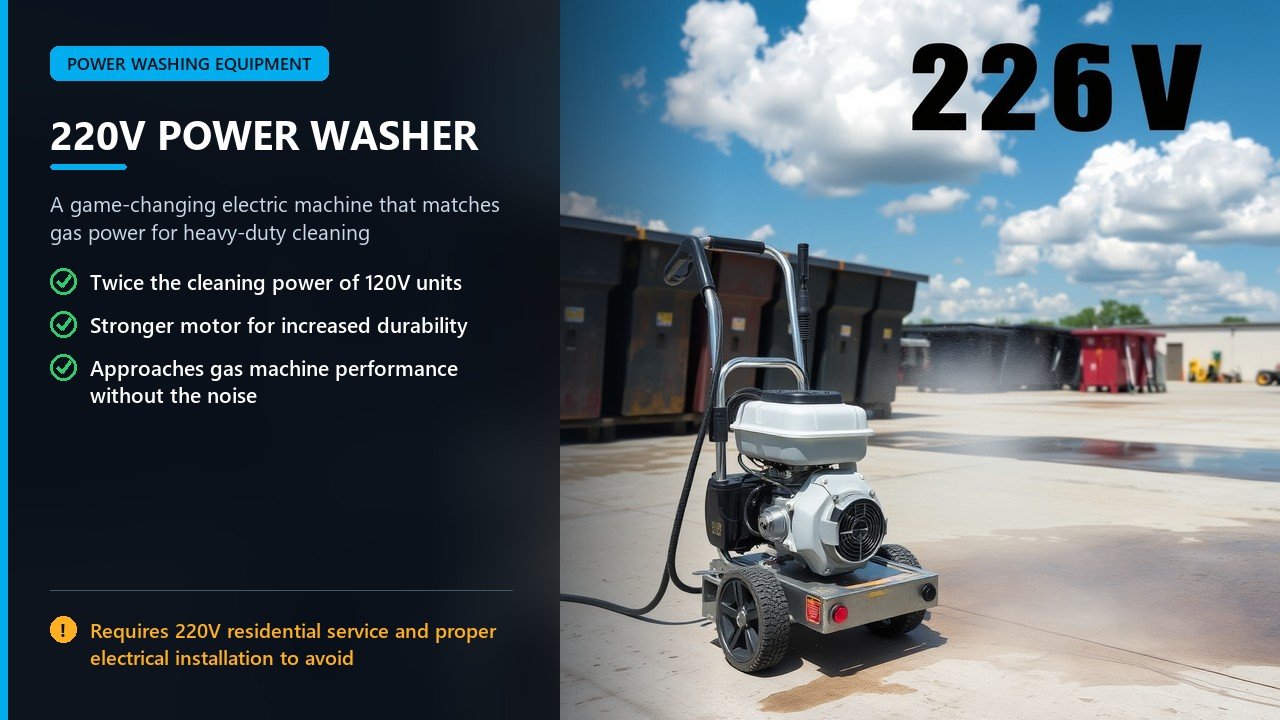
What Makes a 220V Power Washer Different
Electric pressure washers sold to homeowners run on standard 120-volt household current. That circuit gives you roughly 15 to 20 amps, and there is only so much work you can do with that amount of power. Manufacturers of 120-volt machines often quote impressive peak PSI numbers, but under a sustained load they cannot keep up with a gas engine of similar size. The circuit simply will not deliver the watts.
A 220v power washer uses a 240-volt circuit, which for the same current roughly doubles the available power. That extra power lets the machine drive a larger motor and pump, so it holds pressure under load instead of sagging. The result is a machine that can push 2,500 to 3,000 PSI at 2.5 to 3 GPM or more, numbers that put it squarely in gas territory for many tasks. The trade-off is that a 240-volt machine is not a grab-and-go tool. It needs the right outlet, the right circuit, and in many cases a professional installation.
Why the voltage matters more than the brand
Two pressure washers can carry identical price tags and identical PSI claims, and the 240-volt one will still outwork the 120-volt one every time on tough jobs, because power in equals work out. When a pump has to maintain pressure against real resistance, the machine with more electrical headroom does not bog down. That is the entire reason serious detail shops, breweries, food plants, and building maintenance crews often choose 240-volt over 120-volt, and it is why Consumer Reports notes that 240-volt electrics, though rare, produce power on a par with gas models.
120V vs 220V vs Gas: An Honest Comparison
Before you commit to any voltage, it helps to see the three options side by side.
| Attribute | 120V Electric | 220V / 240V Electric | Gas |
|---|---|---|---|
| Typical output | 1,300 to 2,300 PSI, 1.2 to 2 GPM | 2,500 to 3,000+ PSI, 2.5 to 4 GPM | 3,000 to 4,500+ PSI, 2.5 to 4+ GPM |
| Power source | Standard household outlet | Dedicated 240V circuit or outlet | Gasoline engine |
| Noise | Quiet | Quiet | Loud, needs hearing protection |
| Maintenance | Minimal | Minimal to moderate | Oil, fuel, spark plugs, air filter |
| Fumes | None | None | Yes, never run indoors |
| Portability | High | Lower; tied to an outlet or hardwired | High, runs anywhere |
| Best for | Cars, small patios, light jobs | Shop use, food plants, detail work, indoor industrial | Mobile outdoor heavy cleaning |
The pattern is clear. If you need to move around a large property and there is no power nearby, gas still wins on portability. If you work in a fixed location or an indoor facility where fumes are unacceptable, a 220v power washer is often the best tool available. And if you only clean a car and a small walkway, a 120-volt machine is cheaper and simpler, and you should not overbuy.
Who Actually Needs a 220V Power Washer
A 240-volt electric machine earns its keep in specific situations. See if you recognize yourself in any of these.
Fixed commercial locations. A wash bay, a shop floor, a car dealership service area, or a food processing plant may have a wall mount or stationary machine that runs every day. A hardwired 240-volt unit becomes a utility, like a spigot, and there is no engine to service or fuel to store.
Indoor work where fumes are a problem. Gasoline engines produce carbon monoxide and must never run indoors. A 240-volt electric is the safe answer for enclosed spaces, and its quiet operation is a bonus in shared buildings.
Users who want gas-level power without gas maintenance. If you are tired of oil changes, stale fuel, and pull cords, but you still need real cleaning power, a 240-volt electric is the middle path.
Detail shops and anyone running many hours. Induction and brushless motors, common on better 240-volt machines, are built to run longer than the low-cost universal motors in budget electrics. Buyers who run a machine daily often find the 240-volt class more durable and repairable.
If none of those fit, and you mostly clean your own driveway a few times a year, a 220v power washer is more machine and more electrical work than you need. A quality 120-volt electric will serve you fine.
The Electrical Requirements Nobody Warns You About
This is the part that turns a simple purchase into a project, and it is where most people underestimate the cost. A 240-volt pressure washer is not plug-and-play in the way a 120-volt model is.
Voltage, phase, and amperage
Commercial electric pressure washers come in several configurations. Some are 120-volt, some are 230 or 240-volt single phase, and higher-output or all-electric hot water systems may use 208 or 460-volt three-phase power. A machine’s power needs are defined by voltage, phase, and amperage together, and a higher-output machine may require a dedicated circuit, a larger breaker, a specific receptacle, or a hardwired connection. Buying by PSI alone and ignoring the electrical spec is a classic and costly mistake.
For example, a compact 240-volt machine might draw around 18 amps at 4 horsepower, while a bigger 8-horsepower unit can draw roughly 30 amps at 240 volts. Those are not numbers you feed from a shared household circuit.
| Configuration | Typical Use | What It Usually Requires |
|---|---|---|
| 120V, 15 to 20 amp | Homeowner light duty | Standard grounded outlet |
| 240V single phase, 15 to 30 amp | Shop, garage, light commercial | Dedicated 240V circuit, correct breaker and outlet, often GFCI |
| 208V or 230V three phase | Industrial and stationary hot water | Three-phase service, hardwired, often a qualified electrician |
| 460V three phase | Large industrial facilities | Industrial service, hardwired installation |
The GFCI rule is not optional
Water and electricity are a dangerous pair, which is why the safety standards around these machines are strict. Portable pressure washers rated 250 volts or less, single phase, are generally required by the National Electrical Code and the UL 1776 standard to have a Class A ground fault circuit interrupter, or GFCI, built into the power cord plug or within the cord. For machines rated more than 250 volts or using three-phase power that do not have an integral GFCI, the code requires the machine to be connected to a receptacle protected by a Class A GFCI, either at the receptacle or in the branch circuit.
This is not a suggestion. The U.S. Consumer Product Safety Commission has issued recalls and public warnings for electric pressure washers that lacked an integrated GFCI, citing serious shock and electrocution hazards. You can read the Commission’s safety information on its official site at CPSC.gov. If you are buying any electric pressure washer, confirm the GFCI protection is present and intact.
Do not use an extension cord
Every serious manual says the same thing, and it is worth repeating. Do not use an extension cord with an electric pressure washer. An extension cord defeats the effectiveness of the GFCI and increases shock risk, and it also causes voltage drop that makes the motor overheat and lose power. The machines are supplied with a long cord, typically around 35 feet, precisely to discourage extension cords. If your outlet is too far away, the answer is a better outlet, not a longer cord.
You can review general electrical safety guidance from the U.S. Department of Labor at OSHA’s electrical safety resources.
Pumps and Motors: What Separates Good From Great
Two internal components decide whether a 240-volt machine is a workhorse or a headache, and both are worth understanding before you spend money.
The motor type
Cheap electrics use universal motors, which are light and inexpensive but not built for long, hard use. Better machines use induction or brushless motors, which run cooler, quieter, and far longer, and are generally more repairable. If you plan to run the machine regularly, the induction motor is worth the premium. It is the difference between a disposable appliance and a tool.
The pump type
Residential electrics typically use axial cam pumps, which are inexpensive and fine for occasional use. Commercial 240-volt machines usually use triplex plunger pumps, which are designed to run long hours and can be rebuilt rather than replaced. A triplex pump on a 240-volt motor is the combination that gives these machines their staying power. When you are comparing specs, a triplex pump is a strong signal that the machine was built for real work.
Whatever the pump, its oil matters. Running the wrong oil or letting the level drop can kill a good pump quickly, which is why our guide to the type of oil that goes in a pressure washer pump is essential reading for any owner.
How to Choose a 220V Power Washer
Use this checklist so you buy the right machine the first time.
Confirm your electrical supply. Know whether you have 240-volt single phase or three-phase, the amperage available, and whether you can install a dedicated circuit. The machine’s spec plate is the authority, not the marketing copy.
Match voltage and phase to the machine. Never buy a three-phase machine for a single-phase building. Never assume a 240-volt outlet is wired for the amperage a big unit needs.
Verify GFCI protection. Confirm the machine or the circuit provides Class A GFCI protection for personnel. This is a safety requirement, not a feature.
Check GPM, not just PSI. Pressure breaks the bond of dirt, but flow carries it away and speeds up the work. A higher GPM at a reasonable PSI often cleans faster and works better with accessories like surface cleaners and foam cannons.
Look for an induction or brushless motor. For any regular use, choose a machine built to run long hours.
Look for a triplex pump. It signals commercial durability and rebuildability.
Decide portable vs stationary. A portable 240-volt unit can move between locations if you have outlets, while a wall mount or stationary machine suits a fixed wash bay and simplifies workflow. Our article on the skid mounted pressure washer with tank shows how a fixed machine can be fed anywhere with a tank, which is the practical way to run a stationary unit without plumbing.
Plan your water supply. A 240-volt machine often flows 2.5 GPM or more. Confirm your supply can keep up, and if not, add a tank. Our guide to tank feeding for a pressure washer covers how to avoid starving the pump.
Confirm parts and service. Before buying, check that the pump, seals, and motor are serviceable and that parts exist. A repairable machine outlasts three disposable ones.
Hot Water, Cold Water, and the Electric Confusion
One more point trips up almost everyone. An “all-electric hot water” pressure washer is not simply a 240-volt cold water machine with a heater bolted on. Heating water takes a huge amount of energy, so many machines called electric hot water still use a fuel-fired burner for heat even though the pump is electric. A true all-electric heated machine draws a large amount of current and usually requires heavy service, often three-phase. If you need hot water, understand exactly how the machine produces heat before you buy, because the electrical demand is very different.
If heat matters for your work, our guide to hot box pressure washer heater units explains how heater systems work and how to run them safely.
Common Mistakes With 220V Power Washers
Buying before checking the circuit. The number one mistake. A great machine you cannot power is useless. Confirm voltage, phase, and amperage first.
Assuming a standard outlet will do. A 240-volt machine needs a 240-volt outlet, usually on a dedicated circuit. Adapters and extension cords are not a workaround.
Using an extension cord. It defeats the GFCI and causes voltage drop and overheating. Never do it.
Ignoring GFCI protection. Skipping or bypassing it is a genuine electrocution risk. Treat it as non-negotiable.
Choosing by PSI alone. Flow, motor type, and pump type matter just as much, and often more for productivity.
Forgetting water supply. A high-flow electric needs a supply or a tank that can keep up, or the pump runs dry and gets destroyed.
Skipping winterization. Electric machines freeze too. Water left in the pump and hose can crack components. Our walkthrough on how to store a pressure washer for winter covers the routine for every type of machine.
Safety Rules That Apply to Every Electric Pressure Washer
High-voltage electricity and water demand respect. Follow these habits without exception.
Always plug into a properly grounded outlet and confirm the GFCI works before you start, using the test and reset buttons. Inspect the cord for damage before each use, and never use it if the insulation is cracked or cut. Keep the machine, cord, and plug away from standing water, and never spray water at the machine, the outlet, or the cord. Point the gun in a safe direction before you start, and use the trigger safety lock whenever you pause. Never aim the wand at a person, an animal, or yourself, because high-pressure water can cause serious injection injuries. Wear eye protection, and never run a gasoline machine indoors, though a 240-volt machine is safe to run inside because it produces no exhaust.
What a 220V Power Washer Costs
The price of the machine itself varies widely, and so does the cost of the electrical work that supports it. Budget-friendly commercial 240-volt cold water machines can start in the 600 to 1,300 dollar range, while better-built units with triplex pumps, induction motors, and higher flow run from roughly 1,500 to 3,000 dollars. Wall-mount and stationary machines, and any heated all-electric unit, climb higher still, sometimes into the multi-thousand-dollar range. For context, a compact 240-volt machine rated around 2,800 PSI at just under 3 GPM typically lands in the low four figures, which is a fair snapshot of the entry point.
Then add the electrical side. A dedicated 240-volt circuit with the correct breaker, a proper outlet, and GFCI protection might add a few hundred dollars if the panel has room, and considerably more if it does not. A hardwired three-phase installation costs more again. This is why the true comparison is never “machine A versus machine B” but “total installed cost versus the work it replaces.”
The value case is strongest for anyone who bills for time. If a 240-volt machine lets you finish commercial jobs faster and take on work a 120-volt unit cannot handle, it pays for itself in productivity. For a homeowner who cleans a car and a patio a few times a year, the same machine is pure overkill, and a good 120-volt unit plus a walk-behind surface cleaner is the smarter spend.
Buying used and buying new
Because 240-volt electrics are built to be serviced, the used market can be attractive, but only if you can verify the machine’s history. Check the motor, confirm the pump turns freely, look for leaks around seals, and, critically, confirm the electrical spec matches your building. A used three-phase machine you cannot power is worthless to you no matter how cheap it is. If you buy used, budget for seals, an oil change, and possibly a pump rebuild, and confirm parts availability before money changes hands.
Frequently Asked Questions
Is a 220v power washer better than a gas pressure washer?
For fixed or indoor locations, often yes. A 240-volt electric delivers gas-like power without noise, fumes, or engine maintenance, and it can run indoors safely. Gas still wins when you need to work far from power or move across large properties.
Can I plug a 220v power washer into a regular outlet?
No. A 240-volt machine needs a 240-volt outlet, usually on a dedicated circuit, with the correct breaker and often a GFCI. Some large or three-phase machines must be hardwired by a qualified electrician.
Do I need an electrician to install one?
In many cases, yes. If you do not already have a suitable 240-volt circuit with the correct amperage and GFCI protection, a licensed electrician should install it. A permanent or three-phase machine is almost always a professional install.
Why can I not use an extension cord?
An extension cord defeats the GFCI’s protection, increasing shock risk, and it causes voltage drop that overheats the motor and reduces performance. Use the machine’s own long cord and a properly located outlet instead.
Are 220v and 240v the same thing?
In North American homes they refer to the same class of circuit. What people call 220 volts is the standard residential 240-volt service. The important thing is to match the machine’s rated voltage, phase, and amperage to your supply.
What is the difference between 120V and 220V electric pressure washers?
A 120-volt machine runs on a standard outlet and has limited sustained power, good for light work. A 220-volt machine draws more power, drives bigger motors and pumps, and holds pressure under load, which suits commercial and heavy-duty cleaning.
Can a 220v power washer run hot water?
Only if it is a heated model. Many machines with electric pumps still heat water with a fuel burner, while true all-electric heated units draw heavy current and often need three-phase service. Confirm how a specific machine makes heat before buying.
Can I convert a 120V pressure washer to 220V?
No, not practically. The motor, pump, wiring, and controls are all matched to the voltage they were designed for, and swapping components safely is beyond what a typical user should attempt. If you need 240-volt power, buy a machine rated for it rather than modifying a 120-volt unit. Electrical modifications to pressure washers can create serious shock and fire hazards.
Final Thoughts
The 220v power washer solves a problem that frustrates a lot of people who buy electric and end up disappointed. It is the point where electric finally has enough power to do heavy work, without the noise and upkeep of an engine. But it is also a machine that asks something of you in return. You have to confirm your electrical supply, respect the GFCI rules, avoid extension cords, and match the machine to your real workload.
Get those things right, and a 240-volt electric becomes one of the most dependable tools in a shop: quiet, clean, powerful, and, with a triplex pump and an induction motor, repairable for years. Get them wrong, and you own an expensive machine that keeps tripping a breaker. Do the electrical homework first, choose GPM and build quality over flashy PSI claims, and your 220v power washer will deliver gas-level cleaning power on nothing but a plug. When you are ready to match the machine to a water source that can keep up, our guide to a water tank for pressure washer rigs is the natural next step.