240 Volt Pressure Washer: Outlets, Amps, and Wiring Explained
A 240 volt pressure washer is not just a more powerful plug-in machine; it is a different electrical animal from the 120 volt washers most homeowners own. Voltage decides how much power a circuit can deliver, and doubling it lets a motor pull more watts through the same wiring. That is why the strongest electric pressure washers run on 240 volts, and why buying one raises questions about outlets, breakers, and wiring. This guide explains what 240 volts means for a pressure washer, what it can run, and what you need in place before you plug one in.
The short version: A 240 volt pressure washer draws its power from a 240V circuit, which delivers roughly twice the watts of a 120V circuit at the same current. In North America that means a special circuit such as a dryer or range outlet; in Europe, the UK, and Australia, 230 to 240 volts is ordinary household voltage and every plug-in washer uses it.
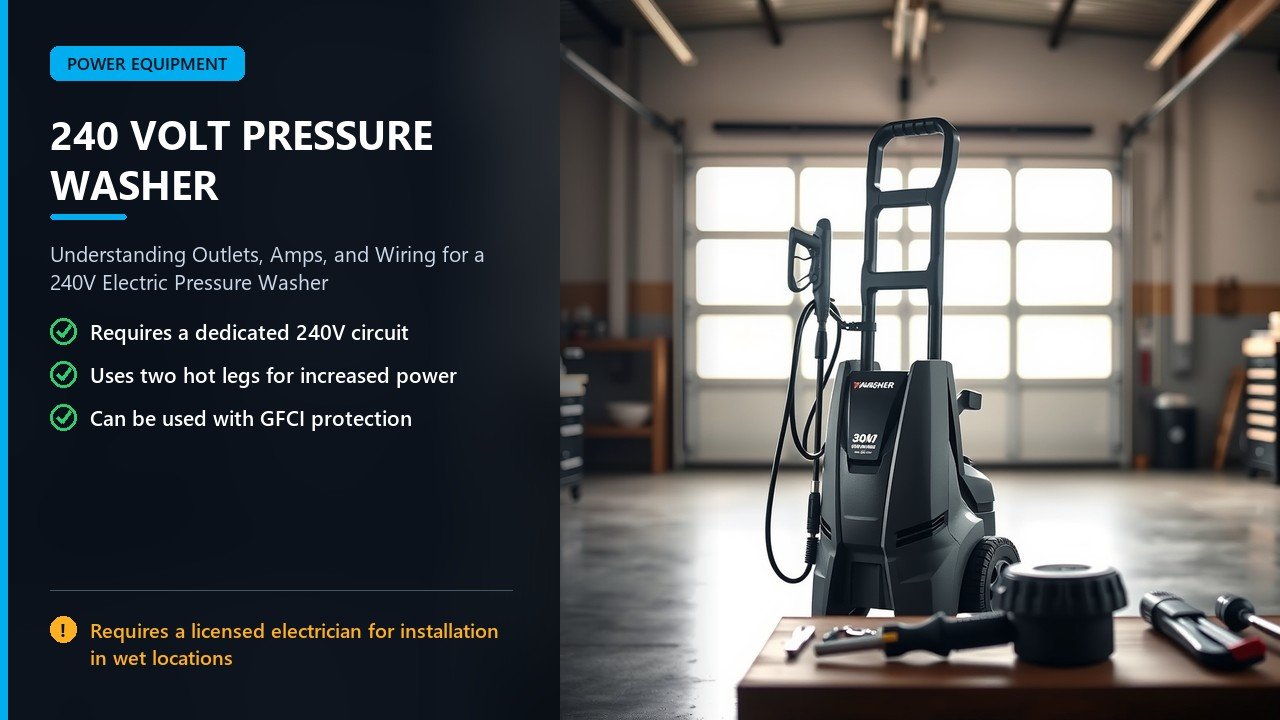
What 240 Volts Actually Means
Voltage is electrical pressure. A 120 volt circuit in North America supplies one hot leg of power and a neutral, giving a 120V potential difference. A 240 volt circuit uses two hot legs, each 120 volts but opposite in phase, so the difference between them is 240 volts. The appliance connects across both hot legs rather than from hot to neutral, and that is what doubles the available power.
This is why a home already has 240V available: an electric dryer, range, water heater, or central air conditioner runs on it. The pressure washer simply joins that list of 240V loads. The important consequence is that a 240V washer needs a 240V circuit, not a standard wall outlet, which changes both the installation and the cost. It also explains why 240V washers are less common in homes: the circuit is the barrier, not the machine.
Why Voltage Sets the Power Ceiling
Electrical power in watts equals volts times amps. A standard 120V household circuit is limited to 15 or 20 amps, so the most it can deliver is about 1,800 to 2,400 watts, and continuous loads should stay at 80 percent of that. That ceiling is why most 120V electric pressure washers top out near 2,000 to 2,300 PSI and draw around 13 to 14.5 amps. They are running near the limit of what the circuit allows.
Double the voltage and the same current delivers double the watts. A 240V, 15-amp circuit carries about 3,600 watts; a 240V, 30-amp circuit carries about 7,200 watts. That headroom is what lets a 240V machine run a larger motor, produce higher pressure and flow, and operate continuously without tripping a breaker. Voltage is not a spec to brag about; it is the gate that decides how much power the machine can ever use.
240V Is Normal Abroad, Special in North America
The phrase “240 volt pressure washer” means different things in different markets. In Europe, the UK, Australia, and much of the rest of the world, 220 to 240 volts is the ordinary mains voltage, and every plug-in pressure washer runs on it through a normal wall socket. There, a 240V washer is simply a corded electric washer, and no special circuit is required.
In North America, where 120V is standard for general outlets, 240V is the special case. That is why a 240V pressure washer sold in the US or Canada is usually a larger, higher-output machine that needs a dedicated circuit. If you are reading a European spec sheet that lists 230V, understand that it describes a routine electric washer, not a high-power unit in the North American sense. Our overview of the 220V electric pressure washer covers that international standard.
Single-Phase and Three-Phase 240 Volts
Not all 240 volts is the same. Residential 240V is single-phase: two hot legs of 120 volts each. Commercial and industrial power often uses three-phase, where three hot legs are offset in phase, letting a motor run smoother and draw its power more efficiently. Many large electric pressure washers, especially hot-water and high-flow units, are three-phase and rated for 240 to 460 volts.
This distinction matters because a three-phase machine cannot be plugged into a home dryer outlet. A single-phase residential washer might use a 20 or 30 amp 240V circuit, while an industrial three-phase unit can draw over 100 amps per phase. Before buying, confirm the phase and the amperage, not just the voltage, because those three numbers together determine whether the machine can run in your building. For a homeowner, single-phase is almost always the relevant case. Our guide to the 240V single-phase supply goes deeper into residential systems.
Outlets and Circuits a 240V Washer Uses
A 240V single-phase machine needs a matching receptacle and circuit. The common North American types are the NEMA 14-30R, a 30-amp 240V outlet with two hots, a neutral, and a ground, used for modern electric dryers; and the NEMA 14-50R, a 50-amp 240V outlet used for ranges and RVs. There are also neutral-free 240V types such as the 6-30R and 6-50R for welders and some equipment.
| Outlet | Rating | Typical use |
|---|---|---|
| NEMA 5-15R / 5-20R | 120V, 15 or 20A | Standard household outlets |
| NEMA 14-30R | 240V, 30A | Modern electric dryer |
| NEMA 14-50R | 240V, 50A | Range, RV, large equipment |
| NEMA 6-30R / 6-50R | 240V, 30 or 50A | Welders, 240V tools |
The outlet is only half the story; the circuit behind it must be sized for the machine. A dryer circuit with 30-amp breaker and 10-gauge wire, or a range circuit with a 50-amp breaker and 6-gauge wire, sets the ceiling. Our guide to the 240V electric pressure washer covers the commercial machines that use these circuits.
Can You Run a Washer From a Dryer or Range Outlet?
In principle, a 240V single-phase pressure washer can run from an existing 240V outlet if the plug types match and the circuit amperage is sufficient. In practice, most 240V washers come with a specific plug, and a dryer outlet may be a different type. Adapters exist, but they should only be used when the outlet, breaker, wire, and machine all agree on voltage, amperage, and grounding.
Never plug a 240V washer into a circuit that is too small, and never modify a machine’s cord to force a fit. If the machine draws 20 amps and the outlet is a 30-amp dryer circuit, that is fine; if the machine draws 30 amps and you plug it into a 30-amp circuit that also feeds other loads, it will trip. When in doubt, have an electrician assess the circuit rather than improvising with adapters.
Amps, Watts, and Sizing the Circuit
Sizing a 240V circuit starts with the machine’s amperage, printed on its rating plate. A pressure washer drawing, say, 20 amps at 240 volts consumes about 4,800 watts. To run a continuous load safely, the circuit should supply at least 125 percent of that draw, so the breaker and wire must exceed the machine’s needs. This is the same 80 percent rule that governs all continuous loads.
Wire gauge follows the breaker: 30 amps needs 10-gauge copper, 40 amps needs 8-gauge, and 50 amps needs 6-gauge, with distances considered for voltage drop. Undersized wire overheats and is a fire risk. If you are adding a dedicated 240V circuit for a pressure washer, a licensed electrician should size and install it. The extra cost up front is trivial next to the cost of a failed circuit or a fire.
GFCI Protection and Wet Locations
Because pressure washing puts electricity and water in the same place, ground-fault protection is essential. Modern electrical codes require GFCI protection for receptacles in wet and damp locations, including laundry areas and outdoors. A GFCI trips within milliseconds of detecting current leaking to ground, which is exactly the fault that electrifies water or a metal housing.
Many quality electric pressure washers also build GFCI protection into their power cord for an extra layer. That built-in protection is useful but not a substitute for a GFCI-protected circuit. Keep connections dry and off the ground, inspect cords before use, and never handle a plug with wet hands. Water and electricity demand the same caution whether the voltage is 120 or 240; higher voltage makes the stakes higher. Our electric cold water pressure washer guide covers the broader safety and setup picture.
Extension Cords and Voltage Drop
Extension cords are a weak point on any electric pressure washer, and more so on 240V machines. A thin or long cord causes voltage drop, so the motor sees less than its rated voltage, runs hot, loses power, and may overheat or trip. Manufacturers of commercial electric washers typically recommend against extension cords for exactly this reason, and many supply a long GFCI cord so you do not need one.
If a cord is unavoidable, it must be rated for the voltage and at least the full amperage of the machine, with heavy gauge conductors and a length kept as short as possible. For 240V equipment, the correct cord is heavier and more expensive, and the margin for error is smaller. Whenever practical, position the washer near the outlet and extend the water hose instead of the power cord. A longer water hose costs less than an undersized cord and never overheats a motor.
What a 240V Pressure Washer Can Do
The practical payoff of 240 volts is more cleaning power from a plug-in machine. Where a 120V washer delivers 2,000 to 2,300 PSI at around 1.6 to 1.8 GPM, a 240V unit can push to 3,000 PSI and higher, often with more flow and the ability to run longer without tripping a breaker. That moves an electric washer into territory once reserved for gas machines, without the noise, exhaust, or fuel.
Higher pressure and flow mean faster cleaning on driveways, siding, vehicles, and equipment, and better performance on stubborn dirt. For commercial users who have 240V available, it is the way to get gas-like output with electric convenience and indoor-safe operation. The trade-off is that you need the circuit, and the machine costs more than a 120V unit. Our guide to the 3,000 PSI electric pressure washer shows what that class can do.
Electric vs Gas at 240 Volts
Once an electric washer reaches 3,000 PSI and up, the choice against gas becomes real. Gas still wins on ultimate power and mobility, since a gas machine carries its own engine and can reach 4,000 PSI and beyond. Electric wins on quiet, fume-free operation, minimal maintenance, and the ability to run indoors or where noise is a problem. A 240V electric machine narrows the power gap that normally separates the two.
The deciding factor is usually your power supply. If you have a 240V circuit where you clean, an electric machine gives you strong, clean performance with almost no upkeep. If you work far from power or need maximum output, gas remains the answer. Our comparison of commercial pressure washer power frames the trade-offs, and the STIHL commercial range illustrates the gas end of the market.
Wall-Mounted and Commercial 240V Machines
Many 240V electric pressure washers are wall-mounted or stationary units designed for wash bays, workshops, and fleet facilities. A wall-mounted machine frees floor space, keeps the pump off the ground, and is plumbed and wired permanently, which suits a dedicated cleaning bay drawing 240V power. These installations pair a 240V circuit with a fixed water supply and often a hose reel.
For a business, a permanent 240V setup is often more efficient than dragging out a portable machine. The wiring and plumbing are done once, and the unit is always ready. Our guides to the electric wall pressure washer and a commercial wall-mounted washer for wash bays explain how these systems are configured.
Three-Phase Industrial 240V Systems
At the heavy end, electric pressure washers use three-phase 240 to 460 volt power for maximum output. These machines appear in industrial cleaning and hot-water applications where single-phase current cannot supply enough power. A representative commercial all-electric line illustrates the range: a 3.5 GPM, 2,000 PSI unit drawing about 130 amps at 230 volts three-phase, up to a 3.8 GPM, 3,500 PSI machine drawing around 150 amps per phase.
| Class | Flow / Pressure | Power |
|---|---|---|
| Compact 3-phase | 3.5 GPM / 2,000 PSI | 230V 3-phase, approx. 130A |
| High-pressure 3-phase | 3.5 GPM / 3,000 PSI | 230V 3-phase, approx. 140A |
| High-flow 3-phase | 3.8 GPM / 3,500 PSI | 230V 3-phase, approx. 150A |
These are installed systems, not plug-in appliances, and they require industrial power. The takeaway for a residential buyer is that the equipment exists on a spectrum from a standard 120V plug through single-phase 240V to three-phase industrial power, and each step needs a corresponding supply. The commercial all-electric reference shows the amperage those machines demand.
Buying a 240V Pressure Washer
Before buying, confirm four things. First, the voltage and phase your machine needs, and whether your building can supply it. Second, the amperage, so you can match the breaker and wire. Third, the plug and receptacle type, so the machine physically connects. Fourth, the pressure and flow you actually need, since 240V does not guarantee a capable machine if its pump and GPM are weak.
Then check the practical details: cord length, GFCI provision, hose and nozzle quality, and whether the machine is portable or meant for permanent mounting. Match the machine to the circuit you have or are willing to install, and the purchase will go smoothly. If you are unsure about the electrical side, an electrician can confirm the circuit in minutes and save you from an expensive mistake.
Safety Around 240 Volts and Water
Higher voltage means a higher-stakes mistake. Keep all connections dry and off the ground, use GFCI protection, inspect cords for damage before every use, and never operate an electric washer with wet hands or while standing in water. Do not spray electrical outlets, wiring, or the machine itself. If the power cord is damaged, stop and replace it rather than taping it.
The water jet is a separate hazard at these pressures; keep it away from people and never point a nozzle at yourself or another person. Read the machine’s manual and respect its warnings. A 240V pressure washer is a capable tool, and like any capable tool it rewards attention and punishes carelessness. Treat the electricity and the pressurized water with equal respect.
120V vs 240V: A Direct Comparison
Putting the two side by side makes the case for 240 volts concrete. The table below compares typical classes; actual figures vary by model, but the pattern is consistent. The 240V machine wins on power and duty cycle, while the 120V machine wins on convenience and cost.
| Factor | 120V washer | 240V washer |
|---|---|---|
| Circuit | Standard 15 or 20A outlet | Dedicated 240V circuit |
| Typical current | 13 to 14.5A | 15 to 30A+ |
| Pressure range | About 1,500 to 2,300 PSI | About 2,500 to 3,000+ PSI |
| Duty cycle | Shorter runs, thinner margin | Continuous, heavy-duty |
| Best for | Home, cars, patios | Commercial, large jobs |
The comparison shows why the choice is really about supply and workload rather than preference. If your jobs are light and your power is standard, a 120V washer is the sensible pick. If your work is heavy and you have 240V, the larger machine is worth the circuit. Our guide to the 240V electric pressure washer explores the commercial end of that split.
Do You Need a Dedicated Circuit?
A 240V pressure washer normally needs a dedicated circuit, meaning one that serves only that machine. Sharing a circuit with another heavy load, such as a dryer running at the same time, can push total current past the breaker and trip it mid-job. A dedicated circuit eliminates that conflict and is the correct way to install a permanent or semi-permanent washer.
If you are using an existing 240V outlet that also feeds an appliance, be careful. A dryer circuit is dedicated to the dryer, and unplugging the dryer to run a washer works only if the washer’s draw stays within the circuit and you accept the inconvenience. For anything beyond occasional use, a separate dedicated circuit is the right answer. An electrician can add one and size it correctly for the machine.
Hot Water and 240V Electric Washers
Some 240V electric pressure washers deliver hot water as well as high pressure, using electric immersion heaters or burner modules. These machines rely even more on a strong power supply, since heating water adds a large electrical load on top of the pump motor. That is one reason all-electric hot water washers often run on three-phase industrial power rather than a home circuit.
For users who need heat, the electrical requirements climb, and the installation becomes a plumbing and electrical project rather than a simple plug-in. The payoff is powerful degreasing and sanitizing without fuel or exhaust, which suits food facilities, workshops, and indoor cleaning. Our guide to the heated electric pressure washer explains how these machines generate hot water on electricity alone.
Common 240V Setup Mistakes
The most common mistake is assuming any big outlet will do. A 240V washer needs the right voltage, amperage, phase, and plug type, and a mismatched outlet will not work or, worse, will be unsafe. A second mistake is using a long, thin extension cord; on 240V equipment the resulting voltage drop can damage the motor and void a warranty. Use the cord supplied or none at all.
A third mistake is undersizing the wire or breaker when installing a circuit, which invites overheating and nuisance trips. A fourth is skipping GFCI protection in a wet area, which removes the safeguard that protects against lethal ground faults. Each of these errors is avoidable with a little planning or a call to an electrician. Get the electrical work right once, and the washer simply runs.
Reading a 240V Pressure Washer Rating Plate
The rating plate on the machine is your most reliable source for the electrical facts. It lists the rated voltage, frequency, and amperage, sometimes with the motor’s horsepower and phase. The voltage tells you the supply you need, the amperage tells you the circuit size, and the phase tells you whether it is a residential single-phase unit or an industrial three-phase machine. Read all three before you buy or install a circuit.
Frequency matters too. North American power is 60 hertz, while much of the world uses 50 hertz. A machine built for 50 Hz may run at the wrong speed or overheat on 60 Hz, or vice versa. These details are easy to overlook when a listing only advertises pressure and flow, but they decide whether the machine will actually work where you live. When in doubt, match the plate to your supply exactly. Our overview of the 220V standard helps explain the regional differences in mains voltage and frequency.
Frequently Asked Questions
Can I plug a 240V pressure washer into a normal outlet? No. A standard North American outlet is 120 volts. A 240V washer needs a 240V circuit such as a NEMA 14-30R or 14-50R outlet, sized to the machine’s amperage.
Why do 240V pressure washers have more power? At the same current, 240 volts delivers about twice the watts of 120 volts. That extra power lets the motor run a stronger pump and produce higher pressure and flow.
Is 240V the same as 230V or 220V? They refer to the same nominal household voltage range. In Europe, the UK, and Australia, 230 to 240 volts is ordinary mains power, so a 240V washer there is a standard plug-in machine.
Can I run a 240V pressure washer from a dryer outlet? Sometimes, if the plug types match and the circuit amperage is sufficient. Adapters should only be used when voltage, amperage, grounding, and the machine all agree. When in doubt, consult an electrician.
Do I need a GFCI for a 240V pressure washer? Yes. Wet and outdoor locations require GFCI protection, and many washers also build GFCI into the power cord. Keep connections dry and inspect cords before every use.
Final Thoughts
A 240 volt pressure washer sits at the top of the electric class, delivering gas-like output without the engine, provided the supply can support it. The voltage is what makes that possible, and it is also what makes the machine different to own: you need a 240V circuit, correctly sized and protected, rather than an ordinary 120V wall socket. In much of the world that is routine, while in North America it is a deliberate installation.
Decide by your power supply before your budget. If you have a 240V circuit where you clean, an electric washer gives you strong, quiet, low-maintenance performance. If you do not, either have one installed properly or choose a 120V or gas machine that matches what you have. Get the electrical side right, respect the water and the current, and a 240V pressure washer will deliver years of serious cleaning power. Match the machine to the supply, not the promotional pressure number, and you will rarely regret the choice.