A commercial wall mounted pressure washer is built for a different life than the homeowner machine on the next wall. Where a residential unit is designed for occasional weekend cleaning, a commercial wall mount is engineered to run hard, day after day, in a wash bay, a detailing shop, or a maintenance facility — and to keep running with minimal downtime. The difference shows in the motor, the pump, the control system, and the serviceability, not just the sticker price.
When Marcus opened a second detailing bay, he tried to save money by hanging two consumer electric washers on the wall. Both failed within a season of daily use. He replaced them with a single purpose-built commercial wall mount and never looked back. It handled the workload of his two shifts, shut itself off between cars to save wear, and could be serviced with parts from the dealer. The commercial unit cost more up front and far less over its life.
This guide explains what makes a wall mounted pressure washer genuinely commercial: duty cycle, Total Stop System control, induction motors, triplex pumps, and serviceability. It covers power and phase requirements, mounting demands, water supply, hose handling, cold versus hot water, representative models, accessories, and maintenance.
Quick Note: A commercial wall mounted pressure washer is defined by duty cycle, a Total Stop System (TSS), an induction motor, a serviceable triplex pump, and a wash-bay-grade frame. It typically runs on a dedicated 240V circuit (single- or three-phase) and delivers roughly 2,000–4,000 PSI at 3–4 GPM.
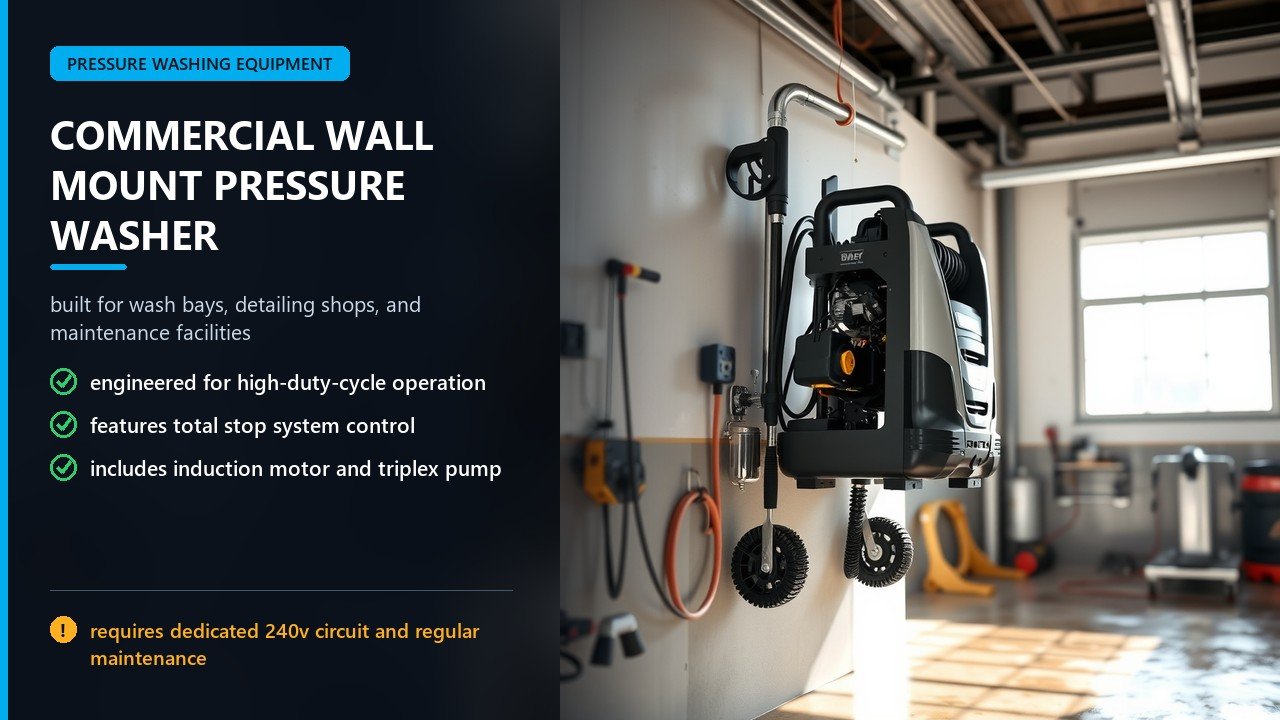
What Makes a Wall Mount “Commercial”
Many machines can be bolted to a wall, but few are built to live there in a working environment. The commercial designation rests on several engineering choices.
- Duty cycle. A commercial unit is designed for continuous, repeated operation without overheating. Consumer machines are rated for short bursts.
- Induction motor. Totally enclosed, fan-cooled (TEFC) induction motors run cooler, quieter, and far longer than the universal motors in budget electrics, and they are serviceable.
- Triplex pump. A serviceable triplex plunger pump with a forged brass manifold, ceramic plungers, and a thermal relief valve — not a sealed axial pump.
- Total Stop System. TSS shuts the motor off when the trigger is released and restarts it when pulled, saving power, reducing noise, and extending pump and motor life.
- Wash-bay frame and mounting. A robust frame with wall-mounting brackets engineered for permanent installation.
- Serviceability and warranties. Parts availability and multi-year pump warranties are the norm — for example, a 7-year pump and 1-year motor warranty on a leading line.
Take the Mi-T-M CAW Aluminum Series as an example. It offers models from 2,000 to 4,000 PSI at about 4 GPM with 6 to 10 HP motors, General pumps, thermal relief valves, a factory-preset stainless and brass trapping unloader, a time-delay shutdown, wall-mounting brackets, and options for auto start/stop and remote control boxes. That is a commercial machine in every respect.
| Model (example line) | PSI / GPM | Motor |
|---|---|---|
| CAW-2004 | 2,000 / 3.9 | 6.0 HP, 230V, 1φ |
| CAW-3004 | 3,000 / 3.9 | 8.0 HP, 230V, 1φ |
| CAW-4004 | 4,000 / 4.0 | 10.0 HP, 230V, 1φ |
| Canpump 5 HP | 2,400–2,500 / 2.9–3.1 | 5.0 HP, 240V, 1φ |
The Total Stop System Explained
The Total Stop System is the feature that most defines a commercial wall mount, and understanding it helps you compare machines. TSS does two things: it stops the motor when you release the trigger, and it restarts the motor the instant you pull it again. On a machine that runs all day between vehicles, that cycling is not a small convenience — it is the difference between a machine that lasts and one that wears out.
Two TSS designs dominate. The pressure-switch design uses two pressure-actuated switches to sense water flow and control the motor. The Canpump pressure-switch TSS works exactly this way: a switch at the quick-connect outlet signals the controller to power the motor when the trigger is pulled, and the system shuts down on trigger release after a timer. The wireless control design uses a battery-operated trigger gun that sends a signal to a module, as in Canpump’s wireless TSS model.
Whatever the design, TSS brings real benefits: lower energy use, quieter operation between cars, less motor and pump wear, and a machine that is always ready without running continuously. One caution from the manufacturer’s guidance — any leak in the system affects the pressure-switch controls, so a dripping fitting can make the machine fail to shut off or start unexpectedly. Keeping the system leak-free is essential on a TSS machine, which is why quality couplers and fresh O-rings matter so much. Our coupler guide explains how to keep those connections dry.
Quick Note: A Total Stop System stops the motor when you release the trigger and restarts it when you pull it. This saves energy and extends motor and pump life, but it depends on a leak-free system. A dripping fitting can cause TSS to shut off incorrectly or fail to stop — so keep couplers and O-rings in good order.
Power and Phase Requirements
Commercial wall mounts draw serious current, and the electrical supply is often the first obstacle to installing one. Know your service before you buy.
| Motor Size | Typical Supply | Circuit |
|---|---|---|
| ~5 HP | 208–240V single-phase, ~21–22 A | 30 A breaker |
| 6–8 HP | 230V single-phase, ~24–34.5 A | Dedicated 40–50 A |
| 8–10 HP | 230V three-phase, ~11–23 A | Dedicated, 3-phase |
Single-phase 230V models use common NEMA plugs, while three-phase models step up in efficiency and lower the amperage per leg. Some lines offer 460V options for facilities with that service. The right answer depends on what your building supplies, so match the machine to your service rather than the reverse. If three-phase power is available, a three-phase motor generally runs cooler and more efficiently for the same output.
Two practical notes. First, always use a dedicated circuit — a shared breaker will trip under the motor’s starting draw. Second, because these are permanent installations in wet environments, provide proper grounding, GFCI protection where required, and a disconnect near the machine. Have a licensed electrician handle the connection.
Mounting and Installation Requirements
A commercial wall mount is heavy — 150 to 300 pounds or more for many models — and it vibrates under load. Correct mounting is a structural matter, not a cosmetic one.
- Fasten into solid structure. Concrete is ideal. The manufacturer’s instructions typically call for concrete sleeve anchors; if the wall is not concrete, use heavy-duty bolts capable of holding the machine’s full weight.
- Use the frame as a template. Position the wall-mount frame and mark bolt locations from the frame itself, exactly as the installation guide directs.
- Plan the plumbing and power runs before mounting, so the water inlet, power box, and hose outlet land where you need them.
- Leave service access. Ensure you can reach the pump oil fill, unloader, filter, and control box without removing the machine.
- Mount for reach and drainage. Put the unit where the hose reaches your work and where the machine stays clear of standing water.
Get the mounting right and the machine will run quietly and reliably for years. Cut corners and vibration will loosen it, and a heavy unit coming off a wall is both a hazard and an expensive repair. Our broader guide to wall-mounted machines, the best wall mounted pressure washer, covers the home and light-commercial side of installation.
Pumps, Water Supply, and Plumbing
Commercial wall mounts almost always use a serviceable triplex pump from a recognized brand — General being the most common in this class. Features to expect include a forged brass manifold, ceramic plungers, a detachable pressure-adjustable unloader, an inlet filter or mesh screen, and a thermal relief valve. Serviceability is the point: the pump should be rebuildable with readily available parts, so it can be maintained rather than replaced.
The water supply must keep up with the machine’s flow. A 5 HP wall mount flowing about 3 GPM requires at least that much supply, and in practice a margin above it. The manufacturer of one 5 HP model specifies a minimum of 3 US GPM and recommends plumbing the inlet with a proper feed; leaks or undersized supply starve the pump and cause cavitation. A float tank or a plumbed line with adequate pressure and volume is the reliable solution. Keep the inlet filter clean, and never let the machine run dry.
Detergent injection is usually built in. Many commercial wall mounts include an external quick-connect low-pressure detergent injector, drawing chemical into the low-pressure side so it never passes through the pump. That protects the pump and seals and allows easy swapping between soap and rinse. Pair this with a surface cleaner for flatwork and a foam cannon for vehicles, both of which a 3–4 GPM commercial machine drives well — our surface cleaner guide explains matching the tool to the flow.
Cold Water vs. Hot Water Commercial Wall Mounts
Most commercial wall mounts are cold water, and that handles the majority of wash-bay work: vehicles, equipment, floors, and building exteriors. Cold water is simpler, cheaper, and needs no fuel or venting.
For facilities that fight grease and oil — food service, heavy fleets, industrial maintenance — hot-water wall-mounted systems exist. These add a burner and coil and cost significantly more, and they require fuel storage and ventilation. A representative hot-water static unit might deliver around 2,175 PSI with a steam stage and a high-pressure chemical system. If hot water is essential, weigh the cost and complexity against the alternative of a portable or propane-fired unit; our guide to the propane powered pressure washer covers clean-burning hot water for fixed and mobile use.
Match the water type to your grime, not to the biggest number on the spec sheet. Many businesses find a capable cold-water wall mount plus proper detergents more than sufficient, and save the hot-water premium for where it truly pays off.
Hose Handling: Reels and Booms
In a commercial bay, hose management is as important as the machine. A tangle of high-pressure hose slows every job and creates a trip hazard around vehicles. Two solutions dominate.
A wall-mounted hose reel keeps the hose coiled at the machine and pays it out to the work. Reels with integrated frames ship with some wall-mount models, and adding one to any machine is a modest upgrade that transforms tidiness. Our hose reel guide covers sizing and options.
A ceiling boom takes management a step further. A 360-degree swivel boom mounted overhead lets an operator move freely around a vehicle without dragging hose across the floor, and a wand holder gives the gun a dedicated home. This is the classic configuration for a dedicated wash bay, and it pairs perfectly with a wall-mounted machine. Together, the wall mount and the boom keep the entire work area clear and safe.
Serviceability and Maintenance
The commercial advantage is not just durability — it is the ability to keep the machine running. Plan for these routines.
- Pump oil. Change it on schedule; one 5 HP wall-mount model specifies SAE 75W-90 pump oil at 0.5L. Clean oil protects the plungers and bearings.
- Inlet filter. Clean or replace it regularly to protect the pump from debris.
- Leak checks. TSS depends on a leak-free system, so inspect couplers, O-rings, and fittings often.
- Unloader and thermal relief. Keep the preset unloader functioning and never rely on the thermal valve as a substitute for avoiding long bypass.
- Motor care. Keep the TEFC motor clean and its cooling fins clear; induction motors need little else but good airflow.
- Coil and burner (hot water): clean and service per the manual, and have the gas or fuel system checked by a qualified technician.
- Winterization. Fixed electric machines can freeze; protect the pump, hose, and gun. Our pump saver guide covers the routine.
Keep pump oil clean, the inlet filtered, and the system leak-free, and a commercial wall mount will outlast several consumer machines. When the pump eventually needs service, the fact that it is rebuildable means a repair rather than a replacement — the payoff for buying commercial in the first place. Our guide on whether to rebuild, replace, or buy new explains the economics.
Representative Commercial Wall Mounts
Several brands build in this category, and comparing them on motor, pump, TSS, and mounting reveals the differences that matter.
- Mi-T-M CAW Aluminum Series. 2,000–4,000 PSI at about 4 GPM, 6–10 HP motors, General pumps, wall-mount brackets, time-delay shutdown, and optional auto start/stop and remote boxes.
- Canpump wall-mount range. 2–5 HP models at 1,500–2,500 PSI with Total Stop System control, triplex pumps, integrated hose reels on some models, and wireless or pressure-switch TSS.
- Detail King commercial wall mount. A detailing-oriented unit aimed at professional shops that need a tidy, always-ready bay setup.
- BE Power and Tomahawk. Stationary LP and electric wall systems, some with ceiling booms, for wash bays and industrial sites.
When comparing, check four things: the pump brand and serviceability, the TSS design, the power requirement, and the warranty. Those, more than the styling or the badge, determine how well a commercial wall mount serves your business. Equipment dealers can help match a machine to your electrical service and bay layout, which is worth more than a small discount on the wrong unit.
Multi-Bay Setups and Remote Controls
One advantage of a commercial wall mount is how well it scales. A single machine can serve a bay directly, or, with remote controls, a whole set of bays from one central unit. This is where commercial systems earn their keep in larger facilities.
Remote control boxes let an operator start and stop the machine from a distance, and some lines support multiple remotes. The Mi-T-M CAW Series, for example, offers a remote box that may be mounted away from the unit, plus options for additional remotes. Combined with a time-delay shutdown, this means the machine can sit idle between jobs and power up only when a trigger is pulled — ideal for a facility where several workers share one machine.
When planning a multi-bay setup, think about hose runs and pressure loss. Long hose runs reduce pressure at the nozzle, so size hose generously and keep runs as short as practical. Mount the machine centrally when bays surround it, and use booms to route hose overhead. A well-planned multi-bay system lets one commercial wall mount clean several vehicles an hour without anyone waiting for a machine.
Soft Wash and Chemical Integration
Many commercial wash operations go beyond high pressure. They soft wash — applying cleaning solutions at low pressure with dedicated pumps — for surfaces that high pressure would damage, such as roofs, delicate siding, and painted exteriors. A commercial wall mount can serve as the pressure component of a broader cleaning system.
The key is chemical handling. On a wall mount, detergent is usually injected downstream, so chemical never passes through the high-pressure pump. Keep the injector and any chemical lines clean, and flush them with fresh water after use so residue does not clog the system. For aggressive chemicals, use pumps and seals rated for them, and never assume a standard machine tolerates every cleaner.
Pair the wall mount with the right accessories for the surface: high pressure and a surface cleaner for concrete and equipment, lower pressure with detergent for delicate surfaces, and a foam cannon for vehicles. A commercial machine with adjustable pressure makes this flexibility practical. Our nozzle guide explains how tip selection sets the pressure and spray pattern for each job.
Water, Wastewater, and Compliance
In a permanent wash facility, water handling is part of the design. A commercial wall mount consumes water at its rated flow for as long as it runs, so a plumbed supply with adequate volume and pressure is essential. Many facilities add a float tank to stabilize supply and protect the pump from pressure fluctuations.
Wastewater is the other side of the equation. Depending on your location and the nature of your cleaning, you may be required to contain or treat runoff rather than letting it reach storm drains. This is especially relevant for fleet and industrial washing, where oil, grease, and chemicals may be present. Planning for drainage, containment, or reclamation at the design stage is far cheaper than retrofitting later, and it keeps the operation compliant.
None of this changes the choice of pressure washer, but it shapes how you build the bay around it. A commercial wall mount is a component in a system that includes supply, drainage, power, and hose management. Treat it as such, and the whole facility performs better.
Note: In a permanent wash bay, remember the whole system: water supply with margin, containment or treatment of runoff per local rules, a dedicated electrical circuit, and hose management. A great machine in a poor facility still underperforms.
A Commercial Decision Framework
Buying a commercial wall mount is simpler if you work through a short checklist before you compare models.
- Define the duty. How many hours a day and how many jobs will it run? Hours matter more than peak numbers for choosing a commercial machine.
- Choose cold or hot water based on your grime. Hot water only if grease, oil, or food residue demands it.
- Confirm your electrical service. Single-phase 240V, three-phase, or 460V, with the amperage and a dedicated circuit available.
- Confirm the water supply delivers at least the machine’s GPM with margin, ideally plumbed or via a float tank.
- Insist on a serviceable triplex pump from a recognized brand, with parts available.
- Require a Total Stop System and, if the bay is large, remote controls.
- Plan mounting and hose handling: solid structure, and a reel or ceiling boom.
- Check the warranty and dealer support, and confirm parts and service availability.
Answer those eight questions and the field narrows to a few good machines, each of which will serve. Approach it the other way — falling for a headline PSI figure first — and you risk buying a machine that cannot run on your power, cannot keep up with your water, or cannot be serviced when it matters most.
Common Mistakes to Avoid
- Hanging a consumer machine in a commercial duty. Budget electrics cannot sustain all-day use; they fail early and often.
- Ignoring the power requirement. Confirm single- vs three-phase and amperage before ordering, and use a dedicated circuit.
- Mounting into inadequate structure. Use concrete anchors or heavy-duty bolts rated for the machine’s full weight.
- Overlooking TSS leak sensitivity. A dripping coupler defeats Total Stop control; keep the system sealed.
- Undersizing the water supply. Starving a triplex pump causes cavitation and damage; provide flow with margin.
- Skipping pump oil changes. Dirty oil is a leading cause of premature pump failure.
- Neglecting hose management. Without a reel or boom, hose chaos slows every job and creates hazards.
- Choosing hot water unnecessarily. Match the water type to the grime and save the premium for where it matters.
Frequently Asked Questions
What is a commercial wall mounted pressure washer? A permanently installed electric pressure washer built for sustained business use, with a duty-cycle-rated induction motor, a serviceable triplex pump, a Total Stop System, and a wash-bay-grade wall-mount frame and brackets.
What is a Total Stop System? A control system that stops the motor when the trigger is released and restarts it when pulled, saving energy and extending motor and pump life. It may use pressure switches or a wireless trigger gun.
What power does a commercial wall mount need? Most run on dedicated 208–240V single-phase circuits drawing roughly 20–35 amps, with three-phase and 460V options on larger models. Always use a dedicated circuit.
Can I install a commercial wall mount myself? Mounting and plumbing can often be done by a capable owner, but the electrical connection should be made by a licensed electrician, especially for 240V and three-phase service.
How much water flow does a commercial wall mount need? At least its rated GPM, with a margin above it. A 3 GPM machine needs roughly 3 GPM or more of supply, ideally from a plumbed line or float tank, to avoid cavitation.
Are commercial wall mounts worth the cost? For a business that cleans daily, yes. They last far longer, run cooler and quieter with TSS, and can be serviced with available parts, so the cost per year of use is often lower than repeatedly replacing consumer units.
Final Thoughts
A commercial wall mounted pressure washer is an investment in uptime. Its value lies in the engineering that a consumer machine cannot offer: a duty-cycle-rated induction motor, a serviceable triplex pump, a Total Stop System that protects the machine between jobs, and a frame built to live on a wash-bay wall. Choose the power supply and water flow it needs, mount it into solid structure, and keep the system leak-free, and it will outrun and outlast any repurposed homeowner unit.
For a detailing shop, a fleet bay, or a maintenance facility, the combination of a commercial wall mount, a hose reel or ceiling boom, and quality accessories turns cleaning into a fast, repeatable routine. The machine stays ready, the floor stays clear, and the work gets done. That is what commercial means in this category — not just more power, but the ability to keep working when a lesser machine would already be on a repair bench.