STIHL Commercial Pressure Washer: The RB Lineup Explained
STIHL builds pressure washers for the home, but the company also fields a range aimed squarely at professional work. When buyers search for a STIHL commercial pressure washer, they are usually looking at the petrol-powered RB series and the high-output electric RE 170 PLUS. These machines trade price and portability for pressure, flow, and endurance, and they are built to run day after day without the breakdowns that end cheap units early. This guide explains the commercial STIHL range, what separates it from the homeowner models, and how to match a machine to the work you actually do.
The short version: STIHL’s commercial pressure washers are the petrol RB 200, RB 400, RB 600, and RB 800, plus the electric RE 170 PLUS. They deliver higher pressure and flow, use durable pumps and engines, and are designed for frequent, heavy-duty cleaning rather than occasional weekend use.
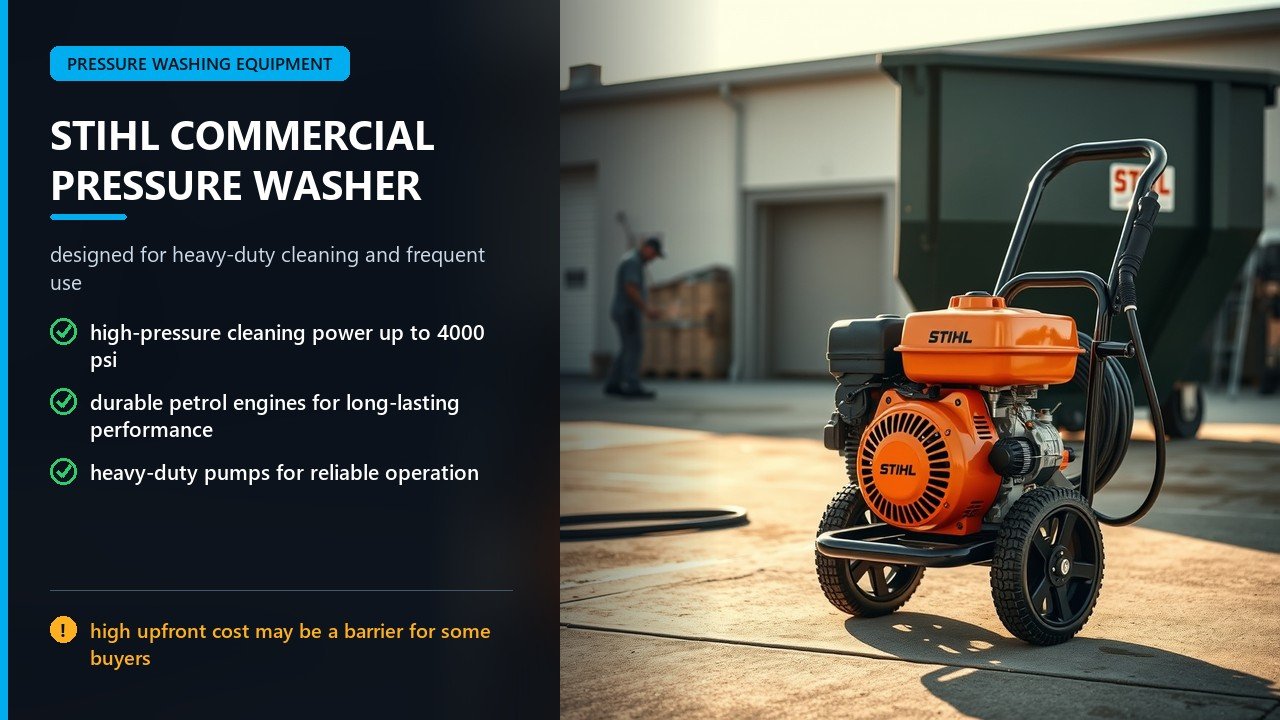
What Makes a STIHL Pressure Washer Commercial
Commercial, in the pressure washing world, is not a badge on the box; it is a description of duty cycle, build quality, and output. A commercial machine is expected to run for hours at a time, to survive being loaded into a truck and used on job sites, and to keep working when a homeowner unit would be overheating or shaking itself apart. STIHL’s commercial models meet that bar through larger engines, more durable pumps, and features that cut operator fatigue.
STIHL itself describes its petrol high-pressure cleaners as built for users who need maximum cleaning power and complete mobility, designed for heavy-duty and commercial applications. The company positions the range as spanning models for workshops and commercial spaces through to professional cleaners for agriculture, forestry, local authorities, and construction. The homeowner RE machines sit below this line, and our overview of STIHL electric and battery washers covers that side of the range.
The RB Petrol Lineup at a Glance
The petrol RB series is the heart of the commercial offering. Four models step up in power, from a heavy-duty starter machine to an industrial flagship. The table below summarises the range; note that specifications and prices vary by region, so confirm details with a local STIHL dealer. Treat the figures as a guide to relative power rather than a fixed spec sheet, because STIHL adjusts output and features for different markets.
| Model | Engine / Power | Pressure / Flow |
|---|---|---|
| RB 200 | 3.7 kW petrol | Up to 170 bar / 2,500 PSI |
| RB 400 DIRT BOSS | 196 cc / 6.5 hp | 2,700 PSI at 2.7 GPM |
| RB 600 | Professional-grade petrol | Higher output than RB 400 |
| RB 800 | 14 hp petrol | Up to 290 bar / 4,200 PSI |
RB 200: The Heavy-Duty Entry Point
The RB 200 is the smallest petrol machine in the commercial conversation, and it is best understood as a heavy-duty all-rounder rather than a consumer unit. Its 3.7 kW engine produces up to 170 bar, roughly 2,500 PSI, and the machine includes a detergent injector system and an easy-start pump. STIHL markets it for demanding outdoor cleaning such as driveways, decks, vehicles, and equipment.
For a small contractor or a property owner with substantial grounds, the RB 200 is the sensible entry to petrol power. It has the mobility and independence of a gas engine, so it works far from an outlet, and it accepts the accessory range that lets it do more than a wand alone. It is not the machine for multi-hour fleet washing, but it bridges the gap between a strong homeowner washer and a true production unit.
RB 400 DIRT BOSS: The Middle Workhorse
The RB 400 DIRT BOSS is the model most people picture when they think STIHL commercial. It pairs a 196 cc, 6.5 hp engine with a 2,700 PSI pump flowing 2.7 gallons per minute, for a cleaning-unit figure of 7,290. Those numbers put it in the same class as many dedicated commercial gas washers, and the build backs them up.
The pump uses a brass manifold with stainless steel valves and ceramic-coated pistons, and the engine has a cast-iron liner. Those materials resist wear and corrosion far better than the aluminium-and-plastic internals of budget units, which is what makes the RB 400 viable for daily use. STIHL also fits a built-in shutdown when oil runs low, an anti-vibration system, and an automatic fuel shut-off for clean transport. The RB 400 DIRT BOSS product page lists the full specification.
RB 600: Professional-Grade Power
The RB 600 steps above the RB 400 with more output and heavier-duty construction, positioned by STIHL as a professional-grade cleaner for tough, high-frequency tasks. It is the machine for a trade user who has outgrown the RB 400 but does not need the flagship. In practice it delivers more cleaning units, meaning it covers ground faster, which matters when time on the job is billed.
Choosing between the RB 400 and RB 600 usually comes down to the type and volume of work. If you clean driveways and vehicles occasionally, the RB 400 is ample. If you clean commercial lots, machinery, or heavy residue regularly, the RB 600’s extra power reduces labor, and labor is the real cost in professional cleaning. The principle that flow rate, not pressure alone, decides how fast you clean is worth understanding, and our guide to GPM and cleaning speed explains it.
RB 800: STIHL’s Most Powerful Cleaner
The RB 800 is the flagship, a 14 hp petrol machine producing up to 290 bar, roughly 4,200 PSI. STIHL builds it for industrial and commercial applications and names construction equipment, large surfaces, and heavily soiled areas as its targets. At this level you are no longer buying a pressure washer for a driveway; you are buying production equipment for a business.
At 4,200 PSI the RB 800 sits in the top gas class, where pressure and flow combine to strip the heaviest dirt and coatings. That power demands respect; the wrong tip or technique will damage surfaces, and safety becomes a discipline. Our look at the flagship gas class covers what that much machine can do and where its limits lie.
The RE 170 PLUS: STIHL’s Commercial Electric Option
Not every commercial job suits petrol. For indoor or noise-sensitive work, STIHL offers the RE 170 PLUS, an electric machine it positions for commercial and demanding domestic use. It delivers up to 180 bar, and it is built with a brass pump head, ceramic pistons, and adjustable pressure and flow control. A 12-metre steel-reinforced hose, a hose reel, a detergent tank, and multiple nozzles round out a genuinely professional package.
The RE 170 PLUS is the answer for workshops and machinery cleaning where you have power available and want no exhaust fumes indoors. It cannot match the RB 800’s raw output, but it is quieter, needs less maintenance, and can run all day on mains power. Our guide to commercial electric pressure washers explores when electric beats gas for professional work.
Engine and Pump Design: Why They Last
The difference between a commercial STIHL washer and a cheap one shows up in the parts you never see. The RB series uses brass manifolds, stainless steel valves, and ceramic-coated pistons, all of which resist the corrosion and abrasion that kill lesser pumps. Some STIHL machines use triplex-style pump designs, which are inherently more durable than the axial-cam pumps found in budget units, a distinction our guide to the triplex pump explains.
The engines follow the same logic. A cast-iron cylinder liner outlasts a bare aluminium bore, and STIHL’s low-oil shutdown prevents the catastrophic failure that follows an engine run dry. These features are why a commercial machine commands a higher price and why it delivers a lower cost per hour over its life. Reliability is the product, not just pressure.
Cleaning Units: Why PSI Times GPM Matters
Marketers love a big PSI number, but cleaning units, the product of pressure and flow, tell a truer story. The RB 400, at 2,700 PSI and 2.7 GPM, produces 7,290 cleaning units. A machine with higher PSI but lower flow can actually clean more slowly, because flow is what carries dirt away and covers area. For commercial work, where speed equals money, cleaning units are the number to watch.
This is why professional operators rarely chase pure pressure. A balanced machine with strong flow removes dirt in fewer passes, which reduces labor, water waste, and fatigue. The RB lineup is tuned around that balance, and understanding it helps you compare STIHL models against other brands on equal footing. When you shop, ask for the pressure and the flow, multiply them, and compare the totals; the higher cleaning-unit figure will usually finish the job faster. For a deeper look, see our guide to commercial pressure washer power and duty.
Features That Matter in Daily Use
Commercial work exposes design flaws fast, and STIHL engineers for that reality. The Easy Start Pump System uses a pressure relief valve so the engine starts without fighting back pressure, which spares the operator’s shoulder and the starter rope. The anti-vibration system isolates the pump on a four-point mount, reducing fatigue in the hands and extending pump life. The automatic fuel shut-off valve closes the fuel line with the engine switch, preventing leaks during transport.
Small features like the two-piece lance and gun assembly, the parking position for the lance, and integrated nozzle and hose storage add up to a machine you can live with for hours. These are not marketing extras; they are the difference between a tool that lasts a season and one that lasts a decade. When you evaluate any gas pressure washer, look for exactly these operator-focused details.
Commercial Accessories That Extend the Machine
A commercial STIHL washer is a platform, and the accessory range is what adapts it to different jobs. STIHL offers a rotary surface cleaner for flat paving, a water broom for pushing water, a gutter cleaner for blocked downspouts, an aluminium wand extension for reach, a pivot coupler to relieve hose twist, and a range of nozzle options. The official cleaning agents complete the set. Our guide to STIHL cleaning products details the agents and accessories.
For a professional, the surface cleaner is often the highest-value add-on, because it turns slow wand work on large areas into fast, even coverage. Gutter cleaners and wand extensions handle the awkward high and overhead jobs that would otherwise need a ladder. Buying the right accessories up front is cheaper than discovering mid-job that your machine lacks the reach or the pattern you need.
Pressure and Flow Control at the Gun
STIHL’s professional-class machines let you regulate pressure and water quantity directly on the gun, so you can dial the output to the surface without swapping tips or shutting down. That control is a genuine productivity feature: you can move from blasting concrete to rinsing a painted surface in seconds. It also reduces the risk of surface damage from an over-powered pass.
Adjustable output is common on high-end machines for good reason. It lets one machine serve many surfaces, which is exactly what a commercial user with varied jobs needs. Combined with a matched nozzle set, it gives the operator fine control over pressure, pattern, and chemistry, the three variables that decide a clean result.
Petrol or Electric: Choosing for Commercial Work
The first commercial decision is power source. Petrol, in the RB series, buys mobility, independence from outlets, and the highest output. That suits outdoor sites, remote work, and heavy cleaning where maximum power matters. The trade-offs are noise, exhaust, fuel handling, and more maintenance. Electric, in the RE 170 PLUS, buys quiet, fume-free operation and simpler upkeep, which suits indoor workshops and noise-sensitive jobs.
If your work moves around and your sites lack power, petrol wins. If you clean inside a shop or in residential areas where noise is a problem, electric wins. Many professionals eventually own both, using electric for indoor and light jobs and petrol for the heavy outdoor work. Our comparison of electric cold water pressure washers helps frame the electric side.
Matching a STIHL Commercial Machine to the Job
| Work | Suggested model |
|---|---|
| Driveways, decks, vehicles | RB 200 |
| General professional cleaning | RB 400 DIRT BOSS |
| High-frequency commercial work | RB 600 |
| Industrial, construction, heavy soil | RB 800 |
| Indoor workshops, machinery | RE 170 PLUS |
Read down the left column to find your work, then match it to the model. The mapping reflects output and duty cycle rather than price, and it is a practical way to avoid buying more machine than you need or less than the job demands. For many trade users the RB 400 or RB 600 is the sweet spot, balancing power against cost and weight.
Cost and Ownership
STIHL commercial pressure washers are priced accordingly. In US dollars the RB 400 runs about $979, and regional pricing places the RB 200, RB 600, and RB 800 progressively higher, with the RB 800 well into four figures. The RE 170 PLUS sits near the lower end of the professional range. These are investments, not impulse buys, and the right way to judge them is by cost per hour of work, not sticker price.
A commercial machine earns its price through uptime. Fewer breakdowns, longer pump life, and less operator fatigue translate into more jobs completed and fewer repair bills. A cheap washer that dies mid-season costs more than its price in lost work. If you run a cleaning business, the reliability of a commercial unit is the feature you are really buying. Our overview of what commercial pressure washers cost puts the numbers in context.
Maintenance to Keep It Commercial-Grade
A commercial machine stays commercial only if you maintain it. Change the pump oil on schedule, keep the water filter clean, never run the pump dry, and protect the machine from frost. Use fresh fuel in the petrol models and treat or drain fuel for storage. These routines are simple and cheap, and they are the reason a well-kept STIHL outlasts a neglected one by years.
Because commercial units run hard, they also deserve a hard look before each season. Check hoses, seals, and nozzles, and replace anything worn before it fails on a job. Correct fuel and oil are foundational; our guides to STIHL pump oil and the best gas for pressure washer engines cover the specifics. Winter care is equally important, as our guide to storing a power washer for winter explains.
Is the RB 400 Really Commercial?
You will notice a wrinkle when you research the RB 400: STIHL’s US materials describe it as built for domestic use, while other STIHL regions and many dealers present the RB series as designed for heavy-duty and commercial applications. Both descriptions reflect the same machine; the difference is marketing positioning across markets. The RB 400 is a durable, easy-starting petrol washer with commercial-grade components that suits daily heavy cleaning, even if STIHL’s home-market copy calls the range domestic.
The practical takeaway is to judge the machine by its components and duty cycle, not its label. A brass manifold, stainless valves, ceramic pistons, a cast-iron liner, and a 7,290 cleaning-unit output are commercial credentials regardless of which brochure you read. If your work matches the RB 400’s capabilities, it will serve you well, and the accessory range lets it grow with your needs.
Hose, Wand, and Nozzle Setup
A commercial machine is only as productive as its plumbing. The RB 400 comes with a 25-foot no-kink flex hose, which lets you clean a large area without repositioning the machine, and a stainless steel high-pressure nozzle plus a brass detergent nozzle. Stainless and brass resist the corrosion that eats cheap nozzles, which matters when you use a machine daily. The two-piece lance and gun assembly gives accurate control, and the lance is extended for tall applications.
The hose length is a practical consideration on commercial jobs. A 25-foot hose reaches across a driveway or a bay without constant moves, but on larger sites you may add a hose extension to keep the machine stationary and safe from traffic. Nozzle choice drives the pattern and pressure, so a matched set of tips plus a surface cleaner covers the widest range of surfaces. Getting the plumbing right is not a detail; it is where productivity is won or lost.
The DIRT BOSS Name and What It Signifies
The DIRT BOSS name is STIHL’s signal for a machine built to handle heavy, repeated use. It appears on the RB 400, the model STIHL describes as ready to demolish dirt on a daily basis. The message is deliberate: this is the machine for buyers whose work does not stop at a weekend, and the components underneath the name, such as the cast-iron liner and ceramic pistons, back up the claim.
Names aside, the useful question is whether a machine’s duty cycle matches your workload. A DIRT BOSS badge is meaningless if you clean one driveway a month, and it is essential if you clean commercial lots every day. Match the machine to the hours and the severity of the dirt, and the branding becomes a helpful shortcut rather than an empty label.
Safety With a Commercial Pressure Washer
The hazards of pressure washing scale with power, and a commercial machine demands more discipline than a homeowner unit. At 4,200 PSI the RB 800 can inject water through skin, damage eyes, and strip surfaces instantly. Never point a nozzle at a person or animal, wear eye and hand protection, and keep the wand moving so no spot takes the full force for long. Never clean with the tip closer than necessary.
Petrol machines add fuel handling and carbon monoxide to the risk list. Refuel only when the engine is cool, never indoors, and run the machine outdoors or with proper ventilation. Treat the water jet as a cutting tool, because at commercial pressures that is effectively what it is. For a full treatment of the injuries that are easy to underestimate, read our guide to high-pressure water jet safety.
Buying a STIHL Commercial Pressure Washer
STIHL sells its pressure washers through approved dealers and regional online shops rather than big-box stores, which has two implications. First, availability and pricing vary by region, so a model in one market may be absent in another. Second, some models carry sales restrictions: the RB 400 DIRT BOSS, for example, is not available for purchase or delivery in California. Confirm local availability and price before you commit.
Buying through a dealer also means service and parts access, which is exactly what a professional needs. A commercial machine will eventually need seals, a pump rebuild, or an engine service, and a dealer relationship makes that straightforward. Ask about warranty terms and the accessory range when you buy, and register the machine. The STIHL pressure cleaner shopping guide is a useful starting reference for the range.
Frequently Asked Questions
Which STIHL pressure washers are commercial? The petrol RB 200, RB 400 DIRT BOSS, RB 600, and RB 800 make up STIHL’s heavy-duty and commercial petrol range, and the electric RE 170 PLUS covers commercial and demanding domestic use.
What is the most powerful STIHL pressure washer? The RB 800 is STIHL’s most powerful cleaner, with a 14 hp engine and up to 290 bar, roughly 4,200 PSI, aimed at industrial and commercial cleaning.
Does STIHL make an electric commercial pressure washer? Yes. The RE 170 PLUS delivers up to 180 bar with a brass pump head, ceramic pistons, adjustable pressure and flow, a hose reel, and a detergent tank, suited to workshops and indoor cleaning.
Is the STIHL RB 400 DIRT BOSS commercial or residential? It is presented as domestic in some STIHL regions and as heavy-duty or commercial elsewhere. Its commercial-grade components, including a brass manifold and ceramic pistons, make it suitable for frequent, heavy cleaning.
What pressure does a STIHL commercial washer deliver? It depends on the model, from around 2,500 PSI on the RB 200 through 2,700 PSI on the RB 400 to about 4,200 PSI on the RB 800, with the RE 170 PLUS reaching roughly 2,600 PSI.
Final Thoughts
A STIHL commercial pressure washer is a working tool built around uptime, not a weekend toy. The petrol RB series scales from the heavy-duty RB 200 to the industrial RB 800, with the DIRT BOSS and RB 600 covering the professional middle, and the RE 170 PLUS serving commercial users who need quiet, fume-free electric power. Durable pumps, robust engines, and operator-focused features separate them from homeowner machines.
Choose by power source first, then by output and duty cycle: petrol for mobility and maximum power, electric for indoor and quiet work, and a larger model only when the work justifies it. Maintain the machine, use the right oil and fuel, and add the accessories that match your jobs. A dealer relationship and genuine parts keep it running when it counts. Done right, a commercial STIHL pays for itself in reliability, in results, and in the seasons of work it delivers without complaint.