Luis runs a small pressure washing business out of a trailer, and he will tell you the moment he realized the difference between a toy and a tool. He was finishing a two-year-old driveway that had been stained by three winters of moss and runoff. His older machine, rated at 2,300 PSI, had pushed at the same concrete for twenty minutes and left a ghost of the stain. A friend brought over a 4000 PSI pressure cleaner with a matching flow, and Luis watched the gray band of moss lift off in one slow pass, no chemicals, no scrubbing, just pressure backed by volume. That afternoon he priced the upgrade and started saving.
A 4000 PSI pressure cleaner is a serious machine, the kind that sits at the top of the consumer pile and the bottom rung of professional equipment. It is also the machine most often bought for the wrong reasons, bought because the number 4000 sounds impressive, when the number that decides the job is the gallons per minute next to it. And it is a genuinely dangerous tool on its own terms, capable of moving more pressure than a bare foot can survive, which is why the same power that cleans concrete in a pass needs to be chosen, aimed, and used with full respect. This guide explains what 4000 PSI actually does, what it pairs with to be useful, what it can and cannot clean safely, who should buy one, and the mistakes that turn a fleet-grade machine into a claim-ticket incident.
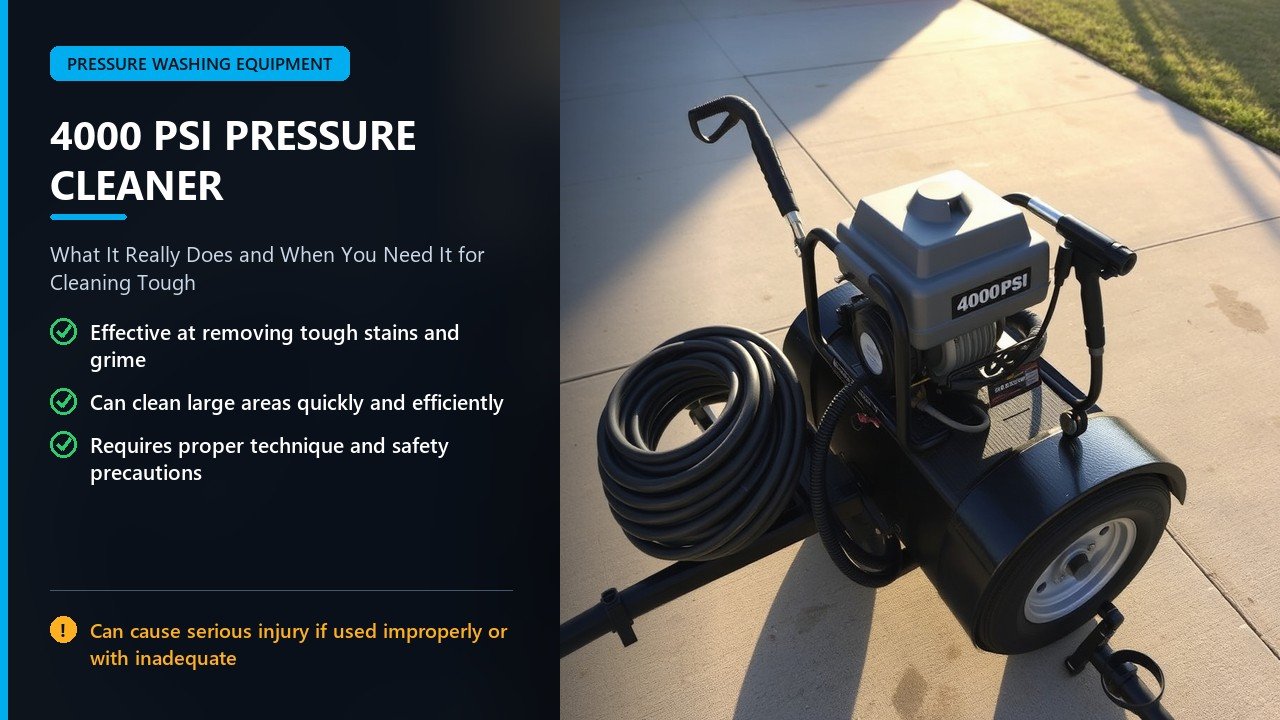
What 4000 PSI Actually Means
The number 4000 refers to the pressure the machine can hold at the nozzle, expressed in pounds per square inch. It is an impressive number, and it is worth being precise about what it does.
Pressure removes bonded grime. High pressure works by hitting a stain hard enough to shatter its bond to the surface. Moss, old oil residue, paint, and years of grime surrender faster as pressure climbs, which is why Luis’s first pass seemed to vanish beneath the stronger stream.
Pressure also removes finishes. The same force that erases a moss stain will erode wood, cut through soft mortar, score aluminum, and strip a deck’s protective coating without breaking a sweat. A 4000 PSI cleaner is not a gentler version of a weaker one; it is a stronger destructive tool with a control that has to be respected.
It varies with the nozzle. The 4000 figure is at the tightest nozzle angle, the zero-degree tip, which focuses all that force onto a thin line. Wider tips spread the pressure and soften the stream. No machine is 4000 PSI at every setting, and knowing which tip does what is the difference between cleaning and carving. Our guide to what a 4000 PSI machine can do catalogues each tip’s role.
The Number That Matters More: Flow
Ask any working cleaner why a 4000 PSI machine cleans faster and the answer will not stop at pressure. It will mention gallons per minute, because flow, not PSI alone, carries the power of the job.
Pressure cleans, flow sweeps. Pressure breaks the stain loose; flow flushes it away. A machine with high PSI and low flow blasts the surface but lacks the volume to carry dirt off it, leaving a film the cleaner has to re-hit. A machine with both high PSI and high flow strips and carries in a single pass.
Serious machines pair them. A machine that delivers 4000 PSI and 4 GPM is the classic professional combination of a pressure washing rig, and the two numbers together are what lift heavy grime. Machines that sell on a big PSI number alone, with flow stuck around 2.5 GPM, are not in that league no matter what the sticker says. Our article on 4 GPM flow as the professional standard explains why the pair outranks the single number.
Water supply becomes the limit. A 4 GPM machine needs about four gallons of water per minute just to keep running, and many homeowners discover that their hose connection, supply line, or well simply cannot feed the machine. High flow claims are only real if the water can actually arrive. A quick flow test at the spigot before you buy saves you from a machine that starves.
What It Cleans, and What It Should Not Touch
A machine of this power brings a short list of natural jobs and a longer list of things it will damage if you let it.
Concrete and masonry. Driveways, sidewalks, patios, garage floors, and retaining walls are the wheelhouse. Concrete handles the pressure and the moss, mildew, oil, and discoloration surrender to it. This is the machine that makes the heaviest cleaning a routine instead of an ordeal.
Heavy commercial grime. Loading docks, equipment, forklifts, industrial floors, and farm machinery are the professional contexts, where the machine earns its keep by stripping grease and grime that weaker units smear.
Parking areas and fleet vehicles. With a surface cleaning head and careful technique, it handles large flat scrapes and the business side of fleet trucks.
Heavy caution for soft surfaces. Wood decks, vinyl siding, painted metal, asphalt shingles, caulk, and mortar all risk damage from a machine this strong used at full tilt. A 15-degree or 25-degree wide tip, kept moving, held at distance, and tested on an inconspicuous spot first, softens the risk, but nothing removes it entirely. If your job list is mostly wood, vinyl, and paint, a 3000 to 3500 PSI machine may serve better and safer. Our comparison of PSI for cars versus pavement shows how much narrower the safe window is on painted surfaces.
| Surface | Safe? At 4000 PSI | Best Practice |
|---|---|---|
| Concrete, masonry | Yes | Wide tip, keep moving |
| Wood deck | Risk | Low flow tip, distance, spot test |
| Vinyl siding | Risk | Wide angle, never up close |
| Painted metal | Risk | Avoid or mask; paint lifts fast |
| Tires, wheels | Yes, careful | Keep stream off bearings and seals |
The Machine Types That Reach This Level
Not every 4000 PSI cleaner is built the same, and the difference is in how the pump is driven and what it is made for.
Direct-drive gas machines. The pump is bolted straight to the engine’s output shaft. These are common at the boundary between consumer and pro, offer good power per dollar, and run the pump at engine speed. They are lighter and less expensive, and they are exactly what a serious homeowner or start-up cleaner operates.
Belt-drive machines. A belt decouples the pump from the engine, letting the pump run at a lower, slower speed, which reduces wear and extends service life. Belt drives are heavier, pricier, and built for daily commercial use. Between the two, a belt-drive unit is the upgrade past direct drive when the job becomes full-time. Our guide to why a Honda-engine 4000 PSI machine pays off digs into engine choice on both.
Electric and hybrid machines. Very few electric machines approach 4000 PSI; most electric units top out lower because motors have trouble sustaining that pressure at full flow. When you see 4000 PSI on a plug-in unit, check the flow because the two rarely travel together.
The trailer rig. At this power level, many businesses mount the machine, reels, and a water tank on a trailer, turning a strong cleaner into a mobile unit with its own supply.
The Real Danger: Pressure Washer Injuries
This is the section every 4000 PSI owner needs before any other chapter, because the machine’s power is also its threat.
Skin cannot stop it. A pressure washer stream can inject water into soft tissue, and the National Institute for Occupational Safety and Health and OSHA both track pressure washer injuries, including injection injuries that require surgery despite looking like a scratch at first. At 4000 PSI the risk is at its peak, because the stream is powerful enough to breach skin.
Never point it at people or pets. No joke, no exception. A stream that tears moss off concrete will do far worse to a leg, and eyewear gets broken instantly. Treat the spray end as the business end of a hazard, not a toy.
Essential gear: Heavy-duty gloves, shatter-resistant safety glasses or a face shield, closed-toe footwear, and hearing protection for gas machines. Keep the trigger-control gun’s lock secure, keep the machine braced, and never run the spray uphill toward a face. Our article on avoiding injuries and surface damage goes through the full safe-work routine.
Accessories a 4000 PSI Machine Wants
Raw pressure is only half a cleaning system. A machine this strong earns its keep when it is matched with tools that use the power.
A surface cleaner. The single best upgrade. It spreads the pressure across spinning tips under a shroud, cleaning flat concrete without streaking and without the operator standing on the pressure. On a 4000 PSI machine, a good surface cleaner turns the longest chore into the fastest one.
Hose and fittings rated for the pressure. The hose, gun, and fittings must meet the machine’s working pressure. A 2,700 PSI hose carried over from an old machine is a burst waiting to happen on a 4,000 PSI unit. Our guides on hose ratings and burst failure prevention cover the matching rules.
Wide-angle nozzles. At this pressure, a 25-degree and 40-degree tip are daily carry gear for the softer passes, along with a 15-degree for general duty. The zero-degree pencil is a carve tool, reserved for stubborn single spots, never for broad sweeping.
Chemicals pre- and post-treatment. Even at 4000 PSI, professional cleaning is often chemistry plus pressure. A pre-soak loosens grime, and a post-treatment rinse or a cleaning agent keeps the surface ahead of regrowth. If you soft-wash, understand that bleach and surfactants run through a soap dispenser and into the stream under this much force.
Do You Actually Need 4000 PSI?
The honest buying question. A 4000 PSI machine is not automatically better for everyone, and for a big share of buyers it is simply overkill.
Buy it if your surfaces are concrete-heavy and grimy. Old driveways, mossy patios, garage floors, and multi-surface commercial surfaces are the territory where the extra pressure pays for itself in hours saved.
Skip it if the job list is mostly softer materials. Wood decks, vinyl, painted trim, and detailing work favor a moderate machine with lighter handling and a gentler touch. The power you never use is power spent, and on this gear the price jumps fast.
Rent before you buy. A weekend rental or borrow from a neighbor for one serious job tells you exactly how much machine the work actually eats. You may find the 4000 PSI unit cleans your driveway in one pass, or you may find a 3200 PSI machine at a third of the cost covers everything you own. Our guide to whether 4000 PSI machines are worth it walks the same decision.
Think about maintenance, not once, but constantly. Serious machines carry serious maintenance: pump oil, engine oil, winterizing, hose care, and filter attention. If the thought of that routine is unwelcome, a lighter machine with a lighter schedule is closer to the truth of your life.
Cleaning Technique That Uses the Power
Strong machines fail in the hands of people who point them like a fire hose and expect results. A little technique turns the same power into faster, cleaner, safer jobs.
Work from distance to close. Start a pass a foot and a half back and test, then step in a few inches at a time until the surface starts to score. That testing distance tells you the machine’s real working range before you commit a full pass. Cheap practice, perfect results.
Keep the stream perpendicular. Angled strikes waste power and let dirt run alongside the blast. On flat concrete, a surface cleaner handles perpendicular for you; by hand, keep the wand roughly square to the surface and let the pass direction do the work.
Pass, do not scrub. Slow, overlapping passes beat rapid zigzags. Each pass removes a band of grime; overlapping edges avoid the tiger stripe look that owners post in forums and regret all season.
Pre-soak heavy grime. A light pre-wet with water or a degreaser softens the bond so the pressure strips it, rather than chipping at it. Oil and moss both release faster after a few minutes of soak, and the pressure then does a fraction of the work.
Finish with a rinse pass. After the stripping pass, a final wide-angle rinse carries the debris away. Homeowners often skip it and wonder why the path looks dirty again the next day; the rinse is the half the job we remember only after it rains.
Maintenance: The Real Cost of Ownership
A 4000 PSI machine is a power tool with two service lives, the engine’s and the pump’s, and both demand attention on a schedule.
The engine services like a car. Oil level checks before use, a fresh fill on the manual’s schedule, air filter attention, and spark plug care. On a gas machine this is the routine that keeps it starting in season three while the neglected neighbor’s unit sits as a lawn ornament. Our guide to choosing the engine oil covers the fluid side of that schedule.
The pump is the precision eyeball. Pump oil level and condition, worn o-rings, and the winterizing step that saves it from a freeze. A pump starved of oil or frozen once is a pump that dies young, and it is the single most expensive part on the machine.
Water purity protects both. Sediment shortens pump seal life, so an inlet filter or storage tank setup that keeps the intake clean is cheap insurance. Dirty tanks, garden-dirt infill, and hard water all translate into an early seal kit.
Annual service is minutes, not hours. New pump o-rings, fresh oil, a clean air filter, and a blown-out hose add up to about twenty minutes a year and push machine life into a decade. The owners who call a 4000 PSI machine a mistake are usually reporting on their own skipped schedule, not the machine’s limits.
The Pre-Job Checklist That Saves a Flawed Day
At 4000 PSI, the minutes you invest before the first trigger squeeze write the entire job’s success, and the checklist takes ninety seconds.
Water first, machine second. Connect and open the water supply fully before the engine starts, and confirm steady flow at full open. Running a pump dry, even for a few seconds, is a fast death and the most common first-week failure on new machines.
Check the machine’s fluids. Engine oil at the mark, pump oil correct, fuel fresh. A machine that is starved or stale either seizes or sputters out mid-job, and both waste the afternoon you set aside for cleaning.
Inspect the whole pressure path. Hose jacket, fittings, gun, and tips, quick look at each. Any crack, bulge, or grit in a coupler gets fixed on the ground, not halfway through the driveway with the stream running. Our checklist for hose safety lists the exact failure signs to scan for.
Prepare the site. Know where the water drains, and where sensitive things sit: open windows, pet bowls, painted trim, and anything that a flooding stream or drifting spray could damage before the pass even arrives. Close them before you start, not after you hear the spray.
Stake out your gear. Nozzles sorted into a belt or pouch, chemicals mixed and labeled, the gun’s trigger unlocked ready for use but never stored live. An organized machine is a safe machine, and at this power level, organization is not a personality trait, it is part of the procedure.
Common 4000 PSI Mistakes
Buying PSI and ignoring GPM. The pressure number sells the machine, but flow does the cleaning. Judge the pair.
Using the zero-degree tip for broad work. It carves lines into concrete and strips surfaces. Reserve it for single stubborn spots.
Cleaning verticals from below. Running the stream up into siding or a window frame drives water into the wall system. Work from below at an angle only on surfaces made for it.
Borrowing the old hose. An underrated hose on a stronger machine is a burst hazard. Match every fitting and line to the machine’s pressure.
Letting novices run it unattended. This machine has the power to injure in a second. If you hand it over, hand over the training first, not just the trigger.
Neglecting the pump. A 4000 PSI pump is a precision part with its own oil and service. It dies fastest when it is starved, frozen, or run dry.
Frequently Asked Questions
What is a 4000 PSI pressure cleaner good for? Heavy-duty concrete and masonry cleaning, commercial grime, and professional pressure washing where pressure plus high flow strip bonded stains in single passes.
Can 4000 PSI damage concrete? Directly, mostly no; concrete handles 4000 PSI unless a tight tip is held stationary, which can etch a line. Indirectly, yes: it can wash away weakened mortar. Keep the stream moving.
Is 4000 PSI too much for a car? For paint, generally yes at full pressure. If cars are the main job, a 1500 to 2000 PSI machine at low flow is the safer tool. At 4000 PSI, only a wide tip, distance, and extreme caution belong near a paint line.
What GPM should a 4000 PSI machine have? To act like the number suggests, 4 GPM or more. A 4000 PSI machine with 2.5 GPM is a different, weaker creature, high pressure but low volume.
Is a 4000 PSI machine safe for a beginner? Safe if trained, safer with practice on a weaker machine first. The injuries at this power level are real and permanent, so a novice’s first machine is better bought a rung lower to build the habits.
Final Thoughts on the 4000 PSI Pressure Cleaner
The 4000 PSI pressure cleaner is a machine with two honest faces. Held properly, matched with flow, and aimed at the surfaces it was made for, it is the tool that strip-stains driveways in one slow pass and eats commercial grime for breakfast. Handled loosely, underrated at the fittings, or pointed at soft materials, it scores finishes, blows caulk, and in a single unlucky second does permanent harm to a hand or a foot.
Buy it for the pair of numbers, pressure and flow together, and only when your actual work list is heavy concrete and hard grime. Pair it with a surface cleaner, an adequately rated hose and gun, and the wide-angle tips the job needs. Respect the danger honestly, keep it out of untrained hands, and service the pump the way it asks to be serviced. Do all of that and the 4000 PSI machine stops being a number on a sticker and becomes exactly what it was built to be: the fastest, strongest cleaner that gravity and water have to offer, pointed only at the dirt that earned it.