Pressure Washer Hose 3/8: Ratings, Construction, and How to Choose
A pressure washer hose 3/8 is the workhorse size for serious cleaning, but the number 3/8 tells you only the inside diameter, not whether the hose is any good. Two hoses with the same 3/8 inch bore can differ enormously in pressure rating, construction, and lifespan. One is a light rubber line rated for 3,000 PSI, and another is a double-wire-braid commercial hose good for 6,000 PSI and years of hard use. Knowing what separates them is how you avoid buying the wrong one.
This guide explains how 3/8 pressure washer hoses are built, how to read their ratings, what the R1 and R2 labels mean, and how to match a hose to your machine. For the broader picture, our pressure washer hose guide covers the whole subject.
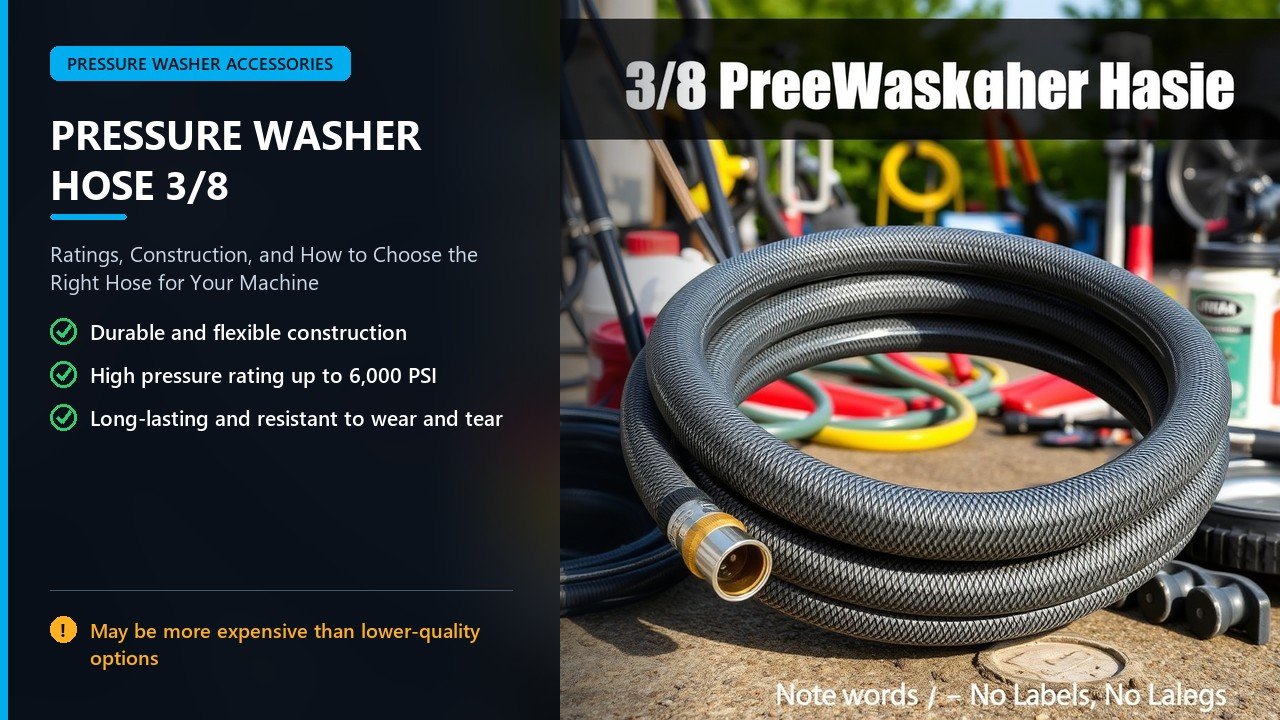
Why 3/8 Is the Standard Size
Three-eighths of an inch is a sweet spot between flow and manageability. It carries enough water for machines running 2.5 to 5 gallons per minute with only modest pressure loss, yet it stays flexible enough to drag around a jobsite. Smaller 1/4 inch hose is lighter but chokes high-flow machines, while 1/2 inch reduces friction further but becomes heavy and stiff. For most gas pressure washers, 3/8 is simply the right compromise.
That is why so many machines ship with 3/8 hose and why the length and accessories are built around it. A 4 GPM machine, for example, loses about 90 PSI per 100 feet through 3/8 hose, which is acceptable, while 1/4 inch would lose far more. If you are stepping up to a high-flow machine, 3/8 is the baseline. Our 3/8 for high flow guide explains the reasoning.
How a 3/8 Hose Is Built
Look inside a quality 3/8 pressure washer hose and you find layers. The inner tube carries the water and resists the chemicals and heat the pump sends through it, usually a nitrile or synthetic rubber compound. Around the tube sits a reinforcement layer, the braided steel wire that gives the hose its strength and keeps it from bursting under pressure. Outside that is the cover or jacket, which protects the braid from abrasion, sunlight, and ozone.
The number of wire braids is the key structural difference between hose grades. A single braid is one layer of steel wire woven around the tube; a double braid is two. The double-braided hose holds far more pressure and resists flex fatigue better, which is why commercial 6,000 PSI hoses use two braids. The cover material also matters: a rubber cover is tough and non-marking, while some hoses use a polymer jacket that is lighter and more abrasion resistant but often limited to cold water. Our high pressure hose guide profiles the differences.
Ends and guards complete the assembly. A pressure washer hose usually ends in threaded fittings or quick connects, and quality hoses add bend restrictors at each end. Those spring-like guards keep the hose from kinking sharply right where it meets the fitting, which is the spot most likely to fail first. A hose with good bend restrictors lasts noticeably longer than one without.
Reading the Pressure Rating
Every hose carries a working pressure rating, and it must meet or exceed your machine’s output. A 3/8 hose might be rated for 3,000, 4,000, 5,000, or 6,000 PSI, and the rating reflects its construction. The working pressure is the safe continuous limit; the burst pressure, usually three or four times higher, is the point of failure. Never run a hose near its burst rating, and never fit a hose rated below your pump.
| 3/8 Hose Type | Working Pressure | Typical Use |
|---|---|---|
| Light / single braid, cold | 2,500 to 3,000 PSI | Home electric washers |
| Standard R1, single wire braid | 3,500 to 4,000 PSI | Gas washers, general work |
| Heavy R1, single wire braid | 4,000 to 5,000 PSI | Hot water, commercial |
| R2, double wire braid | 5,000 to 6,000 PSI | Industrial, sewer jetting |
The safest approach is to match the hose rating to the machine and leave a margin. A 3,500 PSI washer does not need a 6,000 PSI hose, but a 4,000 PSI commercial machine works best with a 4,000 PSI or higher hose, preferably double-braided if it sees hot water or constant use. Overshooting the rating a little costs more but buys durability. Titan Fittings lists 3/8 hose assemblies at 4,000 and 6,000 PSI, showing the two common tiers.
What R1 and R2 Mean
The labels R1 and R2 come from the SAE hydraulic hose standards, and they have made their way into pressure washer hose descriptions. R1 is a single-wire-braid construction, equivalent to SAE 100R1 or the international EN 853 1SN. R2 is a double-wire-braid construction, equivalent to SAE 100R2 or EN 853 2SN. The higher number means more reinforcement and higher pressure.
In hydraulic terms, a 3/8 inch R1 hose might work around 2,600 PSI and an R2 around 4,800 PSI, but pressure washer hoses are often built to the tougher SAE 100R17 specification, which pushes a 3/8 hose to 4,000 PSI or more even with a single braid. That is why you see 3/8 pressure washer hoses rated 4,000 PSI with one braid and 6,000 PSI with two. The letters are a shorthand for construction, and the actual PSI number on the hose is what matters. This hydraulic hose selection guide explains the R1 and R2 grades.
Both standards include a large burst margin, usually around three or four to one, meaning a 4,000 PSI hose may not burst until 12,000 to 16,000 PSI. That margin exists for safety and for the pressure spikes that occur when a trigger closes suddenly. Do not treat the burst rating as a usable ceiling; respect the working rating and the margin protects you.
Single Braid Versus Double Braid
The braid count changes how a 3/8 hose behaves, not just how much pressure it holds. A single-braid hose is lighter and more flexible, which makes it easier to handle on a residential or light commercial machine. A double-braid hose is heavier and stiffer but far more resistant to the flex fatigue that eventually breaks the wire reinforcement, so it lasts longer under constant use.
For a homeowner using a 3,000 PSI washer on weekends, a single-braid 4,000 PSI hose is plenty. For a contractor running a hot water machine or a sewer jetter all day, the double-braid 6,000 PSI hose is worth the weight. The extra cost buys thousands more cycles before failure. Choosing between them is really choosing how hard the hose will work.
The cover also splits the market: rubber covers are non-marking and heat tolerant, ideal for driveways and interiors, while polymer-jacketed hoses are lighter and slick but often cold-water only. Match the cover to your environment, and if you work indoors or on finished surfaces, choose non-marking rubber. Our non-marking hose guide covers that choice.
Temperature Ratings
Heat is where many 3/8 hoses quietly fall short. A cold-water hose rated for 140 degrees Fahrenheit will soften and fail if used on a hot water machine that sends 200-degree water through it. If your machine heats water, or you might connect it to a hot water source, choose a hose rated for the temperature, typically 200 to 250 degrees Fahrenheit for commercial hoses.
NorthStar’s hot water non-marking 3/8 hose, for example, is rated 6,000 PSI and 250 degrees Fahrenheit with double wire braiding and a wrapped rubber cover, which suits a commercial hot water machine. A cheaper cold-only hose would not survive that. Always check the temperature rating alongside the pressure rating, because a hose can be strong enough for the pressure yet fail from heat. Our Gates hose guide shows hot water construction.
Length and Pressure Loss
Length works against a 3/8 hose the same way it works against any hose: the longer the run, the more pressure the water loses to friction. At 4 GPM, a 3/8 hose drops roughly 90 PSI per 100 feet, so a 50-foot hose costs about 45 PSI and a 100-foot hose about 90 PSI. That is usually acceptable, but a 150 or 200-foot 3/8 hose starts to cost meaningful pressure at the nozzle.
The fix is not to shrink the hose or the nozzle, which raises pressure on the pump, but to balance length against diameter and job needs. If you must run very long, consider stepping up to 1/2 inch hose for the main length, or accepting a modest pressure penalty. For most work within 100 feet, 3/8 remains the practical choice. Our length and pressure loss guide covers the math.
Buying a longer hose than you need is a common mistake, because it adds weight, pressure loss, and coiling hassle for reach you rarely use. Match the length to the job, and keep a shorter hose for closer work. A 50-foot 3/8 hose handles most residential tasks; go longer only when the layout demands it. Our 100 ft hose guide covers longer runs.
Threads, Ends, and Bend Restrictors
A 3/8 pressure washer hose typically ends in 3/8 inch NPT male threads, often with a swivel on one end, or in 3/8 inch quick connect fittings. The swivel end lets you attach the hose without twisting it, which prevents kinks and makes connections easier. Quick connect ends snap onto matching couplers for fast setup, though they add an O-ring that must stay clean.
Bend restrictors at the ends are a mark of a better hose. They absorb the sharp bend where the hose meets the fitting, spreading the stress that would otherwise crack the reinforcement. A hose without them tends to fail first at the crimp, right where it turns. If your 3/8 hose lacks restrictors, adding a set is a cheap way to extend its life. Our hose fitting guide covers the end types.
Match the ends to your machine before buying. A hose with the wrong ends means an adapter, and an adapter means another leak point. If your pump outlet is quick connect, buy a quick connect hose, or one with both threaded ends and quick connect adapters so you can choose.
Choosing a 3/8 Hose: A Quick Checklist
| Spec | What to Check |
|---|---|
| Pressure rating | At or above your machine’s PSI |
| Braid count | Single for light, double for heavy use |
| Temperature | 200 to 250 F if hot water |
| Cover | Non-marking rubber for interiors |
| Length | As short as the job allows |
| Ends | Match your pump and gun |
| Bend restrictors | Prefer included |
A hose that meets all seven checks will serve reliably and last. Buying on pressure rating alone, or grabbing the cheapest 3/8 hose, is how owners end up replacing hoses every season. A quality 3/8 hose is a long-term part, not a consumable, and the difference in cost is small next to the difference in life. Our 1/4 hose guide shows the same logic in the smaller size.
Caring for a 3/8 Hose
A 3/8 hose lasts longer with basic care. Coil it in large loops rather than tight wraps, which prevents kinks and stress at the ends. Keep it off hot surfaces like mufflers and exhausts, which can melt the cover and weaken the braid. Avoid dragging it over sharp edges and protect it from vehicles, and store it out of direct sun when not in use, since ultraviolet light degrades the cover over time.
Inspect the cover periodically for cuts, bulges, and soft spots. A bulge in the jacket means the reinforcement is failing, and the hose should be retired before it bursts under pressure. Check the bend restrictors and fittings for cracks, and keep the threads or quick connects clean. Treating a good 3/8 hose well can double its service life. Our hose care guide covers the routine.
Most U.S. pressure washer hoses are built to standards such as SAE 100R17, which is why a 3/8 hose can carry far more pressure than its hydraulic cousin of the same diameter. United Hose publishes 3/8 pressure washer hose in 25 to 200-foot lengths at 4,000 PSI working pressure, which gives a sense of the typical commercial offering. Choosing among them comes down to the checks above.
3/8 Versus 1/4 and 1/2 Hose
The three common pressure washer hose sizes each have a role. A 1/4 inch hose is light and easy to manage, but its narrow bore creates high water velocity and significant pressure loss on high-flow machines. A 1/2 inch hose flows freely and loses little pressure, but it is heavy, stiff, and expensive, and it holds far more water than a small machine needs. The 3/8 inch size balances these extremes and fits most machines.
Water velocity explains the difference. At about eight gallons per minute, a 1/4 hose pushes water at roughly 52 feet per second, a 3/8 hose at about 23 feet per second, and a 1/2 hose at a comfortable 13 feet per second. High velocity means more friction and more pressure lost, which is why a small hose chokes a large pump. For a 3/8 hose, the velocity is acceptable across the range of machines it serves.
The practical rule is to match the hose to the pump’s flow. Up to about 3 GPM, 3/8 is ideal and 1/4 can work for short runs. From 3 to 5 GPM, 3/8 is the standard. Above 5 GPM, step up to 1/2 inch to keep pressure loss reasonable. Using a hose that is too small for the flow robs the nozzle of pressure; using one that is too large adds weight for no benefit. Our 3/8 standard size guide covers the balance.
Real 3/8 Hoses and What They Show
Looking at real products makes the ratings concrete. A commercial hot water non-marking 3/8 hose, such as NorthStar’s 6,000 PSI unit, uses a wrapped rubber cover and double wire braiding for durability, with stainless steel quick connects, red bend restrictors, a 3:1 burst ratio, and a 250-degree Fahrenheit temperature limit. That combination of double braid, hot water rating, and bend restrictors marks it as a serious commercial hose.
At the other end, a single-braid 3/8 hose rated around 4,000 PSI with a polymer or rubber cover serves a gas or electric machine well for general cleaning. Gates, for instance, builds a 3/8 pressure wash hose with a nitrile tube, one wire braid, a non-marking cover, a 4,000 PSI working pressure, a 2.5 inch bend radius, and a temperature range from minus 40 to 250 degrees Fahrenheit. The 2.5 inch minimum bend radius tells you how tightly the hose can safely turn before the reinforcement is stressed.
Between these poles sit many 3/8 hoses rated 4,000 to 5,000 PSI, some single braid and some double, with various covers and fittings. Retailers such as Simpson Cleaning stock hoses and accessories across these tiers. The lesson is that a 3/8 hose is a family of products, not one item, and the label tells you which member you are buying.
Hot Water and 3/8 Hose
If your machine heats water, the 3/8 hose becomes a critical component rather than an accessory. Hot water removes grease and grime faster, but it also stresses the hose’s inner tube and cover. A cold-water hose used on a hot water machine can soften, blister, or burst, and the failure can be sudden. For hot water, specify a hose rated to at least the machine’s maximum water temperature, often 200 to 250 degrees Fahrenheit.
Hot water hoses typically use a heat-resistant inner tube, a rubber cover, and often a double braid, and they may carry a lower pressure rating than the strongest cold hoses because heat reduces material strength. That trade-off is normal. What matters is that both the pressure and temperature ratings meet the machine, and that the fittings and seals are also rated for the heat. Our non-marking hose guide covers hot water and interior use together.
Even a cold-water machine benefits from a hose with some heat tolerance, because the pump warms the water slightly and bypass can build temperature when the trigger is closed for a while. A hose comfortably rated above your operating temperature lasts longer and fails more gracefully. When in doubt, choose the higher temperature rating; the cost difference is small next to a mid-job failure.
Fittings, Swivels, and Quick Connects
The ends of a 3/8 hose matter as much as the hose body. Threaded ends, usually 3/8 inch NPT, seal by the thread and hold with a wrench, and a swivel on one end lets the hose rotate as you thread it on, avoiding the twist that causes kinks. Quick connect ends snap into matching couplers for fast changes, sealing with an internal O-ring rather than the thread.
Swivel fittings are especially valuable on a 3/8 hose because a stiff, braided hose resists turning, and forcing it to rotate can kink the reinforcement near the crimp. A swivel lets the fitting turn while the hose stays still, which protects the end and makes setup faster. If you attach and detach your hose often, a swivel on the gun end is a worthwhile feature.
Quick connects add convenience but also a wear point, since the O-ring can dry out, crack, or pick up grit and start leaking. Keep the O-rings clean and add a little silicone grease periodically, and replace them when they harden. A leaking quick connect is usually a five-cent O-ring, not a failed hose. Our guide to hose fittings covers replacement.
Common 3/8 Hose Mistakes
The most common mistake is buying a hose with too low a pressure rating for the machine, which risks a burst at the worst moment. The second is ignoring the temperature rating on a hot water machine. The third is choosing an overly long hose, which adds weight and pressure loss for reach that is rarely needed, and makes the hose harder to manage and store.
Other frequent errors include dragging the hose over sharp edges and hot surfaces, coiling it in tight loops that kink the reinforcement, and storing it in direct sunlight where ultraviolet light breaks down the cover. Owners also often overtighten threaded fittings, damaging the seal, or neglect the quick connect O-rings until they leak. Each of these shortens the life of an otherwise good hose.
The fix is simple attention. Match the ratings, keep the length sensible, coil in generous loops, avoid heat and sharp edges, and check the seals now and then. A 3/8 hose treated this way can last for years, while the same hose abused may fail in a single season. Our durable hose guide expands on these habits.
Storing and Winterizing a 3/8 Hose
A 3/8 hose is part of the water system, so it needs the same freeze protection as the pump. If water is left inside and freezes, it expands and can split the inner tube or the fittings. Before winter, drain the hose completely and store it where it will not freeze, ideally coiled loosely and hung or laid flat rather than kinked. A hose reel can hold it, but make sure the reel also drains.
For long-term storage, coil the hose in large, even loops and secure it so it does not tangle. Keep it away from oils, solvents, and ozone sources, and out of prolonged sun. If the hose has quick connects, store them with the O-rings clean and lightly greased so they do not dry out and crack during the off season. Our hose care guide covers the whole routine.
When the season starts, inspect the hose before pressurizing it. Replacing a cheap or worn hose at the start of the season is far better than discovering its weakness mid-job. Treating the 3/8 hose as seasonal equipment, rather than an afterthought, keeps it ready when you are.
Frequently Asked Questions
What is a 3/8 pressure washer hose used for? It is the standard high-pressure hose for gas pressure washers and many electric models, carrying water from the pump to the gun at full pressure. It suits machines from about 2.5 to 5 GPM.
What PSI is a 3/8 pressure washer hose? Ratings range from about 2,500 PSI for light cold-water hose to 6,000 PSI for double-braid R2 hose. Match the rating to your machine’s output.
Is R1 or R2 better for a pressure washer? R2 double braid holds more pressure and lasts longer but is heavier. R1 single braid is lighter and fine for lighter machines. The PSI number on the hose matters most.
Can I use a 3/8 hose on any pressure washer? Only if its pressure and temperature ratings meet the machine, and the ends match. A 3/8 hose rated below your pump’s PSI is unsafe.
Why does my 3/8 hose lose pressure? Friction over length and any kinks reduce pressure. A 3/8 hose loses about 90 PSI per 100 feet at 4 GPM, so keep it as short as practical and avoid kinks.
How long do 3/8 pressure washer hoses last? A quality double-braid hose with bend restrictors can last years of regular use, while a cheap single-braid hose may fail in a season or two under hard use.
The Bottom Line
A pressure washer hose 3/8 is the right size for the vast majority of serious cleaning, but size is only the starting point. Read the pressure rating, count the braids, check the temperature limit, match the ends, and prefer bend restrictors. Do that and a 3/8 hose delivers full pressure for years instead of becoming an annual expense.
Grade your hose by how hard it will work. Light home use calls for a single-braid 4,000 PSI cold-water hose; commercial hot water or industrial work calls for a double-braid 6,000 PSI hose. Spend a little more on construction and care, and the humble 3/8 line becomes one of the most reliable parts of your pressure washing setup, quietly carrying the pressure that makes the machine worth owning.