Three hours into a driveway job, Marcus watched his helper make a third slow pass over the same concrete while the water still carried dirt in thin gray lines. The machine was running at full pressure, but the work was crawling. The problem was not power. It was flow. When he finally moved up to an 8 GPM pressure washer, the same driveway came clean in a fraction of the time, and he understood something every experienced cleaner eventually learns: on big flat surfaces, gallons per minute matter at least as much as PSI.
An 8 GPM pressure washer is a high-flow machine that moves eight gallons of water per minute, roughly double or triple the flow of a typical homeowner unit. That flow is what lets it rinse a surface clean fast and feed attachments like surface cleaners and turbo nozzles at their rated capacity. This guide explains what 8 GPM really means, what these machines can do, the water supply they demand, and how to choose and run one without wasting money or water.
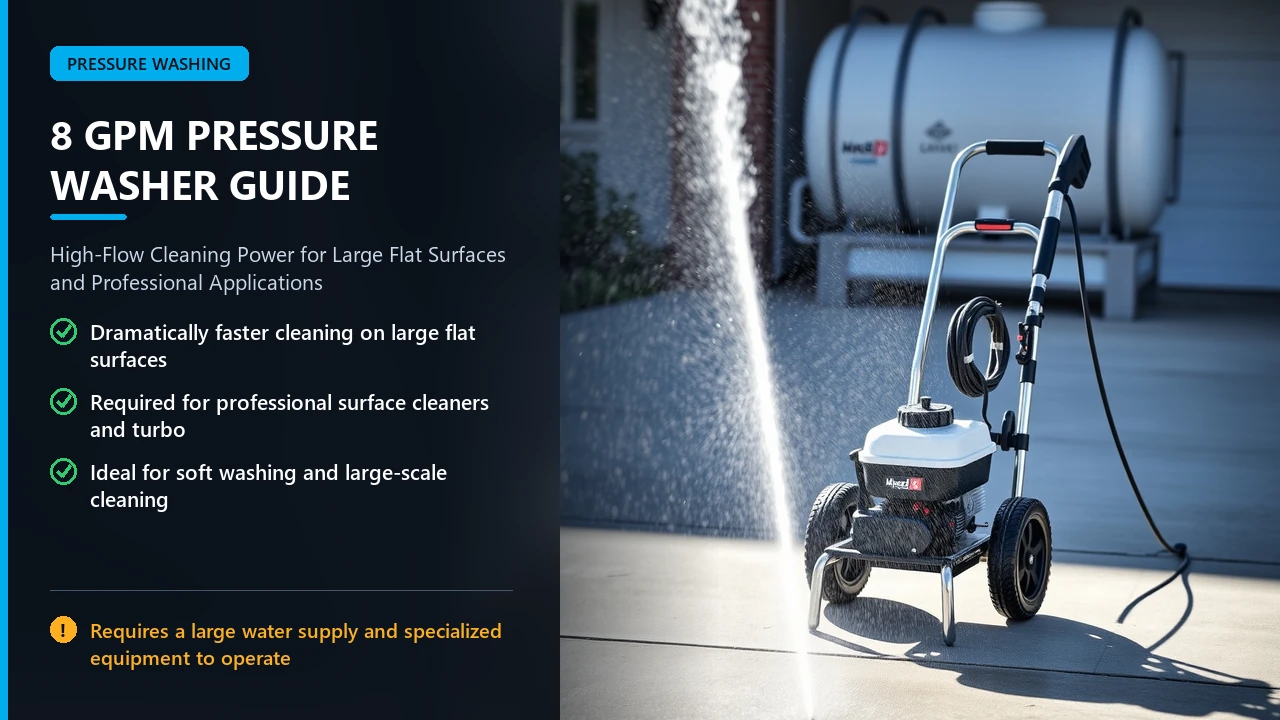
What 8 GPM Actually Means
Pressure washers are rated by two numbers: pressure in PSI and flow in GPM. Pressure determines how hard the water hits the surface, and flow determines how much water is delivered every minute. Most people fixate on PSI because it is the bigger, louder number, but cleaning speed on flat surfaces comes largely from flow. A machine delivering more gallons per minute rinses away loosened dirt faster and covers more area in the same time.
Eight GPM is a serious commercial flow rate. A typical electric homeowner machine runs around 1.2 to 1.5 GPM, and a decent gas residential machine might reach 2.5 to 4 GPM. Commercial machines often run 4 to 6 GPM. At 8 GPM, you are in the range used by professional cleaning crews who work large concrete, fleets, and commercial properties, where time on the job directly affects profit. Our explanation of GPM meaning and pressure washer flow covers the fundamentals, and the look at what GPM is good for a pressure washer explains why flow so often beats PSI alone.
| Machine Type | Typical GPM | Who It Suits |
|---|---|---|
| Electric homeowner | 1.2–1.5 | Cars, patios, light duty |
| Gas residential | 2.5–4 | Driveways, siding, home use |
| Commercial mid-range | 4–6 | Professional cleaning, fleets |
| High-flow commercial | 8+ | Large concrete, surface cleaning |
Why Flow Powers Cleaning Speed
To understand why an 8 GPM machine is so fast, picture washing a driveway with a garden watering can versus a fire hose. Both deliver water, but the hose moves far more volume, so it clears the surface almost instantly. A pressure washer works the same way. Pressure loosens the dirt, but flow is what carries it away and keeps the surface flushing clean.
This is most obvious with surface cleaners, the spinning attachments that clean flat concrete quickly and evenly. A surface cleaner is rated for a range of flow rates, and it only performs at its best when the machine can feed it enough water. Put an 8 GPM machine behind a properly rated surface cleaner and it glides across concrete, cleaning a wide path in one pass. Starve the same cleaner with a low-flow machine and it leaves stripes and requires multiple slow passes. For turbo nozzles and soft washing, the same principle applies: flow is what the attachment needs to work as designed.
Flow also helps with rinsing. After detergent lifts grime, you need enough water to rinse it away completely. High-flow machines rinse faster and more thoroughly, which means less residue, less rework, and less time on site. For a professional, that time savings compounds across every job and every season. Our guide on a power washer 8 GPM with high-flow cleaning that saves hours explores that time savings in detail.
What an 8 GPM Machine Can Do
An 8 GPM pressure washer is built for professional-scale work and shines wherever area and time are the challenge.
Large flat surfaces are the classic use. Driveways, parking lots, sidewalks, and plazas clean dramatically faster with a high-flow machine driving a surface cleaner. Fleet and commercial vehicle washing benefits from the speed and rinsing power, especially on mud-caked trucks and equipment. Soft washing for building exteriors uses higher flow and lower pressure with chemical injection, and 8 GPM machines are well suited to that application. Property maintenance for commercial clients, including dumpster pads, loading docks, and concrete around buildings, is another natural fit.
Where 8 GPM is not needed is light residential work like washing a car or a small patio. For those jobs, the flow is overkill and the machine is harder to supply and tote. The value of 8 GPM appears when you are cleaning large areas professionally and the cost of slow work adds up. Matching the machine to the work is the whole game. Our guide on the best pressure washer for commercial use helps frame that decision.
Types of 8 GPM Machines
You can find 8 GPM machines in several forms, and the right one depends on whether you need portability, hot water, or maximum output.
Most 8 GPM machines are gasoline-powered, because the flow requires an engine large enough to drive a large pump. Cold water 8 GPM machines are common for concrete and general cleaning, while hot water versions add a burner and heater for grease and commercial work. Some are trailer-mounted as complete rigs with a water tank, hose reels, and everything pre-assembled, while others are skid-mounted to drop into a truck bed or onto a trailer, or come as loose machines to build around.
| Setup | Advantages | Best For |
|---|---|---|
| Trailer-mounted 8 GPM | Complete, mobile, ready to work | Professional cleaning crews |
| Skid-mounted 8 GPM | Flexible, fits truck or trailer | Custom builds, contractors |
| Hot water 8 GPM | Grease removal plus high flow | Fleets, industrial, food sites |
| Cold water 8 GPM | Simpler, cheaper, lighter | Concrete, general big-area work |
For most professional use, a trailer-mounted machine makes the most sense because it solves the water supply problem at the same time, carrying a tank that matches the machine’s high demand. If you already have a truck and trailer, a skid-mounted unit gives you flexibility to build the rig you want. Hot water adds capability for grease, at the cost of more weight, fuel, and maintenance. Our guide to picking a commercial pressure washer helps match machine type to the work you actually sell. Pump makers such as General Pump and Cat Pumps publish flow and pressure ratings that make it easier to match a pump to an 8 GPM application, and the Cleaning Equipment Trade Association offers broader equipment guidance for professional cleaners.
The Water Supply Challenge
The single biggest obstacle to running an 8 GPM machine is feeding it. Eight gallons per minute is a lot of water, and most residential supplies cannot deliver it. A typical garden spigot might flow 4 to 6 GPM at best under real conditions, and shared plumbing can be worse. Starve an 8 GPM machine and it will not deliver its rated performance, and you may damage the pump if it runs dry.
The professional solution is a large tank. Trailer rigs for high-flow machines carry generous tanks, often a hundred gallons or more, so the machine has the volume it needs without depending on the site. A buffer tank and feed pump can also keep a high-flow machine supplied even when drawing from a modest source, by staging water in reserve. If you plan to run 8 GPM from a fixed site, you need a high-capacity water source and a supply line sized to match, often three-quarter inch or larger.
Plan the water side as carefully as the machine side. A great 8 GPM machine on a weak supply is a letdown, while the same machine fed from an adequate tank performs exactly as it should. Water supply is not a detail on a high-flow setup; it is the foundation. If you work where water is scarce, our guide on a hose sized for your PSI and GPM helps you move that volume without choking the machine.
Hose, Nozzle, and Accessory Sizing
A high-flow machine demands accessories that can move the water, or the flow never reaches the surface.
Hoses must be sized to match the flow. An undersized hose creates friction loss that robs you of volume and pressure, which defeats the point of an 8 GPM machine. High-flow rigs typically use three-eighth inch or larger high-pressure hose, kept as short as practical, with quality fittings that do not restrict flow. Nozzle size must also match, because a nozzle sized for a low-flow machine will over-pressure the pump even as it under-delivers water. Use a tip size chart to select nozzles matched to your GPM and PSI, and keep spare tips on hand.
For flat surfaces, a surface cleaner rated for 8 GPM is the key attachment, and choosing one that matches your machine’s flow is essential for smooth, streak-free results. Turbo nozzles should also be rated for the flow and pressure you run. Even the unloader and any inline filters must be sized for high flow so nothing in the path restricts the machine. Our look at the surface cleaner washer guide to flawless flat surface cleaning covers matching cleaners to flow rates.
Pressure, Flow, and Balance
High flow does not require extreme pressure, and understanding the balance helps you buy and use the machine wisely.
Many professional 8 GPM machines run at 3,000 to 4,000 PSI, which is plenty for cleaning concrete, fleets, and building exteriors. The combination of solid pressure and high flow is what makes them fast, because the water hits hard enough to loosen grime and flows fast enough to carry it away. You do not need extreme PSI to clean well; you need the right balance of pressure and flow for the surface.
For softer surfaces, you can lower pressure with a wider nozzle or a pressure regulator while keeping the flow high, which is ideal for soft washing and delicate surfaces. That flexibility is one reason high-flow machines are versatile: they can clean concrete aggressively and building exteriors gently, using the same machine with different nozzles and settings. Understanding the balance between pressure and flow lets you get the most from one machine across many types of work.
8 GPM vs Lower-Flow Machines
The jump from a typical commercial machine to 8 GPM changes more than the cleaning speed. It changes the whole support system around the machine.
A 4 GPM machine can run happily from many residential supplies and a modest tank, and it handles a good range of professional work. An 8 GPM machine roughly doubles the flow, which doubles the water it consumes and the speed it cleans, but it also roughly doubles the demand on your supply, tank, and hoses. The machine itself may not cost twice as much, but the complete rig around it does, because everything that touches water must be upsized to match.
| Factor | 4 GPM Machine | 8 GPM Machine |
|---|---|---|
| Cleaning speed on concrete | Moderate | Much faster |
| Water supply needed | Modest spigot or small tank | Large tank or high-capacity source |
| Surface cleaner size | Smaller units | Large, high-flow units |
| Hose sizing | Standard commercial | Larger to avoid restriction |
| Typical user | Many pros, some homeowners | Professional crews, large areas |
The lesson is that higher flow is not simply a better version of a lower-flow machine. It is a different class of equipment that asks more of everything around it. If your water supply, vehicle, and budget can support it, the payoff on big jobs is real. If they cannot, a well-chosen 4 to 6 GPM machine may serve you better and cost far less to run. Choose based on the whole system, not the single number on the machine’s label.
Soft Washing and Specialty Uses
High flow is not only about blasting concrete. Some of the best uses of an 8 GPM machine involve lower pressure and higher volume, which many people overlook.
Soft washing cleans building exteriors, roofs, and delicate surfaces using low pressure, high flow, and cleaning chemicals rather than force. An 8 GPM machine is ideal because it delivers plenty of water to rinse surfaces thoroughly after the chemical does the work, while the pressure stays gentle enough to protect siding, shingles, and paint. This is a major application for professional exterior cleaning, and it is one where flow, not pressure, is the whole point.
Chemical injection systems rely on flow as well. Downstream injectors and dedicated injection pumps need enough water movement to draw and mix chemicals at the right ratio. A high-flow machine keeps that ratio consistent, which means even cleaning and predictable results. On large properties, that reliability matters as much as raw speed.
Beyond exteriors, 8 GPM machines handle large fleet lots, commercial dumpster pads, industrial floors, and construction equipment efficiently, all jobs where thousands of square feet and heavy soil make lower-flow machines slow. The common thread is area: when a job is large, high flow saves so much time that it changes what the work costs to deliver. Our look at a 8 GPM power washer setup for soft washing and big jobs explores these specialty applications further.
Cost and Value
An 8 GPM pressure washer is a significant investment, but for professional work it is a tool that generates income rather than a hobby expense.
Costs include the machine, and often a trailer and tank to feed and move it, plus hoses, reels, surface cleaners, nozzles, and fuel. A complete high-flow rig can represent a real capital outlay, which is why it is usually bought by businesses that bill for cleaning, not by homeowners. The value comes from speed. If an 8 GPM machine and a surface cleaner cut a job from six hours to three, the machine pays for itself in labor and in the extra jobs you can fit into a week.
Weigh the purchase against the work you do. If you clean large areas professionally, the time savings are real and repeatable, and the machine quickly earns its keep. If your work is small and occasional, a lower-flow machine is more sensible, and the extra flow is money and complexity you do not need. Buy for the jobs you have and expect to grow into, rather than the biggest number on the page.
Running and Maintaining an 8 GPM Machine
High-flow machines reward good habits, and a little care keeps them producing.
Confirm a solid water supply before every job, and never let the pump run dry. Check and clean inlet filters regularly, since debris that starves a high-flow pump causes immediate damage. Change engine oil and service the pump on schedule, check and lubricate fittings, and keep hoses in good condition, replacing any that show wear before they burst. If the machine has a hot water heater, winterize it thoroughly and keep the burner serviced so it holds temperature.
Store the rig properly, cover it if it lives outdoors, and drain the system before freezing weather. Because these machines work hard and see heavy use, maintenance is not optional, but it is straightforward. A well-kept 8 GPM machine runs for years and holds its value, while a neglected one fails at the worst moment, usually mid-job with a customer watching.
Frequently Asked Questions
What is an 8 GPM pressure washer used for? It is used for large flat surfaces like concrete, fleet and commercial vehicle washing, soft washing building exteriors, and professional property maintenance where high flow cleans much faster than typical machines.
Is 8 GPM better than high PSI? They work together. Pressure loosens dirt and flow carries it away. For large flat surfaces, high flow often matters more than high pressure because it cleans and rinses far faster.
What water supply does an 8 GPM pressure washer need? It needs about eight gallons per minute, which most residential spigots cannot provide. Professional setups usually use a large onboard tank, or a reserve tank and feed pump, to supply the machine reliably.
Can a homeowner use an 8 GPM pressure washer? They can, but it is usually overkill for home jobs and hard to supply. High-flow machines make the most sense for professional cleaners who work large areas and bill for their time.
Do I need a special hose for 8 GPM? Yes. High-flow machines need a hose sized to move the water without restriction, typically three-quarter inch or larger on the supply side and a properly rated high-pressure hose on the output. Undersized hose chokes performance.
What surface cleaner works with 8 GPM? Choose a surface cleaner rated to handle at least eight gallons per minute. A cleaner fed enough water glides and cleans evenly, while an underfed one leaves stripes and needs extra passes.
Is 8 GPM too much for some jobs? Yes. Light residential work like washing a car or a small patio does not need that volume. For those jobs, a lower-flow machine is easier to supply, cheaper, and gentler where needed.
Can an 8 GPM pressure washer soft wash? Yes, and it excels at it. Soft washing uses low pressure and high flow with chemicals, so an 8 GPM machine rinses surfaces thoroughly while staying gentle on siding, roofs, and paint.
How much water does an 8 GPM machine use per hour? At full flow it uses around 480 gallons per hour, which is why a large tank or a high-capacity supply is essential. Always plan water for the full length of your job plus a margin.
Final Thoughts
An 8 GPM pressure washer is a professional tool built around flow. It cleans large flat surfaces dramatically faster than typical machines, feeds surface cleaners and turbo nozzles the way they were designed to run, and rinses surfaces clean with speed that turns slow jobs into quick ones. For a cleaning business, that speed is income.
The tradeoff is water supply. Feeding eight gallons per minute demands a tank or a serious water source, plus a pump, hose, and attachments sized to match. Plan the water side as carefully as the machine, respect the flow requirements, and maintain the rig, and an 8 GPM machine will pay for itself many times over. If your work is large and professional, the flow is worth every gallon.