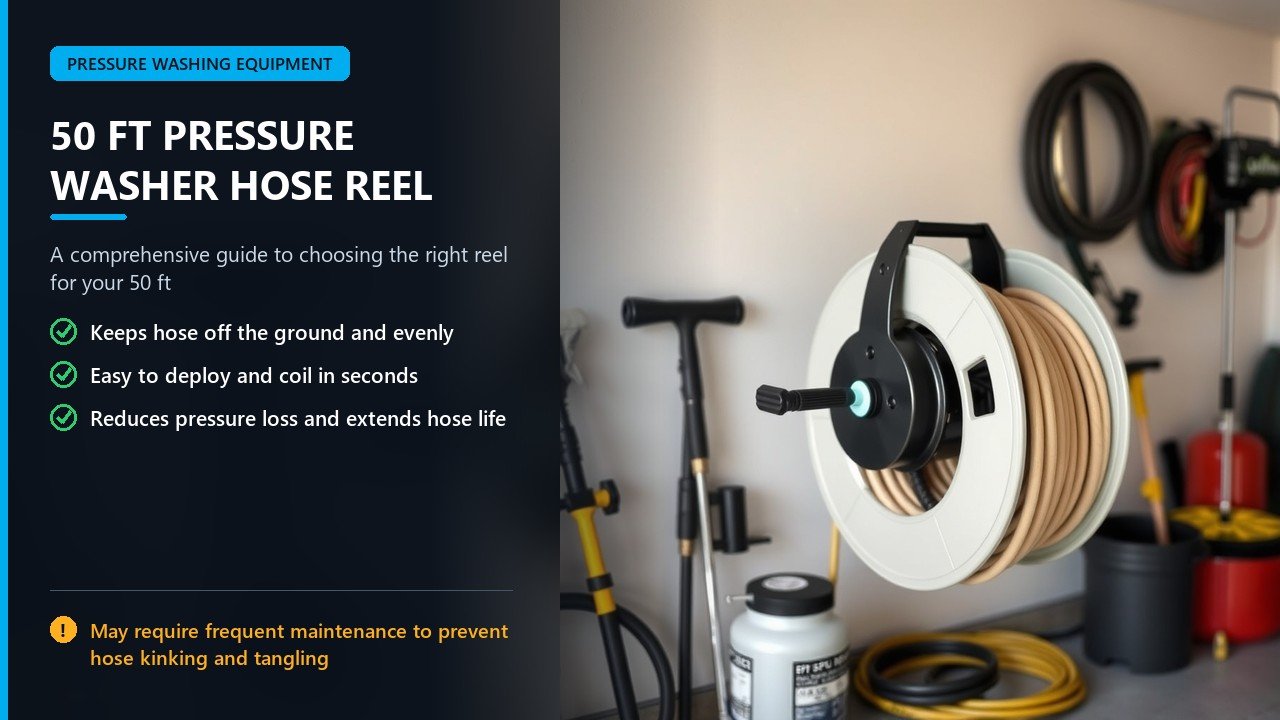
Fifty feet is the quiet hero of pressure washer hose lengths. It is long enough to circle most houses, reach the far end of a two-car driveway, and work around a vehicle without moving the machine, yet short enough that pressure loss stays modest and the coil remains manageable. That balance is why a 50-foot hose is the sweet spot for so many residential setups, and why a 50-foot pressure washer hose reel is one of the most practical storage upgrades an owner can make. A reel sized for that length keeps the hose off the ground, wound evenly, and ready to deploy in seconds, turning the tedious end-of-job coil into a one-minute task. Choosing the right reel for a 50-foot hose, and matching it to the machine and the storage spot, is a small decision with a large payoff in convenience and hose life.
A 50 ft pressure washer hose reel is a reel designed to hold and manage a fifty-foot pressure washer hose, available as a manual-crank, fixed, or retractable unit and mounted on a wall, a cart, or a stand. The reel’s capacity, its pressure rating, and its hose diameter compatibility must match the fifty-foot hose it will store, and the hose itself should be rated for the machine. This guide explains why fifty feet is a common and effective length, what to look for in a reel to hold it, the reel types and their trade-offs, how to mount and install one, how the reel interacts with pressure and flow, the maintenance a reel needs, and how to pair the reel and hose for a clean, reliable setup.
Why Fifty Feet Is the Sweet Spot
Understanding why this length works explains why a reel for it is worth owning.
Enough reach for most homes. Fifty feet reaches the far side of a typical driveway, around most single-family houses, and down a long walkway, which covers the majority of residential cleaning. It is long enough to avoid repositioning the machine constantly. Our guide to hose reach covers the sizing.
Modest pressure loss. Every foot of hose costs a little pressure through friction, and fifty feet is short enough that the loss stays small on most machines, preserving the machine’s performance. A much longer hose would noticeably soften the spray. Our guide to how diameter affects flow explains the loss.
Manageable coiling. Fifty feet coils in a reasonable loop without the bulk of a hundred-foot hose, so even a manual reel handles it comfortably and a coil on the machine stays tidy. The length avoids the tangle of a very long hose. Our reel guide covers the storage.
Balanced flexibility. The fifty-foot length balances reach against weight and handling, being long enough to work with and short enough not to drag and kink as readily as a longer hose. It is a practical compromise that suits most operators. Our guide to the 50-foot hose covers the length in depth.
What a 50-Foot Reel Must Match
The reel and the fifty-foot hose have to agree on several specs for the pairing to work.
Capacity in feet and diameter. A reel’s capacity is stated as a length at a specific hose diameter, so a reel rated for fifty feet of quarter-inch hose will hold that, but not fifty feet of a larger diameter. Match the stated capacity to your hose’s length and diameter exactly. Our guide to the hose specs covers the sizing.
Pressure rating. The reel, including its swivel, must be rated above the machine’s working pressure with margin, because the swivel is a pressure point that can leak or fail. A reel rated for a small machine is not safe on a large one. Our guide to hose ratings covers the numbers.
Hose diameter supported. The reel must accept the diameter of the hose, typically quarter-inch for residential machines or three-eighths-inch for larger units, and its drum and guide must fit that diameter. A reel built for a narrow hose may not accept a larger one. Our diameter guide covers the sizes.
Connector compatibility. The reel’s inlet and outlet must match the hose and the machine’s connections, usually with M22 or quick-connect fittings. A reel whose connectors do not match needs adapters, which add leak points. Our guide to fittings covers the connectors.
The hose’s own rating. Beyond the reel, the fifty-foot hose must be rated for the machine, with the right diameter and pressure rating, because the reel does not change the hose’s requirements. Choose the hose for the machine first, then the reel for the hose. Our buying guide covers the hose.
Reel Types for a 50-Foot Hose
The three reel families each suit different owners and setups.
Fixed reel. The simplest and most durable, a fixed reel stores the hose without a rewind mechanism, requiring the operator to coil it by hand onto the reel. It is inexpensive, has nothing to wear out, and suits an owner content to coil manually. Our guide to hose reels covers the family.
Manual crank reel. A hand-crank reel winds the hose with a handle, which is easier than coiling by hand and still simple and durable, with only a crank mechanism to maintain. It is a good middle choice for a 50-foot hose, which is light enough to crank comfortably. Our wall-mounted guide covers the manual setup.
Retractable reel. A spring-driven reel winds the hose automatically with a tug, the most convenient option, at the cost of a spring, ratchet, and swivel that need care and a hose flexible enough to wind tightly. For frequent use, the convenience is worth it. Our guide to retractable reels covers the mechanism.
Cart-mounted versus wall-mounted. A cart-mounted reel travels with the machine, while a wall-mounted reel stays at the cleaning station and keeps the hose tidy there. For a machine that moves around the property, a cart reel is convenient; for a fixed cleaning spot, a wall reel is ideal. Our wall-mounted guide covers the siting.
| Reel Type | Effort | Best For |
|---|---|---|
| Fixed | Coil by hand | Low cost, simple |
| Manual crank | Crank | Balance of ease and cost |
| Retractable | Auto with a tug | Frequent use |
Mounting and Installing the Reel
A 50-foot hose is light enough to make mounting straightforward, but the fundamentals still apply.
Mount to solid structure. Whether wall or post, mount the reel to solid framing, studs, or a sturdy stand, not to drywall or thin paneling, because even a manual reel bears the hose’s weight and pull. Solid mounting prevents the reel from tearing loose. Our wall-mounted guide covers the mounting.
Choose the height for reach. Mount the reel at a height that keeps the hose off the ground when stored yet lets the operator pull it comfortably, often around chest height. The right height depends on the operator and the hose run. Our wall-mounted guide covers the siting.
Connect the inlet properly. Feed the supply from the machine to the reel’s inlet, and the working hose from the outlet to the gun, matching connectors and sealing the swivel, which is the most leak-prone part. Our weeping-seal guide covers the sealing.
Add a leader hose if needed. If the reel sits far from the machine, a short leader hose from the machine to the reel inlet keeps the connection clean and lets the reel be positioned conveniently. The leader stays fixed while the fifty-foot hose does the working. Our reel guide covers the accessory.
Set tension on a retractable reel. For a retractable unit, adjust the spring tension so the fifty-foot hose retracts under control and holds at the working length, following the maker’s procedure. Proper tension makes the reel a pleasure and prevents a slamming retract. Our retractable guide covers the adjustment.
Test the whole setup. After installation, pressurize briefly and check the swivel, inlet, and outlet for leaks, and confirm the machine builds pressure. A quick test prevents a mid-job leak at the reel. Our pressure troubleshooting guide covers the diagnosis.
The Reel, Pressure, and Flow
A reel adds convenience, and it interacts with pressure and flow in a few ways worth understanding.
The swivel is a restriction and a seal. The reel’s inlet swivel is both a potential flow restriction and the common leak point, so a quality swivel matters. A narrow or worn swivel can cost a little flow or weep under pressure. Our swivel guide covers the sealing.
Fifty feet keeps loss modest. Because the stored hose is only fifty feet, the friction loss stays small, so the reel does not meaningfully reduce the machine’s performance at this length. A longer hose on the same reel would cost more pressure. Our diameter guide covers the loss.
Diameter still rules. The reel does not change the hose’s diameter, so the diameter choice still governs flow, and a larger diameter reduces loss on longer or higher-flow setups. Pick the diameter for the machine, then the reel for that hose. Our diameter guide covers the sizing.
Avoid stacking restrictions. Adding a leader hose, adapters, or multiple connectors at the reel stacks flow restrictions, so keep the path from the machine to the gun as simple as the setup allows. Fewer joints mean less restriction and fewer leaks. Our fitting guide covers the connectors.
Match the reel to the machine’s class. A residential 50-foot reel and hose suit a residential machine, while a high-flow commercial machine needs a reel and swivel rated for its pressure and flow. Match the reel to the machine’s class. Our buying guide covers the match.
Choosing the Hose for the Reel
The fifty-foot hose on the reel should be chosen for the machine and for reel compatibility.
Match the machine’s rating and flow. Choose a hose rated above the machine’s pressure and in a diameter that suits its flow, so the reel delivers the machine’s full performance. The hose is the machine’s link to the work. Our guide to the 50-foot hose covers the choice.
Choose flexibility for the reel. A hose that winds neatly on the reel should be flexible enough to coil without kinking, especially on a retractable reel that winds it tightly. A stiff hose fights the reel and kinks as it winds. Our retractable guide covers the flexibility need.
Prefer a manageable weight. A fifty-foot hose is noticeably lighter than a hundred-foot one, which makes cranking and pulling easier, especially on a manual reel. The length itself is an ergonomic advantage. Our hose reach guide covers the trade.
Check the connectors match. The hose ends must match the reel and the gun, ideally with quick connect for fast changes, so the whole setup works as a unit. Our quick connect guide covers the standard.
Consider a matched reel-and-hose kit. Some makers sell the reel and hose together, ensuring the capacity, diameter, and connectors agree, which removes the guesswork of matching separately. A kit is a convenient route to a guaranteed fit. Our buying guide covers the kits.
Maintaining a 50-Foot Reel Setup
Simple care keeps the reel and hose working for years.
Seal and inspect the swivel. The swivel is the reel’s common leak point, so check it for weeping and replace its o-rings as needed, since a leaking swivel corrodes the mechanism over time. Our weeping-seal guide covers the repair.
Do not over-stretch a retractable spring. Pull the hose only within the reel’s rated length, because over-stretching weakens the retract and forcing a binding reel damages the mechanism. Respect the reel’s range. Our retractable guide covers the limits.
Coil or crank evenly. Wind the hose evenly on the drum without crossing turns, whether by crank or by guiding a retract, so the hose stores without kinks and the reel stays balanced. Even winding protects the hose and the reel. Our reel guide covers the technique.
Keep it off abrasive and wet floors. Storing the hose on the reel off the floor protects it from abrasion and damp, extending its life. Our storage guide covers the placement.
Drain and winterize. Drain the hose and reel before freezing weather, because trapped water splits the hose and can damage the swivel. Our winterizing guide covers the drain.
Guide the hose on retract. On a retractable reel, guide the hose in rather than letting it snap back, to prevent whipping and uneven winding. Controlled retraction is both safer and tidier. Our retractable guide covers the habit.
Where the 50-Foot Reel Should Live
The reel’s placement determines how convenient the setup is and how well it protects the hose.
A fixed cleaning station. A wall-mounted reel at a dedicated cleaning station, near a spigot and a power or parking spot for the machine, keeps the whole setup in one tidy place. The hose stays coiled and dry, and the machine rolls up to a ready station. It is the cleanest arrangement for a homeowner who cleans in a consistent spot. Our wall-mounted guide covers the station.
A portable cart setup. A cart-mounted reel travels with the machine, which suits an owner who cleans multiple properties or moves the machine around the yard. The hose and reel move together, so the setup deploys anywhere the machine goes. Our frame guide covers the cart construction.
Near the machine’s parking spot. If the machine has a home in the garage, mount the reel nearby so the hose stores at the machine, keeping the two together and preventing the hose from being left on the floor. A reel beside the machine’s parking spot is the natural choice.
Out of direct harsh sun and off the floor. Ultraviolet light and damp degrade a hose over years, so a reel in shade and off a wet floor extends the hose’s life. Even a good hose suffers if stored in the open sun and on damp concrete. Our hose care notes cover the protection.
Reachable but out of the way. The best placement is easy to reach for pulling and winding yet out of the walking path, so the setup is convenient without creating a trip hazard. Convenience and safety both favor deliberate placement. Our safety gear guide covers the site habits.
Accessories That Complete the Setup
A few small additions make a fifty-foot reel setup cleaner and faster to use.
A swivel at the gun. A swivel between the working hose and the gun lets the gun rotate without twisting the hose at the reel, reducing kinks and helping the hose wind evenly. It is a small part with a real effect on how the reel behaves. Our swivel guide covers the upgrade.
A leader hose for the inlet. A short fixed leader from the machine to the reel inlet keeps the supply connection tidy and lets the reel sit where it is most useful, rather than where the machine happens to be. The leader stays put while the fifty-foot hose moves. Our reel guide covers the arrangement.
A quick-connect set at the working end. Standardizing the connection between the hose and the gun and accessories on quick connect makes swaps fast and keeps the setup clean. It pairs naturally with a reel that already tidies the hose. Our guide to quick connect covers the standard.
A nozzle holder or organizer. A place to keep the nozzles and accessories at the reel station keeps the setup organized and the right tip at hand, which speeds up a job and reduces searching. Our accessory guide covers the organizer.
A small spares kit at the reel. O-rings for the swivel, a spare connector, and a wrench turn a mid-job leak into a quick fix, and the reel is where leaks most often appear. A station with a few spares stays productive. Our weeping-seal guide covers the repair.
A protective cover for the reel. If the reel is stored where dust, sun, or weather reach it, a simple cover protects the mechanism and the hose, extending both. It is a cheap addition with a clear payoff. Our storage guide covers the protection.
Common Mistakes With a 50-Foot Reel
Mismatching reel capacity and hose. A reel rated for a different length or diameter will not store your hose cleanly. Match both.
Under-rating the reel. A reel and swivel rated below the machine leak or fail. Match the pressure rating.
Mounting to drywall. The hose’s pull can tear a reel off weak material. Mount to solid framing.
Ignoring the swivel. The swivel is the common leak point. Check and reseal it.
Over-stretching a retractable spring. It weakens the retract. Respect the rated length.
Letting the hose retract uncontrolled. It whips and winds unevenly. Guide it in.
Storing it wet and freezing. Trapped water splits the hose. Drain before the cold.
Frequently Asked Questions
What reel do I need for a 50-foot pressure washer hose? A reel whose stated capacity matches fifty feet at your hose’s diameter, rated above your machine’s pressure, with connectors that match your hose and gun.
Is 50 feet a good hose length? Yes. It reaches most residential areas, keeps pressure loss modest, and stays manageable to coil, which is why it is a common sweet spot.
Can I put a 100-foot hose on a 50-foot reel? No. A reel rated for fifty feet will not neatly hold a hundred feet, especially at the same diameter. Match the reel’s capacity to the hose.
Should I choose a retractable or manual reel for 50 feet? A fifty-foot hose is light enough for a manual crank reel, while a retractable reel adds convenience for frequent use. Choose by how often you use the machine.
Does a reel reduce pressure? A reel adds a swivel and a small restriction, but at only fifty feet the loss is minor. A worn or narrow swivel can cost a little flow, so choose a quality reel.
How do I maintain a 50-foot hose reel? Keep the swivel sealed, wind the hose evenly, avoid over-stretching a retractable spring, keep it off wet floors, and drain it before freezing weather.
Final Thoughts on the 50 Ft Pressure Washer Hose Reel
The 50 ft pressure washer hose reel pairs the most practical residential hose length with the storage that makes it pleasant to use. Fifty feet reaches most homes and hardscapes while keeping pressure loss modest and the coil manageable, and a reel sized for that hose keeps it off the ground, wound evenly, and ready in seconds, protecting it from abrasion and kinks in the bargain. Whether the reel is fixed, manual-crank, or retractable, the deciding factor is matching its capacity, pressure rating, and connectors to the fifty-foot hose and the machine.
Choose the hose for the machine’s pressure and flow, then the reel for the hose, confirming that the capacity is stated for that length and diameter and that the swivel is rated for the pressure. Mount it to solid structure at a workable height, seal and inspect the swivel, wind the hose evenly, and drain it before freezing weather. Respect a retractable reel’s spring and guide the hose in on every retract. Do these things, and the fifty-foot reel turns the end-of-job coil into a moment’s work while keeping the machine’s performance intact, which is exactly the practical value this popular length and its reel provide.