When a pressure washer hose fails, the search for a replacement often turns up a name the owner has never heard before: Propulse. It appears in listings as a specific replacement hose, sometimes as an upgrade from a stiff factory line, and owners reasonably ask what it is, whether it fits their machine, and whether it is worth buying. The honest answer is that Propulse is one of several hose brands serving the pressure washer market, and like any hose, its value depends on matching its construction and rating to the machine and the job. A hose is not a generic part; the wrong one leaks, kinks, bursts, or quietly robs the machine of pressure. Understanding what a Propulse pressure washer hose is, how to read its ratings, how to confirm it fits, and how to judge it against the alternatives is how an owner turns a confusing listing into a sound purchase.
A Propulse pressure washer hose is a replacement or upgrade high-pressure hose sold under the Propulse name, intended to carry water from the pump to the spray gun. Like every pressure washer hose, it is defined by a handful of specifications: its maximum pressure rating, its inner diameter, its length, its connector type, and its construction, which together determine whether it suits a given machine. This guide explains what to look for in a Propulse hose, how a hose’s ratings map to real use, how to confirm fit and connectors, how it compares with other hose options, the maintenance and troubleshooting that apply to any hose, and how to decide whether it is the right replacement for your machine.
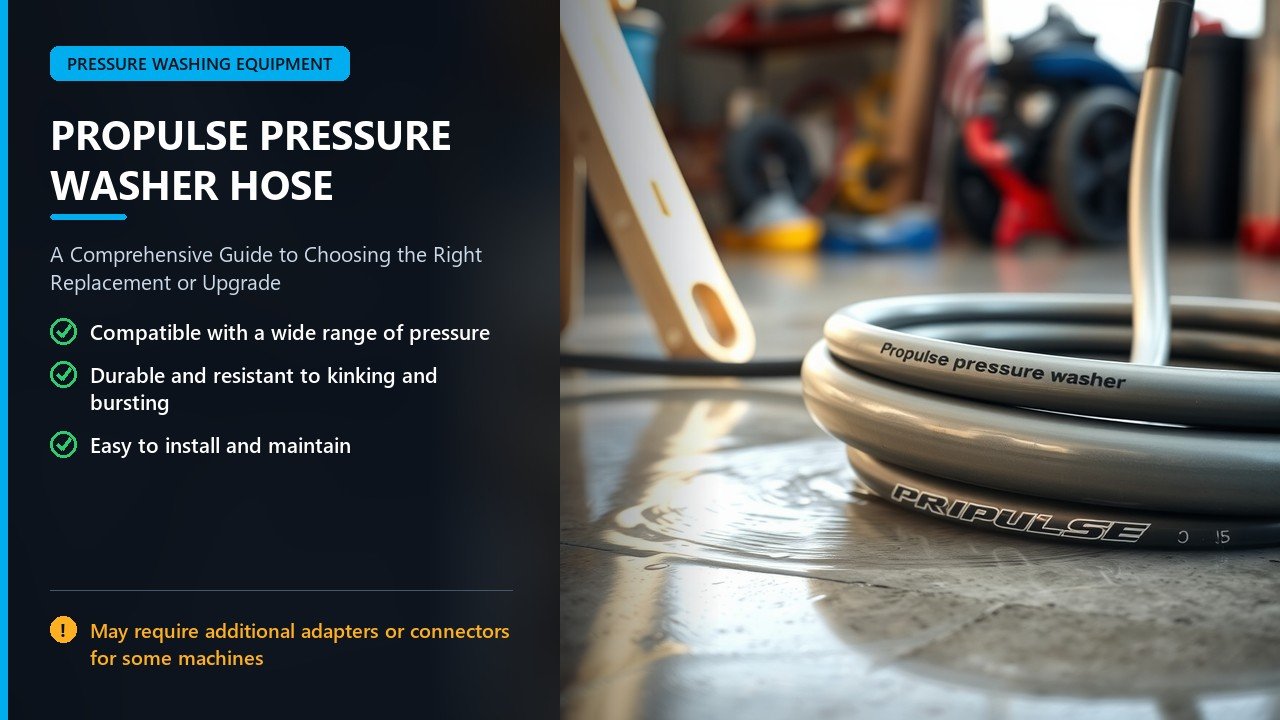
What a Pressure Washer Hose Has to Do
Before judging any specific hose, it helps to state the job the hose must perform.
Carry high-pressure water without bursting. The hose sits downstream of the pump and carries water at the machine’s full working pressure, so it is built with reinforcement layers to resist internal pressure without rupturing. The pressure rating is the hose’s most important number, and a hose rated below the machine’s output is a burst waiting to happen. Our guide to preventing hose burst failures covers the ratings.
Resist kinking and abrasion. The hose is dragged over concrete, around corners, and coiled repeatedly, so it must resist kinking under pressure and abrasion on rough surfaces. A hose that kinks shuts off flow and can burst at the kink; a hose that abrades eventually weeps. Construction quality shows up here over time.
Deliver the machine’s flow without choking it. The hose’s inner diameter must match the machine’s flow needs, because an undersized hose adds friction and costs pressure at the nozzle. Diameter is the quiet spec that determines whether the machine performs at its rated ability. Our guide to how diameter affects flow explains the relationship.
Fit the machine and the operator. The hose’s connectors must match the pump outlet and the gun inlet, and its length must suit the job. A hose that does not fit, or that is far too short or long for the work, is the wrong hose no matter how good its construction. Fit and length are as important as the pressure rating.
Reading a Propulse Hose Spec
A Propulse listing presents a set of numbers, and reading them correctly is the whole decision.
Maximum working pressure. Look for the hose’s maximum working pressure, and choose one rated above your machine’s output with margin. A common residential hose is rated around 3,000 to 4,000 PSI, while heavier lines reach higher. If the hose’s rating is below your machine’s, it is not the right hose, whatever else it offers.
Burst pressure versus working pressure. Listings sometimes quote a burst pressure, which is far higher than the safe working pressure. Burst pressure is the point of catastrophic failure, not the rating to run at, so size to the working pressure and treat the burst figure as the margin that protects it. Do not confuse the two.
Inner diameter. Propulse hoses typically come in standard diameters, most often a quarter-inch for residential machines and three-eighths-inch for larger, higher-flow units. Match the diameter to your machine’s flow, and upsize for long runs, since a narrow long hose chokes a high-flow machine. Our diameter guide covers the sizing.
Length. Hoses come in lengths from short 25-foot lines to long 100-foot runs. Choose a length that reaches your work without excess, because extra length costs pressure through friction. For a residential machine, a 50-foot hose is often the sweet spot; for larger areas, consider the 100-foot trade. Our guides to the 50-foot and 100-foot hoses help.
Connector type and thread. The hose ends must match the pump and gun, usually with M22 threaded fittings or a quick-connect interface. Confirm the thread and connector style before buying, since a hose with the wrong ends is useless without adapters. Our guide to hose fittings identifies the ends.
| Spec | What to Match | Why It Matters |
|---|---|---|
| Working pressure | Above machine output | Prevents bursts |
| Inner diameter | Machine flow | Preserves pressure |
| Length | The job’s reach | Balance friction vs. reach |
| Connectors | Pump and gun | Ensures fit |
Confirming Fit for Your Machine
Fit is the most common reason a replacement hose disappoints, and confirming it takes a minute.
Identify your pump outlet and gun inlet. Check the threads or connectors on your machine’s pump outlet and on the spray gun inlet, which are usually M22 on pressure washers but may differ by brand. Note the type and size, and compare them to the hose’s ends. Our fitting guide helps identify what you have.
Match the pressure and flow, not just the thread. A hose can fit the threads and still be wrong if its pressure rating is too low or its diameter too small. Confirm all three, pressure, diameter, and connector, before buying. A too-small hose on a high-flow machine is a common mismatch that shows up as weak pressure.
Check for adapters if needed. If the hose’s connectors do not match your machine, adapters can bridge the difference, but each adapter adds a flow restriction and a potential leak. Prefer a hose whose ends match directly, and use adapters only when necessary. Our fitting guide covers the adapter options.
Consider quick connect for convenience. If your machine uses quick connect, choose a hose with quick-connect ends so it swaps in seconds. Standardizing the whole setup on quick connect makes hose changes fast and clean. Our guide to wand quick connect covers the standard that shares it.
Propulse Versus Other Hose Options
Propulse competes with many hose brands, and the comparison comes down to construction and value rather than name.
Construction quality. The best hoses use multiple reinforcement layers, a durable outer cover, and fittings secured to withstand pressure and repeated flexing. A well-built hose from any reputable brand outperforms a cheap hose from a famous one. Judge construction by the reinforcement description, the outer jacket, and the fitting crimp, not by branding alone.
Flexibility and handling. Some hoses are stiff and hard to manage, especially in cold weather, while others stay flexible. A flexible hose is far easier to work with and coils neatly, which matters on every job. If reviews mention stiffness, weigh that against your climate and patience.
Price and value. A replacement hose should be priced sensibly against its rating and construction, and a mid-priced hose from a known maker usually delivers better value than either a bargain line or a premium one that offers little extra for the money. Compare like for like on the specs before deciding the name is worth a premium. Our buying guide’s value section covers the judgment.
Availability and support. A hose whose brand is easy to reorder and whose maker honors warranties is a safer purchase than an obscure line, because pressure washer hoses do eventually fail and a supported replacement is easier. Consider whether you can buy the same hose again when the time comes.
What matters least. The label. A Propulse hose that meets your specs will serve as well as any, and a competitor’s hose that meets them better will serve better, regardless of name. Buy on the numbers and the construction, and the brand becomes a tiebreaker rather than the decision. Our buying guide covers the full criteria.
Installing and Maintaining the Hose
Once chosen, a hose gives long service with a little care.
Seal the connections. Use the correct o-rings and thread sealant where specified, and tighten connections snugly without over-torquing brass fittings. A hose that weeps at the connector usually needs a new o-ring or a resealed thread, not replacement. Our weeping-seal guide covers the fix.
Keep it off abrasive surfaces. Dragging a hose over rough concrete and sharp edges wears the outer cover and eventually the reinforcement. Route it along smooth paths where possible, and avoid running it through standing water or over broken glass. Abrasion is a leading cause of hose failure.
Avoid kinks and sharp bends. A kink under pressure concentrates stress and can burst the hose, so keep the hose as straight as practical and avoid bending it sharply at the fittings. A swivel between the hose and the gun reduces kinking at the connection. Our guide to hose swivels covers the upgrade.
Coil it properly for storage. Coil the hose in large, even loops rather than tight wraps, and store it out of harsh sun and freezing temperatures. Proper coiling prevents kinks and stress at the fittings, and shade slows the outer cover’s degradation. Our reel guide’s storage section covers the tidy option.
Winterize the hose. A hose left full of water in freezing weather splits from the inside, so drain it completely before cold storage. This is part of winterizing the machine, and it applies to every hose on the setup.
How a Pressure Washer Hose Fails Over Time
Understanding the failure modes helps an owner spot trouble early and get full life from a hose.
Abrasion wears the cover and the reinforcement. The outer jacket takes the daily abuse of dragging over concrete, brick, and gravel, and once it wears through, the reinforcement layers are exposed and weakened. A hose with a rubbed-through spot near a fitting is a failure waiting to happen, and rerouting it off abrasive surfaces is the prevention. Abrasion is one of the most common causes of an early hose death.
Kinking fatigues the wall. Every sharp kink under pressure concentrates stress at one point in the hose wall, and repeated kinking at the same spot eventually cracks the reinforcement and bursts the hose. A swivel at the gun, careful routing, and avoiding tight bends reduce the fatigue that leads to a kink burst. Our swivel guide covers the reduction.
Age embrittles the cover. Ultraviolet light and ozone from the sun and the environment harden and crack the outer cover over years, and a stiff, cracked cover signals a hose near the end of its life. Storing the hose out of harsh sun extends the cover’s life, and recognizing the brittle stage prevents a sudden failure. Our storage notes pair with the reel options.
Fitting failure at the crimp. The connection between the hose and its end fitting is a common failure point, whether from a poor crimp, corrosion, or stress from yanking the hose by the fitting. Never pull a pressure washer hose by its end fittings, and inspect the crimps for weeping or bulging. A failing fitting is dangerous at pressure.
Freeze failure from trapped water. A hose stored wet in freezing weather splits from the inside as the water expands, and the damage often shows only when the hose is pressurized. Draining the hose completely before cold storage prevents this entirely. Our winterizing guide covers the drain.
Over-pressure failure. Running a hose above its rating, whether by mismatching it to a bigger machine or by a stuck unloader spike, stresses the reinforcement and shortens the hose’s life or bursts it outright. Matching the rating to the machine and keeping the unloader healthy are the safeguards. Our buying guide covers the rating.
Repair or Replace the Hose
When a hose misbehaves, the choice between fixing and replacing is usually clear.
Fix the connections first. A leak at the connector is nearly always an o-ring or thread issue, not a hose failure, so replace the o-ring or reseal the thread before condemning the hose. This is the most common problem and the cheapest fix. Our weeping-seal guide covers the repair.
Replace a bulging or burst hose. A bulge or a burst means the reinforcement has failed, and there is no safe repair. Replace the hose immediately, because the next failure under pressure is dangerous. Do not tape or patch a burst section and keep working. Our buying guide covers the replacement choice.
Replace a hose worn through to the reinforcement. Once abrasion has exposed the reinforcement layers, the hose’s strength is compromised and it should be replaced. A worn-through hose is on borrowed time, and the failure comes without warning. Prevention by rerouting saves the hose before this point.
Replace a permanently stiff, cracked hose. A hose whose cover has gone brittle and cracked has reached the end of its service life, and it will kink and burst more readily. A fresh hose restores flexibility and reliability, and it is usually cheaper than the frustration of a stubborn old line. Our buying guide’s value section helps pick the replacement.
Extend life with care. Between replacements, proper coiling, off-abrasive routing, avoided kinks, clean fittings, and dry storage all add years to a hose’s service. Most pressure washer hoses fail from neglect rather than defect, so the habits that prevent abrasion, kinks, and freezing are the same habits that let a good hose earn its price. Our maintenance notes pair with the buying guide.
Troubleshooting Hose Problems
Most hose issues have a known cause, and identifying it saves a premature replacement.
Leaking at the connectors. Almost always a worn or missing o-ring or an under-sealed thread, not a failed hose. Replace the o-ring and reseal the thread first, and only replace the hose if the leak persists at a split or a fitting crimp. Our weeping-seal guide covers the repair.
Kinking and flow loss. A hose that kinks easily is either too stiff, too long, or routed poorly. Reroute it, shorten it, or replace it with a more flexible hose, and add a swivel to reduce kinks at the gun. A kink under pressure is a burst risk, so address it.
Bursts and bulges. A bulge or a burst means the hose’s reinforcement has failed, often from age, abrasion, or running above its rating. A bulging hose must be replaced immediately, since the failure is imminent and dangerous. Check that the replacement’s rating matches the machine.
Weak pressure. If a new hose costs pressure, suspect an undersized diameter, an excessive length, or a restrictive adapter at the connection. Confirm the diameter and length suit the machine, and remove unnecessary adapters. Our diameter guide covers the diagnosis.
Stiffness in cold weather. Some hoses harden in the cold and become difficult to manage, which is a materials issue rather than a fault. If cold-weather handling matters, choose a hose rated for flexible cold performance. Our buying guide covers the material choice.
Common Mistakes When Buying a Replacement Hose
Choosing on brand alone. The specs matter more than the name. Match pressure, diameter, length, and connectors to your machine.
Ignoring the pressure rating. A hose rated below the machine’s output can burst. Size to the working pressure with margin.
Undersizing the diameter. A narrow hose chokes a high-flow machine. Match the diameter to the flow.
Wrong connectors. A hose with the wrong ends needs adapters or does not fit. Confirm the threads before buying.
Buying a needlessly long hose. Extra length costs pressure. Choose the length the job needs.
Confusing burst and working pressure. Run at the working pressure and treat burst pressure as margin, not a target.
Neglecting o-rings and storage. Most leaks are o-rings, and most long-term damage is abrasion and freezing. Maintain and store the hose well.
Frequently Asked Questions
What is a Propulse pressure washer hose? A replacement or upgrade high-pressure hose sold under the Propulse brand. Its suitability depends on its pressure rating, diameter, length, and connectors matching your machine.
Will a Propulse hose fit my pressure washer? It will if its connectors match your pump outlet and gun inlet, usually M22, and its pressure rating and diameter suit your machine. Confirm all four specs before buying.
What pressure rating do I need in a hose? Choose a hose rated above your machine’s working pressure with margin, so the hose runs safely below its limit. For a 3,000 PSI machine, a 3,000 to 4,000 PSI hose is typical.
What diameter hose should I get? A quarter-inch hose suits most residential machines, while three-eighths-inch suits larger, higher-flow units and long runs. Match the diameter to your machine’s flow.
How long should my replacement hose be? Long enough to reach your work with a little slack, and no longer, because length costs pressure through friction. A 50-foot hose is a common residential choice.
Is a pricier hose worth it? Only if its construction, rating, and flexibility actually exceed a mid-priced hose. Buy on the specs and build quality, and treat the brand as a tiebreaker.
Final Thoughts on the Propulse Pressure Washer Hose
A Propulse pressure washer hose is a replacement or upgrade line judged by the same specs as any other: its maximum working pressure, its inner diameter, its length, and its connectors, each of which must match the machine it serves. The brand is a tiebreaker, not the decision. A hose rated above your machine’s output, in the diameter that suits its flow, in the length your work needs, with ends that fit your pump and gun, will perform well whatever name it carries, and a competitor’s hose that meets those specs better is simply the better buy.
Confirm fit with a quick look or photo of your connectors, choose construction and flexibility that suit your climate and jobs, install it with proper o-rings and snug fittings, and maintain it by keeping it off abrasive surfaces, avoiding kinks, coiling it well, and draining it before freezing weather. Most hose problems are o-rings and routing rather than the hose itself, so diagnose before replacing. Choose deliberately, treat the hose as the wear part it is, and the replacement you pick will carry the machine’s full pressure reliably for seasons, turning a confusing listing into a straightforward, well-chosen upgrade.