Marcos details cars out of a two-bay garage, and for the first three years he fought the same battle every Saturday morning. The stock hose that came with his washer was a stiff blue coil with a memory of its own. It would roll itself back into a pigtail the moment he set it down, loop under a client’s tire, and pinch shut right at the base of the gun whenever he stepped backward around a fender. He lost count of how many times he stopped mid-panel, walked back, straightened the line, and lost his rhythm.
Then a supplier talked him into an Uberflex hose as a replacement. He noticed the difference before he even pulled the trigger: it laid flat on the concrete like an extension cord instead of a coiled snake. A year later, having put several hundred job sites through it, he will tell you it was the cheapest quality-of-life upgrade he ever made to the machine, and also that it is not perfect for every setup.
That honest, balanced view is what this guide aims to give you. Below is a full look at the Uberflex pressure washer hose, including who actually builds it, how the kink resistance works, which fittings it threads onto without adapters, where it falls short of heavier commercial lines, and how to pick the right length and diameter for your machine before you spend a dollar.
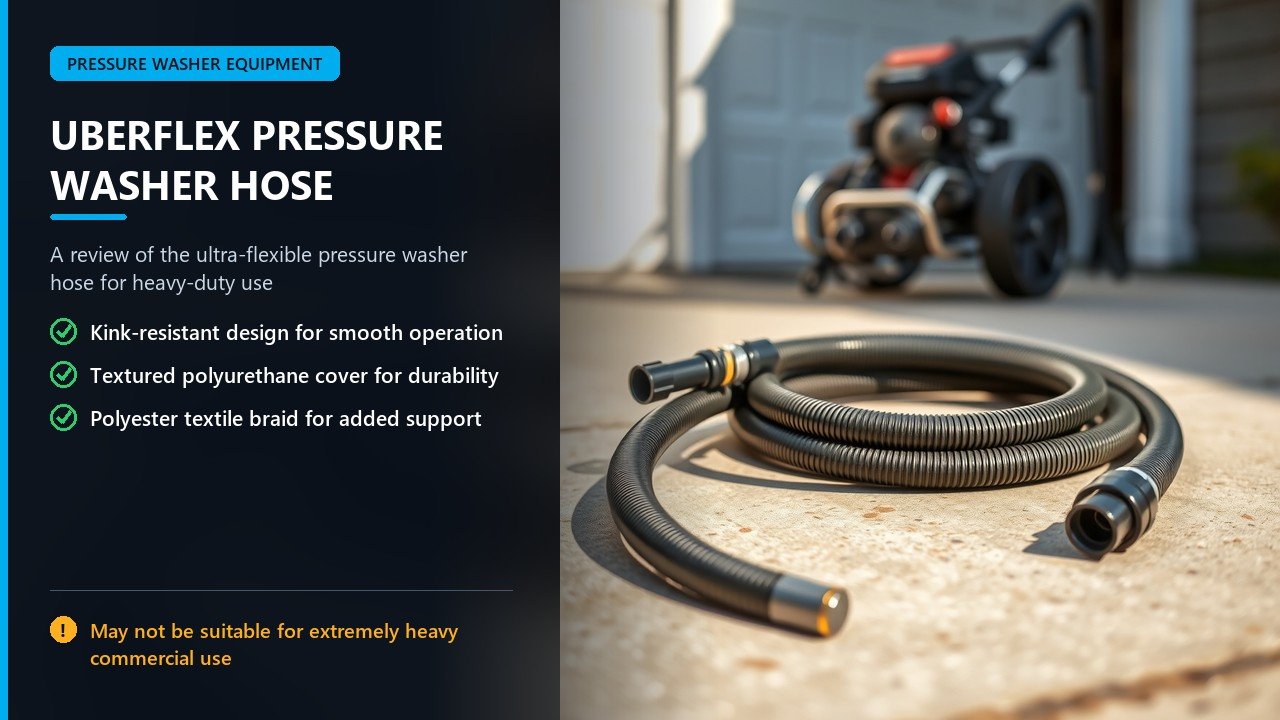
What the Uberflex Pressure Washer Hose Actually Is
Uberflex is not a pressure washer brand and it is not a knockoff of somebody else’s design. It is a purpose-built high-pressure hose line produced by ProPulse, a manufacturer that supplies hoses to both consumer and commercial equipment makers. Plenty of washers you have probably shopped for ship with an Uberflex from the factory, which is why the name keeps coming up in reviews and forum threads.
The design brief behind the Uberflex pressure washer hose is straightforward. Standard hoses use a PVC or vinyl outer jacket that stiffens in cold weather, curls permanently where it was coiled, and grips itself when it crosses over. Uberflex replaces that with a matte, lightly textured polyurethane cover bonded to a high-tensile polyester textile braid. The result is a line that behaves more like a heavy-duty extension cord than a plumbing hose: it bends around tight corners, drops into a loose coil when you let go, and springs back to shape after being folded.
It is sold in a range of lengths from short whip lines up to long reels, in 1/4-inch and 3/8-inch inside diameters, in several pressure classes, and with either fixed or swivel couplers at the ends. The two best-known versions are the standard blue hose rated around 3,100 PSI and the higher-pressure red version rated around 3,700 PSI, though exact specifications vary by length and part number, so the listing is always worth reading closely.
Why an Uberflex Hose Does Not Kink
Kinking happens when a hose is bent past its minimum bend radius and the wall collapses on itself, pinching the flow. Once that happens, the material often takes a set, and the hose keeps wanting to fold there for the rest of its life. Uberflex attacks the problem in three separate ways.
Flexible jacket instead of rigid PVC
The polyurethane cover stays pliable across a wide temperature range and has no memory of its original coil. Where a PVC hose fights to return to its packaging shape, a polyurethane jacket simply drops where you place it.
Textile braid that supports the wall
Inside sits a high-tensile polyester braid. The braid carries the pressure load, which means the outer jacket does not have to be thick and stiff to hold the line together. Thinner, supported walls bend further before collapsing.
Tight bend radius and snag-resistant texture
The matte texture lowers friction against concrete, curbs, and itself, so the hose slides instead of gripping and folding. ProPulse even uses a demonstration they call the pretzel test, twisting a competitor hose until it snags and knots while an Uberflex rotates freely and returns to shape.
Real users confirm the claim but add nuance. Kink resistance is genuinely excellent. Tangling is a separate issue, and some owners report that the lightweight line can tie itself into a loose knot when it is dragged across a shop floor. The fix is ordinary hose discipline: pull it straight before you start, keep a consistent direction of travel, and put it on a reel or a wall hanger rather than balling it up in a bucket.
Uberflex Models, Sizes, and Pressure Ratings
The lineup covers most residential and light commercial machines. Use the table below as a starting point, then confirm the exact part number against your washer’s output.
| Configuration | Typical Inside Diameter | Working Pressure | Best Suited To |
|---|---|---|---|
| Standard blue hose | 1/4 inch | About 3,100 PSI | Electric washers and small gas units under 3,000 PSI |
| High-pressure red hose | 1/4 inch | About 3,700 PSI | Higher-output electric and mid-range gas machines |
| Commercial textile braid | 3/8 inch | Varies by part, often 3,000 to 4,000 PSI | Contractor gas washers, reels, and trailer rigs |
| Short whip or jumper line | 1/4 or 3/8 inch | Matches the parent hose | Pump to reel connections on a skid or cart |
| Replacement coupler ends | Match to hose | Must equal hose rating | Repairing a good hose with a worn fitting |
Two numbers matter more than the color. The first is working pressure, the sustained pressure the hose is designed to carry. The second is burst pressure, which in this class is commonly rated at four times the working pressure as a safety margin. A hose rated at 3,100 PSI with a 4:1 burst factor fails around 12,400 PSI, which sounds enormous but accounts for pressure spikes, water hammer, and the unloader hammering during normal operation.
The second number is temperature. Standard consumer Uberflex hoses are typically rated for water up to about 140 degrees Fahrenheit, which covers cold-water machines and most light hot-water use. If you run a dedicated hot-water pressure washer, confirm the temperature rating on the exact listing rather than assuming, because hot water degrades ordinary rubber and polyurethane far faster than cold.
Fittings and Compatibility Before You Buy
This is where most returns and frustrated reviews come from, and it takes five minutes to avoid entirely.
M22-14mm versus M22-15mm. The common M22 fitting on pressure washer guns and pumps comes in two stem sizes. Ryobi, Greenworks, Active, and many standard trigger guns use a 14mm stem, which threads directly to a standard Uberflex coupler. Sun Joe and AR Blue Clean commonly use a 15mm stem, and forcing a 14mm coupler onto a 15mm fitting crushes the internal O-ring and leaks. A cheap 15mm to 14mm adapter solves it cleanly.
1/4 inch versus 3/8 inch. Diameter is about flow, not pressure. Small electric machines under about 2.0 GPM are fine with 1/4-inch line and benefit from the lower weight. Larger gas machines pushing 3 to 8 GPM need 3/8-inch line, because a line that is too small restricts flow, starves the pump, and leaves performance on the table.
Fixed versus swivel couplers. A swivel at the gun end lets the hose rotate independently of the fitting, which is the single best defense against twist building up as you work. Fixed ends are simpler and slightly cheaper, but you have to manage the twist yourself.
Quick connect or threaded. Threaded M22 is universal and secure. Quick connect couplers let you drop the hose in seconds, which matters if you switch between a wand, a surface cleaner, and a gun all day.
Our ProPulse hose fitting guide covers the brand-specific details, and the broader hose fitting explainer walks through matching every connection in the chain.
Uberflex Compared With Other Popular Hoses
The flexible hose market has several strong names, and the differences are smaller than the marketing suggests. Here is how the main options line up in everyday use.
| Hose | Construction | Strengths | Where It Falls Short |
|---|---|---|---|
| Uberflex | Polyurethane cover, polyester textile braid | Very light, lays flat, non-marking, tight bend radius, widely available | Lightweight line can tangle if dragged carelessly |
| Flexzilla-style hybrid polymer | Flexible hybrid polymer jacket | Excellent flexibility, bright visibility, strong kink resistance | Similar price for slightly less abrasion resistance in some tests |
| Simpson MorFlex | Flexible non-marking jacket | Tough, good abrasion resistance, proven on job sites | Typically costs more per foot |
| Factory stock PVC hose | Rigid PVC or vinyl jacket | Cheap and included with the machine | Permanent coil memory, kinks, stiff in cold weather |
| Rubber 1-wire hose | Rubber tube with single steel wire braid | Very durable and abrasion tolerant | Noticeably heavier, tends to hold coils, marks surfaces |
Side-by-side testing usually produces the same verdict: the jump from a factory PVC line to any quality flexible hose is dramatic, while the gap between the top flexible options is marginal. Detailers tend to prefer the lighter polyurethane options because wrist fatigue over a full day is real. Contractors who drag hose across gravel and rebar often prefer a tougher rubber or hybrid line and accept the extra weight.
The most useful comparison for most buyers is simply Uberflex versus whatever came in the box. Our guide to kink-free pressure washer hoses puts that upgrade in context.
Where the Uberflex Hose Falls Short
No hose is right for every job, and the complaints that show up repeatedly in reviews cluster around a few predictable areas.
- Heavy industrial and foam brush service. Some commercial self-serve bay operators report that lightweight textile-braid lines kink at the point of use under constant high-flow brush duty and do not hold up to the punishment of a public bay. For that work, a heavier 3/8-inch rubber hose is the better tool.
- Tangling rather than kinking. The hose does not crease, but a light line dropped carelessly can knot. This is a handling habit, not a defect, but it catches people off guard.
- Strain reliefs and bend restrictors. The molded guards at the fittings are the most common failure point on any flexible hose. They can crack with heavy use, and once one fails the hose tends to kink right at that spot.
- Temperature ceiling. Consumer versions are not rated for the sustained heat of a true hot-water machine. Using one beyond its rating shortens its life and can void the point of buying quality.
- Pressure mismatch. Putting a 3,100 PSI hose on a machine that peaks at 4,000 PSI is how hoses fail. Always match or exceed your washer’s maximum output.
Choosing the Right Length and Diameter
Length is a tradeoff between reach and performance. Every additional foot adds friction, and friction costs pressure at the nozzle. The practical limits depend on diameter and flow.
- 25 feet. Tight garages and small patios. Minimal pressure loss, very easy to handle.
- 50 feet. The sweet spot for most homeowners and detailers. Enough to walk around a full-size truck without dragging the machine, with negligible friction loss on a 1/4-inch line.
- 75 to 100 feet. Useful for large driveways and commercial work. On a small electric machine, expect some pressure drop, so pair longer runs with a slightly larger orifice or a stronger pump.
- 150 feet and beyond. Reel territory, usually 3/8-inch line on a gas machine. Above this, flow restriction becomes a real design problem rather than an inconvenience.
Diameter follows flow. Under about 2.0 GPM, 1/4-inch keeps the hose light and responsive. From roughly 2.5 GPM upward, step to 3/8-inch so the pump is never starved. Undersizing the hose is one of the most common causes of a machine that sounds healthy but cleans weakly.
If you are extending an existing setup rather than replacing it, read our guide on how long a pressure washer hose can run before adding another fifty feet in series. The table below gives a realistic sense of what length costs you in output.
| Running Length | Inside Diameter | Rough Pressure Loss at the Wand | Practical Verdict |
|---|---|---|---|
| 25 feet | 1/4 inch | Minimal | Best feel and easiest handling for small work |
| 50 feet | 1/4 inch | Small, usually unnoticeable | The all-round choice for homeowners and detailers |
| 75 to 100 feet | 1/4 inch | Noticeable on low-flow electric machines | Step up diameter or accept some drop in cleaning power |
| 100 feet | 3/8 inch | Modest on a 3 GPM or larger machine | Correct pairing for gas washers and long reach |
| 150 feet and up | 3/8 inch | Significant without a strong pump | Reel-mounted commercial territory, matched to high flow |
Notice that the same fifty extra feet behaves differently depending on what is pushing the water. A 1.3 GPM electric machine notices friction far sooner than a 4 GPM gas engine, because the pump has less reserve to overcome the restriction. This is the real reason diameter matters more than branding when you buy a replacement line.
Care, Storage, and Getting a Long Life Out of It
Flexible hoses fail from abuse far more often than from age. A short routine keeps them working.
- Rinse and dry before storage. Road salt, grit, and detailing chemicals sit on the jacket and work into the braid at the cut ends. Rinse it, hang it, and let it dry in the shade.
- Keep it out of direct sun. UV exposure is the fastest way to make any polyurethane jacket brittle. A shaded wall hanger or a closed reel adds years.
- Never store it wet and coiled. Trapped moisture breeds mold on the jacket and corrodes the braid under the cover, which is a complaint owners of lighter hoses raise most often.
- Inspect the ends every month. Look for cracking at the bend restrictor, weeping at the crimp, and flattened spots. Catching a fitting early costs a few dollars; replacing a burst hose on a job costs a customer.
- Replace O-rings on schedule. The tiny seals are the usual culprit behind a sudden leak at the gun. Our O-ring guide lists the common sizes.
- Protect it from freezing. Water trapped in a hose that freezes will split the tube even if you winterized the pump. Drain the line completely before cold storage.
Installing an Uberflex Hose and Checking the Seal
Swapping a hose takes five minutes, and doing it properly the first time prevents the leak complaints that send people back to the store convinced they bought the wrong product.
- Match the thread before you unbox anything. Compare the new coupler to the fitting on your gun or pump. M22 screws on by hand and tightens a fraction past snug with a wrench, not a full turn beyond it.
- Inspect both O-rings. Look for a seal that is seated, clean, and free of nicks. A single hair of grit or a flattened ring will weep under pressure no matter how tight you crank the fitting.
- Thread by hand first. Start the coupler with your fingers so you are certain the threads are engaged. Cross-threading a brass fitting into a gun wand ruins both parts and is entirely avoidable.
- Tighten only to snug. A quarter turn past hand-tight with a wrench is plenty. Over-torquing squeezes the O-ring out of its seat and actually causes the leak you were trying to prevent.
- Pressure test on the ground. Connect the water, point the wand at the grass, and pull the trigger for thirty seconds while somebody watches both ends. Look for a fine mist rather than a drip, which is what a bad seal actually looks like.
- Straighten the line before you start. Walk the hose out to full length so no loops are sitting on the ground. An Uberflex lays flat naturally, but a twist left in place at the start will fight you all day.
Once it is running, pay attention to how the hose behaves at the gun end. If the fitting gets warm or the spray pulses, you have a restriction somewhere, and the first suspects are a partially closed spigot, a clogged inlet screen, or a hose that is too small for the machine’s flow.
Signs Your Pressure Washer Hose Needs Replacing
Hoses rarely fail without warning. Most give you a week or two of clues first, and the people who notice them avoid the catastrophic version.
- Weeping at the crimp. A fine spray at the metal collar means the crimp has loosened or the tube has pulled away inside. That fitting will let go eventually.
- A bulge in the jacket. Any bubble or soft spot is a weakened section about to rupture. Retire the hose immediately, because the failure happens at full pressure.
- Cracked strain relief. Once the molded guard at the fitting splits, the hose begins kinking at exactly that point, which accelerates the damage in a loop.
- Flat spots or hardened sections. Age, UV exposure, and heat cycles stiffen the jacket. A hose that no longer wants to lay flat has lost the property that made an Uberflex pressure washer hose worth buying in the first place.
- Permanent kinks. If a fold stays after you straighten the line, the tube has taken a set and will keep restricting flow there forever.
- Constant leaking at the gun. After you have replaced the O-ring twice, the fitting itself is worn and the hose should go.
- Mold or a sour smell. Discoloration on a non-marking jacket usually means moisture sat in the coil too long. It will not clean up, and it will keep seeding new growth.
Replace on a schedule as well as on symptoms. A residential hose used every other weekend will comfortably last several seasons, while a working truck that gets dragged across driveways five days a week should be inspected monthly and retired before it fails on a customer’s property. Our non-marking hose guide explains how surface contact wears the jacket differently from normal aging.
Is an Uberflex Hose Worth Buying
For most residential owners, detailers, and light commercial users, yes, and the reasoning is simple. The hose that ships with a consumer pressure washer is the one place manufacturers reliably cut costs, because nobody compares hoses at the point of sale. Replacing it with a flexible, kink-resistant, non-marking line changes how the whole machine feels in your hands within the first ten minutes.
The value proposition is strongest if you wash vehicles. A non-marking polyurethane jacket will not leave black streaks on a freshly cleaned driveway or a client’s concrete apron, and the reduced weight matters when you are holding a gun at arm’s length for an hour.
The case is weaker if you run a high-flow commercial rig, work in a self-serve bay, or drag hose across abrasive ground every day. In those situations a heavier 3/8-inch rubber or hybrid hose earns its extra weight in durability, and the flexibility advantage shrinks.
Whichever direction you go, buy for your machine’s peak PSI and GPM, confirm the fitting size before ordering, and choose a swivel end if your budget allows. Do that and the hose stops being the part of the setup you fight with.
Frequently Asked Questions
Who makes the Uberflex pressure washer hose? ProPulse, a division of the Schieffer Company. They supply hoses to both consumer brands and professional equipment builders, which is why the name appears on washers from several manufacturers.
Is Uberflex actually kink free? It is strongly kink resistant. The polyurethane jacket and textile braid let it bend to a very tight radius and return to shape instead of taking a permanent crease. It can still pinch if you stand on it or trap it under a tire, like any hose.
What PSI is it rated for? The common standard versions are rated around 3,100 PSI, with higher-pressure versions around 3,700 PSI and some commercial variants rated higher. Always confirm the exact listing for the length and color you are buying.
Will it fit my pressure washer? It fits machines with M22-14mm fittings directly. If your washer uses an M22-15mm stem, common on some Sun Joe and AR Blue Clean models, you will need a 15mm to 14mm adapter to avoid leaking.
Can I use it with a hot water pressure washer? Standard consumer versions are typically limited to about 140 degrees Fahrenheit. If you run heated water regularly, confirm the temperature rating on the specific hose before purchasing.
Is Uberflex the same as Flexzilla? No. Uberflex is made by ProPulse, Flexzilla is made by Legacy Manufacturing. Both are flexible, kink-resistant lines with similar performance, and the choice usually comes down to availability and price.
Does it mark concrete? No. The matte polyurethane cover is non-marking, which is one of the main reasons detailers prefer it over black rubber hose on freshly cleaned surfaces.
How long do these hoses last? With proper rinsing, shaded storage, and correct pressure matching, several seasons of regular use. Most premature failures come from UV exposure, freezing, or a pressure rating below the machine’s output.
Final Thoughts on the Uberflex Pressure Washer Hose
The Uberflex earns its reputation because it solves the problem that makes pressure washing feel like a chore before you have even started. A hose that lies flat, coils willingly, does not mark the surface, and refuses to hold a kink turns the setup from a wrestling match into a routine.
It is not a heavy-duty answer for every application, and it will not survive abuse that a thick rubber commercial line shrugs off. But for the huge number of people running a residential or light gas machine, washing cars, cleaning driveways, and putting the hose away at the end of the day, it is one of the most satisfying upgrades available for the money.
Match the pressure rating to your machine, confirm the fitting size before you order, keep it shaded and dry between uses, and it will quietly do its job for seasons while you stop thinking about the hose entirely, which is exactly what a good hose should do.
Sources and Further Reading
- ProPulse, Uberflex hose construction, ratings, and product range: pressurewashersupplier.com
- The Lawn Review, side-by-side Uberflex and Flexzilla hose comparison: thelawnreview.com
- Pressurewashify, Uberflex hose specifications and compatibility notes: pressurewashify.com
- AutoGeek Online, long-term owner impressions in detailing service: autogeekonline.net
- U.S. Occupational Safety and Health Administration, hand and power tool safety: osha.gov