The hose gave out on a Tuesday afternoon, halfway through a driveway. Ray had dragged the same coiled hose out of the garage for three summers, stepping over its kinks and ignoring the bulges that had started to form near the gun end. When it finally burst, it sprayed water across the garage door, soaked his work boots, and ended the job. The replacement he grabbed off a clearance shelf failed within a month for the same reason the first one did: he had never asked what actually makes the best hose for pressure washer work. He had just bought whatever was on sale and assumed a hose was a hose. It is not. A pressure washer hose lives under constant high pressure, sees sharp bends, and often remembers to forget that it was ever cheap.
Choosing the best hose for a pressure washer is less about brand loyalty and more about matching four things to your machine and your work: diameter, length, pressure rating, and material. Get those right and a hose lasts for years, stays flexible in cold weather, and never lets you down mid-job. Get them wrong and you spend your weekends fighting kinks, replacing fittings, and buying again. This guide explains every number on the label in plain language, compares the common materials, and shows you how to pick a hose that fits your pressure washer and your habits.
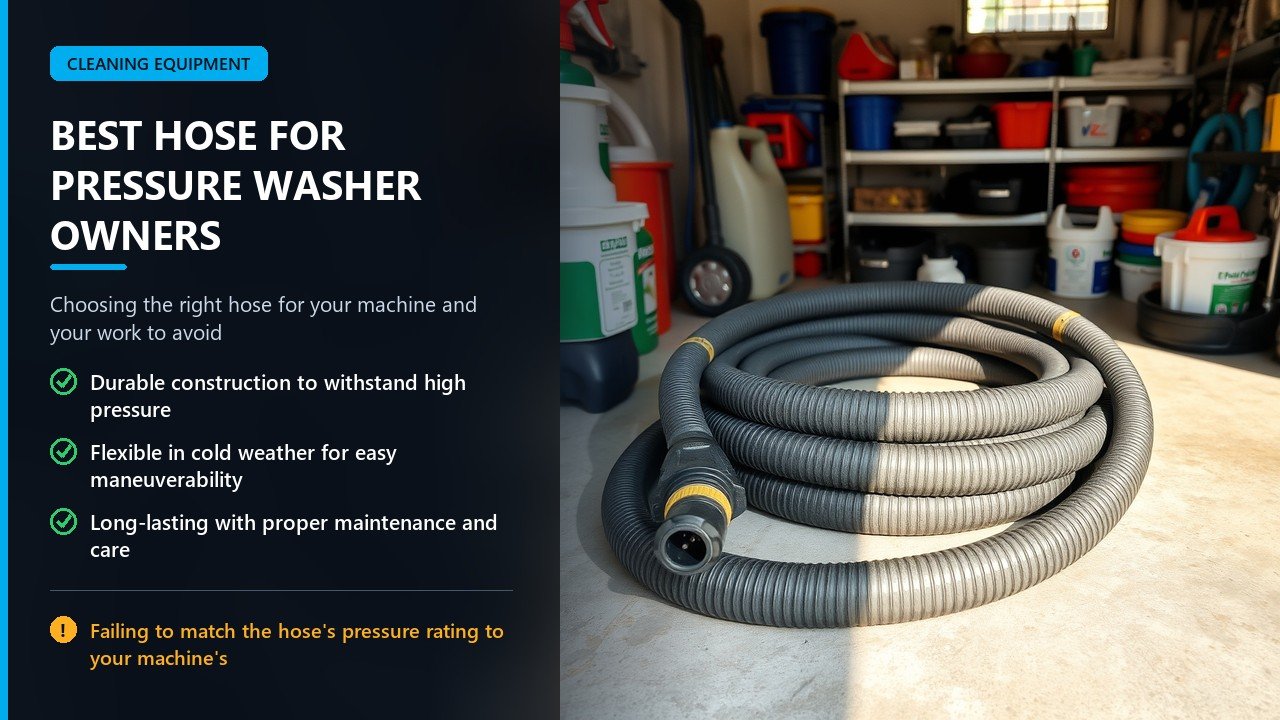
What Makes a Pressure Washer Hose Different From a Garden Hose
A garden hose carries household water pressure, usually somewhere between 40 and 80 PSI. A pressure washer hose carries the full output of a pump that can reach 3,000 to 4,000 PSI and more, often with bursts of pressure when the trigger is released and re-engaged. That difference drives everything about how the hose is built.
Reinforcement is the key. Inside a pressure washer hose runs a braid of high-tensile fiber, wire, or both, wrapped around a rubber or synthetic tube. That braid is what keeps the hose from ballooning and bursting under load. A garden hose has no such reinforcement, which is why using one on a pressure washer is dangerous and pointless. It will swell, split, and could injure someone when it fails.
Fittings are crimped, not clamped. Pressure washer hoses have permanently attached, crimped metal fittings rated for the same pressure as the tube. Garden hoses use removable plastic or brass clamps that pop off under pressure. Never try to repair a pressure washer hose with a hose clamp; it cannot hold.
Bend radius and flexibility matter more. Because a high-pressure hose is stiffer than a garden hose, a poorly made one kinks easily and stops flow, which starves the pump and can damage it. The better hoses use a flexible construction and a protective spring or sleeve at the gun end to survive constant bending. Our guide to high-pressure water hose buying covers the failure points in detail.
The Four Numbers That Define the Best Hose for Pressure Washer Use
Every pressure washer hose is described by a handful of specifications. Learn to read them and choosing becomes simple.
Inside diameter. This is the bore of the hose, usually expressed in fractions of an inch: 1/4 inch, 5/16 inch, or 3/8 inch. Diameter controls how much water can flow through at a given pressure. A wider bore moves more water and usually means faster cleaning, which is why high-flow machines use 3/8-inch hoses. A narrower bore restricts flow, which is fine for small electric washers but starves a big pump.
Length. Length is about reach and convenience, but it is not free. Every foot adds friction and drops the pressure that reaches the nozzle. A 25-foot hose delivers more pressure at the tip than a 100-foot hose on the same machine. Buy the shortest hose that reaches your work, and add length only when you need to roam.
Pressure rating. This is the maximum pressure the hose is built to handle, often listed as both working pressure and burst pressure. Always choose a hose whose working pressure comfortably exceeds your machine’s rating. A hose rated at 4,000 PSI on a 4,000 PSI machine is running at its ceiling; one rated higher gives you a safety margin. The burst pressure, usually several times the working pressure, tells you how much reserve the hose has before it fails.
Temperature rating. If you use a hot water pressure washer, the hose must be rated for heat. Standard cold-water hoses melt and fail quickly under hot water. Hot-water hoses use heat-resistant materials and are rated for specific temperatures, often up to around 250 degrees Fahrenheit. Our article on pressure washer hoses built to handle heat explains why you cannot substitute a cold hose on a heated machine.
| Hose Diameter | Typical Flow Support | Best Paired With | Notes |
|---|---|---|---|
| 1/4 inch | Up to about 3 GPM | Small electric washers | Light, flexible, kinks easily |
| 5/16 inch | About 3 to 4 GPM | Mid-range electric and small gas | Good balance of flow and weight |
| 3/8 inch | 4 GPM and above | Gas, hot water, commercial | Standard for high-flow machines |
Diameter: The Flow Decision
Diameter is the single most misunderstood spec, because owners often buy a narrower hose to save money without realizing it chokes the machine. A pressure washer pump is designed to move a certain number of gallons per minute. If the hose bore is too small, the pump cannot deliver that flow, pressure builds incorrectly, and the machine runs hot and tired. Over time, a restricted hose contributes to pump wear.
Match the hose bore to the machine. Small electric washers in the 1,300 to 2,000 PSI range work fine with a 1/4-inch hose. Mid-size machines do well with 5/16 inch. Full-size gas machines, hot water units, and anything rated at 4 GPM or higher should have a 3/8-inch hose to move water without restriction. If you are unsure, erring on the wider side costs you a little weight and a little flexibility but protects your pump. Our guide to why the 3/8-inch hose is the standard high-flow choice explains the reasoning.
Material: Rubber, PVC, Hybrid, and Steel Braided
The material decides how the hose feels, how long it lasts, and how well it handles cold, heat, and abrasion. There is no single best material; there is a best material for your conditions.
Rubber. Rubber hoses are the traditional choice for quality. They stay flexible in cold weather, resist kinking, handle abrasion well, and tolerate heat better than PVC. They are heavier and cost more, but they last. For year-round use and gas machines, rubber is usually the smart pick.
PVC and thermoplastic. PVC hoses are light and inexpensive, which makes them popular for small electric washers and occasional use. They stiffen in cold weather and are more prone to kinking and cracking. If you store your washer in a heated space and only clean a few times a year, PVC can serve you well. If you leave it in a cold garage, PVC will punish you.
Hybrid and synthetic blends. Many mid-range hoses use a rubber-and-synthetic blend that aims for the flexibility of rubber at a lower price. Quality varies widely across brands, so read reviews about cold-weather stiffness and kink resistance rather than trusting the word “hybrid” on its own.
Steel braided. A steel-braided hose wraps a braided stainless layer over the inner tube for maximum abrasion and pressure resistance. These are built for commercial work and can run at very high pressures and temperatures. They are stiff and expensive, and often overkill for a homeowner, but they are the right tool for a busy wash bay. Our look at how a 4,000 PSI pressure washer hose handles the load shows where the heavy-duty materials earn their keep.
| Material | Cold Flexibility | Kink Resistance | Heat Tolerance | Best For |
|---|---|---|---|---|
| PVC / thermoplastic | Poor | Fair | Low | Light electric, warm storage |
| Rubber | Excellent | Very good | Good | Year-round home and gas use |
| Hybrid blend | Good | Good | Moderate | Value seekers, mid-range use |
| Steel braided | Fair | Excellent | Excellent | Commercial and hot water |
Length, Reach, and Pressure Drop
Length is where convenience and performance pull against each other. A longer hose lets you circle a house or reach a back fence without moving the machine, but it also bleeds pressure and adds weight to drag. The trick is to buy for your real working radius, not your imagination.
Homeowners usually do best with 25 to 50 feet. A 50-foot hose covers most driveways and single-car garages and remains easy to handle; many owners consider it the residential sweet spot, which our guide to the 50 ft pressure washer hose explores.
Larger properties and two-car driveways often call for 75 to 100 feet. A 100-foot hose is manageable but noticeably heavier and softer at the tip, so you may need to step the nozzle down or accept more passes. Our article on the 100-ft power washer hose covers how to keep performance up over longer runs.
Coupling hoses together is possible with the right adapter, but each extra connection is another place to leak and another source of pressure loss. If you regularly need more than 100 feet, consider moving the machine closer instead of adding hose. The friction penalty of extra length is real, and our breakdown of length, diameter, and lost pressure shows how the numbers stack up.
Fittings and Connections
A great hose with the wrong fittings is useless. The two connection standards you will meet most are the M22 threaded fitting and the 1/4-inch quick connect, and some machines use specialty fittings such as 3/8-inch quick connect.
Know your ends. Look at where the hose attaches to the pump and to the gun. M22 fittings screw on and are common on both electric and gas machines. Quick connects push in and lock with a collar and are convenient for swapping hoses fast. Adapters exist to convert between the two, which is often the simplest solution if a new hose does not match. Our guide to matching hose connectors before you buy shows how to identify each end.
Do not overtighten. Threaded fittings seal on a rubber or plastic washer, not on the metal faces. Over-tightening crushes the washer and causes the leak you were trying to prevent. Snug is enough, and if it drips, replace the washer before you reach for more torque.
Use the right adapter, not tape, on quick connects. PTFE tape belongs on threaded joints only. Quick-connect seals rely on an o-ring, and tape does nothing for them. A spare set of o-rings is cheap insurance.
Hot Water and Specialty Hoses
If you run a hot water pressure washer, the hose must be rated for it. Heat breaks down ordinary rubber and softens PVC fast, so a cold-water hose on a hot machine can fail within a few uses. Hot-water hoses use heat-resistant compounds and are rated for high temperatures, often near 250 degrees Fahrenheit, and they usually have a reinforced, abrasion-resistant cover.
Specialty needs change the choice too. If you clean indoors or care about scuff marks on finished floors, look for a non-marking pressure washer hose. If you work around vehicles and sharp edges, an abrasion-resistant cover protects both the hose and the paint. And if you run a drain-cleaning setup, a dedicated jetting hose with the right fittings and stiffness is a different animal entirely. Match the hose to the work, not just to the machine.
Replacement Hose or Full Hose Kit
When it is time to replace a hose, you usually have two ways to buy. A bare replacement hose is just the tube with its two crimped ends, ready to connect to the fittings you already own. A hose kit bundles the hose with the adapters, quick-connect plugs, and sometimes a nozzle or o-ring set that many owners end up buying separately anyway.
Choose a bare hose when your current fittings are in good shape and already match your machine. This is the cheaper and simpler route, and it avoids a drawer full of duplicate adapters. Just confirm the ends on the new hose match the ends on the old one before you order.
Choose a kit when you are upgrading machines, changing connection types, or starting from scratch. A kit removes the guesswork because the manufacturer has paired parts that fit together, which is especially helpful if you are moving from an M22 gun to a quick-connect setup or adding a second machine to a small fleet. The value of a kit is convenience and certainty more than price.
Consider a hose-and-reel combo if storage is part of your problem. A matched hose and reel set keeps the hose protected, makes coiling fast, and reduces the kinks that come from sloppy hand coiling. Our look at how a matched pressure washer hose and reel combo reaches and lasts explains why buying the two together often beats mixing parts.
How to Test a Hose Before You Trust It on a Big Job
A new hose deserves a test run before it goes to work on a paid job or a full driveway. The check takes two minutes and can save a ruined afternoon.
Pressure test on a safe surface. Connect the hose and run the machine with a nozzle attached, pointing the wand at a clear patch of ground. Watch the full length of the hose, especially the crimped ends, for any bulge, blister, or drip. A hose that swells in one spot is already failing.
Check the flow, not just the pressure. Hold the wand steady and feel for a consistent stream. A stream that pulses or weakens when you move the hose suggests a kink or an internal restriction. A healthy hose delivers steady flow regardless of how the hose lies.
Feel for stiffness and kinks. Let the hose rest in a loose loop and see how it behaves. A good hose falls into smooth curves; a poor one folds into sharp kinks that stop flow. If your new hose kinks on soft ground in mild weather, it will only get worse in the cold.
Inspect the fittings. Confirm the attachments seat fully and lock with a positive click or a firm hand-tight fit. A loose connection sprays at the joint and drops the pressure that should reach the tip. Keep a few spare o-rings on hand so a small leak never becomes a reason to stop mid-job.
Common Mistakes When Buying the Best Hose for a Pressure Washer
Most hose failures trace back to a handful of buying and care mistakes.
Underrating the pressure. Choosing a hose rated below the machine’s output is the fastest route to a burst. Always exceed your machine’s maximum pressure with a margin to spare.
Buying too narrow. A cheap 1/4-inch hose on a 4 GPM machine strangles the pump. Match the bore to the flow.
Buying too long. Extra hose looks useful until you feel the pressure drop and the drag. Buy for your real radius.
Reusing an old hose on a new machine. A hose that worked on a small electric washer may not survive a high-flow gas unit. Check the rating every time you change machines.
Ignoring kinks. A kink is not a minor annoyance; it stops flow and strains the pump. Replace hoses that kink constantly rather than fighting them forever. A stiffer, kink-resistant hose pays for itself.
Storing it badly. Coiling a hose tightly, hanging it over a sharp hook, or leaving it in the sun ages it fast. Coil loosely, store indoors if you can, and avoid freezing water inside it. Our overview of choosing and caring for pressure washer hoses covers storage in depth.
Maintenance That Doubles the Life of Your Hose
A pressure washer hose needs almost no care, but the little it needs matters. Rinse it after each use to remove grit that could work into the fittings. Wipe it dry and coil it in large loops rather than tight circles. Store it out of direct sunlight and above freezing, because trapped water can freeze and split a tube. Inspect the ends where the crimp meets the hose, since that is where most hoses fail, and replace the hose at the first sign of a bulge, blister, or weeping crimp. A compromised hose is not worth the risk of a high-pressure burst. The same seasonal habits that protect your pump, like draining and storing equipment properly, protect the hose, and our guide to why a backup hose saves the job makes the case for keeping a spare ready.
Safety: Why the Rating Is Not Optional
Using a hose that is not rated for the pressure or temperature of your machine is a genuine safety risk. When a high-pressure hose fails, it can whip, and the escaping water can cut skin or inject beneath it. The Occupational Safety and Health Administration and other safety bodies treat high-pressure systems with respect for exactly this reason. Follow a few simple rules: never use a damaged or unrated hose, never run a cold-water hose on a hot machine, and never patch a burst with tape or a clamp. Keep your connections tight and your hose in good condition, and the danger stays where it belongs, far from the operator.
The standards that govern hose construction, including the pressure ratings and reinforcement types, come from organizations such as SAE International. When a hose lists a working and burst pressure, those figures are not marketing; they are engineering limits, and staying well inside them keeps your equipment and your crew safe.
Frequently Asked Questions
What is the best hose diameter for a pressure washer? Match the diameter to the machine’s flow. Use 1/4 inch for small electric washers, 5/16 inch for mid-range units, and 3/8 inch for gas, hot water, and machines rated at 4 GPM or higher.
Can I use a regular garden hose as a pressure washer hose? No. A garden hose is not built for high pressure and will swell, split, or burst. You can use a garden hose as a water supply line to feed the machine, but never as the high-pressure output hose.
How long should my pressure washer hose be? Most homeowners do well with 25 to 50 feet. Larger properties may need 75 to 100 feet, but remember that every extra foot reduces pressure at the nozzle.
Is a rubber hose better than PVC? Rubber is generally better for year-round use because it stays flexible in cold weather and resists kinking and heat. PVC is lighter and cheaper but stiffens in the cold and is better suited to occasional, warm-weather use.
What pressure rating do I need? Choose a hose with a working pressure rating higher than your machine’s maximum output. If your washer produces 3,000 PSI, pick a hose rated comfortably above that, with a generous burst rating as a safety margin.
Why does my hose keep kinking? Kinking usually means the hose is too stiff for the conditions, too long, or cheaply made. A flexible rubber or hybrid hose in the correct length and diameter resists kinks far better than a low-cost PVC hose.
Final Thoughts on the Best Hose for Pressure Washer Setups
The best hose for a pressure washer is not the most expensive one on the shelf. It is the one whose diameter matches your machine’s flow, whose pressure and temperature ratings exceed your pump’s output, whose length fits the work you actually do, and whose material suits your climate and storage. Get those four things right and the hose fades into the background, which is exactly what you want from a part you never think about until it fails.
Start by checking your machine’s GPM and PSI, then choose a bore to match the flow and a rating that beats the pressure. Pick rubber or hybrid for flexibility if you clean in cool weather, PVC only for light warm-season use, and steel braided or hot-water-rated hose for heated and commercial work. Buy the shortest hose that reaches your farthest corner, treat the fittings with care, and store the hose loosely and dry.
Do that and the next time you uncoil a hose, it will do its quiet job, pass full flow to the nozzle, and finish the job without spraying your boots. The hose is the least glamorous part of the whole system, and choosing the right one is the easiest way to make every other part work better.