Dana had been running her mobile pressure washing route for five seasons, and the thing that kept taking her off the road was never the pump, the engine, or even the gun. It was the hose. A cheaper replacement hose failed on a driveway job near Dallas, the burst end snapped back and scuffed the side of a customer’s SUV, and she spent the next two days apologizing, paying for a detail, and hunting for a replacement that could actually handle 4,000 PSI of hot water. The hardware store had one option. It was rated for cold water. She drove across three towns chasing the part.
What Dana needed was not just a hose. She needed a reliable hose for pressure washer gun supplier who stocked the right specs, understood her machine, and could get her the correct part the same day. That distinction matters more than most operators realize, because the hose between the pump and the gun is the single most stressed consumable in the entire system. It sees full pressure, every ounce of heat, constant bending, and the sun, day in and day out.
This guide is written for anyone who needs to source that hose, whether you are a homeowner replacing a failed line or a commercial outfit buying by the case. We will cover what a gun hose actually is, the specifications a supplier must match, the different types of suppliers and how to choose between them, how to vet quality before you commit, wholesale versus single-unit buying, pricing, common buying mistakes, and the maintenance that makes any hose last longer. By the end you will know exactly how to find a supplier who will not leave you stranded on the far side of a job site.
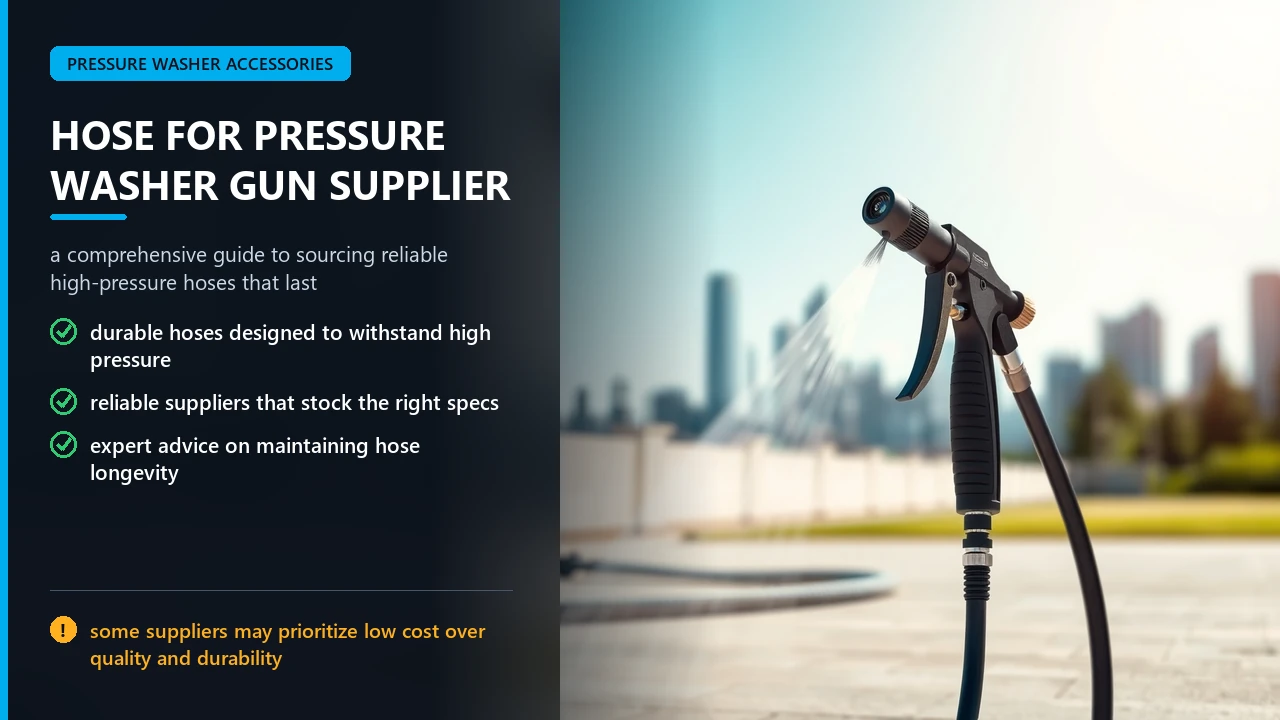
What “Hose for Pressure Washer Gun” Really Refers To
When people search for a hose for a pressure washer gun, they are usually describing the high-pressure line that carries water from the pump to the spray gun. On a typical machine, the flow works like this:
- Pump outlet: the pump finishes pressurizing the water.
- High-pressure hose: a reinforced line rated for the machine’s full PSI carries that water to the gun.
- Spray gun: the trigger releases the pressurized stream into the wand or nozzle.
- Wand: the rigid lance that holds the nozzle and aims the spray.
The hose in the middle is the focus here, and it comes in a few forms. The main high-pressure hose is the long line that lets you walk around the vehicle or the driveway. A short jumper or whip hose connects a hose reel to the gun or the pump outlet, absorbing vibration and taking the flexing that would otherwise fatigue a longer line. Some setups use a dedicated gun hose assembly with crimped fittings, while others use a plain hose you crimp or thread yourself.
A related part that buyers often confuse is the chemical or soap line, a thin low-pressure tube that feeds detergent from a bucket to a downstream injector. That is a different product entirely, with completely different ratings, and a supplier worth using will know the difference immediately. If you want to understand the high-pressure side in depth, our guide to picking the right high-pressure hose is a good companion read.
Anatomy of a Pressure Washer Gun Hose
To judge a supplier, you first have to understand what good product looks like. A high-pressure hose is not just a rubber tube. It is a layered assembly:
- Inner tube. Carries the water and resists heat and chemicals. Common materials include synthetic rubber, thermoplastic, and blended polymers.
- Reinforcement braid. One or two layers of high-tensile steel wire braid. This is what actually holds pressure. A single-wire hose typically handles up to about 3,500 to 4,200 PSI; a two-wire hose stretches to 5,000 to 6,000 PSI.
- Outer cover. Protects the braid from abrasion, sunlight, and oils. Cover materials range from engineered polymer to synthetic rubber and urethane.
- Fittings. Crimped or threaded ends that mate with your pump, gun, or reel. Thread types vary widely, which is a major source of returns.
- Bend restrictors. The spring-like sleeves near each end that stop the hose from kinking and fatiguing at the most stressed point.
Two numbers tell you whether the hose will survive your machine: its pressure rating and its temperature rating. Pressure rating is what the braid is built for. Temperature rating is what the inner tube and cover can survive. A cold-water hose used on a hot-water machine will fail early, no matter how high its PSI rating, because heat breaks down the wrong material from the inside. More about sizing and matching lives in our guide on choosing the right hose for PSI and GPM.
The Specifications a Supplier Must Match
The fastest way to end up with the wrong hose is to buy on length and color alone. Here is what a competent supplier will help you verify before the order ships.
| Specification | Common Options | Why It Matters |
|---|---|---|
| Inside diameter (ID) | 1/4″, 3/8″, 1/2″ | Affects flow, pressure loss, and weight. 3/8″ is the commercial standard. |
| Length | 25′, 50′, 100′, up to 200′ | Longer hoses lose pressure; match reach to the job. |
| Pressure rating | 3,000–6,000+ PSI | Must meet or exceed your machine’s maximum PSI. |
| Temperature rating | Cold water vs. 250°F+ hot water | Hot-water service needs a heat-rated tube and cover. |
| End fittings | M22, 1/4″ QC, 3/8″ QC, threaded male/female | Wrong threads mean leaks or an unusable hose. |
| Run type | 1-wire vs. 2-wire braid | Two-wire for high pressure; one-wire for lighter, more flexible use. |
| Cover type | Standard, non-marking, wrapped | Non-marking covers protect driveways and interior floors. |
Notice how many of these decisions depend on your specific machine and the work. That is exactly why the supplier matters as much as the hose. A knowledgeable supplier asks about your PSI, your water temperature, your gun’s connection, and the surfaces you clean, then recommends a spec that fits. A weak supplier sells you whatever is on the shelf and wishes you luck. Thread matching is a frequent failure point, so our explainer on M22 hose fittings and how to match them is worth reading before you order anything online.
Types of Hose Suppliers and How They Differ
“Supplier” is a broad word. The source you choose changes your price, your lead time, your support, and your risk. Here is how the main channels compare.
| Supplier Type | Strengths | Watch Out For |
|---|---|---|
| Original equipment manufacturer (OEM) | Exact fit, warranty matching, brand support | Higher price, model-specific part numbers |
| National hose distributor | Huge catalog, standard specs, bulk lengths | You still need to know your own specs |
| Local equipment dealer | Hands-on help, same-day parts, service | Smaller stock, sometimes premium pricing |
| Industrial hose specialist | Pro-grade brands, custom crimping, certifications | May have a minimum order |
| Online marketplace seller | Low prices, huge selection, fast shipping | Thin quality control, confusing off-brand specs |
Each channel has a job. If you need an exact factory replacement with a matching warranty, go to the OEM or an authorized dealer. If you need a professional-grade hose in bulk, an industrial hose distributor or specialist is the better call. If you are a homeowner replacing a single 25-foot line, a reputable online seller or local retailer is fine, provided you check the ratings and thread types carefully. The honest rule is that the more a hose costs and the harder you run it, the more a relationship with a knowledgeable supplier is worth. House brands and no-name marketplace listings can be perfectly adequate, but the ratings must be verified, not assumed. You can read more about the trade-offs in our piece on connector types that stop leaks and, for brand-level comparisons, our Parker professional-grade hose guide.
How to Vet a Supplier Before You Commit
Finding a supplier is easy. Finding one who will still be there when a hose fails six months in is the real work. Run every candidate through a short evaluation, whether you order online or walk into a shop.
- Do they ask about your machine? A good supplier wants your PSI, GPM, water temperature, and connection types before recommending a hose.
- Do they publish real specs? Inside diameter, wire count, pressure rating, burst pressure, temperature range, and fittings should be documented.
- Do they cite a standard? Professional hoses are built to recognized standards; a supplier who references them is usually selling certified product.
- What is the warranty? Beyond the brand’s warranty, ask how the supplier handles a failure. Do they replace, refund, or investigate root cause?
- How fast is the lead time? For commercial work, availability beats a slightly lower price every time.
- Do they stock spare fittings and barbs? A supplier who can also sell you the matching fittings saves a separate order and a second shipping charge.
- Can they crimp or custom-make? Custom lengths and on-site crimping let you fit odd setups a catalog never anticipated.
- Are they reachable? Phone or chat support with real humans is a strong signal, especially for technical questions.
If you are sourcing from overseas or from a new trading partner, the U.S. Small Business Administration publishes practical guidance on managing suppliers and vendors that applies directly to buying cleaning equipment parts. For imported hoses, the U.S. Customs and Border Protection agency maintains information on importing goods, including the need for accurate product descriptions and country-of-origin labeling. Those rules matter if you buy wholesale, because a misdeclared hose is a customs problem, not just a paperwork one.
Wholesale, Bulk, and Custom Orders
If you run a cleaning business, a rental fleet, or a repair shop, you will eventually buy hoses by the case rather than the piece. That changes the supplier conversation in a few important ways.
- Minimum order quantity (MOQ). Many industrial suppliers set an MOQ, sometimes measured in units, sometimes in total order value. Ask up front so you are not surprised at checkout.
- Bulk pricing tiers. Unit prices usually drop at quantity break points. It is worth asking for the tiers before you decide how many to buy.
- Custom lengths and fittings. A bulk supplier can often crimp specific lengths with specific ends, which lets you standardize across a fleet.
- Private label. Larger buyers can sometimes have hoses branded to their own company, useful for resellers.
- Lead time and restocking. For a business, a predictable restock schedule beats panic buying. Ask how often fast-moving sizes are replenished.
- Payment and returns terms. Net terms and a clear defect-return policy protect your cash flow and your margins.
The trade-off with bulk buying is cash tied up in inventory. A small operator might do better buying a few quality hoses at a time from a local dealer, while a company with a dozen rigs may save real money by standardizing one spec in bulk. The key is to match your buying pattern to your actual burn rate, not to chase the lowest sticker price on a quantity you will never use.
What Drives the Price of a Gun Hose
Hose prices vary enormously, and it helps to know why a 50-foot line can cost anywhere from fifteen dollars to well over a hundred.
- Wire count. A two-wire 6,000 PSI hose uses far more steel and costs more than a single-wire 3,000 PSI hose.
- Materials. A heat-rated rubber hose with a tough cover costs more than a lightweight thermoplastic cold-water hose.
- Fittings. Stainless swivel fittings and quick couplers add cost but save time and leak frustration.
- Length. Price scales with length, and long hoses also add weight and pressure loss you should account for.
- Brand and certification. A hose built and documented to a recognized standard carries a premium, and it is usually the cheapest part of avoiding a failure.
- Quantity. Bulk pricing can cut the per-unit cost significantly for repeat buyers.
The mistake is treating the hose as a commodity and buying purely on price. A failed hose can cost you a customer, damage property, or injure an operator when a fitting blows. For commercial use, the right calculation is cost per working hour plus the cost of downtime, and quality hoses win that math almost every time. Our guide on Gates hoses for quality, sizing, and safety goes deeper on what separates a durable line from a disposable one.
Connection Types You Will Meet at the Gun
Most hose returns happen at the fittings, not in the hose body, so it pays to recognize the connections your supplier will ask about. Here is the quick reference.
| Connection | Where It Appears | Notes |
|---|---|---|
| M22 (metric thread) | Pump outlet, gun inlet on many consumer and prosumer machines | Very common; comes in male and female. Do not confuse with M22 swivel variants. |
| 1/4″ quick connect | Wands, nozzles, some guns and adapters | The near-universal accessory standard on lighter systems. |
| 3/8″ quick connect | High-flow commercial hoses and reels | Used on bigger machines where flow matters more than accessory size. |
| 3/8″ NPT / NPS | Industrial pumps, reels, and fixed plumbing | Threaded pipe standard; sealant or tape may be required. |
| Barbed and clamp | Supply, bypass, and soap lines | Low-pressure side only; never use on the high-pressure outlet. |
| Banjo / swivel | Jumper hoses and reel connections | Swivels reduce twist and extend hose life, especially near a reel. |
The practical takeaway: identify the fittings at both ends of your existing hose, photograph them, and send those photos to the supplier. A short adapter or a swivel can bridge almost any mismatch, so a small thread difference should never force you to buy a whole new gun. Our guide to quick connect fittings that lock tight explains how the couplers themselves are sized and matched. When in doubt, buy from a supplier who also sells adapters, so a surprise mismatch becomes a two-dollar fix instead of a return.
Common Mistakes When Buying a Gun Hose or Choosing a Supplier
- Buying on length alone. Length is only one of seven specs that matter.
- Ignoring the temperature rating. A cold-water hose on a hot-water machine fails from the inside out.
- Mismatching threads. M22, 1/4″ quick connect, and 3/8″ quick connect do not interchange. Confirm both ends.
- Chasing the lowest price. The cheapest hose often fails at the worst time on the biggest job.
- Forgetting the bend restrictors. Most hose failures happen inches from the fitting, exactly where a restrictor protects.
- Overlooking the supplier’s support. No phone number, no spec sheet, no reliability.
- Buying in bulk before testing. One sample would have prevented a pallet of regret.
- Reusing old fittings on a new hose, especially worn or corroded ones that weaken the crimp.
Almost all of these come down to the same discipline: know your machine’s numbers and buy from someone who respects them. A hose is a safety-critical component under enormous pressure, not a garden accessory. Treat the purchase that way and the failures Dana kept hitting become rare events rather than a monthly cost of doing business.
Making Any Supplier’s Hose Last Longer
Even a premium hose dies young if it is abused. A few habits stretch the life of whatever you buy:
- Use a reel. Coiling a hose by hand creates kinks that weaken the braid. A reel keeps the bend radius gentle.
- Watch the bend radius. Never yank a hose around a sharp corner or drag it over a curb edge under pressure.
- Relieve pressure before releasing. Trigger the gun briefly after shutting off the pump so the hose is not stored under load.
- Keep hoses off hot pavement and hot surfaces when idle, and out of direct sun for long storage.
- Flush and dry before long-term storage, especially in freezing weather.
- Inspect regularly. Look for bulges, cover abrasion, and frayed braid near the fittings, and replace before a failure.
- Store indoors in a loose coil, away from oils and solvents.
A whip hose between the reel and the gun is a smart addition for heavy users, because the cheap, short jumper takes the bending and fatigue so the expensive long hose does not. To understand where a short gun hose fits, see our piece on whip hoses and when to use one. And if you clean driveways or indoor floors, a non-marking hose prevents the black streaks that turn a clean job into a callback.
Frequently Asked Questions
Where can I buy a hose for a pressure washer gun?
You can buy from the machine’s OEM, a national hose distributor, a local equipment dealer, an industrial hose specialist, or a reputable online seller. For commercial or hot-water use, prefer a supplier who publishes full specifications and can confirm your PSI, temperature, and connection type before shipping.
What size hose do I need for my pressure washer gun?
Most commercial machines use 3/8-inch inside diameter hose, while smaller electric units often use 1/4-inch. Length ranges from 25 to 200 feet. The correct choice depends on your machine’s GPM, the reach you need, and how much pressure loss you can tolerate.
Can I use a cold-water hose on a hot-water pressure washer?
No, or at least not for long. A cold-water hose used with hot water will degrade from the inside and fail early. Always match the hose’s temperature rating to your machine’s water temperature.
What is the difference between one-wire and two-wire hose?
One-wire braid hoses are lighter, more flexible, and typically rated to about 3,500 to 4,200 PSI. Two-wire braid hoses are stiffer but handle 5,000 to 6,000 PSI. Match the wire count to your machine’s pressure.
How do I know if a supplier sells quality hoses?
They ask about your machine, publish detailed specs including wire count and temperature range, reference a recognized standard, offer a warranty and a clear return policy, and stock matching fittings. Vague listings with no specs are a warning sign.
How long should a pressure washer hose last?
With good care and a properly rated hose, a quality line can last several seasons of regular use. Failures usually trace back to a kink, a worn fitting, an under-rated hose, or heat damage from the wrong temperature rating.
Final Thought
The hose between your pump and your gun is the part most operators think about last and pay for first. It takes everything the machine throws at it, and when it fails it usually does so at the moment of maximum inconvenience. Sourcing it well is not about finding the absolute cheapest listing. It is about finding a supplier who stocks the right spec, understands your machine, answers the phone when something goes wrong, and can get you back on the road the same day.
Know your numbers before you buy: inside diameter, length, pressure rating, temperature rating, and both end connections. Match every one of them to your machine. Vet the supplier the way you would vet any business partner, using the same diligence the SBA recommends for any vendor relationship. Then protect the investment with a reel, a whip hose, sensible bend radius, and regular inspection. Do that and your next search for a hose for pressure washer gun supplier becomes a five-minute task instead of a three-town drive, and Dana’s hard lesson becomes a one-time story instead of your monthly routine.