The first hard freeze came early that year, and Dale learned it the expensive way. He had drained his hoses, rolled them up, and parked his gas pressure washer in his unheated garage for the winter. He felt like he had done enough. When spring rolled around, he pulled the starter cord and heard the engine sputter, but the pump seized solid. A $40 repair kit became a $400 pump replacement. The culprit was a tablespoon of water left in the pump that expanded into ice and cracked the ceramic plungers and seals.
The lesson is simple: if you do not winterize a pressure washer correctly, freezing temperatures will break it. Whether you have an electric unit you tuck away after fall cleanups or a hot water power washer trailer that must survive subzero nights between jobs, the process takes less than an hour and saves you hundreds of dollars.
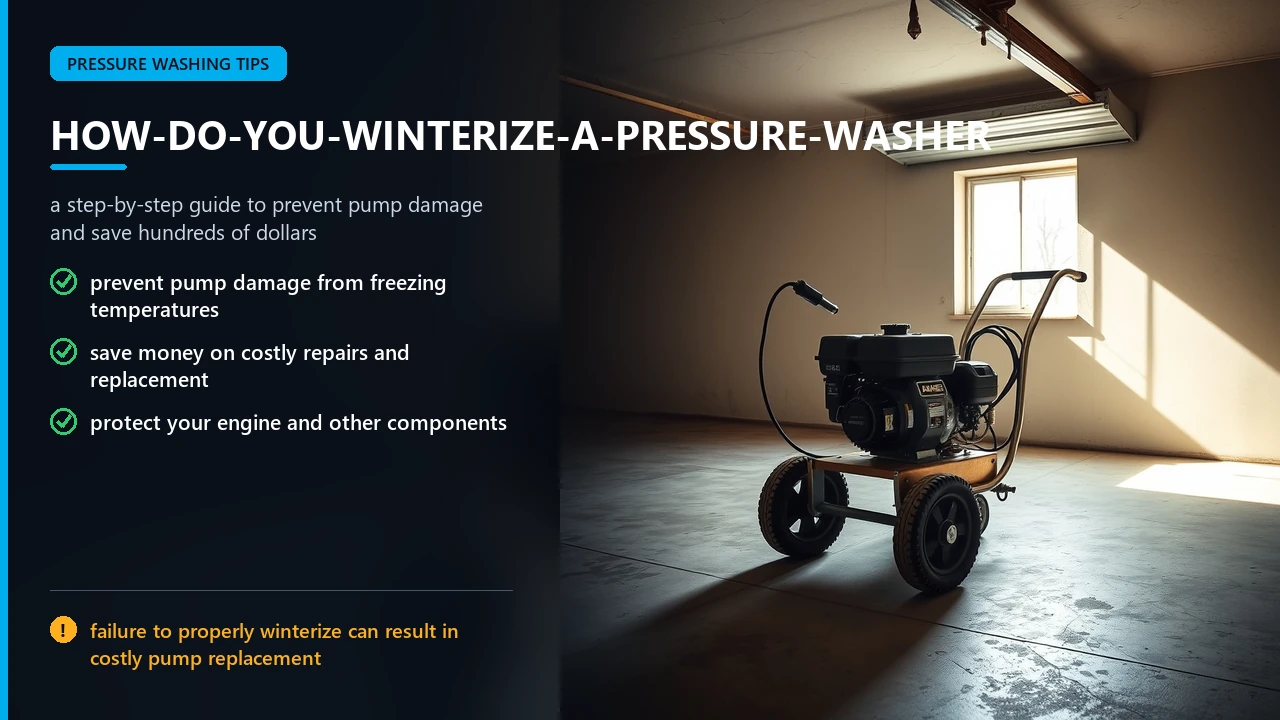
Why You Must Winterize a Pressure Washer
Water expands by about 9% when it freezes. Inside the tight chambers of a pump, that expansion is more than enough to crack plungers, valves, manifolds, O-rings, and unloader assemblies. Freeze damage is almost never covered under warranty, and on a hot water machine it can also crack the heating coil.
Other reasons to winterize properly include protecting the engine from stale fuel, preventing corrosion from leftover detergents, and keeping seals from drying out during long-term storage. If your machine will sit unused for 30 days or more, especially in a climate that dips below freezing, winterization is not optional. For a deeper look at protecting your pump year-round, read our guide on the best pump protector to use before winter.
Supplies You Will Need
| Item | Notes |
|---|---|
| Pressure washer pump saver (RV/propylene glycol based) | Do NOT use automotive antifreeze. Only use products labeled safe for pressure washer pumps. |
| Fuel stabilizer (for gas units) | Use if you plan to leave fuel in the tank. Essential for ethanol-blended fuel (common in the U.S.). |
| Clean water pail | For flushing detergent from the system. |
| Air compressor (optional) | 30-50 PSI max. Useful for blowing out lines if you prefer air over antifreeze. |
| Garden hose scrap (1-3 ft) | Handy to connect pump saver bottle to the water inlet. |
| Rags, eye protection, and gloves | Basic safety. Pump saver can be slippery. |
How to Winterize a Pressure Washer: Step-by-Step
Step 1: Prep and Release Pressure
- Turn the engine or power off completely.
- Disconnect from the water source.
- Point the spray gun in a safe direction, squeeze the trigger to relieve trapped pressure, and engage the trigger lock.
- Allow the unit to cool completely. Never cover a hot machine.
Step 2: Flush Out Detergents
If you used any soap or detergent, place the siphon/injection tube into a pail of clean water. Run the machine at low pressure for 1-2 minutes with the trigger pulled. This flushes chemical residue that can corrode internal parts. Leftover detergent is one of the most common causes of stuck check valves come spring.
Step 3: Drain Hoses, Gun, Wand, and Nozzles
- Disconnect the high-pressure hose from the pump and the spray gun.
- Disconnect the garden hose from the pump.
- Drain all water from the garden hose, high-pressure hose, spray gun, wand, and quick-connect nozzles.
- Coil and store hoses in a dry place. Elevate fittings to allow complete drainage.
Step 4: Empty the Pump of Remaining Water
Gas units: With the engine OFF, pull the recoil starter handle 4-6 times. This draws the remaining water out of the pump without running it dry for more than a few seconds. Do not crank continuously.
Electric units: Turn the unit on for just 1-2 seconds, then off. Repeat only as needed to expel residual water. Never run an electric pressure washer pump dry for more than 5-10 seconds at a time, as it can damage seals.
Step 5: Protect the Pump With Pump Saver or RV Antifreeze
This is the most reliable way to prevent freeze damage.
- Place a rag under the water inlet to catch drips.
- Connect a short (1-3 ft) garden hose to the pump’s water inlet. Insert the other end into the pump saver bottle.
- With the engine/power OFF, use the pump saver as directed. For most products, slowly feed the solution while pulling the recoil (gas) a few times, or briefly cycling (electric), until the colored fluid exits the high-pressure outlet.
- Disconnect the hose and pump saver. Wipe down the unit.
Step 6: Protect the Engine (Gas Units Only)
- Add a quality fuel stabilizer to fresh gasoline in the tank.
- Run the engine for 2-3 minutes with the trigger pulled at low pressure to circulate stabilized fuel through the carburetor and fuel lines.
- Turn off the engine. Alternatively, if you prefer to store with an empty tank, run the engine until it stops completely to avoid stale fuel. Both methods work; stabilized fuel is far easier if you might need to move the unit during winter.
For more on fuel handling and storage, see fuel for power washers: the right gas mix and storage rules.
Step 7: Inspect, Clean, and Store Properly
- Wipe down the frame, handle, and wand. Remove caked-on dirt or grease that can hold moisture.
- Inspect hoses for cracks, bulges, or worn O-rings. Replace any damaged parts now.
- Check and change pump oil if it is due. Learn the right intervals in changing oil in a pressure washer pump.
- Store the unit in a clean, dry, well-ventilated location. Keep it off concrete if possible (use a pallet or treated lumber) to reduce condensation.
- Cover with a breathable, moisture-resistant cover. Avoid airtight plastic that traps moisture.
- For gas units, disconnect the battery if equipped, and consider rodent deterrents in sheds or barns.
Special Considerations for Hot Water Pressure Washers
Hot water (and steam-capable) units require extra care because the heating coil holds water that will not drain out by simply pulling the recoil or tipping the machine. If left untreated, that trapped water will freeze and crack the coil, an expensive repair.
- Antifreeze displacement is required. You must circulate RV antifreeze through the pump until it flows out of the high-pressure outlet, displacing water from the coil and all plumbing. Plan for 1-2 gallons depending on coil size.
- Burner maintenance. While winterizing, inspect the fuel-water separator for the burner (diesel/kerosene). Water in burner fuel causes hard starting and weak heat in spring. Replace the separator element if cloudy or dirty.
- Trailer rigs. If you winterize a mobile rig like a hot water trailer, drain the onboard water tank completely, open the drain valve, and ensure the coil and bypass lines are also purged with antifreeze. For more on trailer-specific setup and care, see hot water trailer build and buyer guide.
Compressed air alternative (hot water caution): Blowing out with compressed air is sometimes used, but it is easy to leave water pockets in a coiled heat exchanger. For peace of mind in climates with hard freezes, circulating pump-safe antifreeze is the safer choice.
Electric vs Gas: Key Differences
| Task | Electric Pressure Washer | Gas Pressure Washer |
|---|---|---|
| Draining pump | Brief on/off cycles (1-2 seconds), never dry >5-10 sec | Pull recoil 4-6 times with engine OFF |
| Fuel | Not applicable | Stabilize or drain completely |
| Storage location | Can be stored in a basement or heated space if dry and ventilated | Never store in living space due to fuel vapors; use garage/shed with ventilation |
| Freeze protection focus | Pump, hoses, gun, wand | Pump, hoses, gun, wand, engine fuel system |
Warm Climate? Occasional Winter Use?
- Warm climates (rarely below freezing): You may not need full winterization. Still drain hoses, gun, and wand, and store in a dry place. Consider pump saver if you expect an unexpected cold snap.
- Occasional winter use: If you use your machine on warmer winter days, drain it completely after each use. Even a few hours below freezing can crack a pump full of water. This is especially critical for mobile rigs that sit between jobs.
- Disposal: Used RV antifreeze (propylene glycol) is different from automotive antifreeze. Dispose of it properly per local regulations. The EPA hazardous waste guidance can help you determine correct disposal in your area.
Common Winterization Mistakes to Avoid
- Using automotive antifreeze: Can damage seals and is not safe for pump internals.
- Running the pump dry too long: Especially with electric units, this destroys seals.
- Skipping hot water coil purge: Tipping the trailer is not enough. You must displace water with antifreeze or blow out thoroughly.
- Leaving ethanol fuel untreated: Stale fuel gums carburetors and fuel lines in as little as 30 days.
- Storing wet: Moisture causes rust and corrosion even above freezing.
- Airtight covers: Trap condensation and promote rust. Use a breathable cover.
- Forgetting accessories: Nozzles, wands, and hoses crack too if left full of water.
Frequently Asked Questions
Do I need to winterize my pressure washer if I store it in a heated garage?
If the space stays above freezing and dry, you may not need pump saver. However, draining hoses, gun, wand, and nozzles is still smart. If there is any risk of a power outage or freeze, use pump saver as cheap insurance.
Can I use compressed air instead of pump saver?
Yes for cold-water units in mild-to-moderate freeze zones. Use 30-50 PSI max in short bursts. For hot water machines with coils, antifreeze displacement is much safer for hard freezes.
How much pump saver do I need?
Most pumps need 4-8 ounces. Follow the bottle instructions. Hot water coils may require more (up to 1-2 gallons of RV antifreeze total) to fully displace water.
Should I drain the fuel or use stabilizer?
Either works. Stabilizer is convenient if you might use the unit over winter or want easy spring startup. Draining is safest for very long-term storage, but you must run the engine dry.
Can I use regular automotive antifreeze in my pressure washer pump?
No. Only use RV (propylene glycol, alcohol-free) antifreeze or a product specifically labeled as pressure washer pump protector. Automotive antifreeze can damage seals and is not designed for this use.
How often should I change pump oil?
Change after the first 50 hours (break-in) on many triplex pumps, then every 100-200 hours or annually. Check your manual. See our guide to pump and engine oil types for specifics.
Final Thought
Winterizing a pressure washer is five to ten minutes of work that prevents a four-figure repair. Drain the accessories, empty the pump, and protect it with pump-safe antifreeze. For gas units, stabilize the fuel. For hot water units, do not skip purging the coil. Store dry, covered, and off concrete.
Do these steps before the first hard freeze, and your pressure washer will start on the first pull (or flip of the switch) when spring comes around, ready to work as hard as it did the day you put it away.