When Ray started his second season of pressure washing, his rig was a pickup truck, a tangled hose, and a twenty-gallon bucket of detergent sitting in the bed. It worked for small house washes. Then a restaurant chain offered him a contract to clean three drive-throughs and a loading dock before 7 a.m., every week, and the pickup fell apart as a business tool. Water ran out before the job did. There was no way to heat it. He was making three trips to a spigot that the manager barely wanted him using.
By the third week he bought a hot water power washer trailer, and the business changed shape almost overnight. He could carry his own water, heat it to strip fryer grease off the concrete, and clean an entire property from one parking spot. He finished before the breakfast rush, drove to the next site, and never asked a customer for an outlet again. That is what a hot water trailer does: it turns a pressure washer into a self-contained cleaning business that travels to the work instead of the other way around.
This guide breaks down everything you need to understand a hot water power washer trailer. We will cover what sets it apart from a cold-water rig, the components that make up the machine, how to size the water tank and burner, the difference between mini trailers and full commercial builds, buy-versus-build economics, real cost ranges, regulatory considerations, maintenance, common mistakes, and answers to the questions operators ask before they spend the money. If you are weighing whether a hot water trailer is worth it, this will help you decide with numbers instead of guesswork.
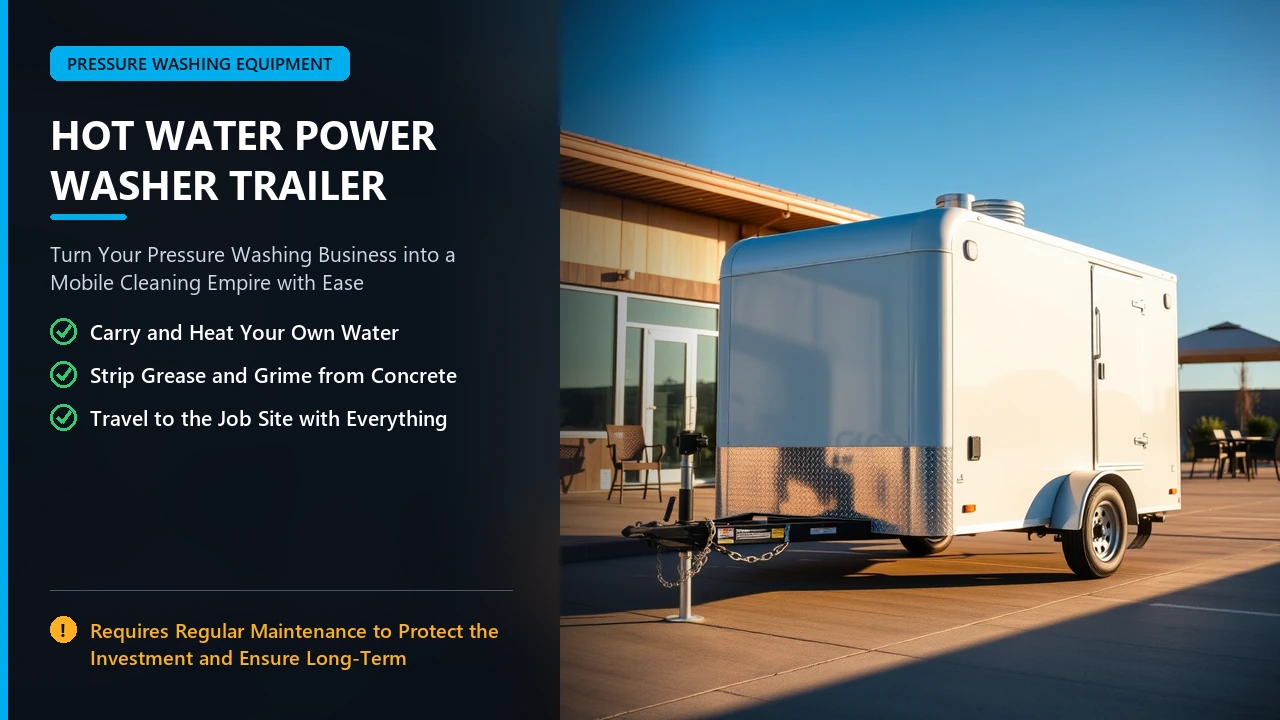
What Makes a Hot Water Power Washer Trailer Different
A hot water power washer trailer is a self-contained mobile cleaning system built onto a towable chassis. Instead of a portable washer you drag around by hand, everything lives on the trailer:
- Pressure washer: the pump and engine (or electric motor) that create high pressure.
- Burner: a diesel- or kerosene-fired heater that raises water temperature, often to 200°F or more.
- Water tank: an onboard supply so you are not tied to a customer’s spigot.
- Hose reel and hose: a mounted reel that keeps the line organized and extends your reach.
- Fuel tanks: separate tanks for engine gasoline and burner diesel on most hybrid builds.
- Accessories and storage: surface cleaners, wands, nozzles, chemicals, and lockable boxes.
The word “hot water” is the critical part. Cold water removes loose dirt, but it smears grease and oil around. Hot water breaks the bond between oil-based soil and the surface, so the same PSI cleans faster, uses less detergent, and leaves a genuinely clean result. That is why every serious commercial restaurant, fleet, and industrial cleaning operation runs hot water. For a deeper look at the why, our guide on how hot water melts grease cold water cannot touch explains the science.
The Core Components of a Hot Water Trailer
Understanding the parts helps you evaluate any trailer you build or buy, because the quality of each component decides how the machine feels in year three.
| Component | What It Does | What to Check |
|---|---|---|
| Pump | Pressurizes water; belt-drive triplex is the commercial standard | Brand, warranty (7-year is common), and oil-bath lubrication |
| Engine | Drives the pump (Honda GX, Vanguard, Kubota diesel are common) | Displacement, electric start, and service network |
| Burner | Heats water via a coil and fuel-fired flame | BTU rating, fuel type, coil warranty (5-year common) |
| Heating coil | The steel pipe heat exchanger the flame passes over | Schedule 80 pipe, stainless wrap, and warranty |
| Water tank | Onboard water supply for remote sites | Size (gallons), material, baffles, drain valve |
| Fuel tanks | Engine and burner fuel | Capacity, fuel-water separator, secure mounting |
| Hose reel | Stores and deploys the high-pressure hose | Capacity (100–150 ft), swivel, and pressure rating |
| Trailer chassis | Carries everything and moves it | Axle rating, brakes, DOT lighting, hitch type |
Two numbers appear again and again on quality machines and are worth memorizing. The first is belt-drive: a belt-driven triplex pump outlasts a direct-drive pump because it spins slower and runs cooler. The second is coil and pump warranty length, which manufacturers set based on how long they expect the part to survive. When a buyer compares two trailers at similar prices, the one with the longer pump and coil warranties is usually the better long-term investment. Our companion piece on hot water trailer components and setup goes component by component.
Mini Trailers vs Full Commercial Builds
Hot water trailers are not one product. They range from small single-axle units you can tow behind a midsize SUV to large dual-axle rigs that function as a complete wash bay on wheels.
| Class | Typical Specs | Best For |
|---|---|---|
| Mini trailer | 3,000–4,000 PSI, 3.5–4 GPM, small tank, gas engine + diesel burner | Startups, detailers, house and drive-through washing |
| Single-axle commercial | 4,000 PSI, 4–5 GPM, 200–325 gallon tank, dual fuel | Fleet washing, restaurant routes, flatwork |
| Dual-axle commercial | 3,000–5,000 PSI, 5–9 GPM, 400–525 gallon tanks, dual reels | High-volume contract work, multi-gun operation |
| Fully self-contained rig | 8+ GPM, large water and fuel, enclosed storage | Industrial, municipal, and multi-crew operations |
A mini trailer, like the popular Mi-T-M hot water units, packs a 4,000 PSI, 3.7 GPM Honda-powered machine with a 12-volt burner and a 10-gallon burner tank onto a light chassis. It starts at a fraction of a full rig’s price and tows behind a half-ton truck. A dual-axle commercial trailer adds larger tanks, dual hose reels, and enough flow to run two guns or a wide surface cleaner, which is what a growing route eventually needs. The right class depends on your water demand, your route length, and whether one operator can keep up or you plan to add crew. Consider the pattern our article on trailer packages that pay for themselves describes: match capacity to billable work, not to ambition.
Sizing Your Water Tank to Real Jobs
The single biggest reason mobile cleaners run out of water mid-job is an undersized tank. The math is simple once you know your flow rate.
A machine rated at 4 GPM uses four gallons every minute the trigger is held. Because operators trigger off between passes, effective consumption is usually somewhere between fifty and eighty percent of the rated flow. A 200-gallon tank on a 4 GPM machine gives you roughly fifty to eighty minutes of trigger time, which comfortably handles a well-planned restaurant route or half a house wash. On a 5.5 to 8 GPM machine, the same tank empties far faster, which is why high-flow trailers carry 325 to 525 gallons.
- Estimate trigger time per job, not clock time. Valve off while repositioning to save water.
- Add a buffer margin of at least twenty percent for rinsing and unexpected soil.
- Carry a fill solution. A transfer pump and long fill hose let you refill from a customer spigot quickly.
- Prefer larger tanks for grease work, because hot-water degreasing often takes more rinse water, not less.
Tank material matters too. Polyethylene tanks dominate because they resist chemicals, do not rust, and are easy to plumb. Whatever the tank, use baffles on larger sizes to stop water sloshing and shifting weight while towing, and add a drain valve so you can empty it before storage and freeze season.
The Burner, Fuel, and Hot Water Output
The burner is what separates a hot water trailer from a cold-water one, and its rating is quoted in BTU per hour. A common commercial range is roughly 250,000 to 550,000 BTU/hr, which produces temperature rises of about 90°F to 150°F above the incoming water temperature. That is enough to reach the 200°F to 250°F range that dissolves grease and qualifies for steam on some models.
Fuel choices are diesel, kerosene, or number 1 or 2 heating oil on most mobile units. Diesel is the most common because it is widely available, energy-dense, and matches the fuel often already carried for other equipment. A well-insulated coil holds heat and improves efficiency, and a stainless-steel wrap protects the coil from water and rust. Fuel consumption varies with output; larger burners run three to four and a half gallons per hour, while smaller 12-volt burners on mini trailers use around two and a half.
A fuel-water separator is not optional. Diesel attracts moisture, and water in the fuel causes hard starting and weak heat. Machines with a proper separator and filter last years longer on the burner side than those without. When you evaluate a trailer, look for a documented burner, a real coil warranty, and a separator in the fuel line, the same features our hot water trailer build and buyer guide treats as non-negotiable.
Buy, Build, or Rent?
There are three practical paths to owning a hot water trailer, and each suits a different situation.
Buying a complete package is the fastest route. A manufacturer or dealer delivers a turnkey rig with matched components, a chassis built and titled for the load, and a warranty. The trade-off is price, but you get reliability, documentation, and a single point of support when something fails.
Building your own lets you control every component and can save money if you already own a good skid. You choose the pump, burner, tank, and reel, then mount them on a trailer rated for the weight. The risk is mismatch: an under-rated axle, missing brakes, or a burner without enough airflow turns a bargain into a liability. Building works best for operators with mechanical experience and a clear parts list.
Renting makes sense for one-off large jobs, seasonal demand, or testing the market before committing. It removes the capital cost and the storage and maintenance burden, but it also removes the reliability of a rig tuned to your workflow. Many owners start by renting, then buy once the route is proven.
The decision usually comes down to how much billable work you have. A trailer that sits idle is a depreciating asset, but a trailer that runs five days a week pays for itself quickly. For context on entry and growth paths, see our article on trailer power washers for sale and the practical setup captured in mobile trailer setups that turn a truck into a crew.
Real Cost Ranges
Hot water trailers are a capital purchase, and the price spread is wide because the components vary so much. Based on the current U.S. commercial market:
- Mini hot water trailers: roughly $8,000 to $15,000 depending on pump, burner, and tank.
- Single-axle commercial: roughly $11,000 to $19,000.
- Dual-axle, high-flow commercial: roughly $18,000 to $25,000 and up.
- Fully self-contained industrial rigs: $25,000 to well beyond, depending on flow, tanks, and features.
Buying a skid to mount on a trailer you already own can shave thousands off the total. Buying used can save more, but inspect carefully: a used trailer often needs new hoses, a fresh burner nozzle, coil descaling, and sometimes a pump rebuild, all of which change the real price. Add the hidden costs too, insurance, a dedicated towing vehicle rated for the load, storage, and fuel, so your budget reflects total cost of ownership rather than the sticker alone. If resale matters, a well-kept branded rig holds value better than a one-off build.
Setting Up a Trailer for a Profitable Route
A hot water trailer is only as good as how it is organized, and good organization shortens every job. A few field-tested habits separate efficient rigs from chaotic ones:
- Batch the work. Apply detergent to an entire area, let it dwell, then rinse in one pass. Bouncing between soap and rinse wastes time and fuel.
- Keep the trailer level and load balanced. An unbalanced tank makes towing dangerous and can starve the pump inlet.
- Position for the drain. Park downhill of the rinse path so wastewater flows away from where you are cleaning.
- Standardize your nozzle and fitting sizes so any spare part fits any point in the system.
- Mount a surface cleaner on the trailer. For flatwork, it multiplies output and justifies higher pricing. Our guide to a hot water surface cleaner explains how the right one pairs with your flow.
- Build a pre-job checklist so you never leave the yard without fuel, nozzle, or chemical.
The best trailer layouts put the most-used items, gun, nozzles, and chemical, within arm’s reach of where the operator stands, and keep fill connections and the tank drain accessible without unpacking. A well-planned rig lets one person do what used to take two.
Legal and Regulatory Considerations
Mobile cleaning crosses several regulatory lines that owners ignore at their peril, especially as the business grows.
- Trailer safety. A trailer carrying hundreds of pounds of water must have an adequate axle rating, working brakes at higher weights, DOT-compliant lighting, and safe tires. Towing rules and vehicle ratings are enforced by organizations such as the National Highway Traffic Safety Administration, and states add their own requirements.
- Wastewater discharge. Many jurisdictions restrict where cleaning runoff can go, especially into storm drains. The U.S. Environmental Protection Agency’s stormwater program explains why wash water is regulated and what compliance can involve, often water recovery or discharge to a sanitary sewer.
- Business and insurance. Commercial towing means commercial auto coverage, and on-site work means liability coverage. Some contracts, especially municipal and food-service, require proof of both.
- Fuel storage and handling. Carrying gasoline and diesel demands approved containers, secure mounting, and awareness of local fire codes.
None of this should scare you off. It is simply part of running a professional service, and being compliant is often what lets you bid the contracts casual operators cannot. Water recovery, in particular, is increasingly a selling point rather than a cost, because it lets you serve customers who care about runoff rules.
Maintenance That Protects the Investment
A hot water trailer works hard in dirty places, so it needs a routine.
- Engine: change oil and filters per the manual; the burner and pump add heat that stresses engine oil.
- Pump: check and change pump oil on schedule; a triplex pump’s oil bath is its lifeblood.
- Burner: clean or replace the nozzle, inspect electrodes, and check airflow for a clean flame.
- Coil: descale when hard water builds up, and drain it before freezing weather.
- Fuel system: change the fuel-water separator and filters often; contaminated diesel is the top burner killer.
- Hoses and fittings: inspect for abrasion and leaks; replace worn O-rings before they fail on a job.
- Trailer: check tire pressure, lights, brake function, and bearing grease before each tow.
Winter storage matters as much as summer operation. Drain the tank, coil, and pump, displace residual water with a pump protector or antifreeze, and store the trailer under cover if possible. A machine that freezes with water inside can crack a coil or manifold and turn a five-figure asset into a repair bill.
Common Mistakes With Hot Water Trailers
- Undersizing the water tank, then losing time hunting for spigots.
- Buying cold water to save money, then failing on the grease jobs that pay the best.
- Skipping the fuel-water separator, which guarantees burner trouble later.
- Ignoring towing weight and brakes, which is a safety and legal problem, not a preference.
- Overbuilding beyond proven demand, tying up cash in idle capacity.
- Neglecting winterization, and cracking a coil or pump over the off-season.
- Not standardizing fittings, so a cheap failure becomes a lost day.
- Forgetting runoff rules, which can turn a good contract into a fine.
Most of these come down to planning. The operators who thrive with a hot water trailer are the ones who sized it to real work, kept the fuel and water clean, maintained the burner and pump, and treated towing and discharge rules as part of the job rather than an inconvenience.
Frequently Asked Questions
Is a hot water pressure washer trailer worth the cost?
For any operator cleaning grease, oil, or heavy commercial soil, yes. Hot water cleans in roughly half the time and with less chemical than cold water, which usually justifies the higher price on grease-heavy routes. For light residential work, a cold-water trailer can be enough.
How much water tank do I need?
Estimate your trigger time and multiply by GPM, then add at least twenty percent. Most commercial trailers use 200 to 525 gallons, with high-flow machines needing the larger tanks.
What fuel does the burner use?
Most mobile hot water burners run on number 1 or 2 diesel, kerosene, or heating oil. Diesel is the most common choice because it is widely available and energy-dense.
Can I tow a hot water trailer with a half-ton truck?
Mini trailers usually can be, but larger rigs with 200-plus gallons of water and dual axles often require a three-quarter-ton or heavier tow vehicle with proper brakes and rating. Always check the trailer’s gross weight against your vehicle’s towing capacity.
How much does a hot water power washer trailer cost?
Most commercial units run from about $11,000 to $25,000 and up, depending on PSI, GPM, hot-water capability, engine size, and accessories. Mini trailers start lower, and fully self-contained industrial rigs cost more.
Do I need to recover my wash water?
It depends on local rules. Many jurisdictions restrict discharge into storm drains, and some contracts require recovery. Check with your state and local environmental authority, and consider water reclamation as both a compliance tool and a selling point.
Final Thought
A hot water power washer trailer is less a piece of equipment than a small business on wheels. It carries its own water and fuel, heats water hot enough to strip the grease that cold machines only smear, and lets one operator serve customers who cannot provide power or water. That combination is why hot water trailers win the contracts that matter, restaurant chains, fleets, and industrial accounts, and why cold-water competitors cannot always follow.
Decide your real demand before you spend. Match the tank to your trigger time, the burner to your soil, and the chassis to the load. Choose buy, build, or rent based on proven work, not ambition. Then maintain the engine, pump, burner, and fuel system like the investment they are, and respect the towing and discharge rules that keep you legal and insurable. Do that and your trailer does exactly what Ray’s did for him: it stops being a tool you drag to a job and becomes the reason customers keep calling you back.