Some cleaning jobs surrender to cold water without a fight. Others, like a restaurant loading dock caked in months of grease or a fleet of trucks coated in road oil, seem to laugh at a cold pressure washer no matter how many passes you make. That is the moment a cleaner starts asking about a pressure washer with a boiler. The heat is what changes the battle, and once you understand what a boiler does and how it pairs with pressure, grease stops being an obstacle and starts being something a machine can simply wash away.
A pressure washer with a boiler is a hot water machine that heats the water before it exits the spray gun. In most commercial designs the heat comes from a fuel-fired burner heating a coil, though the industry and buyers often use the words boiler and heater almost interchangeably. What matters is not the label but the result: hot water that dissolves oils, fats, and grime that cold water only pushes around. This guide explains what a boiler does, how these machines work, the fuel and temperature choices, and how to run one safely and efficiently.
What a Boiler Actually Does
A standard cold water pressure washer does one thing: it pushes water at high pressure through a nozzle. Pressure alone removes loose dirt, mud, and surface grime very well, but it struggles with anything that clings through an oily bond. Grease, cooking oil, hydraulic fluid, and heavy road film are held to surfaces by chemistry, and cold water does little to break that bond.
A boiler adds heat, and heat changes the chemistry. Oils thin, fats liquefy, and the bond between grime and surface weakens. The same pressure that once smeared grease around now lifts it cleanly away. This is why hot water machines dominate in food service, manufacturing, and fleet maintenance, where grease is the primary enemy. The boiler is not adding cleaning chemicals; it is adding the heat that makes both water and detergent work dramatically better.
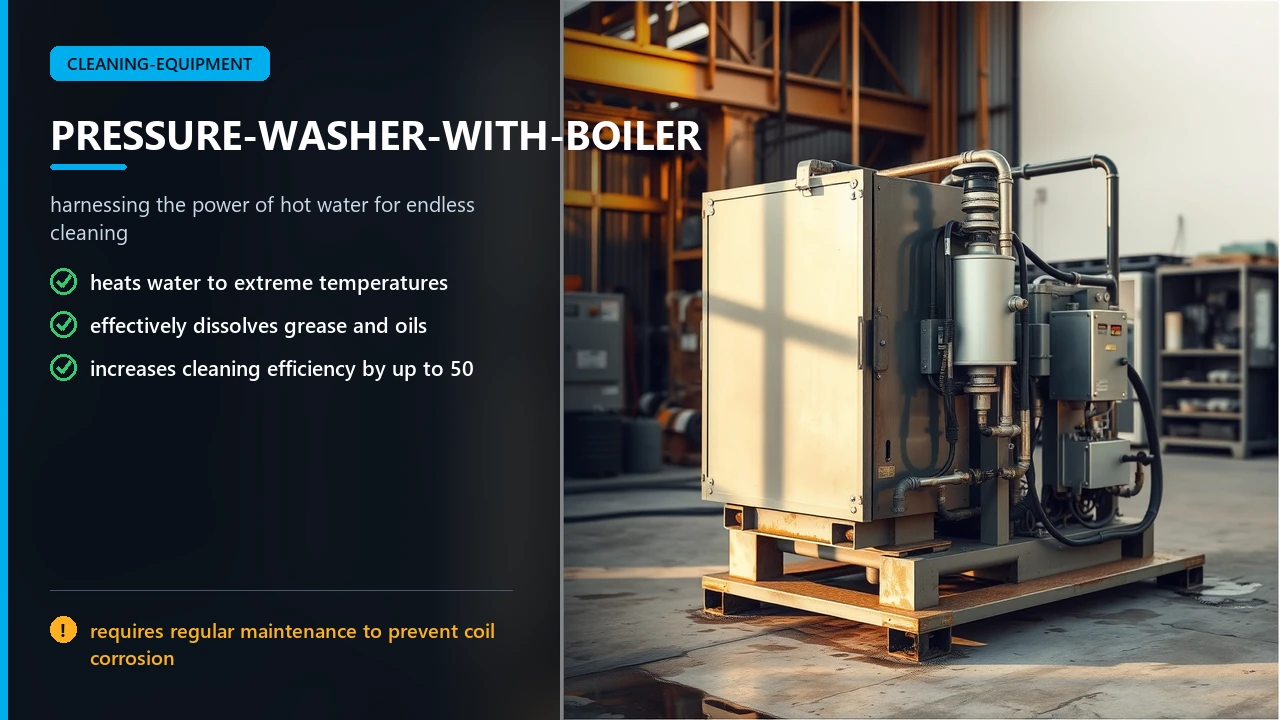
In most pressure washer designs the boiler is really a heating coil surrounded by a burner inside a firebox. Cold water enters the coil, travels through the flame-heated metal, and exits as hot water on its way to the high-pressure pump’s output side. The water never touches a flame directly, which is why the setup is safe when built and maintained properly. Some larger or specialized systems use a true tank-style boiler, but the goal is the same: deliver consistently hot water at the gun.
Boiler vs Burner: Clearing Up the Words
Buyers often get confused because manufacturers use several terms for what feels like the same thing. A quick clarification saves a lot of head-scratching.
The burner is the part that creates the flame, the combustion device that burns diesel, propane, or gas. The coil is the metal tube the water flows through to absorb heat. The boiler or heater is the assembly that holds the burner and coil together and delivers hot water. When someone says a pressure washer has a boiler, they mean it has a heating system that produces hot water, whether the manufacturer markets it as a boiler, a heater, or a hot water unit.
For practical purposes, all of these describe a machine that heats water. The distinctions matter most when you are comparing specs or buying parts, not when you are deciding whether you need heat at all. If your cleaning involves grease, oil, or food residue, the answer is almost always yes.
| Term | What It Refers To | Why It Matters |
|---|---|---|
| Burner | The flame-producing device | Determines fuel type and heat output |
| Coil | Tube the water flows through | Where heat transfers to the water |
| Boiler / Heater | Assembly holding burner and coil | The hot water system as a whole |
| Hot water washer | Complete machine with heat | The finished product you buy |
Why Hot Water Wins on Grease
The advantage of hot water is not subtle, and it shows up on every kind of greasy surface.
Heat lowers the viscosity of oils and fats, meaning they flow and release instead of clinging. It also speeds up the chemical action of detergents, so the same soap cleans more effectively in hot water than cold. The result is less scrubbing, fewer passes, and less water and chemical consumed to finish the job. On a greasy grill hood, a commercial kitchen floor, or a dumpster pad, the difference between cold and hot water is the difference between a chore and a fast, satisfying clean.
Hot water also improves results on surfaces where residue matters, such as food contact areas and equipment that must be sanitized. Because hot water and detergent work together so well, many cleaners can reduce the strength of the chemicals they use, which is healthier for the operator, the surface, and the environment. The heat does the heavy lifting that chemicals would otherwise have to do alone.
For a deeper look at why heat matters, our guide on steam pressure washers explained for powerful cleaning shows how far heat can be pushed, and the breakdown of a hot water heater for a pressure washer that turns cold machines into grease killers explains the heating side in detail.
How Hot Does It Get
Most hot water pressure washers deliver water in the range of about 180 to 210 degrees Fahrenheit. That is hot enough to melt grease and boost detergent performance without turning the machine into a steam generator. True steam machines push water past the boiling point into superheated vapor, which is a different category of equipment with its own rules and capabilities.
For most grease and grime work, 180 to 200 degrees is the sweet spot. Water near the top of that range loosens the toughest deposits faster, while slightly lower temperatures are plenty for routine cleaning and gentler on painted or delicate surfaces. The boiler’s job is to maintain a steady, reliable temperature rather than spike and dip, because consistency is what makes a hot water machine predictable on the job.
| Water Type | Typical Temperature | Best For |
|---|---|---|
| Cold water | Ambient | Mud, dirt, loose grime |
| Warm water | 100–140°F | Light grease, general washing |
| Hot water | 180–210°F | Heavy grease, oil, food soils |
| Steam | 250°F+ | Sanitizing, baked-on residue |
Fuel Choices for the Boiler
The burner needs fuel, and the fuel you choose depends on where you work and what is available.
Diesel and kerosene are the most common fuels for portable and trailer-mounted hot water machines. Diesel is widely available, packs a lot of heat energy, and does not require a fixed gas line, which makes it ideal for mobile cleaning. The tradeoff is fuel storage, refueling, and managing exhaust in enclosed spaces.
Propane burns cleanly and is convenient for some applications, with good heat output and easy availability in many areas. It is popular where a portable fuel supply is needed and where a cleaner burn is preferred.
Natural gas is ideal for stationary machines in a shop or plant where a gas line exists. It removes the need to store and refuel, and it is economical for high-use fixed installations. The limitation is that the machine is tied to the building’s gas supply, so it cannot travel.
Choosing a fuel is really about matching the machine to the workspace. A mobile detailer or contractor needs diesel or propane; a fixed wash bay or food plant with a gas line often does best with natural gas. Our look at the basics of a diesel hot water pressure washer digs into the most common option in more detail.
It helps to think about the full day, not just the machine itself. Mobile cleaning means carrying your fuel with you, so range and tank size matter, and running out of diesel in the middle of a job is a costly mistake. Stationary cleaning means installing a reliable supply and forgetting about refueling, but it also means the machine can never travel. The users who are happiest with their hot water machines are usually the ones who matched the fuel to how they actually work, rather than to what looked impressive on a showroom floor.
Whatever fuel you choose, keep it clean and store it safely. Contaminated fuel clogs burners and causes uneven heating, and improper storage is a genuine fire hazard. Follow the manufacturer’s recommendations for fuel handling, and treat the burner and fuel system with the same care you give the pump, because on a hot water machine the burner is doing half the work.
Where Hot Water Pays Off Most
Hot water is not necessary for every job, so knowing where it earns its keep helps you decide.
Food service and processing is the classic home of the boiler machine. Kitchen exhaust hoods, floors, dumpsters, prep areas, and processing equipment are coated in grease and food soils that cold water cannot touch efficiently. Hot water is often the only practical way to clean these quickly and thoroughly.
Fleet and vehicle cleaning benefits hugely from heat when vehicles carry oil, hydraulic fluid, and heavy road film. Hot water strips these contaminants faster and leaves surfaces cleaner, which matters for inspections, resale, and appearance.
Manufacturing and industrial settings use hot water for machinery, parts, and floors where oil and grease are constant. Construction equipment cleaning benefits too, since hot water cuts through the heavy oil and dirt that accumulate on dozers, excavators, and trucks. Whenever grease and oil are the problem, hot water earns its keep. Our look at hot water pressure washer 4000 PSI and why grease cannot hide explores the high-pressure side of these machines.
Sizing a Boiler Machine
Two numbers define a hot water pressure washer’s work: flow and pressure. Flow, measured in gallons per minute, determines how fast you can clean and how much rinsing power you have. Pressure, measured in PSI, determines how hard the water hits the surface. Hot water machines are judged on both, plus their temperature recovery and fuel consumption.
As a rough guide, lighter commercial work might call for around 3 to 4 GPM at 3,000 to 3,500 PSI, while heavy industrial cleaning can demand 5 GPM or more at 4,000 PSI and beyond. The boiler must be able to keep up with the flow, holding temperature as the machine runs continuously. A machine with plenty of pressure but a boiler that cannot maintain heat will disappoint on long jobs, so pay attention to rated flow and heating capacity together, not just the headlining PSI number.
Operating a Hot Water Machine Safely
Hot water pressure washers are safe when used correctly, but the combination of heat, pressure, and fuel demands respect.
Never spray people or animals. Water at 180 degrees and thousands of PSI causes serious burns and injuries instantly. Treat the gun as you would any dangerous tool and keep the nozzle pointed at the work surface only.
Ventilate the burner exhaust. Fuel-fired burners produce exhaust gases, and running one in an enclosed space without proper ventilation is dangerous. Never operate a diesel, propane, or gas burner indoors without adequate exhaust management, and follow the manufacturer’s guidance.
Watch for flash steam. When hot water meets a cold surface or enters a nozzle in certain conditions, it can flash to steam, which is far hotter than the water itself. Use appropriate nozzles and maintain safe distance.
Let the machine cool before maintenance. The coil and burner stay hot long after shutdown. Give the unit time to cool before touching the burner assembly or servicing the coil, and always disconnect fuel and power first.
The Cleaning Equipment Trade Association publishes guidance on safe operation of pressure washing equipment that is worth reviewing before running a heated machine regularly. Manufacturers such as Hotsy also provide operating manuals and safety documentation specific to their hot water machines, and the Occupational Safety and Health Administration maintains workplace guidance on ventilation and heat safety that applies to any business running fuel-fired equipment indoors.
Maintaining the Boiler and Coil
Heat and hard water are hard on equipment, so maintenance is essential for a hot water machine.
Descale the coil. Heating water accelerates mineral buildup inside the coil, and scale reduces efficiency and eventually blocks flow. Periodic descaling, using a descaler suited to your unit, keeps heat transfer efficient and extends coil life. Hard water areas need this more often.
Maintain the burner. Clean or replace the fuel nozzle, check the electrodes, and keep the air intake clear so combustion stays efficient and clean. A soot-blackened flame means the burner needs attention.
Change the fuel filter and check the fuel supply. Contaminated or restricted fuel causes poor combustion and unreliable heating. Keep fuel clean and filters fresh.
Inspect the pump, hoses, and seals. Hot water is harder on seals and hoses than cold, so check for leaks and replace worn parts with heat-rated components. Regular inspection prevents the small leaks that turn into failures mid-job.
Costs and Payback
A hot water pressure washer with a boiler costs more than a comparable cold water machine, both to buy and to run, because of the burner, the coil, and the fuel. For a business where grease and oil cleaning is the core work, the extra cost pays back quickly through faster jobs, less chemical use, and the ability to take on work a cold machine cannot handle well.
For occasional home use, the cost is usually hard to justify, and a cold water machine with good detergent often does the job. The math changes the moment you clean professionally, because time is money and heat saves time on every greasy job. If you regularly turn down grease work or spend too long on jobs that should be quick, a heated machine is likely worth it.
Fuel consumption is the ongoing cost. Diesel machines burn fuel only when the burner runs, so temperature recovery and job length drive running costs. Stationary natural gas units can be very economical for high-volume use. Weigh purchase price against fuel type, expected use, and the value of the jobs the machine unlocks, not just the sticker price.
What to Look for When Buying
Buying a hot water machine is a bigger decision than buying a cold one, so it helps to have a shortlist of things to check before you commit. The wrong machine shows up later as slow heat recovery, an undersized burner, or a fuel type that makes daily work awkward.
Start with the jobs you actually do most often, then match flow, pressure, and heating capacity to those jobs rather than to a spec sheet that looks impressive. A machine that heats quickly and holds temperature on a continuous job beats one with a higher pressure number that runs out of heat halfway through. Pay attention to the fuel type and how you will refuel, the build quality of the coil and burner, and whether parts and service are available in your area.
| Feature | Why It Matters |
|---|---|
| Flow (GPM) | Speeds up cleaning and rinsing on big jobs |
| Pressure (PSI) | Determines how hard the water hits the surface |
| Heating recovery | Keeps water hot during continuous use |
| Fuel type | Must fit your location and refueling routine |
| Coil and burner quality | Drives reliability, life, and service cost |
| Parts and service | Keeps downtime short when something fails |
Consider the machine’s foot print and mobility too. A trailer or skid machine needs space and towing capacity, while a stationary unit needs a fixed water, power, and fuel or gas supply. If your work moves around, portability matters; if it happens in one place, a stationary unit can be simpler and cheaper to run. Think about warm-up time as well, since a boiler that takes a long time to reach temperature slows the start of every job.
Finally, factor in the whole system, not just the machine. A hot water unit works best with hoses, reels, and fittings rated for heat, because standard cold water hoses and reels can fail under hot water and high pressure. Budget for those supporting parts up front so the machine is not held back by accessories that cannot take the heat.
Frequently Asked Questions
What is a pressure washer with a boiler? It is a hot water pressure washer that heats the water, usually through a burner and coil, before it leaves the spray gun. The heat melts grease and oil that cold water cannot remove effectively.
Is a boiler the same as a burner? Not exactly. The burner is the flame-producing device, the coil is the tube the water flows through, and the boiler or heater is the assembly that combines them to deliver hot water. In everyday use the terms are often used interchangeably.
How hot does a boiler pressure washer get? Most units deliver water between about 180 and 210 degrees Fahrenheit, which is hot enough to break down grease without reaching the superheated range of a true steam cleaner.
Do I need hot water for pressure washing? If your work involves grease, oil, or food residue, hot water makes the job dramatically easier. For mud, dirt, and general washing, a cold water machine is often sufficient.
What fuel do boiler pressure washers use? Common fuels are diesel, kerosene, propane, and natural gas. Portable and trailer machines usually burn diesel or propane, while stationary shop units often use natural gas.
Can I run a hot water pressure washer indoors? Only with proper ventilation for the burner exhaust. Fuel-fired burners produce exhaust gases, so never operate one in an enclosed space without adequate ventilation and manufacturer-approved exhaust management.
Does hot water damage surfaces? Hot water itself is generally gentle on surfaces, but the combination of heat and pressure can harm delicate materials. Test on an inconspicuous area and keep the correct distance and pressure for the surface you are cleaning.
Final Thoughts
A pressure washer with a boiler is the tool that turns grease and oil from a hard fight into a routine job. The heat loosens what pressure alone cannot, letting water and detergent do their best work on the soils that matter most in food service, fleet, and industrial cleaning. Understanding the burner, coil, fuel choices, and safe operation turns a complex piece of equipment into a predictable one.
Choose the fuel that fits your work, size the flow and pressure to the jobs you actually take, run it with ventilation and scald safety front of mind, and keep up with coil and burner maintenance. Do those things and a hot water machine pays for itself in speed and capability. When the next greasy job appears, and it will, the boiler will be the reason it is finished before lunch instead of dragging into the evening.