Marcus typed “pressure washer trailer for sale near me” into three different search engines over two evenings. He found plenty of listings, in nine different states, from sellers who wanted a wire transfer before he had even seen the machine. One “local” ad turned out to be four hours away. Another refused a phone call. By the time he bought, he had learned the hard way what every experienced contractor knows: the search is easy, but finding a rig close enough to inspect, test, and service is where the money and the risk really live.
That is what this guide is about. Not just where listings hide, but how to sort the genuine local deal from the out-of-state trap, what to inspect before money changes hands, what the real costs are beyond the sticker price, and how to keep a local rig running for years instead of months. Whether you are buying your first mobile setup or adding capacity to a growing crew, here is how to find the right pressure washer trailer for sale near you.
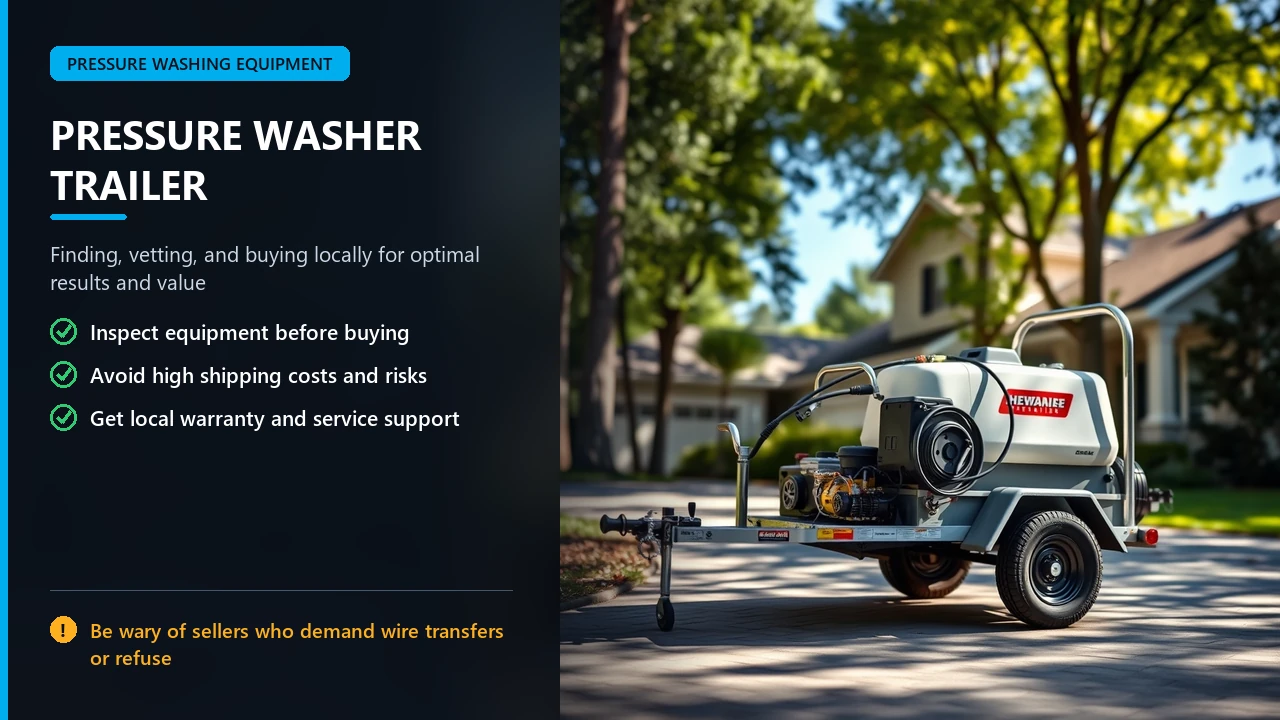
Why “Near Me” Matters More Than You Think
The distance to a trailer is not a convenience issue. It is a value and risk issue, and it shows up in four places:
- Inspection. You cannot feel frame rust, hear a pump bearing, or see a pinhole in a water tank through photos. Distance is what stops you from inspecting, and un-inspected equipment is where bad deals hide.
- Freight and delivery. Shipping a trailer costs hundreds to well over a thousand dollars, and damage in transit is your problem. A local pickup avoids all of it.
- Warranty and service. A trailer bought from a local dealer has a place to go when the burner quits or the pump leaks. The same trailer shipped from three states away is an orphan you have to fix yourself.
- Parts and support. Pumps, guns, and reels fail. A local dealer relationship means same-day parts and borrowed time instead of weeks on backorder.
For a machine that is the heart of your business, “buy local” is not a slogan. It is risk management.
Where Local Listings Actually Live
Most buyers only check one place and give up. The truth is that local trailers sell through several channels, and the best finds are usually not on the first page of a general search.
1. Authorized local dealers
This is the safest channel. Brands like Mi-T-M, Alkota, Landa, Hotsy, Easy-Kleen, and Pressure-Pro sell through dealer networks, and most regions have at least one within a reasonable drive. Dealers carry new and trade-in units, offer financing, warranty the equipment, and service what they sell. Use brand “find a dealer” tools and dealer directories to see who is actually near you. A few national part suppliers also run locator networks with hundreds of partner dealers, which is a fast way to see what is available within an hour of your zip code.
2. Online marketplaces with a radius filter
Classified sites and equipment marketplaces let you set a distance from your location, which is the whole point. Search terms that surface the real local stock include “hot water pressure washer trailer,” “pressure washing trailer,” and specific brand names. Filter by distance first, then price. Skip anything that ignores your radius.
3. Auction and fleet-liquidation channels
Rental companies, municipalities, and large contractors rotate trailers out when they age out of the fleet. These units are usually well maintained and priced to move. Some rental giants sell used equipment directly. You often have to inspect on-site and bid, but the value can be excellent.
4. Contractor forums and local groups
Regional pressure washing groups, trade associations, and local business networks frequently post used rigs before they hit the open market. These sales are often to someone the seller knows, which means more honesty and better documentation.
5. Direct-to-builder turnkey sellers
A growing number of builders sell complete turnkey trailers online and ship them. This can work if the price is right and the service network is real, but read the fine print on shipping, warranty, and who services it in your area. For a first rig, local still wins.
New vs Used: What Changes When You Buy Local
| Factor | New (Local Dealer) | Used (Local Private or Dealer) |
|---|---|---|
| Price | Highest, but financed and warrantied | Can be 40-60% less than new |
| Warranty | Full manufacturer coverage | Usually none from private sellers; short from dealers |
| Condition risk | Minimal | Depends entirely on inspection |
| Financing | Easy through dealer programs | Harder; may need personal loan |
| Parts & service | Dealer-backed | Dealer-backed if bought from a dealer |
| Depreciation | Steepest in year one | Already absorbed |
| Best for | Established businesses, tax-sensitive buyers | Startups, cash buyers, buyers who can inspect |
A used rig bought locally, inspected properly, is often the smartest entry into mobile cleaning. A used rig bought sight-unseen from out of state is a gamble with real money on the table.
Price Expectations by Tier
Knowing the market range keeps you from overpaying and helps you spot a genuinely good deal when it appears. These figures reflect the current market across new and used listings.
| Tier | Typical Configuration | Price Range |
|---|---|---|
| Entry cold water | Compact cold water, small tank, 3 GPM / 2,700 PSI | $3,000 – $6,000 |
| Turnkey starter | 5’x8′ single axle, cold water, soft wash ready | $11,000 – $13,000 |
| Mid turnkey | 6’x10′ tandem, cold water, larger tank, reel | $16,000 – $19,000 |
| Pro hot water | Hot water 5.5 GPM / 3,500 PSI, 200+ gallon tank | $15,000 – $25,000 |
| High-volume commercial | Dual pump, 8+ GPM, couch/soft wash package | $25,000 – $50,000+ |
| Used market | Varies widely by age and brand | 40-60% below equivalent new |
Most contractors launching or scaling find a well-equipped package in the mid range meets their needs and still leaves margin. Focus your search on that band unless your jobs demand the extremes. For a deeper look at how packages are configured, see our trailer systems guide.
What to Look For on the Trailer Itself
When you finally stand in front of a local trailer, inspect it in this order. This is where a nearby deal proves its worth.
Frame, axles, and tires
The trailer is the foundation. Check the frame for rust, cracks, and previous welding repairs. Look at the axle rating against the loaded weight. Inspect tire date codes (the four-digit number), not just tread; an old trailer often hides dry-rotted tires. Confirm the GVWR on the data plate and make sure it matches your tow vehicle’s rating.
Water tank
Poly tanks last decades if not abused. Look for cracks, repaired seams, and a missing or cracked lid. A 200-gallon tank is common on hot water rigs; larger buffer tanks give you more runtime between refills. Check that the tank is strapped down and that the fittings and bulkhead are sound.
Pump and drive
The pump is the most expensive single component. Common quality names include General, CAT, Comet, and AR. On a belt-drive unit, check the belts, pulleys, and tension. On any pump, look for oil weepage at seals and listen for bearing noise. Ask about pump hours if there is no meter.
Engine
Honda GX and Kohler Command Pro engines dominate this class. Start it cold, listen to the idle, and check for smoke, oil leaks, and clean air-filter and oil conditions. A cold start tells you far more than a warm one.
Burner (hot water units)
Confirm the burner fires and reaches temperature. On diesel burners, check the filter, fuel lines, and that the fuel tank is clean. A weak or smoky burner can be a costly fix.
Hose reel, hose, gun, and wand
Spin the reel. A gritty or seized swivel is a repair. Inspect the high-pressure hose for kinks, blistering, and exposed braid. Test the gun for leaks and the trigger for smooth return.
Brakes, lights, and hitch
Test the brakes (surge or electric) and the breakaway system. Check all lights and the coupler. A trailer that cannot legally and safely tow is not a bargain at any price. Towing safety requirements are set by federal and state rules, so verify the setup against NHTSA guidance before you pull it home.
The Questions to Ask a Local Seller
Before you drive out, get answers in writing or on the phone. A hesitant seller is information too.
- How many hours are on the engine and pump?
- Is it hot water or cold water, and what is the burner’s firing rate?
- What is the pump make and model, and when was it last serviced?
- What is the GVWR, and how much does the loaded rig weigh?
- When were the tires and brakes last replaced?
- Why are you selling, and how long have you owned it?
- Can I see it running, from a cold start?
- Is the title clean and in your name?
- Will you allow a mechanic to inspect it?
A serious seller expects these questions and answers them plainly. A seller who dodges them, refuses a cold start, or pushes for fast remote payment is telling you to walk away.
Costs Beyond the Sticker Price
Budget the whole picture, not just the trailer. The total cost of ownership includes several items buyers forget.
- Financing. Many dealers offer equipment financing, often with monthly payments that spread the cost. Compare rates, and note that small-business loans and lines of credit through the SBA or local lenders can be an option for qualified buyers.
- Insurance. Commercial auto, general liability, and inland-marine or equipment coverage. Your insurer can bundle trailer and equipment.
- Tow vehicle capacity. Verify your truck’s tow rating against the loaded trailer, including water weight. Water is roughly 8.3 pounds per gallon, so a full 200-gallon tank adds over 1,600 pounds on top of the machine.
- Training and setup. Someone on the team needs to learn the burner, the pump, and safe operation. Factor a day for it.
- Consumables and spares. Nozzles, filters, belts, oil, and hoses.
- Water access. A buffer tank reduces but does not eliminate the need for a fill point.
Water weight is the most commonly underestimated factor. A trailer that tows fine empty can feel completely different full. Check your combined weight against your truck’s ratings before you commit.
Red Flags in Local Listings
- Below-market price with urgency. If a $16,000 rig is listed at $4,000 and the seller is “deploying tomorrow,” it is a scam or stolen.
- No phone number, email only. Legitimate local equipment sellers take calls.
- Only stock photos. A real seller has photos of the actual unit, including the data plate and hour meter.
- Payment requested before viewing. Never. See the warning above.
- Vague on hours or service. “Runs great” is not an answer to maintenance history.
- Title in someone else’s name. A clean title in the seller’s name is non-negotiable.
- Pressure to skip inspection. A seller who will not let a mechanic look is hiding something.
Transporting It Home Safely
Once you buy, the trip home matters. Confirm the coupler matches your hitch ball, connect safety chains in a crossed pattern, and test the lights and brakes. Secure the machine, tank, and any loose accessories so nothing shifts at highway speed. If you are new to towing, practice in an empty lot before you hit traffic. A local purchase keeps this trip short and lets you return easily if something is not right.
For setup and towing best practices, see our trailer setup and towing guide, and for what a complete rig includes, review the trailer components guide.
After the Sale: Local Service Wins
The deal is not finished when you pull out of the driveway. It is finished when the rig has run a full season without downtime you could not fix. That is the strongest argument for buying near you:
- Same-day parts. A local dealer stocks the pump, burner, and reel parts your rig needs.
- Faster repair. You can drop the trailer off and pick it up, instead of shipping components.
- Warranty handling. Local dealers process warranty claims and loan equipment while yours is down.
- Relationship pricing. Repeat customers get better service, faster turnaround, and honest advice.
When your livelihood rides on the trailer, the nearest qualified service provider is worth more than a slightly lower price three states away.
How to Search Effectively With Keywords and Filters
Most buyers lose good local listings because they search like a shopper instead of a buyer. A few adjustments tighten your results and surface the real nearby stock.
- Add a distance step to every search. Set a radius (say 100-150 miles), then sort by distance, not by price. This puts the inspectable trailers in front of you first.
- Search specific configurations, not just the category. “Hot water pressure washer trailer,” “pressure washing trailer 5.5 GPM,” and “soft wash trailer turnkey” return far more relevant local results than a broad term.
- Search the brands, not the category. Alkin, Landa, Hotsy, Easy-Kleen, Pressure-Pro, Mi-T-M, and Alkota all have dedicated used markets. Brand searches tend to reach serious sellers with real documentation.
- Save the search and set alerts. Good local rigs move fast. Alerts mean you see a fresh listing the day it posts, before it is gone.
- Check the dealer locator before the marketplace. A nearby dealer may have a trade-in along with the same model that is not yet advertised widely.
The difference between a frustrating search and a fast local find is almost always distance and specificity. Search by configuration and brand, and let the radius filter do its job.
Negotiating a Fair Local Price
Local buying gives you something remote listings do not: leverage. Once you are standing at the trailer, you have information, and information is what moves a price.
- Track comparable sales. Before you go, note what similar rigs have been listed for in your region over the past several weeks. That range is your anchor, not the seller’s asking price.
- Let inspection do the talking. Worn tires, a leaking pump seal, a stubborn burner, or missing documentation are all legitimate price discussions. They are repair costs, and they come off the number you pay today.
- Be ready to walk. The strongest position in any equipment negotiation is genuinely being willing to leave. There is always another trailer.
- Negotiate the package, not just the price. Extra hose, nozzles, a surface cleaner, or a spare gun can add real value even if the seller will not drop the number.
- Cash close, condition close. A fair price paid promptly for a machine worth it beats squeezing a desperate seller and inheriting their problems.
For a broader framework on judging value in this market, see our smart buy guide and what to check before you buy.
Financing a Local Purchase
Cash is not your only option, and financing a trailer locally is often easier than financing one you have never seen.
| Funding Option | Best For | Notes |
|---|---|---|
| Dealer equipment financing | New and used dealer stock | Fast, no heavy paperwork; rates vary by credit |
| SBA / bank small-business loan | Established businesses | Competitive rates; longer approval time |
| Equipment lease | Keeping cash for operations | Lower monthly payment; you may not own it at the end |
| Credit line | Buyers with an existing line | Flexible; watch variable rates |
| Cash / personal loan | Private-party local sales | Simplest for used rigs with no dealer backing |
One advantage of local buying is that a nearby dealer can finance, deliver, and service the machine, usually at a lower price than a remote deal once shipping and risk are added in. If you qualify, an SBA-backed loan or a bank line can keep working capital free. Treat financing as part of the total cost, and compare the full terms, not just the monthly payment.
What a Fair Deal Actually Looks Like
A fair deal is not the lowest price on the screen. It is the best combination of condition, capability, proximity, and support. Use this quick scorecard before you commit:
- Condition: Frame, tank, pump, engine, and burner all check out, with a cold start and no hidden repairs.
- Documentation: Clean title in the seller’s name, hour meter or service records if available.
- Capability: GPM, PSI, water capacity, and hot or cold water match your actual jobs.
- Proximity: Close enough to inspect, tow home, and service without shipping.
- Support: A local dealer or a seller who stands behind the machine.
- Price: Within the regional range for its condition and configuration, with room for repair costs you identified.
If most boxes are checked, you have found a good local trailer. If the price is exciting but condition or documentation is weak, you have found expensive work, not a deal.
Renting First: A Smart Local Move
If you are not yet sure a trailer is right for you, renting or buying from a local source lets you test the concept before you commit capital. Many local dealers and rental yards will rent a comparable rig for a weekend. Running one for a few jobs teaches you what capacity, water tank size, and hot water you actually need, so the trailer you eventually buy matches the work instead of a guess. To explore that path, see our find, rent, or buy guide.
Upgrading Over Time
A local trailer can grow with you. Because you can drive it to a nearby dealer and service it yourself, it is practical to add capacity, reels, or a soft wash package as the business scales. Many rigs are bought as a solid core and then improved piece by piece:
- Add a second hose reel for faster crew turnaround.
- Upsize the buffer tank for longer runtime between water stops.
- Add a surface cleaner and dedicated downstream injection for flatwork.
- Upgrade nozzles, gun, and hose to stainless and higher-pressure rated components as they wear.
Buying local supports this lifecycle because parts and service are always within reach, and a dealer who knows your rig can recommend upgrades that fit it.
Frequently Asked Questions
Where is the best place to find a pressure washer trailer for sale near me?
Start with authorized local dealers for new and used inventory, then check online marketplaces with a distance filter, auction and fleet-liquidation channels, and regional contractor groups. Filtering by distance is the key step most buyers skip.
How much should I expect to pay?
Entry cold water rigs run roughly $3,000-$6,000. Turnkey cold water packages run about $11,000-$19,000. Hot water pro rigs run $15,000-$25,000, and high-volume commercial setups climb past $50,000. Used units are often 40-60% below equivalent new.
Do I need a special license to tow one?
Most states do not require a special license for trailers under about 10,000 pounds GVWR, but rules vary. Verify your state’s requirements and your tow vehicle’s rating before buying.
Should I buy new or used locally?
New buys you warranty and peace of mind. Used buys you value if you inspect carefully and buy from a local seller who lets you test it. For a first rig, a locally inspected used unit is often the smartest entry.
How do I avoid scams when buying near me?
Insist on viewing the trailer in person, never pay by wire, gift card, or cash app to a stranger, verify a clean title in the seller’s name, and be suspicious of below-market prices with urgency. The FTC publishes current scam guidance.
What should I inspect first?
Frame and tires, then the water tank, pump, engine, and burner, then the reel, hose, gun, brakes, and lights. Do a cold start and confirm the burner fires on hot water units.
How much does the water weigh?
About 8.3 pounds per gallon. A full 200-gallon tank adds over 1,600 pounds. Always check your loaded weight against your tow vehicle’s rating.
Final Thought
Searching for a pressure washer trailer for sale near me should not feel like a gamble. The right local rig is one you can walk around, start cold, inspect part by part, tow home in an afternoon, and service at a dealer you can drive to next week. Pay a fair price for a machine with clean history, verify the trailer’s frame and title, protect yourself from remote-payment scams, and buy within reach. Do that, and the distance that once felt like a limitation becomes the reason your new rig keeps earning job after job.