Three years ago, Priya was cleaning restaurant grease traps with a pickup truck, a loose pressure washer, and a garden hose she had to drag through the mud. Every job started and ended with forty minutes of setup and takedown, and she turned down bigger contracts because she simply could not carry enough water. The day she bought a turnkey trailer power washer, her business changed shape. She could fill a tank at a hydrant, roll up to a commercial account, and start earning within minutes. Within a year she had hired a second operator and bought a second rig. This is what happens when you stop fighting your equipment and start shopping trailer power washers for sale like a business owner.
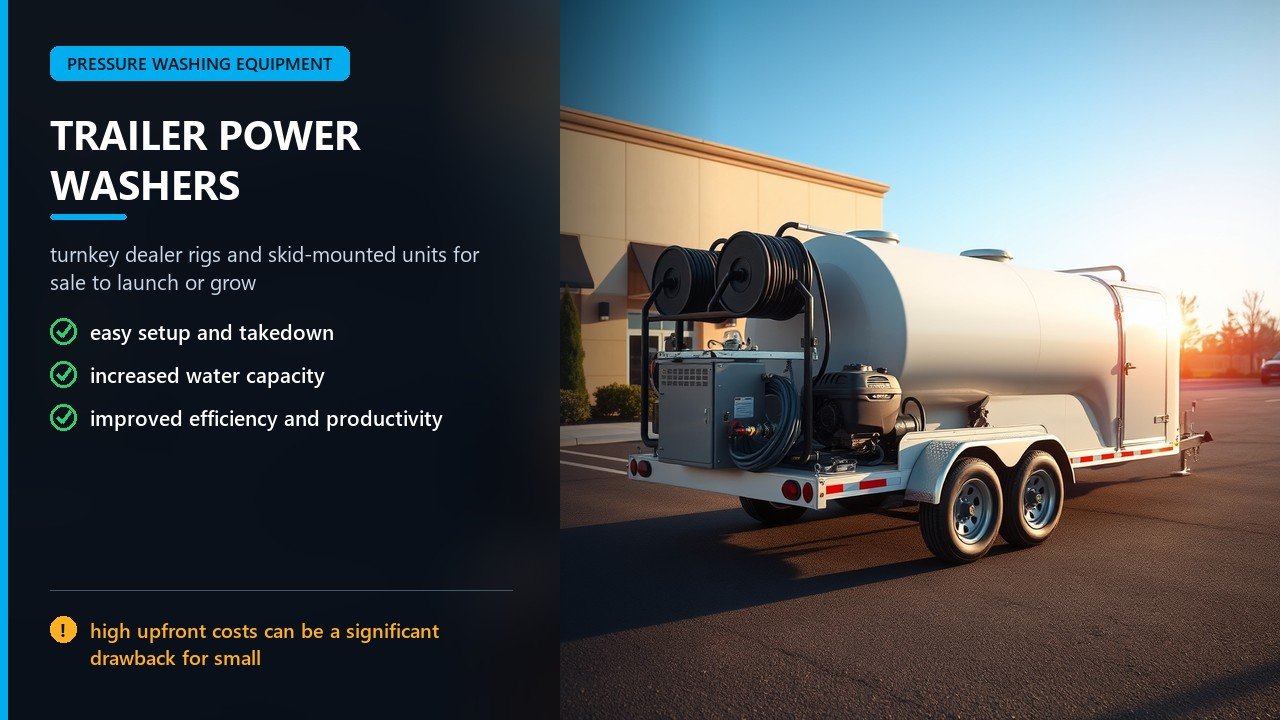
A trailer-mounted pressure washer rig packages a pressure washer, water tank, hose reels, plumbing, and often a soft wash system onto a towable trailer, ready to work the day it arrives. If you are comparing listings, the options can feel overwhelming, from entry-level starter rigs around five thousand dollars to thirty-thousand-dollar commercial machines with hot water and dual operators. This guide helps you cut through the noise so you buy the right rig for your jobs, your truck, and your budget.
What to Expect When Shopping Trailer Power Washers for Sale
A pressure washer trailer for sale can mean very different things depending on who is selling it. Understanding the categories saves you from overpaying or underbuying.
Turnkey dealer rigs
Dealers like BCE Systems, Power Line Industries, and Cyclone Pressure Systems sell complete, road-ready packages that are assembled, plumbed, and tested before shipping. You hook up, fill the tank, and start washing. Turnkey rigs cost more, but they come with a warranty, matched components, and support. For a new business that needs to earn immediately, the time saved on fabrication is often worth the premium.
Skid-mounted units
A skid is the pressure washer and pump mounted on a compact frame that you place on your own trailer, truck bed, or cart. Skids cost less than full trailers and let you use a trailer you already own. Our guide to a pressure washer on a trailer covers how to build around a skid.
Used rigs and private listings
Marketplaces, classifieds, and auctions offer used rigs at a discount, but condition varies wildly. A used rig can be a bargain or a money pit depending on hours, pump wear, coil condition, and trailer maintenance. Inspection matters far more than the listing photo.
Custom builds
If your jobs are specialized, dealers will build a custom rig around your flow needs, tank capacity, and software (pressure washing versus soft washing). Custom builds take longer and cost more but fit your contracts exactly.
How Much Do Trailer Power Washers Cost
Pricing tracks directly to flow rate and whether you need hot water. The table below gives realistic U.S. ranges based on current market listings.
| Rig Type | Typical Spec | Price Range | Best For |
|---|---|---|---|
| Entry turnkey cold water | 4 GPM at 4,000 PSI, 5×8 trailer | $5,000 to $7,000 | New businesses, residential work |
| Mid cold water trailer | 5.6 to 8 GPM cold, single axle | $7,800 to $10,500 | Concrete flatwork, driveways, growth |
| Hot water trailer | 5.6 to 8 GPM hot, diesel burner | $13,000 to $19,500 | Grease, fleet washing, hood cleaning |
| High-output commercial | 8 GPM hot at 3,000 PSI, GX690, tandem axle | $23,000 to $35,000+ | Full-time contractors, large contracts |
These numbers are machine and trailer only. Add soft wash systems, surface cleaners, extra reels, signage, and a tow vehicle capable of handling the loaded weight. A rig with a full water tank is heavy, and a single or tandem axle package with 200 to 300 gallons of water generally tows behind a half-ton or three-quarter-ton truck. Always confirm the wet, loaded weight before you buy.
The Components That Determine a Rig’s Value
When you evaluate trailer power washers for sale, judge the package component by component, not by the shiny trailer.
The pressure washer pump
This is the heart of the rig. A triplex plunger pump from a reputable maker lasts far longer than a cheap axial pump. On high-end rigs you will see industrial pumps rated for thousands of hours, while entry rigs often use budget pumps that are fine for part-time work but wear faster under daily use. Ask about the pump brand and whether it is rebuildable.
The engine
Look for a commercial engine such as a Honda GX290, GX390, or GX690. These engines dominate the trailer market for good reason: they start reliably, run cool, and parts are everywhere. Our Honda GX390 engine guide explains why this family of engines is the standard.
The burner and water temperature (for hot water rigs)
Hot water rigs add a diesel, kerosene, or propane burner and a heating coil. Burner output is measured in BTU, typically 300,000 to 400,000 plus on commercial trailers. Coil condition is critical on used rigs, because a cracked or scaled coil is expensive to replace. Our guide to hot water pressure washing trailer components breaks down these systems.
The water tank and buffer tank
Tank capacity determines how long you can work away from a water source. Many rigs use a 200 to 300 gallon tank, often an IBC tote, with a float valve or demand pump to keep the pressure washer fed. Bigger tanks mean more weight and a heavier tow vehicle. Our article on a water tank and pressure washer covers how tank and pump work together.
Hose reels, hose, and accessories
Count the reels and their capacity. A pressure hose reel for 150 to 200 feet of 3/8-inch hose, plus a separate reel for a supply or soft wash hose, is typical on a good rig. Surface cleaners, wands, tips, and nozzles are usually included but vary in quality. Our guide to a water pressure hose reel explains reel quality and sizing.
The trailer itself
Do not overlook the trailer. Check axle rating, tire condition, lights, brakes, and deck material. A 5×8 single-axle trailer suits entry rigs, while tandem-axle 12-foot trailers carry heavy hot water packages. A poorly maintained trailer can fail inspection or, worse, fail on the highway.
Where to Find Trailer Power Washers for Sale
Your source affects price, support, and risk. Here are the main channels.
- Specialty dealers. Companies that build pressure washing rigs offer the best support and matched components. You pay more but get a warranty and a machine that is ready to earn.
- Equipment distributors and supply houses. Larger distributors carry trailer packages and can often finance them, and they may service what they sell.
- Online marketplaces and classifieds. Facebook Marketplace, Craigslist, and equipment listing sites carry used rigs. Prices are lower, but you inspect everything yourself.
- Auctions. Commercial equipment auctions can yield deals, but you often buy as-is with limited inspection.
- Manufacturer-direct and custom builders. Best for specialized needs and financing through the builder.
For a first rig, buying from a dealer reduces the chance of a costly surprise and gets you cleaning sooner. For a second rig or a budget build, used and private sales can work well if you know what to inspect. Our guides to a pressure wash trailer for sale and a pressure washing trailer for sale walk through inspection in detail.
New Versus Used: Which Makes Sense
New rigs offer warranty coverage, modern components, no hidden wear, and often financing. They cost more up front but carry less risk. Used rigs cost less and can be a fast way to add capacity, but you inherit whatever the previous owner neglected.
A used trailer rig can be an excellent value if the pump is rebuildable, the coil is sound, the engine starts and runs clean, and the trailer is roadworthy. It can be a disaster if the pump is worn, the burner does not fire, or the trailer frame is rusted through. The deciding factor is your ability to inspect and your tolerance for repairs. If you cannot evaluate a rig yourself, bring someone who can, or budget for a professional inspection.
Inspection Checklist for Used Trailer Rigs
If you are buying used, work through this list before you hand over money.
- Engine: Cold-start it, listen for knocks, check for smoke, and inspect oil condition.
- Pump: Check pump oil, look for leaks, and confirm it builds and holds pressure.
- Burner and coil (hot water): Confirm the burner ignites, water heats, and the coil is not cracked or scaled. Run it long enough to reach temperature.
- Unloader and relief valves: Confirm they function and do not leak.
- Tank: Inspect for cracks, prior repairs, and cleanliness. Confirm fittings and float valve work.
- Reels and hose: Check reel function and hose condition; hidden kinks and abrasion are common.
- Trailer: Inspect tires, bearings, lights, wiring, brakes, deck, and frame for rust and cracks.
- Accessories: Confirm surface cleaner, wand, gun, and tips are included and functional.
- Paperwork: Get a title for the trailer and any service records for the machine.
Hot Water Versus Cold Water Trailer Rigs
The single biggest decision after budget is hot or cold water. Cold water rigs cost less, are simpler, and handle concrete flatwork, driveways, and general exterior cleaning well. Hot water rigs add a burner and coil and handle grease, oil, fleets, and restaurant work that cold water cannot. Our guide to a pressure washing detergent explains how heat and chemistry work together.
Choose cold water if your work is mostly residential surfaces and concrete. Choose hot water if you target commercial accounts, fleets, or food service, where grease and oil demand heat. Many contractors start cold and upgrade to hot once the work justifies it, or run both in a fleet as their contracts grow.
Soft Wash Systems on Trailers
Many modern trailer packages include a soft wash system alongside the pressure washer. Soft washing uses low pressure and specialized chemicals to clean roofs, siding, and delicate surfaces safely. A trailer with both pressure washing and soft washing capabilities lets you bid a wider range of jobs with one rig. If your market includes residential exterior cleaning, a combined package is often the smarter buy, even if it costs a little more up front. The entry packages that include a 3.5 GPM soft wash pump and solution tanks are popular for exactly this reason.
How a Pressure Washing Trailer Rig Is Set Up
Understanding how a rig is assembled helps you judge quality and spot shortcuts. A well-built trailer follows a logical flow from water supply to spray gun.
- Water source to tank. Fresh water fills the buffer tank from a hydrant or customer spigot. A float valve or mechanical fill keeps the tank from overflowing, and some rigs use a transfer pump to speed filling.
- Tank to pump. A short, large-diameter hose feeds the pressure washer pump from the tank. A filter before the pump catches debris that would damage the pump’s valves.
- Pump to burner and coil. On a hot water rig, the pump pushes water through the heating coil, where a diesel or propane burner raises the temperature. A thermostat and pressure switch control the burner.
- Coil to hose reel. Heated water travels through a high-pressure hose, often stored on a live reel. The reel’s swivel lets you work with the hose connected.
- Reel to gun and surface cleaner. The operator connects a gun, wand, or surface cleaner at the end. Quick connects make swapping tools fast.
- Soft wash branch (optional). A separate low-pressure pump, solution tank, and hose deliver chemicals for soft washing without running them through the pressure pump.
Clean, well-routed plumbing with quality fittings and no tangled, chafing hoses is the mark of a professional build. When you inspect a rig, follow this chain from tank to gun and look for leaks, poor clamping, and worn hose. If the plumbing looks like an afterthought, the rest of the build may be too.
What a Trailer Rig Can Earn
A trailer power washer is a revenue tool, and the numbers are why so many people invest in one. Flatwork like driveways and commercial concrete is often priced by square footage, while house washing, roof soft washing, and fleet work are typically priced per job or per unit.
Consider a simple illustration rather than a promise: if a rig lets an operator clean a large parking lot or a set of driveways that would have taken two people two days, the labor savings alone can cover a meaningful share of the payments in a week. Add a second service such as soft washing, and one rig generates income from several job types. The key is not the machine; it is how many estimate-driven jobs you can complete per week. A trailer rig removes the two biggest constraints on job volume, water supply and setup time, which is exactly why it can lift revenue so quickly. Before buying, sketch realistic job pricing in your market and ask how many jobs a week the rig lets you complete that you cannot complete today.
Mistakes to Avoid When Buying a Trailer Rig
- Buying on PSI alone. Flow, tank size, and burner quality matter as much as pressure for real-world productivity.
- Overlooking the tow vehicle. A loaded rig is heavy. Confirm your truck can safely tow and stop it.
- Skipping the trailer inspection. Rust, bad bearings, and failed lights turn a bargain into a project.
- Ignoring the coil on used hot water rigs. A scaled or cracked coil is one of the most expensive repairs. Test under heat.
- Buying too much rig for the jobs. A 10 GPM hot water monster is wasted if your market is residential driveways.
- Forgetting insurance and licensing. Cover the rig, your business, and towing before the first job.
- Not budgeting for consumables. Chemicals, extra nozzle sets, o-rings, and fuel are ongoing costs, not one-time ones.
Financing, Insurance, and Getting Road-Ready
A trailer pressure washer is a business asset, so treat the purchase like one. Many dealers and distributors offer financing, which preserves cash flow for marketing and labor. Factor in insurance for the rig and for your business, including commercial auto coverage for towing and general liability for job-site damage. Before your first job, make sure the trailer is registered, titled, and compliant with lighting and safety requirements for your state, and confirm your tow vehicle is properly rated and equipped with the right hitch and brake setup.
Budget for the hidden costs: chemical inventory, spare nozzles and o-rings, fuel, maintenance, and signage. A well-equipped rig that is insured, legal, and stocked is worth more to your business than a slightly cheaper machine that leaves you scrambling on the job.
Choosing the Right Rig for Your Work
Match the rig to the jobs you will actually take.
- Residential and light commercial: An entry or mid cold water rig at 4 to 5.6 GPM is plenty and easy to tow and feed.
- Concrete flatwork and driveways: Higher cold flow, around 8 GPM, covers large areas fast with a surface cleaner.
- Fleets, grease, and hood cleaning: A hot water rig at 5.6 to 8 GPM is the workhorse.
- Full-time high-volume contracting: An 8 GPM hot water rig with a commercial engine and tandem trailer handles daily production and multiple operators.
If you are still deciding between a trailer and a skid on your truck, our guide to pressure washer with trailer setup compares the options, and our article on a mobile pressure washing trailer covers building versus buying.
Trailer Versus Skid Versus Truck Mount
A trailer is popular, but it is one of three common mobile formats. Knowing the differences helps you buy the right one.
- Trailer rig. Everything rides on a towable trailer. You can unhitch and leave the rig at a job, use the tow vehicle for other tasks, and carry large tanks. Best when you need maximum water capacity and a dedicated setup, and when you own or can buy a capable tow vehicle.
- Skid unit. The pressure washer and pump sit on a compact skid you place in a truck bed, on a small trailer, or on a cart. Skids are lighter and cheaper and let you reuse a trailer or truck you already own. Best for starting out or when space and budget are tight.
- Truck mount. The machine is permanently installed in a truck bed or van. Best for detailers and operators who work out of one vehicle every day, but it ties up the vehicle and limits water capacity compared with a trailer.
Many contractors start with a skid in a truck bed and graduate to a full trailer as their contracts grow. If you already run a truck and trailer setup, our guide to a pressure washer on a trailer shows how to build around the rig you have. If you are choosing a format from scratch, a trailer gives the most capacity and flexibility for commercial work.
Frequently Asked Questions
How much does a trailer power washer cost? Entry turnkey cold water rigs start around $5,000. Mid cold water packages run $7,800 to $10,500, hot water rigs $13,000 to $19,500, and high-output commercial trailers $23,000 to $35,000 or more.
What can I tow a pressure washing trailer with? Most single and tandem-axle rigs with a full tank tow behind a half-ton or three-quarter-ton truck. Always confirm the loaded weight and your vehicle’s tow rating and brake capacity.
Should I buy new or used? New rigs offer warranty and less risk. Used rigs cost less but require careful inspection of the engine, pump, burner, coil, and trailer.
Do I need hot water? Only if your work involves grease, oil, fleets, or food service. For concrete flatwork and general exterior cleaning, cold water is simpler and cheaper.
What size water tank do I need? Many rigs use 200 to 300 gallons. More capacity means more time away from a water source, but more weight and a heavier tow vehicle.
What is a soft wash trailer? A rig set up for low-pressure chemical cleaning of roofs, siding, and delicate surfaces, often combined with a pressure washer on the same trailer.
Do trailer rigs come ready to work? Turnkey dealer packages do. Skids and private listings may need plumbing, assembly, or repairs before they earn.
What is the best size trailer for a pressure washing rig? A 5×8 single-axle trailer suits entry cold water rigs, while 6×12 or larger tandem-axle trailers carry heavier hot water packages with bigger tanks. Match the trailer to the loaded weight with margin.
Can I finance a trailer power washer? Many dealers and distributors offer financing, and a rig can qualify as business equipment. Preserve cash flow and compare rates before committing.
Smart Buying Tips Before You Commit
Beyond specs and inspection, a few habits separate a good purchase from a regretted one. Ask sellers for the original build sheet and service records, and insist on a demonstration under load rather than a cold run. Get the exact loaded weight in writing, and verify your tow vehicle, hitch, and brakes can handle it. Compare at least three rigs in the same class so you understand the market, and price the accessories you will need, such as a surface cleaner and extra hose, before you compare totals. Finally, buy the rig that fits your next twelve months of work, not the machine you wish you had someday. A slightly flexible, well-supported rig you can grow into usually beats a bigger, cheaper machine that overwhelms your tow vehicle and water supply.
Final Thoughts on Trailer Power Washers for Sale
A trailer power washer turns a scattered cleaning operation into a professional, mobile business. It carries your water, organizes your hose, and lets you start work minutes after you arrive instead of fighting setup. When you shop trailer power washers for sale, resist the pull of the biggest PSI number. Match the flow, water temperature, tank size, and trailer capacity to the jobs you actually take, buy from a source that supports you, and inspect used rigs carefully before you commit.
Do that, and a rig will do what it did for Priya: let you take on bigger contracts, finish more jobs per day, and grow from one operator into a fleet. The right trailer is not just equipment; it is the backbone of a cleaning business that can scale.
Sources and Further Reading
- BCE Systems, pressure washer trailer packages and specifications: bcesystems.com
- Power Line Industries, Honda GX690 power wash trailer systems: powerlineindustries.com
- U.S. Federal Motor Carrier Safety Administration (FMCSA), trailer and towing safety guidance: fmcsa.dot.gov
- U.S. Occupational Safety and Health Administration (OSHA), hand and power tool safety: osha.gov