Orbital Pressure Washer: Orbital vs Rotary Cleaning Action Explained
The phrase “orbital pressure washer” gets used in a few different ways, and that is why it causes confusion. Sometimes it means a pressure washer fitted with an orbital-action brush that scrubs as it sprays, sometimes it is a loose label for a spinning rotary surface cleaner, and sometimes it is simply a mix-up with orbital floor machines, which are a separate category of equipment altogether. This guide sorts out what orbital action actually is, how it differs from rotary action, where each belongs on a pressure washer, and how to choose the right setup for the surface you are cleaning.
The short version: On a pressure washer, “orbital” describes a brush or pad that vibrates and micro-rotates rather than spinning on a single axis, and it appears mainly in orbital-action cleaning brushes and accessory heads. A rotary tool spins its head or jets in a circle. Both clean effectively; orbital action tends to be gentler and better at edges, while rotary action covers flat ground fast. The orbital floor machines sold for commercial floors are a different tool, not pressure washers.
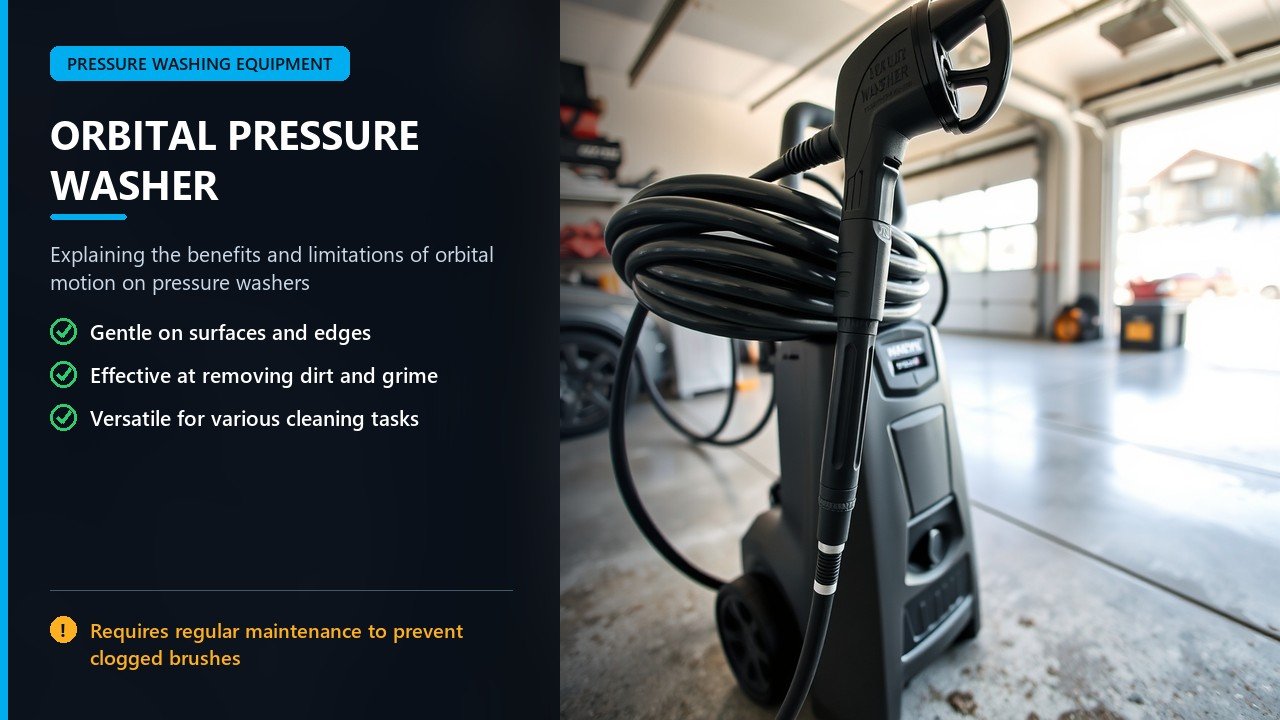
What “Orbital” Means on a Pressure Washer
In cleaning equipment, orbital motion is a fast, small, multi-directional movement rather than a single circular spin. A brush or pad driven in orbital motion vibrates and micro-rotates at speed, attacking dirt from several directions at once. Applied to a pressure washer, that describes an orbital-action brush head that scrubs the surface while the spray rinses it, as opposed to a head that simply rotates.
The term is most often seen on the brush side of pressure washing, where an orbital brush combines a low-pressure water feed with a vibrating or micro-rotating scrubbing pad. It is not the same as a rotary surface cleaner, which spins its jets in a circle beneath a hood. Both are attachments, and both attach to the same kind of pressure washer, but they clean in mechanically different ways.
Orbital vs Rotary: The Core Difference
The core difference is the path the working head takes. A rotary tool turns its brush or jets continuously around one axis, so every point on the surface gets a circular sweep. An orbital tool moves its head in a tight, random, multi-directional loop, so the scrubbing action comes from many angles at once rather than from one spinning circle.
That changes the feel and the result. Rotary action delivers strong, consistent coverage on flat, open ground and covers it fast, which is why rotary surface cleaners own the driveway and patio market. Orbital action is gentler and more forgiving, and it can reach into edges and corners that a round spinning head misses. If your pressure washer accessories spin on a single axis, they are rotary; if they vibrate and micro-rotate, they are orbital.
Where the Term “Orbital Pressure Washer” Comes From
The confusion has two roots. First, pressure washer attachments exist in both orbital and rotary forms, especially rotating brushes, and sellers sometimes use the words loosely. An orbital rotary brush for a pressure washer might scrub with a low-pressure rotating head while its product copy says “orbital action.” Second, the term is strongly associated with orbital floor machines used in commercial floor care, and people who know those machines may reach for “orbital” when describing a pressure washer attachment that scrubs.
Understanding the two roots removes the confusion. A pressure washer with an orbital-action brush is still a pressure washer: water does the rinsing, and the brush does the scrubbing. An orbital floor machine is a scrubbing and polishing tool for hard floors and does not use high-pressure water at all. When you shop, look at what the head actually does, spin or vibrate, rather than at a single word in the title.
Orbital-Action Brushes for Pressure Washers
Orbital-action brushes are the practical form an “orbital pressure washer” takes. These are brush heads that connect to the pressure washer wand, usually through a 1/4-inch quick-connect, and combine a soft or medium bristle with the spray so you can scrub delicate surfaces without the full force of a high-pressure jet. Products in this class describe a low-pressure rotating brush with orbital action, built for cars, boats, deck furniture, and other surfaces that a bare nozzle would damage.
The appeal is control. Because the brush works at reduced pressure and scrubs mechanically, you get cleaning action without the etching and stripping risk of a concentrated jet. Our guide to how water-powered spinning brushes work explains the mechanics that drive these heads, and the same principle of trading pressure for mechanical scrubbing applies to orbital variants.
Rotary Surface Cleaners: The Spinning Alternative
Rotary surface cleaners are the most common pressure washer attachment, and they are the tool most people mean when they want to clean a large flat area fast. A rotary cleaner has a housing that contains one or more nozzles spinning at high speed, with a skirt or brush ring that keeps the spray contained and the nozzle at a set distance from the ground. The result is a fast, even pass with no striping.
Manufacturers offer rotary surface cleaners across a range of diameters, and the hard-floor market is built around them. Our overview of choosing and using a surface cleaner covers the sizes and the matching. If speed on flat concrete is the goal, a rotary surface cleaner is the right tool, and no amount of orbital magic changes that.
The Science of Orbital Motion
Orbital cleaning technology is most developed in floor-care equipment, and the physics carries over conceptually to any orbital head. A single-disc orbital machine combines orbital and rotary motion into a constant vibration, which raises mechanical action without the swirl marks a plain spinning disc leaves. Karcher’s professional BDS 43/Orbital C is a good example: it drives a 43-centimetre brush at 60 rpm with 1,500 oscillations per minute, and the company claims up to 50 percent less cleaning time, using a reverse handle mode to push brush pressure from 38 to 55 kilograms for heavy soil, as described on the Karcher BDS 43/Orbital C page.
Other makers describe the same principle. TASKI’s orbital brush deck uses an orbital micro-rotation at a much higher speed of 2,000 rpm to increase mechanical action, allowing up to 40 kilograms of brush pressure for deep cleaning and top stripping, as shown on the TASKI orbital brush deck page. Hawk Enterprises explains the motion as a random orbital action that mimics the human hand scrubbing, cleaning quickly without damaging delicate surfaces and working across hardwood, tile, vinyl, and concrete, as covered in its article on the science behind orbital floor cleaning.
Orbital Floor Machines vs Pressure Washers
This is where the categories must be kept apart. An orbital floor machine is a walk-behind scrubbing and polishing tool for hard floors, powered by mains electricity, with a pad or brush but no high-pressure water jet. It scrubs, strips, and burnishes floors in commercial buildings, and it is not a pressure washer, even though both use water and mechanical action to clean.
A pressure washer with an orbital brush attachment is the opposite arrangement: high-pressure or low-pressure water is the primary cleaning medium, and an orbital or rotating brush adds scrubbing. If you need to strip and refinish a floor, you want the floor machine; if you need to wash a driveway, deck, or vehicle, you want the pressure washer. Buying the wrong category is expensive, so match the tool to the job before you compare models.
Industrial Orbital Cleaners Explained
There is a third meaning worth noting for completeness. In industrial tank cleaning, orbital cleaners are liquid-driven devices that rotate their jet nozzles around two axes at once, tracing a tight 3D pattern to wash the inside of tanks and vessels. This is orbital motion applied to a spray head, but at industrial scale and outside the reach of a homeowner pressure washer.
Recognising this meaning prevents another mix-up. If a product description talks about rotating nozzles on two axes and washing the inside of a vessel, it is an industrial orbital tank cleaner, not a pressure washer attachment. Homeowners will not encounter this category on a retail shelf, but the shared vocabulary is exactly why “orbital” is such a slippery term.
Benefits of Orbital Action
Where orbital action shines is in gentleness and control. Because the head moves in a tight, multi-directional pattern rather than carving a single circular path, it cleans thoroughly without the swirl marks and hot spots a spinning disc can leave. For softer surfaces and finishes that a jet would damage, an orbital brush gives you mechanical scrubbing at low pressure, which is safer for paint, gelcoat, and fine exterior trim.
Orbital heads also reach edges and corners better than a round spinning tool, and floor-cleaning literature makes much of the ability of rectangular orbital heads to line up flush against walls and skirting. In pressure washing terms, that translates to less hand-scrubbing at the borders of a surface, because the accessory cleans closer to the edge itself. The WAXIE overview of orbital scrubbers highlights the dual random orbital action, the flush-to-wall rectangular head, and the reduced water use that orbital technology can deliver.
Limits of Orbital Action
Orbital action is not the fastest way to clean a large flat driveway. A rotary surface cleaner covers ground with a wide, fast, even sweep, and the orbital alternative trades some of that speed for gentleness and edge access. If you are washing a big concrete slab with stubborn grime and you want speed, a rotary cleaner will finish sooner than a small orbital head that you guide back and forth.
Orbital heads also depend on the brush or pad doing real work, so they are less effective on hardened, weathered soils that need the full stripping force of a high-pressure jet or a cleaning solution first. Think of orbital action as the precision instrument and rotary action as the workhorse. Choosing between them is a question of the surface, the soil, and how much time and pressure you are willing to spend.
Choosing Between Orbital and Rotary Attachments
Start with the surface. For large flat concrete, asphalt, or pavers where speed and even coverage matter, a rotary surface cleaner is the right first tool. For cars, boats, patio furniture, decking, and other surfaces that need scrubbing without a harsh jet, an orbital or rotating brush is the better fit. For edges and tight areas, a brush that reaches flush beats a round spinning head.
Then consider the soil. Light surface dirt rinses away with either tool. Stubborn, bonded grime often needs pressure, detergent, or both before any brush helps, so a rotary cleaner with good pressure may break it loose faster. Our guide to rotary pressure washer tools covers the spinning side of this choice, and reading it alongside this guide gives you both ends of the spectrum.
Matching the Attachment to the Surface
Surface hardness should drive your attachment choice more than brand. Concrete and asphalt tolerate the full force of a rotary cleaner and high pressure. Wood and composite decking want lower pressure and a gentle brush, where orbital scrubbing is safer than a concentrated jet. Vehicles and boats want a soft brush and low pressure, exactly the niche orbital-action brushes were built for.
Paint, gelcoat, and decorative finishes are the surfaces that punish a careless choice, so use the lowest pressure and the most controlled head you can get away with. A brush that scrubs mechanically lets you reduce pressure without reducing cleaning, which is the whole point of an orbital head. For a deeper look at flat-surface cleaning, our guide to the flat surface cleaner explains how coverage and pressure interact.
PSI, GPM, and Attachments
Whatever head you fit, the machine’s PSI and GPM set the ceiling on what it can do. A rotary surface cleaner needs enough flow and pressure to spin its jets and cut grime, while an orbital brush works at reduced pressure on purpose, so a lower-PSI washer can still drive it well. Matching the accessory’s rating to your machine prevents a weak, disappointing result or a damaged tool.
Accessories are typically rated up to a maximum PSI and connect through a standard 1/4-inch quick-connect, so check both the rating and the fitting before buying. A brush rated well above your machine is fine; one rated below it risks failure. The rotary-versus-orbital decision is about cleaning action, but the PSI and GPM check is what keeps the attachment working and safe.
Edge and Corner Cleaning
Edges and corners are where orbital and rotary tools separate most clearly in practice. A round spinning surface cleaner leaves a ridge of uncleaned surface near walls and steps, because its circular hood cannot reach into a right angle. That leftover strip is why so much time goes into hand-scrubbing borders with a wand after the main pass.
Orbital and rectangular brush heads are designed to address exactly that. A head that lines up flush against a wall cleans to the edge and reduces the hand-finishing, which is one of the reasons orbital technology is promoted so heavily in professional floor care. If your cleaning jobs always end with a wand and a scrub brush tracing every edge, an orbital or brush-style attachment is the upgrade that pays for itself in saved effort.
Water Use and Detergent
Orbital heads tend to use less water than a full-pressure pass, because the scrubbing does more of the work and the rinse is a light pass rather than a heavy one. That matters for detergent use and runoff. Less water means less soap to achieve the same result, and less runoff to manage on a job where drainage is tight.
Some orbital cleaning systems are even promoted for chemical-free stripping with the right pad, though pressure washing still relies on detergent for greasy or oily soils. Use a pressure-washer-safe detergent, apply it, let it dwell, and then scrub and rinse with the attachment. The mechanical action of an orbital head makes the detergent work harder, so you can use less and still get a clean surface.
Safety
The safety rules for orbital and rotary attachments are the safety rules for pressure washing, with attention to the tool in your hand. Keep hands and feet clear of a spinning or vibrating head, never touch a moving brush, and relieve pressure before changing an attachment. A rotary cleaner’s spinning jets and an orbital head’s fast-moving pad are both capable of injury if you reach in while the machine runs.
Wear eye and hearing protection, keep the nozzle pointed at the surface, and never aim a pressure washer at a person or animal. Fluid injection is the hidden hazard of high-pressure water, so treat every jet with respect and never test pressure with your hand. An attachment changes the cleaning action, not the danger of the water behind it, and the same care applies whether the head spins or vibrates.
Maintenance of Orbital and Rotary Heads
Keep brush heads clean, and check their bearings or drive for wear, because a brush that stops spinning or stops orbiting simply drags and smears. Rinse the head after use, clear debris from the bristles and the spray orifice, and inspect the quick-connect and O-ring for wear. Rotary surface cleaners need their spinning bar or nozzles kept free of grit so they turn smoothly and evenly.
Replace worn brushes and pads when the bristles flatten or the cleaning slows, and replace any head that leaks or wobbles. Because these are wear items under the pressure washer, they are among the first accessories to need attention. The care that keeps a pressure washer pump healthy applies here too, and our guide to surface cleaner attachments covers the maintenance details that extend accessory life.
Orbital Motion vs Turbo Nozzles
Turbo nozzles sit at the other end of the pressure spectrum from orbital brushes, and it helps to know where each fits. A turbo or rotating nozzle sends a zero-degree jet spinning in a tight circle, concentrating high impact into a small moving spot. It strips paint, etches concrete, and blasts heavy grime fast, but it also concentrates force that can gouge soft surfaces. An orbital brush is the opposite philosophy: spread the effort over a scrubbing pad at low pressure and clean gently.
That makes them complementary rather than competing. Use a turbo nozzle to break up the worst soil on a hard, durable surface, then switch to a brush or orbital head to scrub and even the finish without the risk of etching. Many cleaning kits pair a turbo tip with a brush for exactly this reason. Our guide to the rotating spray nozzle explains how turbo tips build their force, which is useful context for deciding when a brush should take over.
The practical rule is surface-driven. Hard, stained concrete can take a turbo nozzle and a rotary cleaner. Painted, sealed, or delicate surfaces should skip the turbo entirely and go straight to a lower-pressure brush, orbital or spinning, with detergent doing part of the work. Jumping to a turbo nozzle on the wrong surface is one of the fastest ways to damage it, and no attachment fixes a mistake made with too much concentrated pressure.
Common Mistakes When Buying Orbital Attachments
The first mistake is confusing categories. Shoppers searching for an “orbital pressure washer” sometimes land on an orbital floor machine, buy it, and discover it does not connect to a pressure washer at all. Before you buy, confirm that a product is a pressure washer accessory with a quick-connect fitting, not a standalone floor-care machine with its own power cord and tank.
The second mistake is ignoring the pressure and fitting. An attachment rated for 4,000 PSI will not magically give a 2,000-PSI machine more power, and a tool rated below your machine’s output can fail under the pressure. Check the maximum PSI and the connector size, usually 1/4-inch quick-connect, and make sure they match what the pressure washer delivers. A cheap mismatch costs more in the end.
The third mistake is expecting one head to do everything. A rotary surface cleaner that tears through a driveway is clumsy on a car, and a soft orbital brush that protects paint will not strip a weathered deck. Build a small kit, one rotary head for flat ground and one brush, orbital or spinning, for delicate and detailed work, and you will cover almost every job without over-buying. The people who are happiest with their accessories are the ones who matched the head to the task rather than chasing a single do-it-all tool.
The fourth mistake is skipping maintenance. Brushes wear, bearings seize, and O-rings leak, and an attachment that no longer spins or orbits is worse than no attachment at all. Rinse and inspect heads after every use, replace worn pads, and keep the quick-connect clean. A few minutes of care keeps an orbital or rotary head working for years instead of a single season.
Frequently Asked Questions
What is an orbital pressure washer? There is no single machine by that name. Most often it means a pressure washer fitted with an orbital-action brush or head that vibrates and micro-rotates instead of spinning on one axis. The term is also loosely used for rotary surface cleaners and, incorrectly, for orbital floor machines.
Is orbital better than rotary for pressure washing? Neither is universally better. Rotary surface cleaners are faster and more even on large flat ground, while orbital heads are gentler and reach edges and corners better. The surface and the soil decide which suits the job.
Do pressure washers come with orbital heads? They do not usually ship with one, but orbital-action brushes and rotary heads are common aftermarket accessories that connect through a standard 1/4-inch quick-connect. Buy one matched to your machine’s PSI and the surface you are cleaning.
Can I use an orbital floor machine as a pressure washer? No. An orbital floor machine scrubs and polishes hard floors with a pad or brush and no high-pressure water. It is a different category of equipment from a pressure washer, even though both clean surfaces.
What PSI do I need for an orbital brush? Orbital-action brushes are designed to work at reduced pressure, so most pressure washers can drive them. Check the brush’s maximum PSI rating and its fitting, and match it to your machine before buying.
Final Thoughts
“Orbital pressure washer” is best understood as a description of cleaning action rather than a specific machine. On a pressure washer, orbital means a brush or head that vibrates and micro-rotates for gentle, edge-friendly scrubbing, while rotary means a head that spins to cover flat surfaces fast. The two are partners, not rivals, and most serious cleaning kits include both.
The orbital floor machines sold for commercial floor care are a separate category, and the industrial orbital tank cleaners are separate again. Keep the meanings straight, match the accessory to the surface and the soil, and check the PSI and fitting before you buy. Do that, and you will pick the right head the first time and get the clean result you were after.