A 1700 PSI electric pressure washer occupies a sweet spot in the compact electric class: a meaningful step above the smallest budget machines, yet still light enough to carry in one hand and tuck on a shelf. It is the machine people buy when they want real cleaning power for cars, patios, grills, and light siding without the weight, noise, or fuel of a gas unit. For many households, 1700 PSI is exactly the right balance.
But as with every pressure washer class, the number on the box tells only part of the story. Flow, pump type, certification, and the little design choices — carry handle, cord wrap, onboard storage — separate a genuinely convenient machine from one that frustrates. This guide explains what a 1700 PSI electric washer is, the cleaning units math that really predicts performance, what it can and cannot do, the features worth having, and how to choose among the many near-identical models.
Quick Note: A 1700 PSI electric pressure washer is a compact, cold-water, corded machine for light-to-medium residential cleaning. It typically flows 1.2-1.4 GPM and weighs under 20 pounds. Look at cleaning units (PSI x GPM), pump type, and certification — not the pressure figure alone.
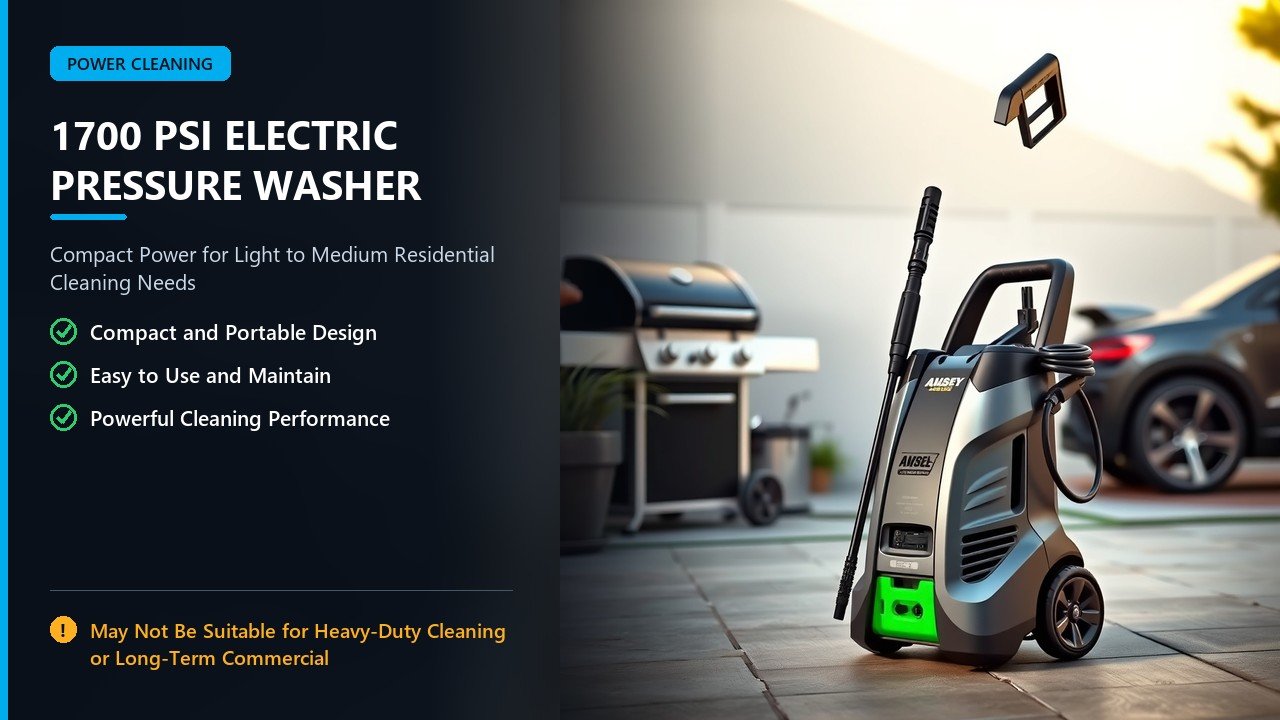
What a 1700 PSI Electric Washer Is
Machines in this class share a familiar recipe: a 13-amp universal motor, an axial cam pump, cold water only, and a compact plastic or steel housing. They run on standard household 120-volt power, plug into a GFCI outlet, and start with the flip of a switch and the pull of a trigger. Most weigh between 12 and 20 pounds and many fit in a space not much larger than a toolbox.
The Worx WG602, for example, delivers 1700 PSI (1,870 PSI max) at 1.2 GPM (1.4 GPM max) from a 13-amp motor and weighs just 16 pounds, with a spray wand using a universal 1/4-inch quick connect, an integrated carry handle, and onboard nozzle storage. That combination — light enough to carry easily, powerful enough for real dirt — defines the class.
The distinction between “rated” and “max” figures matters here. Manufacturers often print a maximum PSI and GPM that the machine can hit only briefly and not simultaneously, alongside the rated numbers it sustains. The rated values are the honest measure of performance, and it is worth reading them. A machine marketed as “1700 PSI” may be rated at 1700 PSI at 1.0 GPM with a separate max flow of 1.3 GPM at a lower pressure, as the Briggs & Stratton 1700 illustrates: 1700 max PSI at 1.0 GPM, and 1.3 max GPM at 1,000 PSI. Neither number is wrong; together they describe the machine.
Cleaning Units: The Real Measure of Power
Pressure strips grime; flow carries it away. The product of the two, called cleaning units, is a far better predictor of how fast a machine cleans than PSI alone. The Black+Decker BEPW1700, for instance, is a 1700 PSI, 1.2 GPM machine whose values yield around 2,040 cleaning units — a compact but capable figure for its size and price.
This is why two 1700 PSI machines can behave differently. One at 1.2 GPM delivers 2,040 cleaning units; one at 1.4 GPM delivers 2,380, and will flush dirt away noticeably faster. When comparing models, multiply the rated PSI by the rated GPM and compare the result. It is the single most useful number on the box, and almost no manufacturer leads with it.
Cleaning units also explain why a compact 1700 PSI machine cannot match a 3,000 PSI gas washer, and why that is fine. The gas machine may produce several times the cleaning power, but it is heavy, loud, and needs fuel and maintenance. For the jobs a 1700 PSI electric handles, the lower figure is more than adequate, and the convenience is the whole point.
Quick Note: Multiply rated PSI by rated GPM to get cleaning units. A 1700 PSI / 1.2 GPM machine makes about 2,040 cleaning units; a 1700 PSI / 1.4 GPM machine makes about 2,380. Higher cleaning units means faster cleaning at the same pressure.
What a 1700 PSI Washer Can Clean
Used with the right nozzle and technique, 1700 PSI handles the everyday cleaning most people need, with a little more margin than the smallest machines.
| Task | Suitability | Notes |
|---|---|---|
| Cars and trucks | Excellent | Low pressure safe for paint |
| Patio furniture, grills | Excellent | Quick and safe |
| Decks and fences | Good | Use fan tips; follow wood grain |
| Siding and brickwork | Good | Keep the nozzle moving |
| Light concrete grime | Fair to good | Better than 1500 PSI; still limited on stains |
| Heavy stains, oil, mildew | Poor | Needs more pressure, flow, or hot water |
The extra pressure over a 1500 PSI machine gives a modest but real gain in stripping power on decks, brickwork, and moderately dirty concrete. It is still a cold-water machine, so grease and oil rely on detergent and dwell time rather than heat. And it remains far from a gas washer’s ability to restore a badly stained driveway.
Where it excels is anywhere the machine must be carried, stored compactly, or used quietly. The light weight of a compact 1700 PSI unit means it comes out of the garage far more often than a heavy gas machine, and that convenience translates directly into a cleaner home. For the jobs where a compact electric is appropriate, our 4,000 PSI pressure washer guide shows the other extreme for readers who need more.
Compact Design and Convenience
The defining advantage of this class is size and simplicity, and the best models are engineered around that. Look for designs that make the machine genuinely easy to live with.
- Integrated carry handle. A well-placed top handle lets you pick up the machine one-handed. Light weight plus a good handle equals a washer you actually use.
- Cord wrap and hose storage. Onboard hooks and wraps keep the cord, hose, wand, and nozzles tidy and ready, and prevent the tangles that waste time at the start of every job.
- Nozzle storage on the body. Keeping nozzles attached to the machine means you never lose them and always have the right tip.
- Small footprint. The Kärcher K1700 Cube, for instance, is under a foot tall and weighs less than 20 pounds, so it stores on a shelf like a small toolbox.
- Push-button or foot-switch start. No priming, no choke, no pull cord — plug in the GFCI cord, switch on, and spray.
These details matter more in this class than raw power, because the whole point of a compact electric washer is ease. A machine that is quick to set up, easy to carry, and tidy to store gets used; one that must be wrestled into place does not.
Certification: Proof of Performance You Can Trust
Because pressure washer marketing often quotes inflated “max” numbers, third-party certification is a meaningful signal. Two organizations matter: the Pressure Washer Manufacturers’ Association (PWMA) and the Cleaning Equipment Trade Association (CETA). Both test machines to standardized protocols and validate performance claims.
A machine carrying a PWMA or CETA mark, or using a clearly defined measurement like Kärcher’s “Tru-Measure” PSI, is telling you its ratings are real. The Greenworks GPW1704 advertises CETA certification, and the Black+Decker BEPW1700 quotes CETA-certified values for its PSI and GPM. When two similar-looking models differ in price, certification is often part of the difference — and it is worth paying for, because it means the number on the box reflects what the machine actually does.
Features Worth Having
| Feature | Why It Matters |
|---|---|
| Total Stop System / start-stop | Motor runs only when the trigger is pulled; saves wear and noise |
| GFCI power cord (35 ft) | Electrical safety outdoors and reach from the outlet |
| 1/4-inch quick-connect wand | Accepts standard nozzles and accessories |
| Turbo nozzle included | Concentrates cleaning power; cleans faster than a standard tip |
| Soap applicator / foam cannon | Detergent application, essential for cold-water cleaning |
| Onboard nozzle and cord storage | Keeps everything together and tidy |
| Hose length (20-26 ft) | Reach without moving the machine; longer is better |
Two features deserve emphasis. A start-stop system (Briggs calls it Instant Start/Stop) keeps the motor from running when you are not spraying, which reduces noise, power use, and pump wear — a real benefit on a machine that gets repositioned often. Included nozzles are also worth checking: a turbo nozzle cleans up to 40 percent faster than a standard tip, and a soap applicator is nearly essential on a cold-water machine because detergent does the heavy lifting.
Representative 1700 PSI Models
| Model | PSI / GPM | Notable Feature |
|---|---|---|
| Worx WG602 | 1700 / 1.2 (1.4 max) | 16 lb, turbo + 40 nozzle, carry handle |
| Briggs & Stratton 1700 | 1700 / 1.0-1.3 | Instant start/stop, 26 ft hose, 3 nozzles |
| Black+Decker BEPW1700 | 1700 / 1.2 | CETA-certified, foam cannon, 35 ft GFCI cord |
| Kärcher K1700 Cube | 1700 / 1.2 | Ultra-compact, foot switch, Tru-Measure PSI |
| Greenworks GPW1700 | 1700 / 1.2 | 13A, push-button start, 35 ft cord, soap applicator |
| Simpson CM61351 | 1700 / 1.0 | Pneumatic wheels, turbo nozzle, cold water |
The models are remarkably similar on paper, which is why the tie-breakers are the details: certification, included nozzles, hose length, weight, and how tidy the storage is. Two machines at the same price and pressure can feel very different in daily use.
1700 PSI Compared to Neighboring Classes
Understanding where 1700 PSI sits helps you buy deliberately rather than by accident.
Versus 1500 PSI. A modest step up in stripping power and often in flow. If you are choosing between the two, the 1700 PSI machine usually costs little more and gives usefully more punch on decks, brickwork, and mid-level concrete grime. Our detailed 1500 PSI electric pressure washer guide covers the class below.
Versus 1800-2000 PSI. A further small jump, with some models gaining flow as well. If your cleaning leans toward dirtier concrete or larger areas, spending a little more here may pay off. But for cars, furniture, and light patio work, a 1700 PSI machine is already sufficient.
Versus gas. A gas machine produces several times the cleaning power and reaches pressure and flow an electric cannot. But it is heavy, loud, needs fuel and maintenance, and demands ventilation. The 1700 PSI electric wins on convenience for exactly the jobs it was designed for.
The honest rule: buy the class that matches your worst realistic job, not your most hopeful one. If that job is a fully stained driveway, no compact electric is the right answer. If it is cars, furniture, decks, and light siding, 1700 PSI is likely ideal.
Getting the Most From a 1700 PSI Washer
- Soak first, then let detergent dwell before rinsing. Cold water relies on chemistry and patience.
- Use the turbo nozzle for stubborn spots — it delivers more cleaning per pass than a fan tip.
- Match nozzles to flow. Using an undersized nozzle over-pressurizes the pump; see our nozzle guide.
- Keep the nozzle moving to avoid streaks and surface damage.
- Upgrade the hose to a kink-resistant one; our electric hose guide explains why.
- Add a foam cannon and quick-connect couplers for faster detergent work and easy accessory swaps; see our coupler guide.
Used this way, a compact 1700 PSI machine cleans better than a more powerful washer in careless hands, because it cannot damage what it touches and rewards technique over force.
Maintaining a 1700 PSI Electric Washer
- Never run it dry. Connect water and purge air before starting; dry running destroys the pump in minutes.
- Use the start-stop system. Release the trigger when not spraying rather than leaving the motor running against a closed line.
- Flush detergent with clean water after each use.
- Winterize with a pump saver or blow out the lines; trapped water cracks pumps and fittings. See our pump saver guide.
- Check O-rings and connections for drips; our wand parts guide covers the seals.
- Store indoors, drain the hose and wand, and keep the inlet strainer clean.
- Inspect the trigger gun for leaks; a dripping gun means a worn O-ring or seal, covered in our trigger gun guide.
These habits are what separate a machine that lasts three seasons from one that lasts eight. The most common causes of premature failure — dry running, freezing, and neglected detergent flushing — are all easy to avoid.
Who Should Buy a 1700 PSI Electric Washer
This machine suits a homeowner with an ordinary property who wants a washer that is light, quiet, plug-in easy, and stored compactly, and whose cleaning is mostly vehicles, outdoor furniture, decks, fences, and light siding. It is a great first pressure washer and a great second one for anyone downsizing from a heavy gas unit they rarely used.
It is not the right tool for a large, stained driveway, a commercial schedule, or thick grease and mildew. Those jobs call for higher pressure, more flow, or hot water. Being honest about which owner you are prevents the most common purchase regret.
A Buying Checklist
- Compute cleaning units (rated PSI x rated GPM) and compare.
- Prefer a machine with third-party certification (PWMA or CETA).
- Confirm it has a Total Stop System or start/stop feature.
- Check for a GFCI cord and a reasonable length (35 ft is good).
- Look for a 1/4-inch quick-connect wand so standard nozzles and accessories fit.
- Check the included nozzles — turbo and soap are the most useful.
- Weigh the machine and check the handle; lighter and easier wins.
- Confirm onboard storage for the cord, hose, wand, and nozzles.
- Read the rated (not just max) PSI and GPM, and the warranty.
Handheld, Cube, and Cart Formats
Within the 1700 PSI class, machines come in a few physical formats, and the format affects convenience as much as the specs do.
Cube and compact uprights. Box-shaped machines that stand on the ground and often measure under a foot tall, like the Kärcher K1700 Cube. They store on a shelf, are easy to carry by a top handle, and are ideal for small homes, apartments, and condos where storage space is tight.
Cart-style compact units. Slightly larger machines on small wheels, such as the Simpson CM61351 Clean Machine with its pneumatic wheels. They roll rather than carry, which helps on longer jobs where you move the machine around a driveway or yard, at the cost of a little more size and weight.
Handheld models. A separate subcategory of electric washers resembling a long gun you carry in one hand, using a shorter hose and often drawing from a bucket or a hose. While many handhelds are rated lower than 1700 PSI, some approach it. They are the ultimate in portability but generally move less water and are best for very light tasks. The 1700 PSI class proper is dominated by cube and cart formats.
The right format depends on your space and habits. If storage is tight and you carry the machine, a cube wins. If you roll it out for jobs across a large driveway, a cart with wheels is more comfortable. Both deliver the same pressure and flow; the difference is how they live in your garage and how they feel on the job.
Detergent and Foam on a 1700 PSI Machine
Because a 1700 PSI electric washer runs cold water, detergent does a large share of the cleaning. Getting the detergent system right is therefore more important on this machine than on a hot-water or high-pressure unit.
Most 1700 PSI machines apply detergent in one of two ways: through a soap applicator attached to the wand, or via a small onboard tank feeding a low-pressure soap nozzle. Both work by injecting detergent downstream, so the chemical does not pass through the pump. That is exactly what you want, because detergent in the pump can attack seals over time.
A foam cannon is the most effective upgrade. It connects in place of the nozzle and throws a thick, clinging foam that dwells on the surface, loosening dirt before you ever touch it with pressure. On a compact machine, a foam cannon often makes a bigger difference to results than any other accessory, because it lets the chemistry work while the modest pressure simply rinses. Pair it with the correct nozzle for your machine’s flow, and don’t overtighten the connections.
After any detergent use, flush the wand, gun, and any injector with clean water. Leftover soap dries into a sticky film that clogs nozzles and feed lines, and it is the leading cause of “my soap stopped working” complaints on machines like these. A one-minute flush after each session prevents it entirely.
Note: On a cold-water machine, detergent carries much of the cleaning load. Use a foam cannon or soap applicator for dwell time, then flush the entire wand, gun, and injector with clean water so dried soap does not clog the system.
Safety and Electrical Care
A 1700 PSI electric washer mixes water and household current, so a few safety habits are essential and quickly become automatic.
- Plug into a GFCI outlet or use the machine’s inline GFCI cord. Ground-fault protection prevents shocks if current leaks to ground.
- Avoid extension cords. Many manuals prohibit them because voltage drop can overheat the motor. If you must use one, choose a heavy-gauge, outdoor-rated cord sized for the machine’s amperage and keep it short.
- Keep the cord and plug dry. Route the cable away from the spray, never stand in water while plugged in, and unplug before servicing.
- Never run without water. Connect the hose and purge air before starting, or the pump will fail quickly.
- Respect the spray. Even 1700 PSI can injure. Never aim at people or pets, wear eye protection, and avoid windows and car glass at close range.
- Shut off and unplug when finished, and drain the machine before storage.
These precautions protect both the operator and the machine, and they preserve the warranty. Failures traced to an extension cord, a dry run, or a frozen pump are not covered, and all three are avoidable.
Common Mistakes to Avoid
- Buying on PSI alone. Compare cleaning units (rated PSI x GPM); flow often matters more than a slightly higher pressure.
- Believing the max number. Read the rated PSI and GPM, and prefer PWMA or CETA certification.
- Running it dry. The fastest way to kill a compact electric pump is to start it without water.
- Ignoring start-stop. Leaving the motor running against a closed trigger heats the pump.
- Skipping detergent flushing. Dried soap clogs nozzles and injectors; flush after every use.
- Expecting gas-machine results. A 1700 PSI electric is a convenience machine, not a heavy-duty restorer.
- Forgetting winterization. Trapped water splits pump heads on the first freeze.
- Using the wrong nozzle size, which over-pressurizes the pump or wastes flow.
Frequently Asked Questions
What can a 1700 PSI electric pressure washer clean? Cars, trucks, patio furniture, grills, decks, fences, siding, brickwork, and light concrete grime. It is a light-to-medium-duty cold-water machine, slightly stronger than a 1500 PSI unit but still not suited to heavy stains.
Is 1700 PSI better than 1500 PSI? Yes, modestly. The extra pressure gives more stripping power on decks, brick, and mid-level concrete, often at little extra cost. The gain is real but not dramatic; flow differences can matter just as much.
What is the difference between max PSI and rated PSI? Max PSI is the highest pressure the machine can briefly reach; rated PSI is what it sustains in normal use. Manufacturers quote both, and the rated figures are the honest measure of performance.
What are cleaning units? Cleaning units are the product of rated PSI and rated GPM. They are a better predictor of cleaning speed than pressure alone. A 1700 PSI, 1.2 GPM machine makes about 2,040 cleaning units.
Is 1700 PSI enough for a driveway? For light surface dirt, yes, especially with a turbo nozzle and good flow. For heavy stains and oil, no — that needs more pressure, flow, or hot water.
Can I use hot water in a 1700 PSI electric washer? No. These are cold-water machines with a maximum inlet temperature typically around 104 degrees Fahrenheit. Hot water can damage the pump and seals.
How do I keep it from freezing? Drain and blow out all water after use, protect the pump with a pump saver, or store in a heated space. Never leave water inside through a freeze.
Final Thoughts
A 1700 PSI electric pressure washer is the compact-class sweet spot for many homes: light enough to carry one-handed, quiet enough for any time of day, simple enough to plug in and use, yet strong enough for cars, furniture, decks, and light siding. Judged by pressure alone it looks modest, but paired with good flow, certification, and thoughtful design, it is a genuinely capable little machine.
When you shop, weigh cleaning units as heavily as PSI, prefer certified performance, choose a machine with start-stop and tidy storage, and match your nozzles and accessories to its flow. Care for it — no dry running, no freezing, detergent flushed, seals fresh — and it will serve reliably for years. Buy the class that fits your work, and a 1700 PSI electric washer is one of the best-value tools a homeowner can own.