Jake had a two-car concrete driveway that had been stained with oil and grime for years. He tried an electric washer and made progress, but after two hours of slow passes, the deep stains were still there. When he borrowed a 2500 psi gas pressure washer for one afternoon, the same driveway looked nearly new in under an hour. The difference wasn’t hours of extra work; it was the right amount of raw power combined with enough flow to rinse the grime away.
A 2500 psi gas pressure washer hits the middle of the pressure spectrum where most homeowners finally get the muscle they need without jumping into full commercial territory. It is powerful enough for big flat surfaces and two-story work, yet still manageable for fences, decks, and siding when used with the right tip. This guide explains what a 2500 psi gas pressure washer is, how it compares to electric models, what it can and cannot clean, how to size it correctly, and how to use it safely.
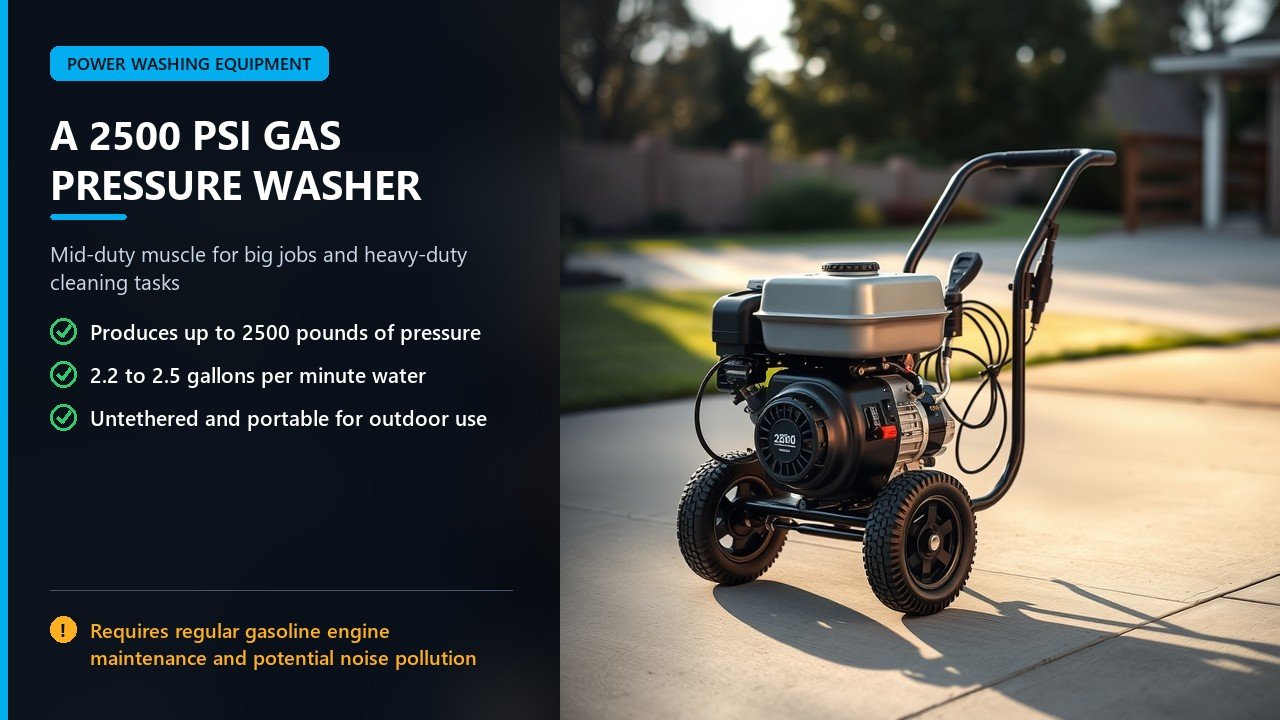
What Is a 2500 PSI Gas Pressure Washer?
A 2500 psi gas pressure washer is a mid-duty pressure washer powered by a gasoline engine that produces roughly 2500 pounds per square inch of pressure and typically 2.2 to 2.5 gallons per minute of water flow. The gas engine drives a pump (often an axial cam or triplex) that forces water through a high-pressure hose and nozzle. These machines are untethered, meaning they do not need to plug into an electrical outlet, so they can work far from the house or garage.
This class is commonly described as medium-duty. It is strong enough for driveways, sidewalks, siding, patios, decks, and paint prep, while still being portable enough for home use. The power comes from the engine, not an extension cord, which is why it excels at larger jobs and higher flow. The trade-off is noise, exhaust, and a bit more maintenance than an electric unit.
PSI and GPM: The Numbers That Actually Matter
Pressure alone does not determine speed. PSI (pounds per square inch) breaks the bond between dirt and the surface. GPM (gallons per minute) moves that loosened debris away. Multiply them to get cleaning units, which is the most honest way to compare machines. A 2500 psi gas pressure washer at 2.3 GPM produces about 5750 cleaning units, while a typical 1500 PSI electric at 1.2 GPM produces about 1800. That extra flow is what makes large surfaces clean faster.
This flow advantage is why gas models finish big jobs more quickly than electrics. Our guide to why flow rate decides how fast you clean explains how volume carries the load, and Consumer Reports’ pressure washer buying guide notes that gas models clean large areas faster than the average electric.
2500 PSI Gas vs Electric
The biggest difference is mobility and power. A gas washer runs untethered with no extension cord, so you can reach the back fence, a detached garage, or a long driveway without hunting for outlets. It also produces higher GPM, which makes horizontal surfaces (driveways, patios) finish faster. Electric washers are quieter, lighter, produce no exhaust, and need almost no maintenance; gas washers need fuel, oil, air filter checks, and pump care.
For routine small jobs like washing a car or patio furniture, electric is often plenty. For large concrete, siding on a two-story house, or frequent big jobs, a 2500 psi gas pressure washer is the better fit. To compare the two categories side by side, see our guide to cold-water electric versus petrol pressure washers. The Lowe’s pressure washer buying guide also breaks down the tradeoffs clearly between corded and gas models.
| Feature | 2500 PSI Gas | Electric (Light/Mid) |
|---|---|---|
| Power source | Gasoline engine | 120V electric motor |
| Pressure/Flow | 2500 PSI / 2.2–2.5 GPM | 1500–2000 PSI / 1.1–1.8 GPM |
| Mobility | Untethered | Cord-limited |
| Noise/Exhaust | Louder with exhaust | Quieter, no exhaust |
| Maintenance | Fuel/oil/filter/pump care | Minimal |
| Best for | Large surfaces, siding, frequent use | Small jobs, tight storage, quiet use |
What Can a 2500 PSI Gas Pressure Washer Clean?
This class shines on medium-to-large jobs. It easily cleans concrete driveways, sidewalks, and patios (removing dirt, mildew, and most surface stains). It handles wood decks and fences when used with a 25° or 40° tip and kept moving at a safe distance. It is excellent for vinyl, aluminum, and stucco siding on one or two stories, especially when paired with the correct fan tip. It also strips mud and grime from lawn equipment, boats, trailers, and garage floors. For paint prep on exterior surfaces, 2500 PSI is often the right balance between effective and controllable.
When paired with accessories like a surface cleaner, a 2500 psi gas pressure washer can clean a two-car driveway evenly and much faster than a wand alone. If you are wondering about stepping up to 2700 PSI, our 2700 PSI pressure washer guide covers that next tier.
What Should You Not Use It On?
Even at 2500 PSI, technique matters. Avoid using a 0° or narrow 15° tip on concrete for prolonged passes; it can etch stripes. Never use high pressure directly on asphalt shingles, old or loose mortar, thin aluminum, or delicate painted surfaces without testing and backing off. Wood can splinter if you get too close or use too narrow a tip. Vehicles need care: use a wide 40° tip, keep distance, and avoid blasting seals, trim, and badges directly.
| Surface/Job | Recommended Tip/Approach |
|---|---|
| Concrete driveway/patio | 25° or surface cleaner; keep moving |
| Wood deck/fence | 25°–40° from distance; test first |
| Vinyl/aluminum siding | 40°; spray down, never up |
| Cars/trucks | 40°, maintain safe distance |
| Equipment/trailers | 15°–25°, avoid bearings/seals |
Nozzles and Accessories That Matter
The spray tip controls the pressure at the surface more than anything. A 0° (red) is a pinpoint jet for very stubborn isolated spots; use sparingly. A 15° (yellow) cuts heavy grime. A 25° (green) is the general workhorse for concrete and hard surfaces. A 40° (white) is the safest for siding, decks, and vehicles. A black soap tip applies detergent at low pressure. A surface cleaner is the single best accessory for large flat concrete; it prevents streaking and speeds up the job dramatically. A turbo nozzle can also help on hard surfaces, but still needs proper technique.
Gas Engine and Pump Considerations
Engine quality matters. Many reputable 2500 psi gas pressure washers use proven small engines (Honda-style or name-brand) that start reliably. Pumps come in axial cam (common in homeowner models, cost-effective) and triplex (more durable, often in pro models). For typical homeowner use, a well-built axial cam pump is fine if properly maintained. If you run the machine often or for long stretches, durability becomes more important. For a deeper look at pump types and machine design, see our article on electric motor pressure washers and related guides.
Maintenance: What Gas Requires
Gas washers need a little more care than electric. Check and change engine oil as recommended, keep the air filter clean, use fresh fuel (or stabilizer for storage), and never run the engine without water. Winterize in freezing climates by draining or using pump antifreeze to avoid cracked pumps. After use, shut off the fuel valve if equipped, let the engine cool, and store the unit in a dry place. Neglecting pump winterization is the most common cause of early failure in gas pressure washers.
Pros and Cons
Pros: High cleaning power with good GPM, untethered for mobility, faster on large surfaces, great for driveways, siding, and paint prep, handles frequent big jobs well.
Cons: Louder and produces exhaust, heavier than electric, requires fuel/oil/maintenance, needs winterization in cold climates, and costs more to maintain over time. For frequent users, these are small tradeoffs for the time saved on big jobs.
Who Should Buy a 2500 PSI Gas Pressure Washer?
Buy this class if you have a large driveway, multiple concrete areas, a two-story home with siding, a detached garage, or you clean often. It is ideal for homeowners who want to finish big jobs quickly without stepping into commercial pricing. Skip it if you only wash cars and patio furniture once a month, live in a small space with noise restrictions, or hate engine maintenance. For light work, an electric model is cleaner and quieter. For perspective on stepping up further, our power washer 4000 PSI guide covers the upper portable range.
Frequently Asked Questions
Is 2500 PSI enough to clean a driveway? Yes. For concrete driveways, 2500 PSI with 2.2–2.5 GPM is sufficient for removing dirt, mildew, and most stains. Pair with a surface cleaner for even, streak-free results.
Is a 2500 PSI gas pressure washer too much for a car? It can be if misused. Use a 40° tip, keep the nozzle 18–24 inches back, and avoid seals and trim. For delicate paint, electric is gentler, but gas is fine with proper technique.
Gas or electric — which is better? Gas is better for large surfaces, mobility, and speed. Electric is better for quiet use, small jobs, and low maintenance. Choose based on your typical jobs.
Do I need to winterize a gas pressure washer? Yes, in freezing climates. Drain water from hoses, pump, and gun, or add pump antifreeze. Freezing water will crack the pump and is not covered by most warranties.
What maintenance does a 2500 psi gas pressure washer need? Check oil, clean air filter, use fresh fuel with stabilizer for storage, inspect hoses/nozzles, and winterize if needed. Also avoid running dry and follow the engine manual.
Final Thoughts
A 2500 psi gas pressure washer is the sweet spot for many homeowners: powerful enough to handle driveways and siding without the bulk and expense of commercial rigs, yet not so aggressive that it is unwieldy for general use. The untethered freedom and higher flow let you finish big jobs faster, and with the right nozzles and accessories, you get professional-looking results without paying a pro every time.
Pick the right tip for the surface, keep it moving, and stay on top of basic maintenance. Do that, and a 2500 psi gas pressure washer will be one of the most useful tools you own for years of outdoor cleaning. For most homeowners tackling big outdoor jobs, it is the right balance of power, mobility, and value.