Some pressure washer brands are everywhere, splashed across big-box shelves and TV ads. Others earn their reputation more quietly, through dealers and word of mouth among people who actually use the equipment. Mi-T-M is the second kind, and its ChoreMaster pressure washer series is the entry point into a line built by an American manufacturer with decades of experience. If you want solid equipment without paying flagship commercial prices, this is a name worth understanding.
ChoreMaster is Mi-T-M’s value and mid-range series, positioned for homeowners, property owners, and small businesses that want reliable cleaning power. The series spans lightweight electric machines all the way up to powerful gas-powered units rated over 4000 PSI, and it draws on Mi-T-M’s own engines and pumps as well as respected components from partners like AR. That combination gives the line a level of real-world durability that its price often hides.
This guide explains who makes ChoreMaster, what the series includes, the key models and their specs, how the machines compare to the competition, what they clean, how to maintain them, and who should buy one. If you are weighing a ChoreMaster against a big-box brand or a premium commercial machine, this will help you decide.
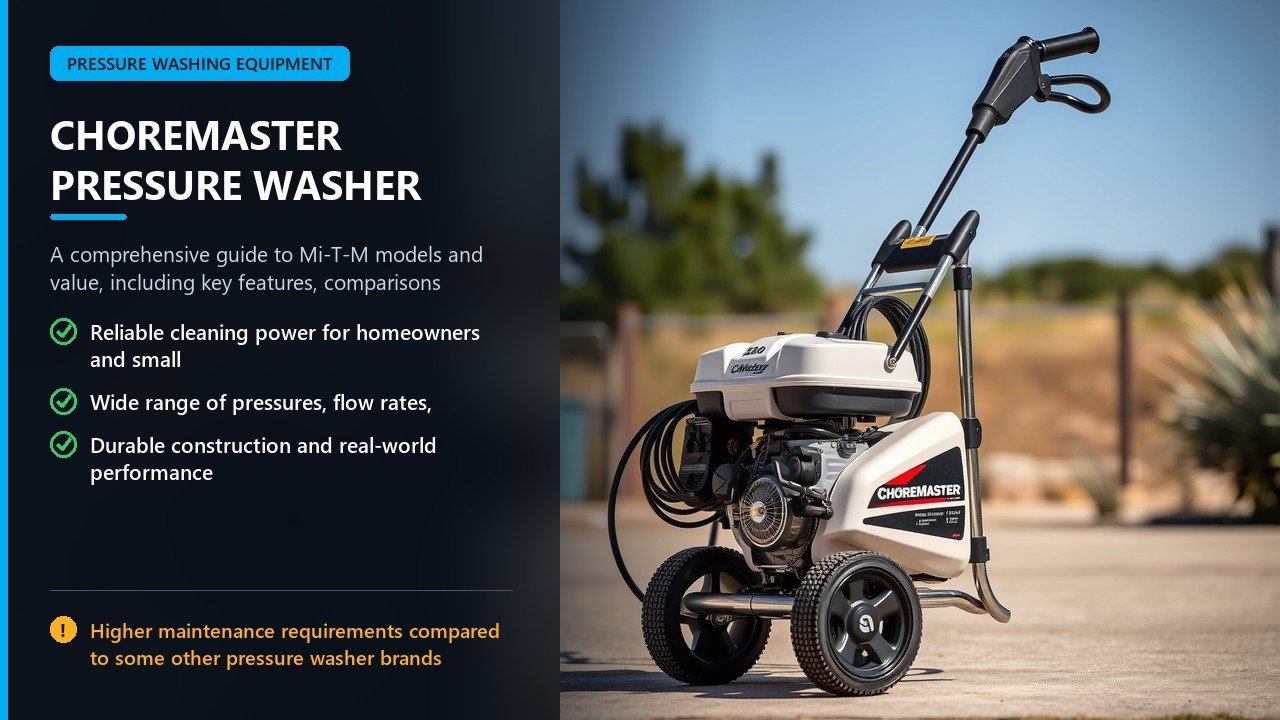
Who Makes ChoreMaster
ChoreMaster is manufactured by Mi-T-M, a company based in Peosta, Iowa, that has been building pressure washers and related cleaning equipment for decades. Mi-T-M designs and builds a broad range of equipment, from consumer machines to heavy industrial units, and it manufactures many of its own engines and pumps. That vertical integration is unusual and valuable, because it means the company controls quality across more of the machine and supports the product with its own parts network.
Buying from a manufacturer like Mi-T-M means buying into a system. Parts are available, dealer service is available, and the equipment is built to be maintained rather than discarded. The ChoreMaster series is the accessible tier of that system, aimed at people who want Mi-T-M quality without stepping up to the company’s heavy commercial and industrial lines.
What the ChoreMaster Series Includes
The ChoreMaster line covers a wide range, from small electric units to serious gas machines. Understanding the span helps you locate the model that fits your needs.
Electric models. The compact electric ChoreMaster machines, such as the CM-1400-0MEC, are lightweight and easy to use, aimed at household cleaning. They typically run on standard household current with a GFCI power cord, use a triplex crankshaft pump, and include features like a thermal relief valve, in-line water strainer, and built-in low-pressure detergent injector. They are quiet, emission-free, and simple to maintain.
Gasoline models. The core of the series is gas-powered, direct drive machines spanning roughly 2400 PSI up to 4200 PSI. These use Mi-T-M’s own OHV engines in various displacements, from around 190cc and 212cc up to 420cc, paired with axial or AR pumps depending on the model. Higher-output models like the CM-3600 and CM-4200 include longer fifty-foot hoses, larger engines, and adjustable pressure unloaders.
Across the line, common features include powder-coated steel frames, flat-free tires, wire-braided high-pressure hose, quick-connect nozzles, and a built-in low-pressure detergent injector. These are the practical features that make a machine easy to live with, and Mi-T-M includes them consistently.
| Model Type | Pressure and Flow | Engine/Motor | Pump |
|---|---|---|---|
| CM-1400-0MEC (electric) | 1400 PSI at 1.5 GPM | 1.5 HP, 120V electric | Triplex crankshaft, adjustable unloader |
| CV-2400-4MBC (gas) | 2400 PSI at 2.0 GPM | 190cc Briggs 675 | Direct drive axial AR |
| CM-3000-0MMB (gas) | 3000 PSI at 2.4 GPM | 212cc Mi-T-M OHV | Mi-T-M axial, fixed unloader |
| CM-4200-0MMB (gas) | 4200 PSI at 3.4 GPM | 420cc Mi-T-M OHV | AR crankshaft, brass manifold, adjustable unloader |
Reading down that table, you can see the progression from a household helper to a machine with genuine commercial muscle. The CM-4200, with a big 420cc engine, high flow, and an AR crankshaft pump with a brass manifold, is a serious unit capable of professional flatwork and equipment cleaning.
The CM-4200: The Flagship of the Line
The model that best represents what ChoreMaster can do is the CM-4200-0MMB, and it is worth examining closely because it shows the series at its strongest.
Rated 4200 PSI at 3.4 GPM, it delivers enough pressure and flow for demanding jobs, and the 3.4 GPM flow rate is what makes it productive rather than merely powerful. It is powered by a 420cc Mi-T-M OHV engine, a large commercial-style engine that supplies the torque needed to drive the pump under load. The pump is an AR crankshaft pump with a brass manifold, which is a real step up from a basic axial unit and signals durability.
The machine includes a fifty-foot, three-eighths-inch wire-braided high-pressure hose, quick-connect nozzles in fifteen, twenty-five, and detergent patterns, a professional-grade trigger gun, and a two-piece thirty-six-inch lance. It features Mi-T-M’s pressure relief start, which eliminates pressure buildup for easier starting, along with a thermal relief valve, an in-line water strainer, and a built-in low-pressure detergent injector. The frame is powder-coated steel with ten-inch flat-free tires. It is a commercial-use machine in the company’s own listing, and its price reflects the components rather than a big-box markup.
For anyone doing serious residential or light commercial cleaning, the CM-4200 is the ChoreMaster to consider, because its flow rate, engine, and pump are all at a level that supports sustained, productive work. Our guide to the best pressure washer for commercial use explains why flow, engine, and pump quality matter so much for anyone working for money.
Why Mi-T-M Engines and AR Pumps Matter
The ChoreMaster series leans on two important component choices: Mi-T-M’s own engines and, on higher models, AR pumps.
Mi-T-M engines. Because Mi-T-M builds its own OHV engines, it controls quality and parts supply. These engines include features like low oil shutdown and pressure relief starting, and they are designed for the kind of regular use a property owner or small business expects. The larger 420cc engine in the CM-4200 is a substantial powerplant, well matched to its high-flow pump.
AR pumps. On higher-output models, Mi-T-M uses AR pumps, and on the CM-4200, an AR crankshaft pump with a brass manifold. AR, short for Annovi Reverberi, is a respected pump maker, and a crankshaft pump is more robust than a basic axial design. The brass manifold resists corrosion and handles heat and pressure well. This is the kind of component choice that separates a machine built to last from one built to a price.
Lower models in the line may use axial pumps, which are adequate for lighter use but not as durable or serviceable as a triplex or crankshaft pump. This is why model selection within the series matters. If you want longevity, step up to a model with the better pump. Our guide to the 5000 PSI pressure washer pump and our explanation of the oil that goes in a pressure washer pump will help you care for whatever pump you choose.
What ChoreMaster Machines Clean
The series is versatile, and the right model handles a wide range of jobs.
Driveways and concrete. The higher-output gas models have plenty of power for concrete flatwork, and the flow rate on the CM-4200 supports a surface cleaner well, making driveways and patios quick work.
Siding and exteriors. With the built-in detergent injector and a wide tip, ChoreMaster machines clean vinyl and painted siding and prep surfaces for painting.
Vehicles and equipment. The detergent injector and adequate pressure handle cars, trucks, and light equipment, though the electric models are better suited to smaller vehicles and lighter tasks.
Decks and fences. With a wider tip and care, the gas models clean and prep wood for staining, provided you use the right technique to avoid damaging the grain.
Home and property maintenance. The electric models shine for lighter tasks like patio furniture, small patios, and quick cleanups, offering quiet, emission-free operation with minimal maintenance.
Light commercial work. The larger gas models cross into commercial territory, handling property management, small business, and equipment cleaning duties reliably.
How ChoreMaster Compares to the Competition
Placing ChoreMaster among other options helps you see its value clearly.
| Consideration | ChoreMaster by Mi-T-M | Big-Box Store Brand | Premium Commercial |
|---|---|---|---|
| Manufacturer | Mi-T-M, American, decades of experience | Contract-built for retail | Established commercial brands |
| Engine | Mi-T-M OHV or partner engine | Residential grade | Honda GX or equivalent |
| Pump | Axial on entry models, AR/crankshaft on higher models | Mostly sealed axial cam | Triplex, name brand |
| Parts and service | Dealer network, Mi-T-M parts | Limited | Extensive |
| Best for | Homeowners, property managers, light commercial | Occasional light use | Daily professional work |
The pattern is that ChoreMaster sits between big-box machines and premium commercial equipment. Against a big-box brand, it wins on build quality, component choices, and support. Against a premium commercial machine, it gives up some engine pedigree and high-end flow but costs considerably less. For buyers who want more than a throwaway machine without paying flagship prices, that middle ground is exactly the point. Our overview of why the DeWalt 3200 PSI pressure washer holds up shows a similar component-focused approach from a different brand.
What to Check Before You Buy
Use this checklist to pick the right ChoreMaster.
Confirm the model and its specs. Pressure, flow, engine, and pump type all vary across the series. A CM-1400 and a CM-4200 are completely different machines.
Check the pump type. Choose a crankshaft or triplex pump if you need durability. Accept an axial pump only if your use is light.
Match pressure and flow to your jobs. For concrete and larger areas, prioritize flow. For lighter home use, a smaller electric model may be all you need.
Consider electric versus gas. Electric models are quieter, cleaner, and simpler to maintain, ideal for indoor or light work. Gas models deliver more power for heavy outdoor jobs.
Confirm parts and service. Buying through a dealer who supports Mi-T-M equipment ensures you can get parts and service when needed.
Inspect the included accessories. ChoreMaster machines generally include good hose and nozzles, but confirm the hose length and nozzle set suit your work.
Maintaining a ChoreMaster Pressure Washer
Mi-T-M equipment is built to be maintained, and a simple routine keeps it running for years.
For gas models, change the engine oil on schedule and check it before each use. Keep the air filter clean. Use fresh fuel and drain or treat it before storage so ethanol does not clog the carburetor. Check and top the pump oil if the pump has a crankcase, and follow Mi-T-M’s guidance on the correct grade. Flush the machine with clean water after every use, especially after detergent, and always purge air before running. Protect the machine from freezing with a proper winter routine, following guides like our article on how to winterize a gas pressure washer before the first freeze.
For electric models, the routine is simpler. Keep the unit dry, check the cord and GFCI for damage, and clean the water inlet strainer. On all models, replace worn nozzles so the pump is not overworked, which our article on the pressure washer nozzle replacement covers, and keep the hose protected, as our guide on why a heavy duty pressure washer hose reel pays off explains.
Who Should Buy a ChoreMaster
Buy a ChoreMaster if you want Mi-T-M quality without the premium price of heavy commercial equipment. It suits homeowners with serious cleaning needs, property managers, and small businesses that want dependable equipment backed by a real parts and service network. The electric models are ideal for light, quiet, indoor-friendly work, while the larger gas models serve demanding outdoor cleaning and light commercial jobs.
Do not buy the smallest model if you actually need commercial power, and do not buy the largest model if your needs are light, because you would pay for capability you never use. Match the model to the job. If you need full commercial capability with maximum flow and heat, a dedicated commercial machine or a different series from Mi-T-M may fit better.
Choosing Between the Electric and Gas ChoreMaster Models
The biggest fork in the road when buying a ChoreMaster is whether to go electric or gas, and the answer depends entirely on your work.
Choose electric if your cleaning is light and occasional, if you need to work quietly, if you want to use the machine near the house or in a garage without exhaust fumes, or if you want minimal maintenance. Electric ChoreMaster models are easy to start, need no fuel or oil changes, and are light enough to carry and store easily. They are excellent for patios, furniture, small vehicles, and quick cleanups, and they are the safe choice for anything close to living spaces.
Choose gas if you need real cleaning power for concrete, siding, large areas, or equipment. Gas models deliver far more pressure and flow, which means faster results and the ability to run a surface cleaner. They are the right choice for driveways, big properties, and light commercial work. The tradeoff is noise, exhaust, fuel and oil maintenance, and the need to operate outdoors. Within the gas range, step up to a model with a crankshaft or triplex pump if you want longevity, because the pump is what takes the abuse.
A useful way to decide is to ask how often you will clean and how big the jobs are. If the answer is a few times a season on small surfaces, electric is perfect. If the answer is regular work on driveways, siding, and equipment, gas is worth the extra cost and maintenance, and a larger model with a better pump will serve you far longer.
Setting Up and Breaking In a ChoreMaster
Whether electric or gas, a careful setup prevents early problems and shows you how the machine behaves before you rely on it.
Read the manual for your specific model. Because the series spans many configurations, the correct oil, fuel, and setup steps vary. Follow the manual for your exact model number.
For gas models, add engine oil before starting. Many ship without oil. Fill to the dipstick marks, and recheck after the first few hours of use. Running a new engine dry damages it permanently.
Check the pump. If your model has a pump with a crankcase and sight glass, confirm the oil level is correct. A pump that ships low or loses oil fails quickly.
Connect and purge the water supply. Attach the hose, turn the water on, and run it through with the machine off and the trigger held open until the stream is steady. Purging air is the most important step for pump life.
Install the correct nozzle. Start with a wide tip, seat it firmly in the quick connect, and tug to confirm it is locked.
Prime the detergent injector. Put the siphon filter into your soap and run briefly on the detergent setting so the line fills. This avoids the confusion of wondering later why no soap is drawing.
Break it in and recheck. Use the machine lightly at first, vary the load, then recheck oil levels and change the engine oil after the first few hours as the manual recommends.
Common Problems and How to Fix Them
Even reliable equipment develops quirks, and most issues trace to a short list of causes.
Gas engine will not start. Check fuel, the fuel valve, and the choke, then confirm the oil level, because low oil shutdown will prevent starting. Old fuel is the most common cause after storage.
Electric motor will not run. Check the outlet, the GFCI on the cord, and the power switch. Electric units also have a total stop system on some models, so confirm the trigger and switch are set correctly and the unit is not in a fault state.
Loss of pressure. On gas models, purge air, clean the inlet strainer, check for a clogged nozzle, and inspect the unloader. On electric models, check the strainer and nozzle first, since the pump and unloader are simpler.
Water leaking from the pump. Worn seals are the usual cause. On a serviceable pump, a seal kit restores it. Stop using the machine before a leak damages the crankcase.
Detergent will not draw. The injector only pulls at low pressure, so use the detergent nozzle and check the siphon line and filter for clogs. Flush the line after every use so soap does not dry inside it.
Engine runs rough. A dirty air filter, old fuel, or a fouled plug is the usual cause. Service all three.
Accessories That Add Value
A few additions make any ChoreMaster more capable and easier to own.
A surface cleaner. For concrete, this is the highest-return accessory, and the higher-flow gas models drive one well. It cleans flatwork evenly and far faster than a wand.
A hose reel. Keeping the hose off the ground protects it and speeds every setup, which matters especially on models with longer hoses. Our guide to choosing a pressure washer hose reel helps you pick a good one.
Quality nozzles and quick connects. A full nozzle set and reliable quick connects keep the machine versatile and flowing freely.
An extension wand. Reach siding and second-story areas from the ground for safety and speed.
A proper storage cover and winter care. Protect the machine between jobs and winterize it properly to prevent freeze damage, following a routine like our guide on how to store a pressure washer for winter and protect the pump.
Frequently Asked Questions
Who makes ChoreMaster pressure washers?
ChoreMaster is a series made by Mi-T-M, an American equipment manufacturer based in Peosta, Iowa, with decades of experience building pressure washers and cleaning equipment.
Is ChoreMaster a good brand?
Yes. ChoreMaster is Mi-T-M’s value and mid-range series, and its machines benefit from Mi-T-M’s own engines, respected pumps like AR on higher models, durable frames, and a real parts and service network. It offers strong value between big-box and premium commercial equipment.
What is the most powerful ChoreMaster pressure washer?
Among the gas models, the CM-4200-0MMB is a strong example, rated 4200 PSI at 3.4 GPM with a 420cc Mi-T-M OHV engine and an AR crankshaft pump. Specs vary by model, so confirm the specific unit.
What pump does a ChoreMaster use?
It depends on the model. Entry models may use axial pumps, while higher-output models use AR crankshaft pumps with brass manifolds. Check the specific model for its pump type, because durability varies.
Are ChoreMaster pressure washers electric or gas?
Both. The series includes lightweight electric models for household cleaning and powerful gas models for demanding outdoor work, with a wide range of pressures and flow rates.
Where can I buy a ChoreMaster pressure washer?
Mi-T-M equipment is sold primarily through dealers and industrial distributors, and some models appear through specialty retailers. Buying through a dealer helps ensure you get parts and service support.
Is ChoreMaster good for commercial use?
The larger gas models with better pumps can handle light commercial work, and Mi-T-M lists some as commercial-use machines. For heavy daily commercial cleaning, a dedicated commercial series with maximum flow is usually a better fit.
How do I maintain a ChoreMaster pressure washer?
Change engine oil on schedule, keep the air filter clean, use fresh fuel, check and change pump oil as required, flush the machine after use, purge air before running, and winterize properly. Electric models mainly need a dry, clean environment and intact electrical components.
Final Thoughts
The ChoreMaster pressure washer series proves that a value line does not have to mean cheap. Backed by Mi-T-M, an American manufacturer that builds its own engines and supports its equipment with parts and service, the series spans from lightweight electric machines to high-output gas units with strong engines and AR pumps. For buyers who want dependable equipment without paying flagship prices, that is a compelling combination.
Choose the model that matches your actual jobs, prioritize a better pump and engine if you want longevity, buy through a dealer who supports the brand, and maintain the machine on a schedule. Do that, and a ChoreMaster will deliver far more than its price suggests. For related context, our guide to the 3500 pressure washer class shows where these machines fit in the broader market, and our look at the best pressure washer for commercial use covers what to step up to as your needs grow.