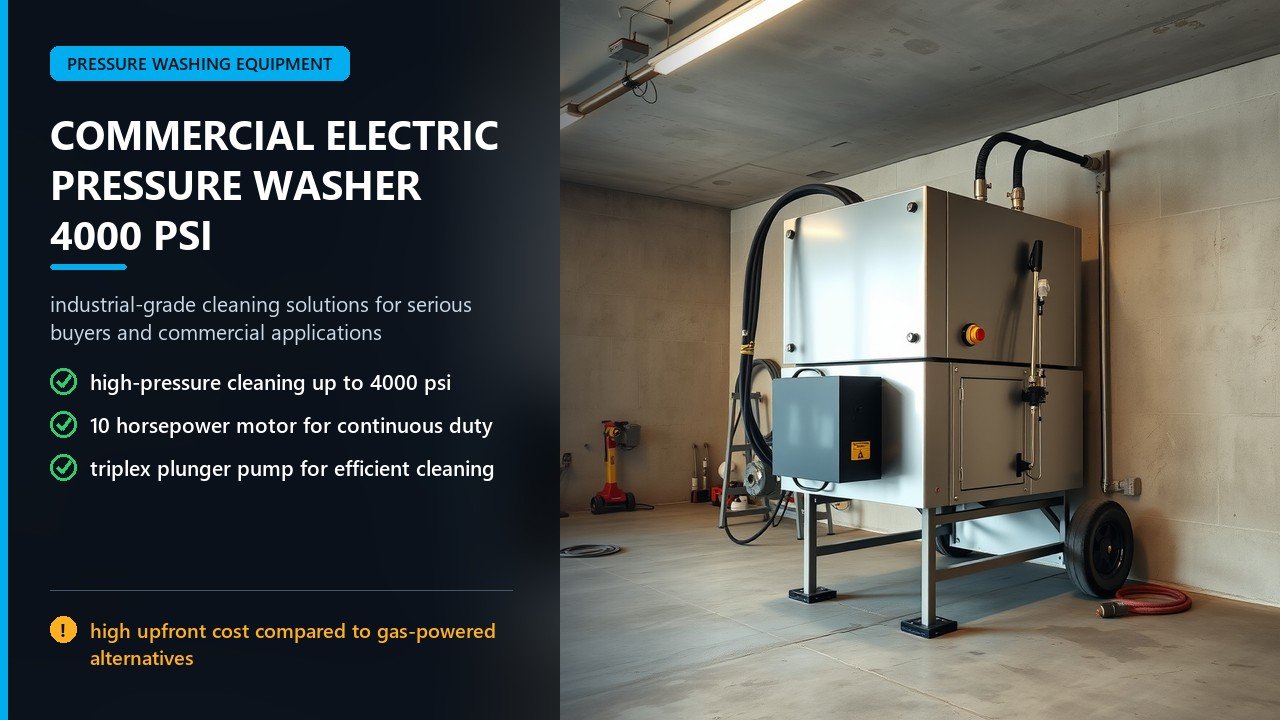
A pressure washer that delivers serious numbers through a power cord instead of a gas tank is a different animal from the electric machines most people have seen. A commercial electric pressure washer 4000 psi machine is a fixed installation, often wall mounted, that produces 4,000 PSI at 4 gallons per minute of cleaning force around the clock, with a 10 horsepower motor and an industrial triplex plunger pump. It is the machine you install in a wash bay, a fleet shop, or a plant, where the work never moves and the cleaning never stops. The market around this class spans single phase units for shops and three phase production machines for plants, and the industrial 4 GPM 4000 PSI electric configurations from Water Cannon lay the range out side by side.
This guide explains what a 4,000 PSI electric machine actually is, why it needs so much motor, how it is built, and what the real buyers of these machines discover about power, installation, and operating cost. If you are spec’ing a commercial wash bay, this is how to read the machine behind the number.
What 4000 PSI Electric Cleaning Actually Means
At 4,000 PSI and 4 GPM, a machine produces about 16,000 cleaning units, the easy shorthand that multiplies pressure by flow to describe total cleaning power. That combination removes road film, oils, fats, protein residue, and light oxidation from concrete, vehicles, and equipment, which is why it appears in fleet bays, food plants, and industrial maintenance. It is not the highest pressure in the industry, but it is the level where commercial cleaning starts in earnest.
Electric delivery changes the character of that power. The motor runs continuously, quietly, and without exhaust, which lets these machines work indoors in spaces a gas unit could never run. The machine also holds pressure steadily, because an electric motor is not hunting like an engine under load. The result is a clean, repeatable, controllable wash, which is exactly what a production environment wants.
Why It Takes a 10 Horsepower Motor
The motor here is not a marketing number; it is arithmetic. Converting 4,000 PSI and 4 GPM into shaft power means dividing PSI times GPM by 1714, which comes to about 9.3 horsepower before any losses. A real motor rated 10 horsepower is the practical answer, and even that rating lives close to its limit, which is why responsible manufacturers specify a service factor and continuous duty rather than racing the pump at its ceiling.
On a 230 volt circuit, that motor draws somewhere around 30 to 35 amps depending on the exact rating and service factor, and the installation runs through a dedicated circuit with the right breaker, wire, and connections. Some 4,000 PSI machines are available in single phase for shops with conventional power, and others in three phase for industrial facilities, where the larger motor is actually easier to serve. The voltage and phase on the nameplate decide the wiring, not the other way around.
TEFC Motors and Continuous Duty
A commercial electric machine is defined by its motor as much as its pump, and the motor specification tells the real story. A TEFC, or totally enclosed fan cooled, motor seals its innards against water and grit, which matters enormously in a wash bay environment. The same motor is rated for continuous duty, meaning it is designed to run steadily for a shift rather than in bursts, and it carries a service factor that lets it survive short overloads without damage.
Thermal overload protection sits behind the switch, and on better machines the electrical panel is rated for washdown environments. What that package buys is a motor that starts instantly every single morning, holds torque under load, and does not need fuel, oil changes, or a choke adjustment. The maintenance that would go to an engine instead goes to the switch, the connection, and the motor’s cooling fins, which is a discipline owners of electric machines learn quickly.
The Pump: Triplex Plunger at the Top
At 4,000 PSI the pump has to be a real one, and commercial machines use a triplex plunger design with ceramic plungers and stainless steel valves in a cast manifold. The triplex layout, three plungers working in sequence, delivers smooth pressure without the pulsing of a simpler pump, and the ceramic plungers and steel valves are exactly what stand up to continuous service at high pressure.
An oil bath crankcase lubricates the guts, and an external unloader manages pressure when the trigger releases, dumping the bypass safely rather than cooking the pump. Better machines add a thermal relief valve that protects the pump during extended bypass operation, because a machine running in bypass for long stretches can heat the water inside the pump head and damage it. These are the quiet details that separate a machine built for a shift from one built for a sale.
How the Motor and Pump Connect
The connection between motor and pump shapes the machine’s character. Direct drive is compact and inexpensive, with the pump bolted to the motor, and it is common on lighter machines. At 4,000 PSI in continuous service, belt drive or a flange and coupling drive is the more common professional choice, because it runs the pump at a lower, friendlier speed, cuts vibration and heat, and extends the life of pump seals and valves.
The physical layout follows: a welded, powder coated steel frame, often with a roll cage and a lifting bar, mounting the motor above the pump, with a liquid filled pressure gauge, an adjustable pressure regulator, and space to add hose reels. The machine is usually stationary, bolted to a wall or a pad, or mounted on casters for rolling it into position. Whatever the mount, the mechanical alignment between motor and pump is one of the installation details that decides how long both survive.
| Drive Type | How It Works | Best Role | Tradeoff |
|---|---|---|---|
| Direct drive | Pump bolted to motor | Lighter duty, compact spaces | Fast, hard on the pump |
| Belt drive | Motor and pump via belts | Sustained commercial work | Bigger, more to maintain |
| Flange and coupling | Rigid coupling, aligned shafts | Fixed industrial machines | Requires precise alignment |
Auto Start and Stop
Most commercial electric machines offer an auto start and stop function. When the trigger releases, the machine idles, and after a set delay of 30 seconds or so the motor shuts itself off, restarting instantly the next time the trigger pulls. The effect on the pump is significant, because it subtracts hours of bypass time every week, and bypass is exactly the condition that heats the water and wears the pump.
This is one of the features worth paying for on a 4,000 PSI electric machine. In a busy bay, the trigger gets pulled and released dozens of times an hour, and a machine that manages itself between pulls runs cooler and lasts far longer. The same idea explains why the external unloader and thermal relief valve matter: the goal of the whole design is to keep pressure and heat off the pump surfaces whenever water is not actively cleaning.
Which Class of Machine Fits Your Bay
The four thousand PSI class is not the whole story of commercial electric washing, and knowing where it sits against the alternatives makes the choice honest. The 3,000 PSI and 4 GPM class needs a 7.5 horsepower motor and serves fleet and shop washing, while the 4,000 PSI 4 GPM class needs 10 horsepower and serves heavier industrial and plant work. Step up to 5,000 PSI and 8 GPM and the motor, feed, and pump grow into a genuinely large three phase installation for production cleaning.
| Class | Typical Spec | Approx Motor | Role |
|---|---|---|---|
| 3,000 PSI / 4 GPM | 12,000 cleaning units | 7.5 HP | Fleet and shop washing |
| 4,000 PSI / 4 GPM | 16,000 cleaning units | 10 HP | Heavy industrial and plant |
| 5,000 PSI / 8 GPM and up | 40,000+ cleaning units | Large three phase | Production class, big flow |
Each step up is a larger motor, a heavier pump, and a bigger electrical feed, which is why jumping from a 3,000 PSI shop unit to a 5,000 PSI plant unit is not just more of the same. The 4,000 PSI class sits at the sweet spot where a single phase capable motor and a conventional bay installation can still serve real industrial cleaning, which is exactly why so many plants choose it.
Wall Mounted, Skid, or on Casters
Installation style is a real decision, not a footnote. Wall mounted machines bolt to a brick or steel wall and take no floor space, which suits a narrow bay where space is precious and the machine feeds a fixed working position. Skid mounted machines sit on a welded frame that can move with a forklift or hoist, which suits a plant that reorganizes. Caster units roll to the work, at the cost of hoses and fittings that move with them. Every wheel option adds flexibility and a little fragility, so the question is simply whether the machine needs to travel within the building.
Whichever mount is chosen, the machine needs room for service: access to the pump oil sight glass, the unloader, and the electrical panel, plus clearance for airflow around a motor that cools itself by design. A machine jammed into a corner and buried behind the tool wall will be maintained exactly as often as it is reachable, which is how good pumps die young.
Single Phase or Three Phase
The 4,000 PSI electric class straddles two electrical worlds, and the choice is decided by the building. Single phase 230 volt machines suit shops with conventional residential style service, and at 10 horsepower they are at the practical top of what single phase can comfortably do. Three phase machines suit industrial facilities and carry the same output with better starting characteristics and efficiency, served by a commercial meter and panel.
If a shop has three phase, the natural buy is a three phase machine. If it only has single phase, a single phase 230 volt model works, but an electrician should confirm the service can deliver the full load amps with margin, especially at startup, when motors draw their heaviest current. This is the identical lesson to the one spelled out in our guide to 220v high pressure washer installation, because a 4,000 PSI electric machine is simply the top of that class.
Wiring, Grounding, and the Circuit
No part of a commercial electric installation is DIY territory. The machine requires a dedicated circuit sized to the motor’s full load amperage, with the correct breaker, wire gauge, and grounding, and many models ship without a cord or plug because an electrician is expected to terminate the feed. A 10 horsepower single phase motor around 35 amps needs a 50 amp circuit with conductors sized for the run, and the whole branch should be served by a GFCI in wet locations, per the same rules that govern any wet site outlet.
There is a reason manufacturers say installation must be done by a licensed professional: a company’s liability, insurance, and code compliance all attach to the way the machine is connected. The few hundred dollars for professional wiring buys certainty that the motor will start, the breaker will hold, and the safety devices will actually work. Skip this step and the machine becomes the shop’s most expensive gamble.
What Comes With the Machine
A 4,000 PSI commercial machine typically arrives as a complete cleaning station. The standard kit includes a trigger gun and insulated wand, quick change tips in 0, 15, 25, and 40 degree patterns plus a soap tip, 50 feet of high pressure hose on quick couplers, and a downstream chemical injection system with feed hoses so detergent can be applied at low pressure. Some machines go further with dual chemical injection, letting the operator switch between two chemical tanks at a valve.
The details of that kit matter on day one. An insulated gun is standard at this pressure, and the wand’s quick change tips make the machine genuinely usable, because the difference between a 15 and a 40 degree stream at 4,000 PSI is the difference between stripping paint and rinsing concrete. The high pressure cleaner hose supplied is rated for the pressure and, on machines that feed heated water, for the temperature, which connects straight back to the way the whole system is rated end to end.
Running Cost and the Gas Comparison
The most overlooked advantage of a commercial electric machine is the operating ledger. An electric motor converts most of its energy into work and costs little to run, uses no fuel storage or engine oil changes, and starts every morning without maintenance. Against a gas machine of the same output, which buys fuel per gallon, needs engine service, and must be ventilated, the electric machine wins decisively for a fixed bay.
That is the whole trade in one line: electric machines need the building to be permanently wired, and gas machines carry their fuel. For a facility with a dedicated bay and a proper circuit, the electric machine is the lower cost, lower fuss workhorse, which is why so many commercial installations are exactly this configuration. The B&E pressure washer range is a clear example of how common this format is, with its commercial electric line built around the same Baldor motors and triplex pumps.
The 4,000 PSI class also meets hot water without contradiction. Many commercial electric machines accept heated water, and some install with a burner or electric heating system so the bay can switch between cold high pressure washing and hot degreasing. Heat changes what the same pressure can move, and the same heater principles apply: water heated after the pump, temperature achieved at rated flow, and the two scale foes to manage. Our guide to the pressure washer heater explains that second system, because a machine that heats is really two machines sharing one frame.
Nozzle Sizing and Flow
At 4,000 PSI, nozzle selection is not convenience; it is safety and control. An undersized orifice raises pressure beyond the rating and risks the pump and the operator, while an oversized orifice drops the working pressure and wastes the machine. The orifice size is chosen by the PSI and GPM, and the color coded tips that ship with the machine are sized for its output, so swapping to an unfamiliar tip means checking the chart rather than guessing.
The flow side deserves the same discipline. A 4 GPM machine needs an adequate water supply at the inlet, with a supply line that can deliver the volume without starvation, because a pump starved of water cavitates and dies. On any commercial machine, the inlet supply is the foundation, and restricting it is the fastest way to wreck the pump. Match the supply, the hose, and the nozzle to the rating and the machine performs exactly as engineered.
Keeping a 4000 PSI Electric Machine Alive
A commercial machine’s lifespan is written by its maintenance routine, and the electrical format actually tightens the list. The most important item is pump oil, a non-detergent weight checked through the sight glass and changed on the maker’s schedule, because the triplex crankcase protects the heart of the machine. The inlet filter and supply strainer come next, because a 4 GPM pump starved of clean water cavitates no matter how good it is. The unloader needs periodic confirmation that it drops pressure cleanly, and every fitting deserves the same flush with clean water after detergent use that any washer gets.
On the electrical side, the routine is a check and a test. Keep motor vents clear of dust and wash, make sure the panel stays dry, and test the GFCI and the emergency stop on schedule, because protection that is never exercised is protection that may not be there when it matters. The whole habit belongs with a broader program, and our guide to power washing preventative maintenance lays out the complete schedule that a commercial bay should follow.
Answers to the Questions Buyers Ask Most
Is a 4000 PSI electric pressure washer worth it?
Yes, if your work is heavy continuous cleaning in a fixed location. The machine delivers commercial force quietly, cheaply, and indoors, with a genuine 10 horsepower motor and triplex pump. It only makes sense where a permanent electrical circuit is available, because it cannot travel like a gas unit.
What kind of motor does a 4000 PSI electric pressure washer use?
A 10 horsepower motor, usually TEFC and rated for continuous duty, on a dedicated 230 volt circuit. Single phase suits most shops; three phase suits industrial facilities. The motor nameplate sets the exact current draw and the circuit size, and it is the spec that ties the whole installation together.
Can a 4000 PSI electric pressure washer run on a normal outlet?
No. At 10 horsepower it draws around 30 to 35 amps at 230 volts, which requires a dedicated circuit far beyond a standard outlet. This is a hardwired or permanent plug installation done by a licensed electrician, with the breaker, wire, and grounding sized to the motor.
What is a cleaning unit and what does 16000 mean?
Cleaning units are pressure times flow. A machine at 4,000 PSI and 4 GPM produces 16,000 cleaning units, a quick comparable measure of total cleaning power across different machines. It is a useful shorthand, though pressure and flow matter independently for different jobs.
Is direct drive or belt drive better for 4000 PSI?
For sustained commercial duty, belt drive or flange and coupling drive is the more common professional choice, because it runs the pump slower and protects seals and valves over long shifts. Direct drive is cheaper and compact, but it works the pump harder at this pressure.
Why does the pump keep running in bypass?
When the trigger releases, the unloader routes water back to the pump rather than dead heading it. Brief bypass is normal, but long bypass heats the water and wears the pump, which is why auto start and stop, an external unloader, and a thermal relief valve are the features to look for on a machine that will idle between pulls.
Do I need three phase for a commercial electric pressure washer?
Only if the machine specifies it. Single phase 230 volt machines exist up to 10 horsepower and serve most shops. If your facility already has three phase, buying the three phase version is usually the better, more efficient choice. Confirm the machine’s voltage and phase against the building before ordering.
How much does a 4000 PSI electric pressure washer cost to run?
Far less than the gas equivalent in a fixed bay. The motor draws its rated amps only while running, there is no fuel to buy or store, and maintenance is limited to the pump and the circuit. Over a year of daily use the electric machine’s running cost is a fraction of a gas unit doing the same work, which is the main reason commercial facilities install them.
Why would I choose electric over gas at 4000 PSI?
For a permanent bay, electric wins on quiet, emission free, instant start operation and low running cost. For mobile work, gas is the only way to carry the power. If the cleaning happens at one location with a proper circuit, electric is the better machine; if it travels, the gas unit is the honest choice.
The Bottom Line
A commercial electric pressure washer 4000 psi machine is the fixed installation workhorse of serious cleaning: 4,000 PSI and 4 GPM of steady, indoor-capable power from a 10 horsepower motor and a triplex plunger pump, served by a permanent electrical circuit. Nothing about it is casual. The motor is built for continuous duty, the pump is built for the pressure, and the electrical work has to be done right, because the machine is as much infrastructure as it is equipment.
The buyers who are happy with one are the ones who matched the machine to the building first. Confirm the circuit, pick single or three phase by the panel, order the belt or coupling drive for long shifts, and let the auto start and stop do its quiet work of protecting the pump. Handled that way, a 4,000 PSI electric machine delivers production line cleaning year after year, and the gas cans stay in the truck where they belong.