A pressure washer can have a strong engine and a good pump and still clean poorly because of the line connected to it. The high pressure cleaner hose is the part that carries every unit of cleaning force from the machine to the wand, and it is also the part most likely to be the bottleneck nobody checks. A hose that is too narrow for the flow, rated below the machine’s output, or fitted with the wrong ends makes a capable washer feel weak, and a hose rated below the machine’s pressure is a genuine safety risk. When the machine is fine but the cleaning falls off, the hose is where the answer usually hides.
This guide covers the four specifications that decide whether a hose is right for your machine, the way hose construction and materials change how it feels all day, and the signs that a line has reached the end of its safe service life. If you are buying a replacement or building a rig, this is how to read a hose spec and get it right the first time.
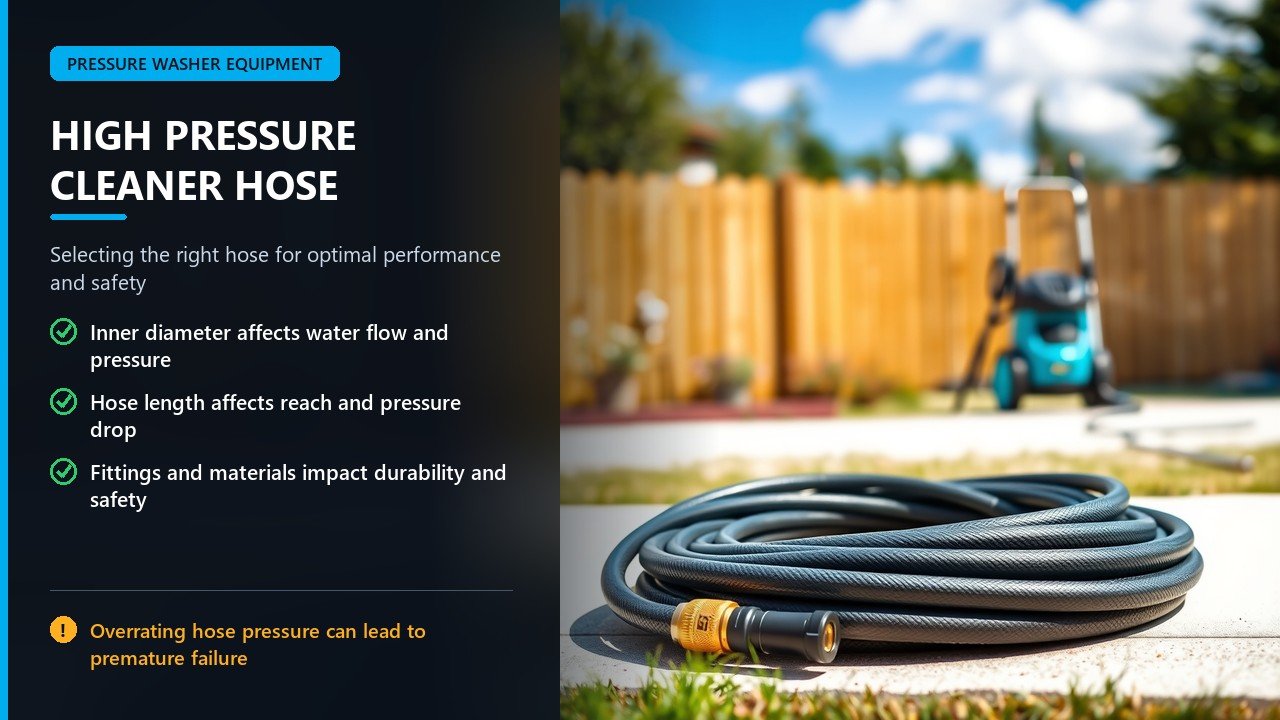
Why the Hose Deserves Attention
Most owners think of the hose as plumbing, a passive tube that carries water. In reality it is a precision component. The high pressure side of a pressure washer operates at thousands of pounds per square inch, and the hose is the one flexible part holding that pressure steady while being dragged, coiled, bent, and walked over. Every kink, every abrasion, and every tight bend in a hose changes what arrives at the nozzle.
The hose also sets the ceiling for the whole system. Water moving through a tube loses energy to friction against the inner wall, and a hose that is too small or too long for the machine’s flow turns pressure into heat you can never recover. That is why the same machine can feel different on two different hoses. Understanding the few numbers on the hose sleeve is what lets you pick a line that works with the machine instead of against it.
Working Pressure, Not Burst Pressure
The first and most important number is the pressure rating. The rule is simple and absolute: the hose’s working pressure must meet or exceed the maximum output of your machine. A hose rated below the machine’s PSI can balloon, split, or blow a fitting under load, which is a project-ending and safety failure. Ratings carry margin for a reason.
Every hose shows two pressure numbers and the difference matters. The working pressure is the safe, continuous operating threshold and the number that must clear your machine. The burst pressure, typically two to three times higher, is a laboratory stress test rating at which a new hose will rupture, and it exists only as a safety cushion. Never select a hose on burst pressure alone. Find the machine’s rated PSI on the spec sticker or manual, then choose a hose rated at or above that number, ideally with a little margin. A hose rated higher than the machine is fine and simply adds a safety allowance; it does not increase the machine’s output.
Inner Diameter: The Flow Spec Everybody Skips
Pressure rating protects the hose from the machine; inner diameter decides whether the water actually arrives. The inside diameter, usually 1/4 inch, 5/16 inch, or 3/8 inch, controls how much water the hose can pass without choking flow. It is sized to the machine’s GPM, not its PSI, and it is the spec retailer pages ignore most often.
A hose that is too narrow creates friction loss. As water pushes through the line it rubs against the inner wall, and in a narrow line at high flow that friction robs pressure and flow before the nozzle. The symptom is a machine that shows full pressure at the pump but feels weak at the wand, and the owner blames the pump when the hose is the culprit. An undersized line on a high GPM machine is strangling the output.
| Inner Diameter | Typical Machine | Flow Range | Long Run Behavior |
|---|---|---|---|
| 1/4 inch | Electric and light gas | Up to about 2.5 GPM | Noticeable drop past 50 feet |
| 5/16 inch | Prosumer gas | About 2.5 to 4.0 GPM | Holds up better on longer runs |
| 3/8 inch | Commercial and high flow | 4.0 GPM and up | Least restriction past 100 feet |
The practical rule: if you are running more than about 3 GPM or extending beyond 50 feet, step up one inner diameter size. A 3/8 inch line on a high flow machine loses far less pressure over a 100 foot run than a 1/4 inch line does, which is exactly why 3/8 inch is the commercial standard. Match the diameter to your machine’s flow and to the longest run you actually make.
Length: Enough Reach, Not Maximum
Length is where overbuying is common, because more hose feels like more freedom. But every extra foot adds weight in the hand and friction in the line. The right length is the minimum that reaches the far corner of the work area from wherever the machine realistically sits, plus a few feet of slack.
A 25 foot hose is light, easy to coil, and easy to store, and it is ideal for compact jobs and single vehicles. A 50 foot hose covers a driveway, a deck, or one face of a typical home from a single setup, which makes it the common compromise. A 100 foot hose is for large properties and commercial setups where the machine and the work are far apart, and it is heavier and harder to manage. On a full property wash most people move the machine at least once anyway, so buying the longest hose available to avoid moving the unit usually adds weight without adding reach you need.
There is a straightforward way to decide. Walk from where the machine will sit to the farthest point you will clean, add a few feet of slack, and that is the minimum length you need. If the number is awkwardly slightly over a standard size, go up one size rather than inventing odd lengths, but only because of the work area, not because of marketing.
Fittings: The End That Decides Whether It Fits
The most common reason a replacement hose does not fit is the end fitting, not the length or the PSI. Both ends of the hose carry a connector, one for the pump outlet and one for the wand or gun, and the machine side and gun side can use different styles. Two basic families cover almost everything.
M22 is the metric threaded connection used on most consumer and many prosumer machines. The catch is that M22 comes in two bore sizes, 14mm and 15mm, and they are not interchangeable. Mix them and the joint leaks under pressure. A quick connect is the push and lock style using a plug and coupler found on many gas units and commercial machines. Some machines use a 3/8 inch NPT, a tapered pipe thread common on pumps and guns.
| Connection | What It Looks Like | Hose End You Need |
|---|---|---|
| M22-14mm | Metric thread, 14mm inner pin | M22-14mm |
| M22-15mm | Metric thread, 15mm inner pin | M22-15mm |
| 3/8 inch NPT | Tapered pipe thread | 3/8 inch NPT |
| Quick connect | Push and lock plug/socket | 3/8 inch QC plug |
Before ordering, look at both ends of your current hose and at the machine inlet and gun. Photograph the threads. If the machine says M22 but you cannot tell the bore, measure the inner opening; roughly 14mm versus 15mm settles it. Brass adapters cost a few dollars and rescue most mismatches, so a wrong fitting is not a dead end, but it is better to order the exact match in the first place. If you are also upgrading the trigger side, our guide on pressure washer gun replacement shows how the gun end fittings work together.
Materials: Where Handling Is Decided
Pressure, diameter, and fittings are mostly about matching specs. Construction is where the feel of the hose is decided, and it is the choice with the most variety. Hoses are built around a braided layer that carries the pressure, and that armoring is covered with a material that determines flexibility, weight, and durability.
The braid itself is worth checking alongside the cover. A single wire or textile braid carries the pressure rating on most consumer and prosumer lines, while semi-professional and industrial hose uses two braid layers, giving higher working pressure and better fatigue resistance for machines running at 200 bar and above all day. The number of braid layers and the material of the cover together tell you whether a hose is built for a season of weekends or a season of contracts. It is the difference between a line that sits at the edge of its rating and one that lives comfortably inside it.
PVC is the most common and the least expensive. It holds pressure and works fine, but it is stiff, it develops coiling memory, it kinks at the wand, and it stiffens in cold weather. Rubber is heavier and much more flexible, resists kinking, and holds up to abrasion, but rubber covers can leave black marks on light concrete and siding. Polyurethane and hybrid polymer lines combine a braided core with a flexible outer casing, giving rubber-like flex without the marking left behind, and they lay flat with less memory when depressurized. Steel braided or wire reinforced lines carry the highest ratings and resist kinking, and they are common on commercial hose. If you want to compare ratings across the commercial category in one place, the commercial pressure washer hose guide from Pressure Washer Wise lays the specs side by side.
Hot Water Machines Need Hot Water Hose
If your machine heats water, the hose has to be rated for the heat as well as the pressure. Cold water hose is typically rated only up to about 140 degrees Fahrenheit, and running heat through it shortens its life and risks a failure at the worst moment. A hot water rated hose is built with a temperature resistant inner tube and cover, often rated to 200 degrees or more, and it is a non-negotiable on any hot water rig.
An incorrectly rated hose on a hot water machine also distorts the heat balance. The burner raises the water temperature at the coil, and a hose that cannot contain it either softens and swells internally or transfers the heat outward, making the line hot to the touch and fatiguing the cover. The pressure and temperature ratings work together, and both must clear the machine’s maximum. This is the same reason the rest of the hot water system, including the hot water diesel pressure washer setup, is rated for heat end to end.
Extensions and Long Runs
Every job does not happen next to the machine. For long runs, you can couple sections of rated hose together, and commercial crews routinely quick-connect 3/8 inch hose in 100 foot sections up to 300 or 400 feet for large sites. That works, but each added section increases friction loss, and each coupling is a potential leak point, so the grownup rule is to use the largest inner diameter you can and keep the total length as short as the job allows.
Friction loss is a function of diameter and flow more than raw length. A 1/4 inch line on a high flow machine shows a noticeable drop past about 50 feet, while a 3/8 inch line holds pressure well past 100 feet. If you plan to run long, step up the inner diameter rather than accepting the loss on a thin line, and use a rated coupler that matches the ends. Before you add a section, size the whole run against the machine’s flow, because a machine at the edge of its rating will tell you about it by cleaning poorly at the far end.
It also pays to carry a spare. On any rig that works away from home, a failed hose takes the whole machine out of service until a replacement arrives, which can cost a full day of jobs. A spare line rated for the machine, coiled in the truck, turns a complete shutdown into a twenty minute changeover. The investment is small next to the job it protects, and it is the kind of preparation that separates reliable operations from ones that learn the lesson the hard way.
Inspection: Reading the Warning Signs
A high pressure hose fails in predictable ways, and reading the warning signs starts with looking at it like a tool rather than a tube. Check the cover for abrasion, cuts, and wear at the points where the line rubs the trailer, the gun, and the ground. Look for bulges or bubbles in the cover, which signal damage to the reinforcement underneath, and for hard kinks that no longer straighten out. A kink is not a personality trait; it is a weakened section that will fail first.
Watch the fittings and the crimp points at both ends. Corrosion, chafing, and weeping at a fitting grow into a burst at the worst moment, and a damaged end is usually not worth repairing. Replace crimped assemblies rather than trusting a field splice under thousands of PSI. If a hose has been run over, pinched in a trailer door, or stored in direct sun for a long season, treat it as suspect even if it looks usable.
| Warning Sign | What It Means | Action |
|---|---|---|
| Cuts or chafe in the cover | Starting to expose the reinforcement | Replace if the fabric shows |
| Bubble or bulge | The braid layer is damaged | Replace before use |
| Hard kink that will not relax | Weakened section | Replace the hose |
| Weeping or corrosion at the end | Fitting damage | Replace the assembly |
| Stiff in cold weather | Material fatigue or limits | Upgrade material or rating |
The general rule is to replace a worn hose at the first sign of cover wear, because the alternative is a burst line that whips dangerously under pressure. When one hose on a rig starts showing wear, check the others at the same time, because they have shared the same work and the same abuse.
Hose service life also depends on how it is used. A hose that spends its life on a reel, washed down after jobs, and stored out of direct sun will outlast the identical hose that is dragged, kinked, and left in the elements by several seasons. There is no fixed mileage number for a hose, but a commercial line that sees daily use is usually worth considering for replacement around the same time its fittings show wear, which is a practical cue that the reinforcement and the seals are aging together. The same habit of routine inspection that keeps the rest of a rig alive, laid out in our guide to power washing preventative maintenance, keeps a hose from failing quietly in the middle of a paid job.
Handling and Storage Extend the Life
Most hoses are not worn out by pressure; they are worn out by how they are used and stored. Keep the line off sharp edges, avoid tight kinks at the wand, and do not step or drive over it. Coil it in broad loops without crossing the coils, because crossed coils pinch the line from the inside and create the kinks that kill it. Store it out of prolonged direct sun, where the cover degrades, and drain and dry the system before cold weather so a freeze cannot crack the line.
Never run over a hose to reposition it, never drag it over freshly poured or acid etched concrete out of impatience, and never leave a pressurized line lying loose where it can whip if a fitting opens. A little discipline about how the hose lies on the ground is the cheapest way to make a good line last.
Pairing the Hose With a Reel
A hose that lives on a reel stays round, off the ground, and out of harm’s way, which measurably extends its life. Real reels also enforce a routine: the line goes out, the job gets done, the line comes back, and nothing is left to be crushed by the trailer. If you have not organized your hose yet, the reel choice matters because the reel’s rated capacity depends on the exact hose diameter and length you run. A reel rated for 200 feet of 3/8 inch hose will not hold the same length of a larger diameter line. Our breakdown of pressure washer hose reels covers the types, the swivel, and how to mount one so the two parts work as a system.
Answers to the Questions Buyers Ask Most
How do I know what PSI hose I need?
Find the machine’s maximum output on the spec sticker or manual, then choose a hose rated at or above that number, in working pressure, not burst pressure. A 3,500 PSI machine needs a hose rated 3,500 PSI or higher, and a slightly higher rating is a fine safety margin.
What size hose is best for a commercial pressure washer?
3/8 inch inner diameter is the commercial standard. It moves the volume of high GPM machines with little friction loss over long runs, which keeps the nozzle pressure honest past 50 to 100 feet. 1/4 inch suits compact electric machines, and 5/16 inch bridges the gap for mid range gas.
Does a longer hose lower the pressure?
Yes. Long runs create friction loss against the inner wall. A 3/8 inch line holds pressure much better than a 1/4 inch line at the same length, which is why stepping up the diameter is the fix for long runs rather than accepting a weak spray.
Can I use a 4,000 PSI hose on a 3,000 PSI machine?
Yes. A higher rated hose is safe and adds margin, but it does not increase the machine’s output. The rating is what the hose can tolerate, not what the machine produces.
Are all M22 fittings the same?
No. M22 comes in two bore sizes, 14mm and 15mm, and they are not interchangeable. Measure the inner opening of each connection if you are unsure, and use a brass adapter to cover the mismatch if needed.
Why does my hose seem to reduce the cleaning power?
If the inner diameter is too small for the machine’s flow, or the run is long on a narrow line, friction loss cuts the pressure and flow at the nozzle. Check the GPM against the diameter, and step up a size if the machine runs more than about 3 GPM or the distance is long.
What is the best material for a pressure washer hose?
It depends on the work. PVC is cheap but stiff and kinks. Rubber is flexible and durable but can mark light surfaces. Polyurethane and hybrid polymer deliver flex without marking and lay flat with less memory, and steel braided line carries the highest ratings. For daily commercial use, a non-marking flexible line rated for your temperature is the strongest all around choice.
How long should a pressure washer hose last?
There is no fixed number, because use and storage decide it. A line kept on a reel, inspected regularly, and replaced at the first sign of cover wear can last years even in commercial service, while one that is kinked, sun soaked, and run over fails much sooner. When the fittings age or the braid shows, it is time to replace regardless of how long the hose has been on the machine.
The Bottom Line
A high pressure cleaner hose is selected on four specs, in this order: a working pressure rating at or above your machine’s output, an inner diameter sized to your machine’s flow, the correct fitting on both ends, and a length that reaches the work without overreaching. Get those four right and the hose performs; get one wrong and it leaks, restricts, or stands between the machine and the cleaning it was built to do.
Budget time for handling and storage too. The most expensive part of a pressure washing setup is rarely the hose itself, but the hose is the part under the most abuse, and replacing one before it fails is far cheaper than replacing one after. Choose the material to suit the surfaces you clean, the temperature to suit your machine, and the diameter to suit your flow, and the line will deliver every unit of pressure from the pump to the nozzle for years. Treated that way, the humble hose stays the quiet workhorse it was meant to be.